


What is the Compostable Biodegradable Refuse Bag Market Size and Growth Rate?
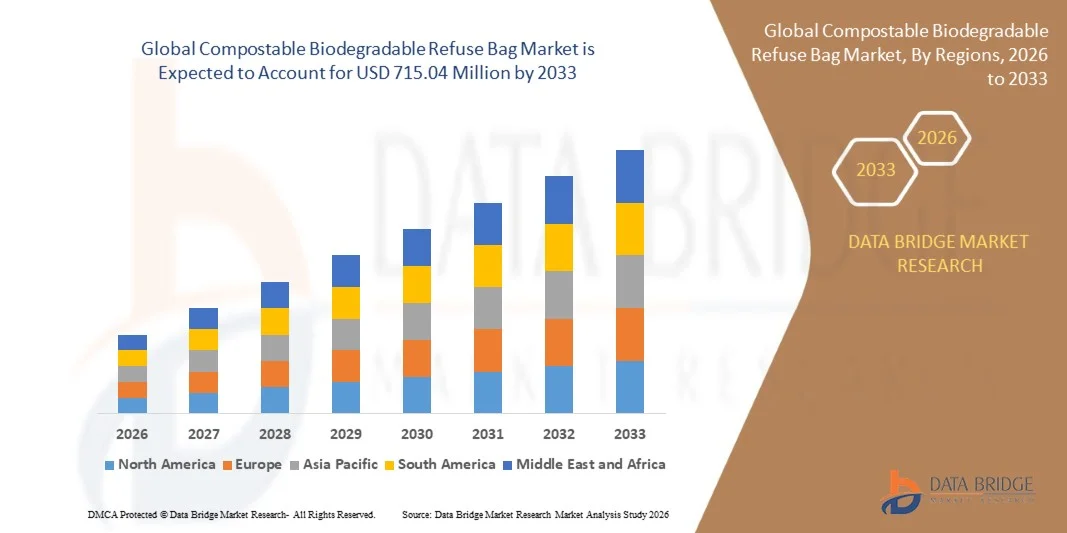
- As per Data Bridge Market Research analysis the compostable biodegradable refuse bag market was valued at USD 369.57 million in 2025 and is projected to reach USD 715.04 million by 2033, growing at a CAGR of 8.60% from 2026 to 2033.
- The market is experiencing steady growth driven by increasing environmental awareness, rising adoption of sustainable waste management solutions, and stringent government regulations promoting the replacement of conventional plastic bags with compostable and biodegradable alternatives.
- The growing focus on reducing plastic pollution, expanding municipal organic waste collection programs, and increasing consumer preference for eco-friendly household and commercial products are encouraging manufacturers and waste management organizations to adopt compostable biodegradable refuse bags across residential, commercial, and industrial applications.
Market Size & Forecast
- Market Value (2025): USD 369.57 Million
- Expected Market Value (2033): USD 715.04 Million
- Forecast CAGR (2026–2033): 8.60%
- Leading Region in 2025: North America
- Fastest Growing Region: Asia-Pacific
What are the Major Takeaways of the Compostable Biodegradable Refuse Bag Market?
- North America dominated the compostable biodegradable refuse bag market in 2025, supported by stringent regulations on single-use plastics, increasing consumer awareness regarding sustainable waste management, and the widespread adoption of compostable products across residential, commercial, and institutional sectors.
- Asia-Pacific compostable biodegradable refuse bag market is expected to witness the fastest growth rate from 2026 to 2033, supported by rapid urbanization, increasing environmental awareness, rising government restrictions on plastic waste, and expanding investments in sustainable waste management infrastructure.
- The 20–30 gallons segment dominated the market in 2025, driven by its widespread use in residential households, commercial kitchens, offices, and food service establishments. This capacity range is preferred due to its versatility, convenience, and compatibility with standard waste bins used for daily organic waste collection.
- The 40–55 gallons segment is projected to register the fastest growth at a CAGR from 2026 to 2033, driven by increasing demand from municipalities, hospitality facilities, healthcare institutions, and commercial waste collection services. Rising organic waste management initiatives are accelerating segment expansion.
- The compostable segment dominated the market in 2025, driven by increasing regulatory support for certified compostable products and growing adoption in municipal organic waste collection programs. Compostable refuse bags are increasingly preferred due to their compliance with industrial composting standards and contribution to circular waste management practices.
- The biodegradable segment is projected to register the fastest growth at a CAGR from 2026 to 2033, driven by rising consumer awareness regarding plastic waste reduction and growing demand for environmentally friendly waste disposal products across emerging economies.
Report Scope and Compostable Biodegradable Refuse Bag Market Segmentation
|
Attributes |
Compostable Biodegradable Refuse Bag Key Market Insights |
|
Segments Covered |
|
|
Countries Covered |
North America
Europe
Asia-Pacific
Middle East and Africa
South America
|
|
Key Market Players |
|
|
Market Opportunities |
|
|
Value Added Data Infosets |
In addition to the insights on market scenarios such as market value, growth rate, segmentation, geographical coverage, and major players, the market reports curated by the Data Bridge Market Research also include import export analysis, production capacity overview, production consumption analysis, price trend analysis, climate change scenario, supply chain analysis, value chain analysis, raw material/consumables overview, vendor selection criteria, PESTLE Analysis, Porter Analysis, and regulatory framework. |
What is the Key Trend in the Compostable Biodegradable Refuse Bag Market?
- Manufacturers are increasingly developing compostable biodegradable refuse bags using plant-based materials and certified compostable polymers to meet tightening sustainability regulations and growing consumer demand for environmentally friendly waste disposal solutions.
- For instance, in October 2024, Novamont expanded its Mater-Bi bioplastic solutions for organic waste collection applications, supporting municipalities and businesses with certified compostable refuse bag materials.
- Companies are focusing on improving bag strength, puncture resistance, and compostability while ensuring compliance with international standards such as EN 13432 and ASTM D6400.
- For instance, in April 2024, BASF continued expanding applications of its ecovio certified compostable biopolymer for organic waste bags and food waste collection solutions to support circular economy initiatives.
- As governments strengthen plastic reduction policies and consumers increasingly adopt sustainable waste management practices, demand for compostable biodegradable refuse bags is expected to accelerate across residential, commercial, and municipal applications.
What are the Key Drivers of the Compostable Biodegradable Refuse Bag Market?
- The implementation of stringent regulations restricting single-use plastics and increasing investments in organic waste collection programs are significantly driving demand for compostable biodegradable refuse bags worldwide.
- For instance, in March 2024, TotalEnergies Corbion expanded production of Luminy PLA biopolymers to support growing demand for certified compostable packaging and waste management products.
- Municipal authorities, retailers, food service providers, and waste management companies are increasingly adopting compostable refuse bags to improve organic waste diversion and reduce landfill-bound plastic waste.
- For instance, in 2024, European Bioplastics continued promoting certified compostable bioplastics as an effective solution for separate bio-waste collection across Europe in line with evolving sustainability regulations.
- As governments continue promoting circular economy initiatives and consumers increasingly prefer environmentally responsible products, compostable biodegradable refuse bags are expected to play a critical role in sustainable waste management systems.
Which Factors are Challenging the Growth of the Compostable Biodegradable Refuse Bag Market?
- Compostable biodegradable refuse bags require higher production costs than conventional plastic bags due to the use of bio-based raw materials, specialized manufacturing processes, and certification requirements.
- These higher costs limit widespread adoption, particularly in price-sensitive markets where conventional polyethylene bags remain significantly less expensive.
- For instance, in 2024, European Bioplastics highlighted that scaling certified compostable bioplastics continues to require investments in production capacity, feedstock availability, and industrial composting infrastructure to support broader market adoption.
- Higher product costs, limited industrial composting infrastructure, inconsistent waste segregation practices, and varying regulatory standards across countries continue to restrict market growth. These challenges slow adoption, particularly in developing regions where composting facilities and consumer awareness remain limited.
How is the Compostable Biodegradable Refuse Bag Market Segmented?
The market is segmented on the basis of capacity, product type, material type, thickness, and end-use.
- By Capacity
On the basis of capacity, the compostable biodegradable refuse bag market is segmented into 7–20 gallons, 20–30 gallons, 30–40 gallons, 40–55 gallons, and above 55 gallons. The 20–30 gallons segment dominated the market in 2025, driven by its widespread use in residential households, commercial kitchens, offices, and food service establishments. This capacity range is preferred due to its versatility, convenience, and compatibility with standard waste bins used for daily organic waste collection.
The 40–55 gallons segment is projected to register the fastest growth at a CAGR from 2026 to 2033, driven by increasing demand from municipalities, hospitality facilities, healthcare institutions, and commercial waste collection services. Rising organic waste management initiatives are accelerating segment expansion.
- By Product Type
On the basis of product type, the compostable biodegradable refuse bag market is segmented into biodegradable and compostable. The compostable segment dominated the market in 2025, driven by increasing regulatory support for certified compostable products and growing adoption in municipal organic waste collection programs. Compostable refuse bags are increasingly preferred due to their compliance with industrial composting standards and contribution to circular waste management practices.
The biodegradable segment is projected to register the fastest growth at a CAGR from 2026 to 2033, driven by rising consumer awareness regarding plastic waste reduction and growing demand for environmentally friendly waste disposal products across emerging economies.
- By Material Type
On the basis of material type, the compostable biodegradable refuse bag market is segmented into Polylactic Acid (PLA), Polyhydroxyalkanoate (PHA), PBS, PBAT, starch blends, and cellophane, paper. The PBAT segment dominated the market in 2025, driven by its superior flexibility, durability, and compatibility with compostable polymer blends used in refuse bag manufacturing. Its excellent mechanical properties make it suitable for both household and commercial waste applications.
The Polyhydroxyalkanoate (PHA) segment is projected to register the fastest growth at a CAGR from 2026 to 2033, driven by increasing commercialization of bio-based polymers, growing investments in sustainable materials, and rising demand for fully biodegradable alternatives to conventional plastics.
- By Thickness
On the basis of thickness, the compostable biodegradable refuse bag market is segmented into 0–0.7 mil, 0.7–0.9 mil, 0.9–1.5 mil, and above 1.5 mil. The 0.9–1.5 mil segment dominated the market in 2025, driven by its optimal balance of strength, puncture resistance, and flexibility for residential, retail, and institutional waste collection applications. Manufacturers increasingly prefer this thickness range to improve product durability while maintaining compostability.
The above 1.5 mil segment is projected to register the fastest growth at a CAGR from 2026 to 2033, driven by increasing demand for heavy-duty refuse bags in industrial facilities, municipalities, healthcare institutions, and commercial waste management operations.
- By End-Use
On the basis of end-use, the compostable biodegradable refuse bag market is segmented into retail and consumer, industrial, and institutional. The retail and consumer segment dominated the market in 2025, driven by increasing consumer preference for sustainable household products, rising awareness regarding plastic pollution, and expanding retail availability of compostable refuse bags. Growing adoption of home composting and organic waste segregation is further supporting segment growth.
The institutional segment is projected to register the fastest growth at a CAGR from 2026 to 2033, driven by increasing implementation of organic waste collection programs across schools, hospitals, municipalities, hospitality facilities, and government organizations. Expanding sustainability initiatives and regulatory compliance requirements are accelerating segment expansion.
Which Region Holds the Largest Share of the Compostable Biodegradable Refuse Bag Market?
- North America dominated the compostable biodegradable refuse bag market in 2025, supported by stringent regulations on single-use plastics, increasing consumer awareness regarding sustainable waste management, and the widespread adoption of compostable products across residential, commercial, and institutional sectors.
- The region also benefits from well-established composting infrastructure, favorable environmental policies, and strong demand for eco-friendly packaging and waste disposal solutions, supporting continued market growth.
U.S. Compostable Biodegradable Refuse Bag Market Insight
The U.S. compostable biodegradable refuse bag market captured the largest share within North America in 2025, fueled by growing state-level restrictions on conventional plastic bags, expanding municipal organic waste collection programs, and increasing consumer preference for environmentally sustainable household products. Rising adoption across retail, food service, and healthcare sectors continues to strengthen demand for certified compostable refuse bags.
Europe Compostable Biodegradable Refuse Bag Market Insight
Europe compostable biodegradable refuse bag market is expected to witness the fastest growth rate from 2026 to 2033, primarily driven by strict environmental legislation, ambitious circular economy initiatives, and increasing investments in organic waste management infrastructure. Growing awareness regarding plastic pollution and strong regulatory support for certified compostable materials are encouraging widespread adoption across residential and commercial sectors.
U.K. Compostable Biodegradable Refuse Bag Market Insight
U.K. compostable biodegradable refuse bag market is expected to witness the fastest growth rate from 2026 to 2033, driven by increasing implementation of plastic reduction policies, rising consumer demand for sustainable household products, and expanding food waste collection programs. Growing investments in composting infrastructure and waste segregation initiatives are further supporting market expansion.
Germany Compostable Biodegradable Refuse Bag Market Insight
Germany compostable biodegradable refuse bag market is expected to witness the fastest growth rate from 2026 to 2033, fueled by strong environmental awareness, advanced recycling and composting systems, and increasing adoption of bio-based materials. Government initiatives promoting sustainable packaging and efficient organic waste collection continue to encourage the use of compostable biodegradable refuse bags across residential and commercial applications.
Asia-Pacific Compostable Biodegradable Refuse Bag Market Insight
The Asia-Pacific compostable biodegradable refuse bag market is expected to witness the fastest growth rate from 2026 to 2033, supported by rapid urbanization, increasing environmental awareness, rising government restrictions on plastic waste, and expanding investments in sustainable waste management infrastructure. Growing demand from countries such as China, Japan, India, and South Korea is accelerating the adoption of compostable refuse bags across residential, retail, and institutional sectors.
Japan Compostable Biodegradable Refuse Bag Market Insight
Japan compostable biodegradable refuse bag market is expected to witness the fastest growth rate from 2026 to 2033 due to the country's strong focus on environmental sustainability, efficient waste segregation systems, and increasing adoption of bio-based packaging materials. Growing consumer preference for eco-friendly products and continuous government initiatives to reduce plastic waste are supporting market expansion.
China Compostable Biodegradable Refuse Bag Market Insight
The China compostable biodegradable refuse bag market accounted for the largest market share in Asia-Pacific in 2025, attributed to rapid urbanization, increasing environmental regulations, and strong government initiatives aimed at reducing plastic pollution. The country's expanding manufacturing capabilities, growing demand for sustainable packaging solutions, and rising investments in biodegradable material production continue to drive significant market growth.
Which are the Top Companies in Compostable Biodegradable Refuse Bag Market?
The compostable biodegradable refuse bag industry is primarily led by well-established companies, including:
- Mondi plc (U.K.)
- Vegware Ltd. (U.K.)
- VICTOR Güthoff & Partner GmbH (Germany)
- CeDo Ltd. (U.K.)
- BioBag International AS (Norway)
- Polybags Ltd. (U.K.)
- Clondalkin Group Holdings B.V. (Netherlands)
- Plastiroll Oy Ltd. (Finland)
- The Biodegradable Bag Company Ltd. (U.K.)
- The Compost Bag Company NV/SA (Belgium)
- SIMPAC Inc. (South Korea)
- TERDEX GmbH (Germany)
- Pack-It B.V. (Netherlands)
- Virosac S.r.l. (Italy)
- MirPack (Spain)
What are Latest Developments in Compostable Biodegradable Refuse Bag Market?
- In January 2026, BASF SE expanded the production capacity of its Ecoflex and Ecovio biopolymers in Asia to support the growing demand for compostable refuse and organic waste bags. The expansion strengthens the supply of certified biodegradable raw materials for bag manufacturers, improves regional availability, and supports the transition toward sustainable packaging solutions, further accelerating growth in the compostable refuse bag market.
- In October 2025, BioBag International AS entered new distribution partnerships across North America and introduced upgraded compostable refuse bags with improved load-bearing capacity and seal strength for residential and commercial food waste collection. This development enhances product performance, expands market reach, and supports increasing municipal composting programs, reinforcing the company's position in the global market.
- In July 2025, Walki Group launched a new range of high-performance compostable films for refuse bags and expanded its extrusion coating capacity in Europe. The investment improves product durability while maintaining compostability standards, helping meet rising demand from retail and industrial waste management sectors and strengthening the company's sustainable packaging portfolio.
- In April 2025, Sphere Group completed the acquisition of Romagnasac to strengthen its biodegradable packaging and compostable refuse bag business. The acquisition expands manufacturing capacity, broadens the customer base across municipal and retail sectors, and enhances the company's competitiveness in the growing sustainable waste management market.
- In November 2024, RKW Group introduced a new range of heavy-duty compostable waste bags featuring enhanced polymer formulations for improved tear resistance and load capacity. The launch addresses increasing demand for durable biodegradable waste solutions across commercial and industrial applications, supporting wider adoption of compostable refuse bags.

- Interactive Data Analysis Dashboard
- Company Analysis Dashboard for high growth potential opportunities
- Research Analyst Access for customization & queries
- Competitor Analysis with Interactive dashboard
- Latest News, Updates & Trend analysis
- Harness the Power of Benchmark Analysis for Comprehensive Competitor Tracking
Global Compostable Biodegradable Refuse Bag Market, Supply Chain Analysis and Ecosystem Framework
To support market growth and help clients navigate the impact of geopolitical shifts, DBMR has integrated in-depth supply chain analysis into its Global Compostable Biodegradable Refuse Bag Market research reports. This addition empowers clients to respond effectively to global changes affecting their industries. The supply chain analysis section includes detailed insights such as Global Compostable Biodegradable Refuse Bag Market consumption and production by country, price trend analysis, the impact of tariffs and geopolitical developments, and import and export trends by country and HSN code. It also highlights major suppliers with data on production capacity and company profiles, as well as key importers and exporters. In addition to research, DBMR offers specialized supply chain consulting services backed by over a decade of experience, providing solutions like supplier discovery, supplier risk assessment, price trend analysis, impact evaluation of inflation and trade route changes, and comprehensive market trend analysis.
Data collection and base year analysis are done using data collection modules with large sample sizes. The stage includes obtaining market information or related data through various sources and strategies. It includes examining and planning all the data acquired from the past in advance. It likewise envelops the examination of information inconsistencies seen across different information sources. The market data is analysed and estimated using market statistical and coherent models. Also, market share analysis and key trend analysis are the major success factors in the market report. To know more, please request an analyst call or drop down your inquiry.
The key research methodology used by DBMR research team is data triangulation which involves data mining, analysis of the impact of data variables on the market and primary (industry expert) validation. Data models include Vendor Positioning Grid, Market Time Line Analysis, Market Overview and Guide, Company Positioning Grid, Patent Analysis, Pricing Analysis, Company Market Share Analysis, Standards of Measurement, Global versus Regional and Vendor Share Analysis. To know more about the research methodology, drop in an inquiry to speak to our industry experts.
Data Bridge Market Research is a leader in advanced formative research. We take pride in servicing our existing and new customers with data and analysis that match and suits their goal. The report can be customized to include price trend analysis of target brands understanding the market for additional countries (ask for the list of countries), clinical trial results data, literature review, refurbished market and product base analysis. Market analysis of target competitors can be analyzed from technology-based analysis to market portfolio strategies. We can add as many competitors that you require data about in the format and data style you are looking for. Our team of analysts can also provide you data in crude raw excel files pivot tables (Fact book) or can assist you in creating presentations from the data sets available in the report.













