


Compound Chocolate Market Overview
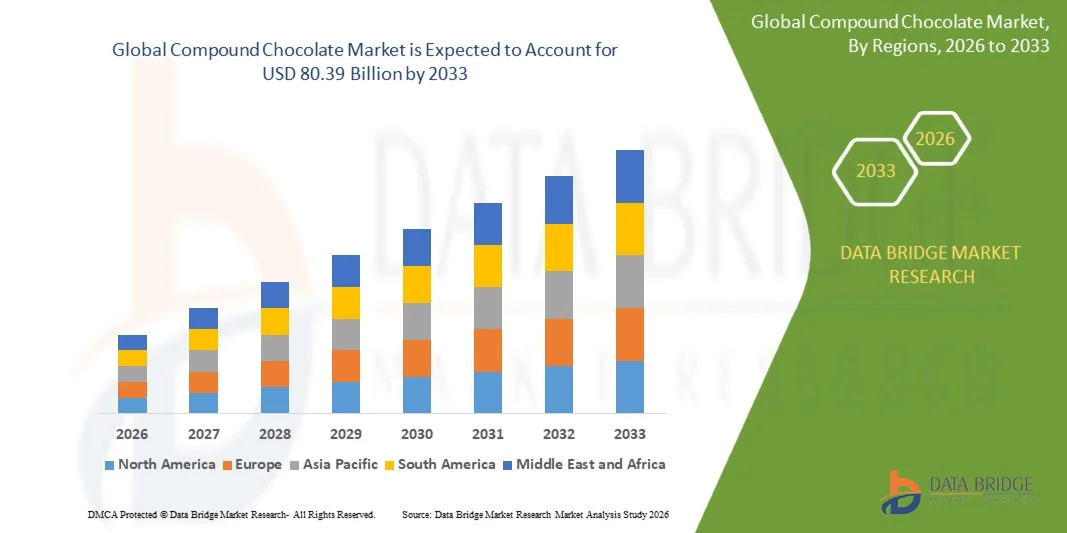
As per Data Bridge Market Research analysis, the compound chocolate market was valued at USD 47.14 billion in 2025 and is projected to reach USD 80.39 billion by 2033, growing at a CAGR of 6.90% from 2026 to 2033. The market is experiencing consistent growth driven by rising demand for cost-effective chocolate alternatives, increasing adoption across bakery and confectionery applications, and expanding utilization in ice cream, frozen desserts, and food processing industries.
The rising cost of cocoa beans, combined with the operational advantages of vegetable fat-based formulations, is encouraging manufacturers to increase the use of compound chocolate in large-scale food production. Its longer shelf life, simplified processing without tempering, and lower production costs are accelerating adoption among food manufacturers, while continuous innovation in flavors, inclusions, and coatings is further strengthening demand across industrial and retail food applications.
Market Size & Forecast
- Global Market Value (2025): USD 47.14 Billion
- Expected Market Value (2033): USD 80.39 Billion
- Forecast CAGR (2026–2033): 6.90%
- Leading Region in 2025: Europe
- Fastest Growing Region: Asia-Pacific
Key Market Trends & Insights
- Europe dominated the compound chocolate market with the largest revenue share of 33.67% in 2025, supported by its well-established chocolate manufacturing base, strong retail networks, and continued innovation in confectionery products
- The milk segment led the market with a 46.55% share in 2025, driven by its widespread use across confectionery, bakery, frozen desserts, and snack products
- Asia-Pacific is expected to be the fastest-growing region at a CAGR of 7.45% from 2026 to 2033, fueled by rapid urbanization, rising disposable incomes, expanding modern retail, and increasing consumption of Western-style confectionery products
- Dark is the fastest-growing type, projected to register a CAGR of 5.8%, reflecting the surge in consumer preference for premium and health-oriented chocolate products
- The chocolate chips/drops/chunks segment dominated the form type category with a 36.72% revenue share in 2025, led by its extensive use in bakery products, cookies, muffins, cakes, cereals, and confectionery items
- Confectionery accounted for 38.40% of the market, preferred by extensive use of compound chocolate in molded chocolates, candy bars, coated confectionery, fillings, and seasonal products
- The frozen dessert and ice cream segment is the fastest-growing application category, with a CAGR of 6.50%, driven by increasing demand for chocolate-coated ice creams, frozen novelties, and premium dessert products
Report Scope and Compound Chocolate Market Segmentation
|
Attributes |
Compound Chocolate Key Market Insights |
|
Segments Covered |
|
|
Countries Covered |
North America
Europe
Asia-Pacific
Middle East and Africa
South America
|
|
Key Market Players |
|
|
Market Opportunities |
|
|
Value Added Data Infosets |
In addition to the insights on market scenarios such as market value, growth rate, segmentation, geographical coverage, and major players, the market reports curated by the Data Bridge Market Research also include in-depth expert analysis, pricing analysis, brand share analysis, consumer survey, demography analysis, supply chain analysis, value chain analysis, raw material/consumables overview, vendor selection criteria, PESTLE Analysis, Porter Analysis, and regulatory framework. |
Compound Chocolate Market Trends
Trend: Rising Demand for Plant-Based and Premium Compound Chocolate
Food manufacturers are increasingly expanding plant-based, dairy-free, and premium compound chocolate portfolios to address evolving consumer preferences for vegan, clean-label, and indulgent confectionery products. Continuous innovation in flavors, inclusions, and functional formulations is enabling manufacturers to improve product differentiation while maintaining processing efficiency and cost competitiveness across bakery, confectionery, frozen dessert, and snack applications. For instance, in April 2024, Cargill partnered with Voyage Foods to commercialize cocoa-free confectionery alternatives for bakery, confectionery, and ice cream applications, addressing demand for sustainable and plant-based chocolate solutions.
This trend is accelerating product innovation, enabling manufacturers to address evolving consumer preferences, broaden product portfolios, and expand the application scope of compound chocolate across bakery, confectionery, frozen dessert, and snack industries worldwide.
Compound Chocolate Market Dynamics
Key Market Driver: Growing Demand for Cost-Effective Chocolate Alternatives
The rapid expansion of the bakery, confectionery, dairy, and snack industries is substantially increasing demand for compound chocolate because it offers lower production costs, simplified processing without tempering, extended shelf life, and reliable performance across industrial manufacturing environments. Manufacturers are increasingly adopting vegetable fat-based formulations to improve operational efficiency while maintaining product quality and affordability in both developed and emerging markets. For instance, in March 2024, Cargill India launched its NatureFresh Professional Chocolate Indulgence range, including block chocolates and chocolate chips with extended shelf life for bakery and ice cream manufacturers.
This driver is strengthening industrial adoption of compound chocolate by improving manufacturing efficiency, reducing production costs, and supporting the growing demand for affordable, high-quality chocolate-based products across global food processing sectors.
Key Restraint/Challenge: Cocoa Price Volatility and Supply Chain Disruptions
A significant challenge for the compound chocolate market is fluctuating cocoa prices and persistent supply chain disruptions that increase raw material costs and procurement uncertainty for manufacturers. Rising cocoa costs continue to pressure production economics, encouraging reformulation strategies while creating volatility across global confectionery supply chains. For instance, Reuters reported in August 2024 that Barry Callebaut temporarily halted production at one of its Mexico plants following quality issues, highlighting the operational risks facing global chocolate manufacturers.
This challenge is increasing supply uncertainty and cost pressures for manufacturers, forcing companies to optimize sourcing strategies, reformulate products, and enhance supply chain resilience to maintain profitability and product availability.
Key Market Opportunity: Expansion of Sustainable Cocoa Alternatives
The growing demand for sustainable and affordable confectionery ingredients presents a significant opportunity for compound chocolate manufacturers. Rising environmental concerns, cocoa supply constraints, and increasing demand for cost-effective formulations are encouraging investment in alternative chocolate ingredients for industrial food production. For instance, in February 2024, Planet A Foods announced that its cocoa-free chocolate alternative, ChoViva, would be launched in REWE and PENNY private-label products, making REWE Group the first food retailer in Europe to incorporate cocoa-free chocolate into its established product range. The launch marked a significant step toward the mass-market adoption of sustainable chocolate alternatives.
This opportunity is fostering innovation in sustainable confectionery ingredients, enabling manufacturers to diversify raw material sources, reduce dependency on conventional cocoa supplies, and unlock new growth avenues across global food and beverage markets.
Compound Chocolate Market Scope
The compound chocolate market is segmented on the basis of type, form, and application.
- By Type
On the basis of type, the compound chocolate market is segmented into dark, milk, and white. The milk compound chocolate segment dominated the market with an estimated share of 46.55% in 2025, driven by its widespread use across confectionery, bakery, frozen desserts, and snack products. Milk compound chocolate offers a balanced flavor profile, creamy texture, and broad consumer acceptance across both developed and emerging markets. Manufacturers prefer this type due to its versatility and compatibility with a wide range of product formulations. The segment benefits from strong demand for chocolate-coated snacks, biscuits, cakes, and confectionery products. Its cost-effectiveness compared to traditional couverture chocolate further supports large-scale industrial adoption. Continuous innovation in flavors and product formats continues to reinforce the segment's leading market position.
The dark compound chocolate segment is projected to register the fastest growth at an estimated CAGR of 5.8% from 2026 to 2033, driven by increasing consumer preference for premium and health-oriented chocolate products. Rising awareness regarding antioxidants and lower sugar content associated with dark chocolate is supporting demand globally. Food manufacturers are expanding dark compound chocolate offerings to cater to changing consumer tastes and clean-label trends. The segment is also gaining traction in bakery, confectionery, and frozen dessert applications. Growing demand for premium indulgence products and innovative flavor combinations is further accelerating adoption. Expanding consumption among younger and health-conscious consumers is expected to sustain long-term growth.
- By Form
On the basis of form, the compound chocolate market is segmented into chocolate chips/drops/chunks, chocolate slabs/bars, chocolate coatings, and other forms. The chocolate chips/drops/chunks segment dominated the market with an estimated share of 36.72% in 2025, owing to its extensive use in bakery products, cookies, muffins, cakes, cereals, and confectionery items. These formats provide convenience, portion consistency, and ease of incorporation into industrial food manufacturing processes. Their versatility makes them suitable for both large-scale food processors and artisanal bakers. Growing demand for ready-to-bake and convenience food products is supporting segment growth. Manufacturers also benefit from simplified storage, handling, and transportation requirements. Increasing product innovation in flavors and sizes continues to strengthen market demand across multiple food categories.
The chocolate coatings segment is expected to witness the fastest growth at an estimated CAGR of 6.8% from 2026 to 2033, driven by rising demand for coated bakery products, confectionery items, frozen desserts, and snack products. Chocolate coatings provide visual appeal, flavor enhancement, and product differentiation while maintaining cost efficiency for manufacturers. Growing consumption of premium snacks and indulgent confectionery products is accelerating adoption globally. Food producers increasingly utilize compound chocolate coatings because they require no tempering and offer superior processing flexibility. Technological advancements in coating formulations are improving texture, stability, and shelf life. Expanding demand from emerging markets is further supporting segment expansion.
- By Application
On the basis of application, the compound chocolate market is segmented into bakery, confectionery, frozen dessert and ice cream, beverages, cereals, and other applications. The confectionery segment dominated the market with an estimated revenue share of approximately 38.40% in 2025, driven by extensive use of compound chocolate in molded chocolates, candy bars, coated confectionery, fillings, and seasonal products. Rising global consumption of chocolate-based confectionery products continues to support strong demand from manufacturers. Compound chocolate provides a cost-effective alternative to traditional chocolate while maintaining desirable taste and texture characteristics. Its ease of processing and extended shelf life make it highly suitable for large-scale confectionery production. Continuous product innovation and premiumization strategies are further enhancing market growth. Strong retail distribution networks and increasing consumer spending on indulgent treats continue to reinforce the segment's leadership.
The frozen dessert and ice cream segment is projected to register the fastest growth at an estimated CAGR of 6.50% from 2026 to 2033, driven by increasing demand for chocolate-coated ice creams, frozen novelties, and premium dessert products. Manufacturers are increasingly incorporating compound chocolate into frozen applications due to its excellent coating performance and resistance to temperature fluctuations. Growing consumer preference for indulgent and premium dessert experiences is supporting segment expansion. The segment is also benefiting from rising product innovation in textures, flavors, and chocolate inclusions. Rapid growth of organized retail and cold-chain infrastructure in emerging economies is further boosting demand. Increasing consumption of frozen desserts among younger consumers is expected to create substantial growth opportunities over the coming years.
Compound Chocolate Market Regional Analysis
Europe dominated the compound chocolate market with the largest revenue share of 33.67% in 2025, supported by its well-established chocolate manufacturing base, strong retail networks, and continued innovation in confectionery products. The region also benefits from strong retail penetration, continuous product innovation, and growing demand for premium and specialty chocolate products across bakery, confectionery, and frozen dessert applications. Increasing investments in sustainable cocoa alternatives, plant-based formulations, and clean-label product development are further supporting market expansion. Rising consumer preference for indulgent yet affordable chocolate products continues to encourage manufacturers to expand their compound chocolate portfolios. The region's mature food processing infrastructure and strong distribution networks continue to strengthen Europe's leadership position in the global compound chocolate market.
U.S. Compound Chocolate Market Insight
The U.S. compound chocolate market is witnessing strong growth due to rising demand for confectionery products, premium bakery items, and chocolate-coated snacks. The country’s well-established food processing industry, extensive retail network, and increasing consumer preference for convenient indulgent foods are driving market expansion. In addition, growing adoption of plant-based and reduced-sugar chocolate formulations is supporting product innovation across the confectionery sector. According to the National Confectioners Association (NCA), U.S. confectionery sales reached USD 54.2 billion in 2024, demonstrating strong consumer demand for chocolate confectionery products and supporting increased utilization of compound chocolate across bakery, snack, and confectionery manufacturing applications.
Europe Compound Chocolate Market Insight
The Europe compound chocolate market remains a major contributor to global revenue, driven by high per-capita chocolate consumption, a mature confectionery industry, and strong demand for premium bakery and dessert products. The widespread presence of leading chocolate manufacturers and food ingredient suppliers continues to support regional market expansion. Increasing investments in sustainable cocoa sourcing, alternative chocolate ingredients, and clean-label product development are further strengthening industry growth. According to the European Cocoa Association, Europe processes more than one-third of the world's cocoa beans annually, highlighting the region's dominant position in global chocolate manufacturing. This extensive production ecosystem continues to enhance compound chocolate demand across Europe.
U.K. Compound Chocolate Market Insight
The U.K. compound chocolate market is experiencing steady growth, supported by strong consumer demand for confectionery products, premium bakery goods, and seasonal chocolate offerings. Increasing product innovation in vegan, reduced-sugar, and sustainable chocolate categories is contributing to market expansion. Furthermore, growing consumer preference for affordable indulgence products is encouraging manufacturers to utilize compound chocolate across multiple applications. According to the UK government's Department for Business and Trade, the United Kingdom is home to more than 700 confectionery manufacturers, with chocolate remaining one of the country's largest food manufacturing categories, supporting continuous demand for chocolate ingredients across bakery and confectionery applications.
Germany Compound Chocolate Market Insight
The Germany compound chocolate market is expanding steadily due to the country’s strong confectionery manufacturing base, advanced food processing capabilities, and high consumption of chocolate products. Food manufacturers are increasingly utilizing compound chocolate in bakery, snack, and confectionery applications to improve production efficiency and product affordability. Continuous innovation in premium and sustainable chocolate products is further supporting market growth. According to the German Confectionery Industry Association (BDSI), Germany is among the largest chocolate producers in Europe, manufacturing hundreds of thousands of tons of chocolate products annually. This extensive production capacity continues to drive demand for compound chocolate ingredients.
Asia-Pacific Compound Chocolate Market Insight
The Asia-Pacific compound chocolate market is expected to witness rapid growth, driven by increasing urbanization, rising disposable incomes, and expanding consumption of confectionery, bakery, and frozen dessert products across China, India, Indonesia, and Southeast Asia. Growing Western dietary influence and increasing investments in food processing infrastructure are supporting regional market expansion. In addition, rising penetration of organized retail and e-commerce channels is improving product accessibility across emerging economies. According to the International Cocoa Organization (ICCO), Asia continues to account for a growing share of global chocolate consumption, supported by increasing middle-class populations and changing consumer preferences. These factors are accelerating compound chocolate demand throughout the region.
Japan Compound Chocolate Market Insight
The Japan compound chocolate market is witnessing consistent growth due to rising demand for premium confectionery products, innovative flavors, and seasonal chocolate offerings. Food manufacturers are increasingly developing value-added chocolate products to cater to changing consumer preferences and premiumization trends. Moreover, growing demand for convenience foods and packaged snacks is supporting compound chocolate utilization across multiple applications. Japan remains one of Asia’s most developed confectionery markets, with major manufacturers such as Meiji, Lotte, and Morinaga continuously expanding their chocolate product portfolios and innovation activities. This strong focus on product development continues to contribute to market growth
China Compound Chocolate Market Insight
The China compound chocolate market is growing rapidly, driven by rising disposable incomes, increasing urbanization, and expanding demand for confectionery and bakery products. Growing consumer exposure to Western-style snacks and desserts is significantly boosting chocolate consumption across the country. In addition, increasing investments in food manufacturing, retail modernization, and product innovation are supporting market expansion. For instance, according to the International Trade Administration (U.S. Department of Commerce), China’s snack food sector continues to experience strong growth, supported by increasing demand for confectionery and packaged food products among younger consumers. These developments are positioning China as one of the fastest-growing markets for compound chocolate globally.
Compound Chocolate Market Share
The compound chocolate industry is primarily led by well-established companies, including:
- Barry Callebaut (Switzerland)
- Cargill, Incorporated (U.S.)
- Puratos (Belgium)
- FUJI OIL CO., LTD. (Japan)
- The Hershey Company (U.S.)
- Blommer Chocolate Company (U.S.)
- Guittard Chocolate Company (U.S.)
- Aalst Chocolate Pte Ltd (Singapore)
- AAK AB (Sweden)
- Natra (Spain)
- Orkla (Norway)
- Mondelez International (U.S.)
- Nestlé S.A. (Switzerland)
- Mars, Incorporated (U.S.)
- Meiji Holdings Co., Ltd. (Japan)
- LOTTE CO., LTD. (Japan)
- MORINAGA & CO., LTD. (Japan)
- Kerry Group plc (Ireland)
- Olam Group (Singapore)
Latest Developments in Compound Chocolate Market
- In July 2025, Barry Callebaut inaugurated its third chocolate manufacturing facility in Neemrana, India, equipped with advanced production lines for chocolate and compound products in multiple formats. The new facility significantly expands the company's production capacity, strengthens its presence in the Asia-Pacific region, and supports growing demand from bakery, confectionery, and food manufacturing customers. The investment also makes India Barry Callebaut's largest chocolate
- In September 2024, Cargill introduced its "Redefining Chocolate Delight, from Asia for Asia" innovation initiative, focusing on new chocolate and compound chocolate solutions tailored to Asian consumer preferences. The initiative emphasizes product innovation, localized flavor development, and collaborative formulation support for bakery, confectionery, and dessert manufacturers across the region
- In April 2024, Cargill announced a global partnership with Voyage Foods to commercialize cocoa-free confectionery alternatives for food manufacturers. The collaboration expands sustainable ingredient solutions for bakery, confectionery, ice cream, and snack applications by providing cocoa-free alternatives that help manufacturers address cocoa supply volatility while supporting product innovation and sustainability objectives
- In November 2022, Barry Callebaut announced the groundbreaking of a new chocolate and compound manufacturing facility in Neemrana, India. The investment was made to expand regional production capacity, strengthen local supply chains, and meet rising demand for chocolate and compound products from industrial food manufacturers, confectioners, and bakery customers across India and neighboring markets
- In March 2021, Barry Callebaut officially opened its chocolate and compound manufacturing facility in Baramati, India. The new factory includes dedicated production lines for chocolate and compound products, an R&D laboratory, and warehousing facilities, enabling the company to supply locally manufactured products to food manufacturers, confectioners, and professional bakery customers while supporting the "Make in India" initiative

- Interactive Data Analysis Dashboard
- Company Analysis Dashboard for high growth potential opportunities
- Research Analyst Access for customization & queries
- Competitor Analysis with Interactive dashboard
- Latest News, Updates & Trend analysis
- Harness the Power of Benchmark Analysis for Comprehensive Competitor Tracking
Global Compound Chocolate Market, Supply Chain Analysis and Ecosystem Framework
To support market growth and help clients navigate the impact of geopolitical shifts, DBMR has integrated in-depth supply chain analysis into its Global Compound Chocolate Market research reports. This addition empowers clients to respond effectively to global changes affecting their industries. The supply chain analysis section includes detailed insights such as Global Compound Chocolate Market consumption and production by country, price trend analysis, the impact of tariffs and geopolitical developments, and import and export trends by country and HSN code. It also highlights major suppliers with data on production capacity and company profiles, as well as key importers and exporters. In addition to research, DBMR offers specialized supply chain consulting services backed by over a decade of experience, providing solutions like supplier discovery, supplier risk assessment, price trend analysis, impact evaluation of inflation and trade route changes, and comprehensive market trend analysis.
Data collection and base year analysis are done using data collection modules with large sample sizes. The stage includes obtaining market information or related data through various sources and strategies. It includes examining and planning all the data acquired from the past in advance. It likewise envelops the examination of information inconsistencies seen across different information sources. The market data is analysed and estimated using market statistical and coherent models. Also, market share analysis and key trend analysis are the major success factors in the market report. To know more, please request an analyst call or drop down your inquiry.
The key research methodology used by DBMR research team is data triangulation which involves data mining, analysis of the impact of data variables on the market and primary (industry expert) validation. Data models include Vendor Positioning Grid, Market Time Line Analysis, Market Overview and Guide, Company Positioning Grid, Patent Analysis, Pricing Analysis, Company Market Share Analysis, Standards of Measurement, Global versus Regional and Vendor Share Analysis. To know more about the research methodology, drop in an inquiry to speak to our industry experts.
Data Bridge Market Research is a leader in advanced formative research. We take pride in servicing our existing and new customers with data and analysis that match and suits their goal. The report can be customized to include price trend analysis of target brands understanding the market for additional countries (ask for the list of countries), clinical trial results data, literature review, refurbished market and product base analysis. Market analysis of target competitors can be analyzed from technology-based analysis to market portfolio strategies. We can add as many competitors that you require data about in the format and data style you are looking for. Our team of analysts can also provide you data in crude raw excel files pivot tables (Fact book) or can assist you in creating presentations from the data sets available in the report.













