


Computational Photography Market Size
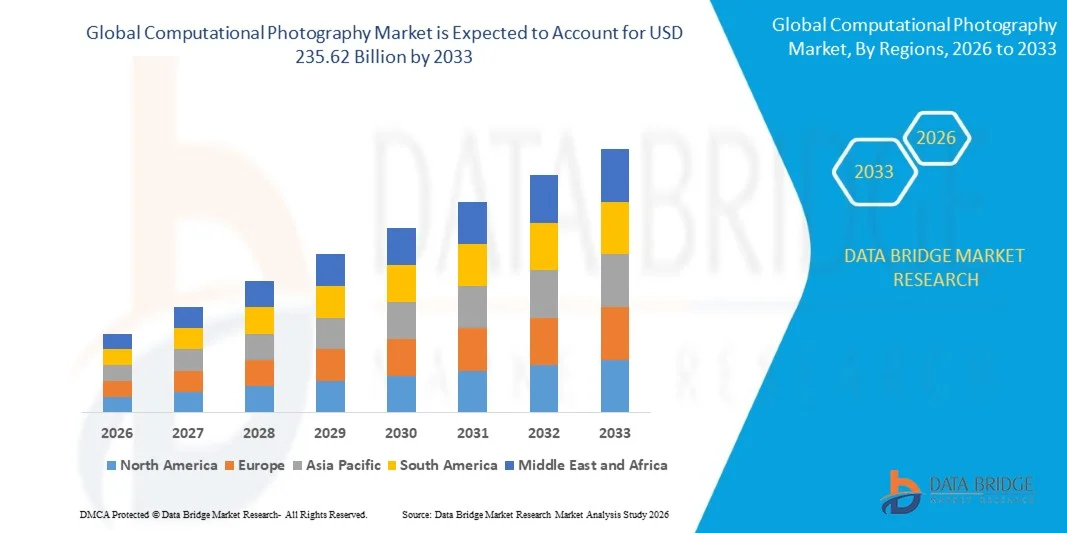
- The global computational photography market size was valued at USD 23.85 billion in 2025 and is expected to reach USD 235.62 billion by 2033, at a CAGR of 33.15% during the forecast period
- The market growth is largely fueled by the rapid advancement of AI-powered imaging algorithms and increasing integration of computational photography features in smartphones, enabling enhanced image quality through HDR, multi-frame processing, and low-light optimization across devices
- Furthermore, rising consumer demand for high-quality mobile photography, content creation, and immersive visual experiences is driving the adoption of advanced camera systems across smartphones, standalone cameras, and machine vision applications, thereby significantly boosting market expansion
Computational Photography Market Analysis
- Computational photography refers to the use of advanced algorithms, artificial intelligence, and image processing techniques to enhance or extend the capabilities of digital imaging systems beyond traditional optical limitations
- The escalating demand for computational photography is primarily fueled by the proliferation of smartphone cameras, growing adoption of AI-based imaging solutions, and increasing use of advanced visual technologies in applications such as AR, VR, and industrial vision systems
- North America dominated the computational photography market with a share of 38.5% in 2025, due to strong adoption of advanced imaging technologies across smartphones, consumer electronics, and professional imaging systems
- Asia-Pacific is expected to be the fastest growing region in the computational photography market during the forecast period due to rapid smartphone penetration, rising disposable incomes, and strong adoption of AI-enabled imaging technologies
- Single and dual-lens cameras segment dominated the market with a market share of 74.6% in 2025, due to their widespread use in smartphones and compact imaging devices. These configurations benefit from cost efficiency while still enabling advanced computational features such as bokeh effects, HDR processing, and noise reduction
Report Scope and Computational Photography Market Segmentation
|
Attributes |
Computational Photography Key Market Insights |
|
Segments Covered |
|
|
Countries Covered |
North America
Europe
Asia-Pacific
Middle East and Africa
South America
|
|
Key Market Players |
|
|
Market Opportunities |
|
|
Value Added Data Infosets |
In addition to the insights on market scenarios such as market value, growth rate, segmentation, geographical coverage, and major players, the market reports curated by the Data Bridge Market Research also include in-depth expert analysis, geographically represented company-wise production and capacity, network layouts of distributors and partners, detailed and updated price trend analysis and deficit analysis of supply chain and demand. |
Computational Photography Market Trends
“Increasing Integration of AI-Based Multi-Frame Image Processing in Smartphones”
- A significant trend in the computational photography market is the increasing integration of AI-based multi-frame image processing in smartphones, driven by the need to enhance image clarity, dynamic range, and low-light performance through advanced computational algorithms. This integration is transforming mobile imaging by enabling software-driven enhancements that overcome traditional hardware limitations in compact camera systems
- For instance, Google Pixel smartphones developed by Google LLC leverage computational photography techniques such as HDR+, Night Sight, and multi-frame fusion to significantly improve image quality in real-time processing environments. Similarly, Apple Inc. integrates Deep Fusion and Photonic Engine technologies across iPhone models to enhance texture detail and color accuracy using AI-based image stacking methods
- The adoption of multi-frame processing is expanding across flagship and mid-range smartphones as manufacturers increasingly focus on delivering DSLR-like output quality through software optimization. This is positioning computational photography as a core differentiator in smartphone camera performance and user experience
- The growing use of neural networks and machine learning models in image signal processing is further enhancing scene recognition, object segmentation, and automated enhancement capabilities. This is enabling devices to intelligently adjust exposure, sharpness, and noise reduction based on real-time environmental conditions
- The market is witnessing strong innovation in chipsets designed specifically for computational imaging, where companies are embedding dedicated neural processing units to accelerate image computation tasks. This rising integration is reinforcing the shift toward software-defined imaging ecosystems across consumer electronics
Computational Photography Market Dynamics
Driver
“Rising Demand for High-Quality Mobile Imaging”
- The rising demand for high-quality mobile imaging is a key driver in the computational photography market, fueled by increasing consumer expectations for professional-grade photos and videos from smartphones and compact devices. This demand is further strengthened by the growth of social media platforms, content creation, and digital communication where visual quality plays a central role
- For instance, Samsung Electronics and Apple Inc. continuously enhance smartphone camera systems with advanced computational features such as scene optimization, portrait mode, and low-light enhancement to meet rising user expectations. These innovations are widely adopted in flagship devices, improving user engagement and driving premium smartphone sales
- The increasing popularity of digital content platforms such as Instagram, YouTube, and TikTok is pushing users to prioritize high-resolution imaging capabilities in mobile devices. This shift is encouraging manufacturers to invest heavily in computational imaging technologies that improve visual output without increasing hardware complexity
- The expansion of mobile photography as a professional tool for influencers, marketers, and creators is further accelerating demand for advanced imaging systems. This is driving continuous upgrades in smartphone camera software and sensor integration across global markets
- The growing consumer preference for devices that offer real-time image enhancement and editing capabilities is strengthening the adoption of AI-powered computational photography solutions. This sustained demand is positioning high-quality mobile imaging as a core growth engine for the market
Restraint/Challenge
“High Dependence on Advanced Hardware Processing”
- The high dependence on advanced hardware processing is a major challenge in the computational photography market, as real-time image enhancement requires powerful processors, high-speed memory, and dedicated image signal processing units. This dependence increases device complexity and limits the scalability of advanced computational imaging features in low-cost devices
- For instance, Qualcomm Incorporated develops Snapdragon chipsets with integrated AI engines and image signal processors that are essential for enabling advanced computational photography features in smartphones. Similarly, Apple Inc. relies on its A-series chips with dedicated neural engines to support real-time multi-frame processing and computational imaging tasks
- The requirement for high-performance hardware increases manufacturing costs, which restricts the inclusion of advanced computational features in budget and mid-range devices. This creates a performance gap between premium and lower-tier smartphone segments
- The continuous demand for higher resolution imaging and real-time processing places significant pressure on chipset developers to improve computational efficiency while managing energy consumption. This challenge impacts battery performance and device thermal management
- The rapid evolution of imaging algorithms further increases hardware upgrade cycles, making it difficult for manufacturers to maintain long-term compatibility across devices. This ongoing dependency on advanced processing capabilities continues to act as a key constraint on widespread market adoption
Computational Photography Market Scope
The market is segmented on the basis of product, application, type, and offering.
• By Product
On the basis of product, the computational photography market is segmented into smartphone camera, standalone camera, and machine vision camera. The smartphone camera segment held the largest market revenue share in 2025, driven by the widespread penetration of smartphones and continuous enhancement of in-device image processing capabilities. Consumers increasingly rely on computational features such as HDR, portrait enhancement, and low-light optimization embedded in smartphones. The integration of multi-frame processing and AI-based imaging algorithms further strengthens smartphone dominance in everyday photography applications. The availability of advanced chipsets supporting real-time image computation also reinforces this segment’s leadership.
The machine vision camera segment is anticipated to witness the fastest growth rate from 2026 to 2033, driven by rising automation across manufacturing and industrial inspection processes. These systems rely on computational imaging to enhance defect detection, precision measurement, and quality control in real time. Increasing deployment in robotics and smart factories supports stronger adoption of advanced imaging solutions. The growing use of AI-powered vision systems in sectors such as automotive and electronics manufacturing further accelerates demand for machine vision cameras.
• By Application
On the basis of application, the computational photography market is segmented into 3D imaging, augmented reality, and virtual reality. The augmented reality segment dominated the largest market revenue share in 2025, driven by strong integration in smartphones, retail visualization tools, and interactive digital experiences. Computational imaging enables real-time object mapping, scene understanding, and overlay precision, enhancing user engagement across consumer and enterprise platforms. The expansion of AR-based navigation, gaming, and shopping experiences further supports its leading position. Continuous improvements in mobile processors and camera sensors strengthen AR adoption across devices.
The virtual reality segment is expected to witness the fastest growth rate from 2026 to 2033, fueled by increasing adoption of immersive training, simulation, and entertainment applications. Computational photography enhances VR experiences through improved depth mapping, motion tracking, and realistic rendering of environments. Rising deployment in education, healthcare training, and gaming ecosystems contributes to accelerating demand. Advancements in headset hardware combined with AI-driven visual reconstruction technologies further support rapid expansion of VR applications.
• By Type
On the basis of type, the computational photography market is segmented into single and dual-lens cameras, 16-lens cameras, and others. The single and dual-lens cameras segment held the largest market revenue share of 74.6% in 2025, driven by their widespread use in smartphones and compact imaging devices. These configurations benefit from cost efficiency while still enabling advanced computational features such as bokeh effects, HDR processing, and noise reduction. Continuous software enhancement allows even limited hardware setups to deliver high-quality imaging performance. Strong consumer adoption of mid-range and premium smartphones further supports this segment’s dominance.
The 16-lens cameras segment is anticipated to witness the fastest growth rate from 2026 to 2033, driven by advancements in light-field imaging and high-precision depth capture technologies. These multi-lens systems enable post-capture refocusing, enhanced depth mapping, and superior image reconstruction capabilities. Increasing research and deployment in professional imaging, scientific applications, and industrial inspection support rising adoption. The integration of computational algorithms with dense lens arrays significantly improves imaging accuracy and flexibility.
• By Offering
On the basis of offering, the computational photography market is segmented into camera module and software. The camera module segment held the largest market revenue share in 2025, driven by its critical role in integrating imaging hardware within smartphones, consumer electronics, and industrial devices. Continuous advancements in sensor design, optics, and miniaturization support high-performance imaging capabilities. Strong demand from smartphone manufacturers and consumer electronics brands reinforces the dominance of this segment. Hardware upgrades remain essential for enabling advanced computational imaging functions.
The software segment is expected to witness the fastest growth rate from 2026 to 2033, driven by increasing reliance on AI-based image processing and algorithm-driven enhancements. Computational photography software enables features such as scene recognition, image fusion, and real-time enhancement without requiring major hardware changes. Growing adoption of cloud-based and on-device AI processing strengthens scalability and performance. Rising integration of machine learning models in imaging pipelines further accelerates software-led innovation in the market.
Computational Photography Market Regional Analysis
- North America dominated the computational photography market with the largest revenue share of 38.5% in 2025, driven by strong adoption of advanced imaging technologies across smartphones, consumer electronics, and professional imaging systems
- The region benefits from high penetration of AI-enabled devices and early adoption of computational imaging features in flagship smartphones
- Consumers and enterprises in the region prioritize high-quality imaging performance, supporting continuous upgrades in camera hardware and software ecosystems. Strong presence of leading technology companies further accelerates innovation and deployment of computational photography solutions across multiple applications
U.S. Computational Photography Market Insight
The U.S. captured the largest revenue share in North America in 2025, driven by rapid integration of AI-powered imaging systems in smartphones, social media platforms, and enterprise imaging solutions. Strong demand for high-resolution content creation, mobile photography, and AR-based applications continues to support market expansion. The presence of major technology firms and smartphone manufacturers further strengthens innovation in computational imaging algorithms. Rising consumer preference for advanced camera capabilities in premium devices significantly contributes to market growth.
Europe Computational Photography Market Insight
The Europe computational photography market is projected to expand at a steady CAGR during the forecast period, driven by increasing adoption of advanced imaging technologies in smartphones, automotive vision systems, and industrial applications. Strong emphasis on digital innovation and high-quality imaging standards supports regional demand. The region benefits from growing integration of AI-based image processing in consumer electronics and professional media applications. Expanding use of computational imaging in security and surveillance systems further strengthens market development.
U.K. Computational Photography Market Insight
The U.K. computational photography market is expected to grow at a notable CAGR during the forecast period, driven by rising demand for high-end smartphone photography and content creation tools. Increasing adoption of AR-based applications in retail, media, and entertainment sectors further supports growth. Strong consumer preference for premium imaging experiences and social media content production accelerates adoption of advanced computational imaging features. Expanding digital infrastructure and technology-driven consumer behavior continue to drive market penetration.
Germany Computational Photography Market Insight
The Germany computational photography market is projected to grow at a considerable CAGR during the forecast period, driven by strong industrial adoption of machine vision systems and advanced imaging technologies. Increasing integration of AI-powered imaging in automotive and manufacturing applications supports market expansion. Germany’s focus on precision engineering and digital innovation further enhances demand for high-quality imaging solutions. Growing use of computational photography in industrial inspection and automation systems strengthens regional adoption.
Asia-Pacific Computational Photography Market Insight
Asia-Pacific is anticipated to witness the fastest CAGR from 2026 to 2033, driven by rapid smartphone penetration, rising disposable incomes, and strong adoption of AI-enabled imaging technologies. Countries such as China, India, and Japan are experiencing significant growth in mobile photography and AR-based applications. Expanding digital ecosystems and increasing demand for affordable high-performance smartphones further accelerate market growth. Strong manufacturing capabilities and rapid technological advancements position the region as a key hub for computational photography innovation.
Japan Computational Photography Market Insight
The Japan computational photography market is growing steadily, driven by high adoption of advanced imaging technologies in smartphones, robotics, and consumer electronics. Strong emphasis on precision and innovation supports integration of computational imaging in industrial and entertainment applications. Increasing use of AI-based image enhancement in mobile devices and camera systems further drives demand. Japan’s technologically advanced ecosystem and strong focus on robotics and automation continue to support market expansion.
China Computational Photography Market Insight
The China computational photography market accounted for the largest revenue share in Asia Pacific in 2025, driven by rapid smartphone adoption, strong domestic manufacturing capabilities, and high consumer demand for advanced imaging features. The country benefits from widespread integration of AI-based camera technologies in mid-range and premium smartphones. Strong growth in social media content creation and short video platforms further accelerates demand. Government support for digital innovation and smart device manufacturing continues to strengthen market leadership.
Computational Photography Market Share
The computational photography industry is primarily led by well-established companies, including:
- Panasonic Corporation (Japan)
- CONNEXX SYSTEMS Corp (Japan)
- Algolu (Canada)
- Nikon Corporation (Japan)
- Canon Inc. (Japan)
- ALMALENCE INC. (Bulgaria)
- Intel Corporation (U.S.)
- Semiconductor Components Industries, LLC (U.S.)
- Sony Corporation (Japan)
- HTC Corporation (Taiwan)
- Affinity Media (U.S.)
- XPERI CORPORATION (U.S.)
Latest Developments in Global Computational Photography Market
- In June 2025, Vexcel Imaging introduced three UltraCam aerial imaging systems, Osprey 4.2, Dragon 4.2, and Merlin 5.0, all integrated with Sony’s IMX811 sensor, enhancing high-resolution aerial imaging performance and strengthening demand for advanced computational imaging in geospatial mapping and surveying applications. These systems improve photogrammetry accuracy, depth reconstruction, and large-scale terrain modeling through advanced sensor integration and image processing capabilities. The use of high-resolution sensors enables better clarity in aerial datasets, supporting applications in urban planning, infrastructure monitoring, and environmental mapping. This development reinforces the shift toward sensor-driven computational imaging solutions in professional and industrial imaging markets. It also supports faster data acquisition and improved analytical precision in remote sensing workflows
- In November 2023, Insta360 launched the Ace and Ace Pro action cameras in collaboration with Leica, combining advanced hardware with AI-powered computational photography to significantly improve image quality, low-light performance, and real-time processing for content creators and action camera users. These devices leverage multi-frame processing, AI noise reduction, and dynamic range optimization to deliver enhanced video stability and clarity in challenging environments. The integration of Leica’s optical expertise with computational imaging algorithms improves color accuracy and detail preservation. This development strengthens demand for high-performance action cameras in travel, sports, and professional content creation markets. It also highlights the growing convergence of optical engineering and AI-driven imaging systems
- In November 2023, OPPO and Hasselblad announced the continuation of their partnership leading to the next-generation HyperTone Camera Systems, reinforcing the advancement of smartphone computational photography through improved color science, AI imaging algorithms, and enhanced mobile photography experiences. This collaboration enhances mobile imaging quality through advanced tuning of tone mapping, color calibration, and multi-frame fusion techniques. The system improves portrait rendering, low-light performance, and dynamic range in smartphone cameras. It further strengthens OPPO’s positioning in the premium smartphone segment by delivering DSLR-like imaging capabilities. This development reflects the increasing importance of brand-technology partnerships in advancing computational photography innovation
- In November 2023, Sony Electronics completed the second phase of testing for its in-camera authenticity technology in collaboration with the Associated Press, enabling embedded digital signatures that improve image verification, trust, and content authenticity in computational photography workflows. This technology allows photos to carry tamper-proof metadata that verifies origin, capturing device, and editing history. It enhances credibility in journalism, media reporting, and digital content distribution environments. The innovation addresses growing concerns around AI-generated misinformation and image manipulation. It also strengthens the role of computational imaging in ensuring transparency and authenticity in professional photography ecosystems
- In January 2022, Xperi introduced a single-camera DTS AutoSense system for driver and occupancy monitoring, enhancing computational vision capabilities in automotive safety systems while reducing hardware complexity, cost, and calibration requirements in in-cabin monitoring applications. The system uses AI-based image analysis to detect driver attention, seat occupancy, and behavioral patterns in real time. It replaces multi-camera setups with a more efficient single-camera architecture, improving system scalability. This development supports the growing adoption of advanced driver assistance systems (ADAS) and intelligent cockpit solutions. It also highlights the expanding role of computational imaging in automotive safety and mobility technologies

- Interactive Data Analysis Dashboard
- Company Analysis Dashboard for high growth potential opportunities
- Research Analyst Access for customization & queries
- Competitor Analysis with Interactive dashboard
- Latest News, Updates & Trend analysis
- Harness the Power of Benchmark Analysis for Comprehensive Competitor Tracking
Global Computational Photography Market, Supply Chain Analysis and Ecosystem Framework
To support market growth and help clients navigate the impact of geopolitical shifts, DBMR has integrated in-depth supply chain analysis into its Global Computational Photography Market research reports. This addition empowers clients to respond effectively to global changes affecting their industries. The supply chain analysis section includes detailed insights such as Global Computational Photography Market consumption and production by country, price trend analysis, the impact of tariffs and geopolitical developments, and import and export trends by country and HSN code. It also highlights major suppliers with data on production capacity and company profiles, as well as key importers and exporters. In addition to research, DBMR offers specialized supply chain consulting services backed by over a decade of experience, providing solutions like supplier discovery, supplier risk assessment, price trend analysis, impact evaluation of inflation and trade route changes, and comprehensive market trend analysis.
Data collection and base year analysis are done using data collection modules with large sample sizes. The stage includes obtaining market information or related data through various sources and strategies. It includes examining and planning all the data acquired from the past in advance. It likewise envelops the examination of information inconsistencies seen across different information sources. The market data is analysed and estimated using market statistical and coherent models. Also, market share analysis and key trend analysis are the major success factors in the market report. To know more, please request an analyst call or drop down your inquiry.
The key research methodology used by DBMR research team is data triangulation which involves data mining, analysis of the impact of data variables on the market and primary (industry expert) validation. Data models include Vendor Positioning Grid, Market Time Line Analysis, Market Overview and Guide, Company Positioning Grid, Patent Analysis, Pricing Analysis, Company Market Share Analysis, Standards of Measurement, Global versus Regional and Vendor Share Analysis. To know more about the research methodology, drop in an inquiry to speak to our industry experts.
Data Bridge Market Research is a leader in advanced formative research. We take pride in servicing our existing and new customers with data and analysis that match and suits their goal. The report can be customized to include price trend analysis of target brands understanding the market for additional countries (ask for the list of countries), clinical trial results data, literature review, refurbished market and product base analysis. Market analysis of target competitors can be analyzed from technology-based analysis to market portfolio strategies. We can add as many competitors that you require data about in the format and data style you are looking for. Our team of analysts can also provide you data in crude raw excel files pivot tables (Fact book) or can assist you in creating presentations from the data sets available in the report.













