


What is the Computer Microchips Market Size and Growth Rate?
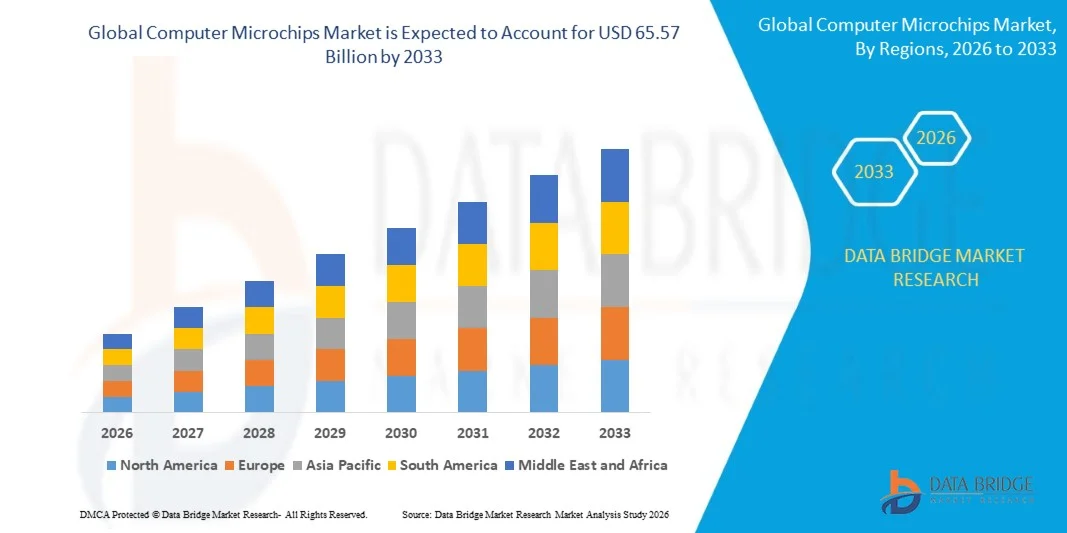
- As per Data Bridge Market Research analysis the computer microchips market was valued at USD 29.50 billion in 2025 and is projected to reach USD 65.57 billion by 2033, growing at a CAGR of 10.50% from 2026 to 2033.
- The market is experiencing robust growth driven by increasing demand for artificial intelligence (AI), cloud computing, high-performance computing (HPC), data centers, and advanced consumer electronics. Continuous advancements in semiconductor manufacturing technologies, including smaller process nodes, chiplet architectures, and AI accelerators, are further accelerating market expansion.
- The growing adoption of AI-enabled devices, rising investments in semiconductor fabrication facilities, and increasing demand for advanced processors across consumer electronics, automotive, industrial automation, healthcare, aerospace & defense, and telecommunications are driving the need for high-performance computer microchips. In addition, government initiatives supporting domestic semiconductor manufacturing and digital transformation are expected to sustain long-term market growth.
Market Size & Forecast
- Market Value (2025): USD 29.50 Billion
- Expected Market Value (2033): USD 65.57 Billion
- Forecast CAGR (2026–2033): 10.50%
- Leading Region in 2025: Asia-Pacific
- Fastest Growing Region: North America
What are the Major Takeaways of the Computer Microchips Market?
- Asia-Pacific dominated the computer microchips market with the largest revenue share of 33.10% in 2025, supported by its well-established semiconductor manufacturing ecosystem, strong presence of leading foundries and chipmakers, expanding consumer electronics production, and increasing investments in advanced chip fabrication technologies.
- North America is expected to witness the fastest growth rate from 2026 to 2033, driven by increasing investments in artificial intelligence infrastructure, cloud computing, high-performance computing, and domestic semiconductor manufacturing. Government initiatives such as the CHIPS and Science Act, coupled with rising demand for AI processors, advanced GPUs, and data center chips, are accelerating market growth.
- The central processing unit (CPU) segment accounted for the largest market revenue share of 32.95% in 2025, driven by its widespread adoption in personal computers, servers, enterprise systems, and data centers. CPUs remain the core processing component across computing platforms, with continuous product innovations from Intel and AMD supporting demand for high-performance computing, gaming, and enterprise workloads.
- The memory chips segment is projected to register the fastest growth with a CAGR of 12.30% during 2026–2033, driven by increasing demand for AI infrastructure, cloud computing, high-performance servers, and data-intensive applications. Growing adoption of DDR5, HBM, and high-capacity memory solutions is accelerating market growth.
- The data processing segment held the largest market revenue share of 41.00% in 2025, owing to increasing deployment of advanced processors in enterprise IT infrastructure, cloud computing, and hyperscale data centers. The rapid expansion of digital transformation initiatives and high-performance computing continues to drive demand for data processing microchips.
- The artificial intelligence and machine learning segment is expected to witness the fastest growth at a CAGR of 12.95% during 2026–2033, supported by increasing deployment of AI accelerators, neural processing units, and specialized processors across healthcare, automotive, finance, and enterprise AI applications.
Report Scope and Computer Microchips Market Segmentation
|
Attributes |
Computer Microchips Key Market Insights |
|
Segments Covered |
|
|
Countries Covered |
North America
Europe
Asia-Pacific
Middle East and Africa
South America
|
|
Key Market Players |
|
|
Market Opportunities |
|
|
Value Added Data Infosets |
In addition to the insights on market scenarios such as market value, growth rate, segmentation, geographical coverage, and major players, the market reports curated by the Data Bridge Market Research also include in-depth expert analysis, geographically represented company-wise production and capacity, network layouts of distributors and partners, detailed and updated price trend analysis and deficit analysis of supply chain and demand. |
What is the Key Trend in the Computer Microchips Market?
- Artificial intelligence is transforming the computer microchips market, with semiconductor manufacturers increasingly developing AI-optimized CPUs, GPUs, NPUs, and custom accelerators to support generative AI, edge computing, and high-performance computing workloads.
- For instance, in March 2025, NVIDIA and Broadcom began testing advanced chip designs using Intel's 18A manufacturing process, highlighting the industry's focus on next-generation fabrication technologies and advanced AI chip production.
- Chipmakers are accelerating the adoption of chiplet architectures, advanced packaging technologies, and smaller semiconductor process nodes to improve computing performance, power efficiency, and scalability for AI-enabled devices and cloud infrastructure.
- Technology companies are increasingly integrating ARM-based processors, AI accelerators, and heterogeneous computing architectures into personal computers, servers, and edge devices to meet growing demand for energy-efficient and high-performance computing platforms.
- For instance, in May 2024, Microsoft introduced its Copilot+ PCs powered by Snapdragon X Series processors with dedicated Neural Processing Units (NPUs), marking a significant shift toward AI-native personal computing.
- As enterprises and consumers continue adopting AI-driven applications, cloud computing, and intelligent edge devices, demand for advanced computer microchips is expected to accelerate, reinforcing AI-centric semiconductor innovation as a defining market trend.
What are the Key Drivers of the Computer Microchips Market?
- The rapid expansion of artificial intelligence, hyperscale data centers, cloud computing, and high-performance computing is significantly increasing demand for advanced computer microchips capable of delivering higher processing power, bandwidth, and energy efficiency.
- For instance, in June 2024, AMD introduced its Ryzen AI 300 Series processors featuring built-in Neural Processing Units (NPUs), enabling AI-powered personal computers with improved performance and energy efficiency for consumer and enterprise applications.
- Semiconductor manufacturers are investing heavily in advanced fabrication technologies, chiplet-based architectures, and next-generation manufacturing processes to improve chip performance while reducing power consumption.
- For instance, in January 2025, NVIDIA unveiled the GeForce RTX 5090 and RTX 5080 GPUs based on its Blackwell architecture, offering significant improvements in AI processing, graphics performance, and energy efficiency for gaming and AI-enabled PCs.
- As AI infrastructure investments, digital transformation initiatives, and high-performance computing deployments continue expanding globally, computer microchips will remain fundamental to enabling next-generation computing platforms across enterprise, consumer, industrial, and cloud environments.
Which Factors are Challenging the Growth of the Computer Microchips Market?
- Advanced computer microchips require substantial investments in semiconductor fabrication facilities, extreme ultraviolet (EUV) lithography equipment, advanced packaging technologies, and research and development, significantly increasing manufacturing costs.
- Rising fabrication complexity, supply chain constraints, and dependence on advanced manufacturing capacity continue to challenge semiconductor production and increase the time required to bring next-generation chips to market.
- For instance, in March 2025, Taiwan Semiconductor Manufacturing Company (TSMC) announced plans to increase its investment in advanced semiconductor manufacturing in the United States to USD 165 billion, including new fabrication plants, advanced packaging facilities, and an R&D center. The announcement highlights the substantial capital investment required to expand production of next-generation computer microchips.
- Geopolitical tensions, export restrictions, and the concentration of advanced semiconductor manufacturing in a limited number of regions continue to expose the industry to supply chain disruptions and production risks.
- As semiconductor manufacturers continue investing heavily in cutting-edge fabrication technologies and production capacity, the high capital requirements and manufacturing complexity remain significant barriers for new entrants and smaller companies, limiting the pace of market expansion despite rising global demand for advanced computer microchips.
How is the Computer Microchips Market Segmented?
The market is segmented on the basis of type, application, architecture, technology, packaging, and end-user.
- By Type
On the basis of type, the computer microchips market is segmented into central processing unit (CPU), graphics processing unit (GPU), memory chips, application-specific integrated circuit (ASIC), field-programmable gate array (FPGA), and others. The central processing unit (CPU) segment accounted for the largest market revenue share of 32.95% in 2025, driven by its widespread adoption in personal computers, servers, enterprise systems, and data centers. CPUs remain the core processing component across computing platforms, with continuous product innovations from Intel and AMD supporting demand for high-performance computing, gaming, and enterprise workloads.
The memory chips segment is projected to register the fastest growth with a CAGR of 12.30% during 2026–2033, driven by increasing demand for AI infrastructure, cloud computing, high-performance servers, and data-intensive applications. Growing adoption of DDR5, HBM, and high-capacity memory solutions is accelerating market growth.
- By Application
On the basis of application, the computer microchips market is segmented into data processing, graphics rendering, artificial intelligence and machine learning, networking and connectivity, sensor integration, encryption and security, and others. The data processing segment held the largest market revenue share of 41.00% in 2025, owing to increasing deployment of advanced processors in enterprise IT infrastructure, cloud computing, and hyperscale data centers. The rapid expansion of digital transformation initiatives and high-performance computing continues to drive demand for data processing microchips.
The artificial intelligence and machine learning segment is expected to witness the fastest growth at a CAGR of 12.95% during 2026–2033, supported by increasing deployment of AI accelerators, neural processing units, and specialized processors across healthcare, automotive, finance, and enterprise AI applications.
- By Architecture
On the basis of architecture, the computer microchips market is segmented into x86, ARM, and RISC-V.The x86 segment accounted for the largest market revenue share of 44.30% in 2025, primarily due to its extensive deployment across desktop computers, laptops, enterprise servers, and workstations. Strong demand from commercial computing and data center applications continues to support its market leadership.
The RISC-V segment is anticipated to register the fastest growth at a CAGR of 18.70% during 2026–2033, driven by increasing adoption of open-source processor architectures in embedded systems, edge computing, artificial intelligence, and Internet of Things (IoT) applications.
- By Technology
On the basis of technology node, the computer microchips market is segmented into 10 nanometers (nm) and Below, 16nm–25nm, 28nm–45nm, and 65nm and Above. The 10 nanometers (nm) and Below segment held the largest market revenue share in 2025, driven by increasing demand for high-performance processors used in artificial intelligence (AI), cloud computing, smartphones, data centers, and advanced consumer electronics. The adoption of smaller process nodes enables greater transistor density, improved computing performance, and enhanced power efficiency, supporting widespread deployment across next-generation computing platforms.
The 16nm–25nm segment is projected to register the fastest growth during 2026–2033, driven by its expanding use in automotive electronics, industrial automation, networking equipment, and Internet of Things (IoT) devices. The segment offers an optimal balance between manufacturing cost, performance, and power efficiency, making it increasingly attractive for a broad range of semiconductor applications.
- By Packaging
On the basis of packaging, the computer microchips market is segmented into ball grid array (BGA), pin grid array (PGA), and chip on board (COB). The ball grid array (BGA) segment accounted for the largest market revenue share in 2025, owing to its superior electrical performance, higher pin density, efficient heat dissipation, and compact design. BGA packaging is widely used in processors, graphics chips, memory devices, and high-performance integrated circuits across consumer electronics, servers, and automotive applications.
The chip on board (COB) segment is expected to witness the fastest growth during 2026–2033, supported by increasing demand for compact, lightweight, and cost-effective semiconductor packaging solutions in wearable devices, medical electronics, IoT products, and advanced industrial systems. Growing adoption of miniaturized electronic devices and high-density packaging technologies continues to drive segment expansion.
- By End-User
On the basis of end-user, the computer microchips market is segmented into consumer electronics, automotive, industrial, healthcare, aerospace & defense, and telecommunications. The consumer electronics segment held the largest market revenue share of 28.91% in 2025, driven by sustained demand for smartphones, laptops, tablets, gaming devices, and wearable electronics. Increasing integration of AI-enabled processors and advanced chipsets in consumer devices continues to strengthen segment growth.
The automotive segment is projected to grow at the fastest CAGR of 12.68% during 2026–2033, supported by rising production of electric vehicles, autonomous driving technologies, advanced driver assistance systems (ADAS), and connected vehicle platforms, all of which require increasingly sophisticated semiconductor solutions.
Which Region Holds the Largest Share of the Computer Microchips Market?
- Asia-Pacific dominated the computer microchips market with the largest revenue share of 33.10% in 2025, supported by its well-established semiconductor manufacturing ecosystem, strong presence of leading foundries and chipmakers, expanding consumer electronics production, and increasing investments in advanced chip fabrication technologies.
- The region benefits from major semiconductor manufacturing hubs in Taiwan, South Korea, China, and Japan, which collectively account for a significant share of global chip production. Rising demand for artificial intelligence, cloud computing, high-performance computing, data centers, and electric vehicles, coupled with government initiatives to strengthen domestic semiconductor manufacturing, continues to reinforce Asia-Pacific's leadership in the global computer microchips market.
China Computer Microchips Market Insight
The China computer microchips market accounted for the largest revenue share within Asia-Pacific in 2025, driven by its position as one of the world's largest electronics manufacturing hubs and increasing investments in semiconductor self-sufficiency. Government initiatives supporting domestic chip production, expanding AI applications, and growing demand from consumer electronics, automotive, telecommunications, and industrial sectors continue to fuel market growth. The rapid expansion of cloud computing infrastructure and hyperscale data centers is further increasing demand for advanced computer microchips across the country.
Japan Computer Microchips Market Insight
The Japan computer microchips market is expected to witness the fastest growth rate from 2026 to 2033, supported by its advanced semiconductor manufacturing capabilities and strong presence in automotive electronics, robotics, industrial automation, and high-performance computing. Increasing investments in next-generation semiconductor technologies, artificial intelligence, and advanced packaging solutions, along with strategic collaborations between domestic and global semiconductor companies, are expected to support continued market expansion.
North America Computer Microchips Market Insight
North America is expected to witness the fastest growth rate from 2026 to 2033, driven by increasing investments in artificial intelligence infrastructure, cloud computing, high-performance computing, and domestic semiconductor manufacturing. Government initiatives such as the CHIPS and Science Act, coupled with rising demand for AI processors, advanced GPUs, and data center chips, are accelerating market growth. The presence of leading semiconductor companies and continued investments in advanced packaging, chip design, and fabrication technologies further strengthen the region's growth prospects.
U.S. Computer Microchips Market Insight
The U.S. computer microchips market captured the largest revenue share within North America in 2025, fueled by the presence of leading semiconductor companies, growing deployment of artificial intelligence, and expanding investments in hyperscale cloud infrastructure and advanced computing technologies. Rising demand for AI-enabled processors, defense electronics, autonomous vehicles, and enterprise computing solutions, together with continued government support for domestic semiconductor manufacturing, continues to drive market expansion across the country.
Europe Computer Microchips Market Insight
The Europe computer microchips market is expected to witness the fastest growth rate from 2026 to 2033, supported by increasing investments in semiconductor manufacturing, automotive electronics, industrial automation, and digital transformation initiatives. Growing emphasis on strengthening regional semiconductor supply chains, combined with rising adoption of AI-enabled technologies and energy-efficient computing solutions, is accelerating demand for advanced computer microchips across multiple industries.
Germany Computer Microchips Market Insight
The Germany computer microchips market is expected to witness robust growth from 2026 to 2033, driven by the country's strong automotive manufacturing base, expanding industrial automation sector, and increasing adoption of artificial intelligence technologies. Rising investments in semiconductor research, electric vehicle production, Industry 4.0 initiatives, and advanced manufacturing technologies are fueling demand for high-performance processors, memory chips, and embedded semiconductor solutions. Germany's continued focus on semiconductor innovation and production capacity expansion is expected to support long-term market growth.
Which are the Top Companies in Computer Microchips Market?
The computer microchips industry is primarily led by well-established companies, including:
- Intel Corporation (U.S.)
- NVIDIA Corporation (U.S.)
- Advanced Micro Devices, Inc. (U.S.)
- Qualcomm Incorporated (U.S.)
- Broadcom Inc. (U.S.)
- MediaTek Inc. (Taiwan)
- Samsung Electronics Co., Ltd. (South Korea)
- Taiwan Semiconductor Manufacturing Company Limited (Taiwan)
- Micron Technology, Inc. (U.S.)
- SK hynix Inc. (South Korea)
- Texas Instruments Incorporated (U.S.)
- NXP Semiconductors N.V. (Netherlands)
- Infineon Technologies AG (Germany)
- STMicroelectronics N.V. (Switzerland)
- Renesas Electronics Corporation (Japan)
What are Latest Developments in Computer Microchips Market?
- In April 2025, NVIDIA announced plans to manufacture AI supercomputers and Blackwell AI chips in the United States for the first time, securing more than one million square feet of production space in Arizona and Texas as part of its USD 500 billion AI infrastructure investment initiative. This expansion is expected to strengthen domestic semiconductor manufacturing, enhance supply chain resilience, and support the growing demand for AI computing infrastructure.
- In June 2024, Advanced Micro Devices, Inc. (AMD) launched its Ryzen AI 300 Series processors featuring integrated Neural Processing Units (NPUs) for next-generation AI PCs. The new processors deliver enhanced on-device AI performance, improved energy efficiency, and faster computing capabilities, reinforcing AMD's position in the rapidly growing AI-enabled personal computing market.
- In September 2025, Qualcomm Incorporated introduced its Snapdragon X2 Elite and Snapdragon X2 Elite Extreme processors for Windows PCs, featuring an 80 TOPS Hexagon NPU and CPU configurations with up to 18 Oryon CPU cores. The new processors are designed to deliver advanced AI computing, improved productivity, and high-performance mobile computing, strengthening Qualcomm's presence in the AI-powered PC processor market.

- Interactive Data Analysis Dashboard
- Company Analysis Dashboard for high growth potential opportunities
- Research Analyst Access for customization & queries
- Competitor Analysis with Interactive dashboard
- Latest News, Updates & Trend analysis
- Harness the Power of Benchmark Analysis for Comprehensive Competitor Tracking
Global Computer Microchips Market, Supply Chain Analysis and Ecosystem Framework
To support market growth and help clients navigate the impact of geopolitical shifts, DBMR has integrated in-depth supply chain analysis into its Global Computer Microchips Market research reports. This addition empowers clients to respond effectively to global changes affecting their industries. The supply chain analysis section includes detailed insights such as Global Computer Microchips Market consumption and production by country, price trend analysis, the impact of tariffs and geopolitical developments, and import and export trends by country and HSN code. It also highlights major suppliers with data on production capacity and company profiles, as well as key importers and exporters. In addition to research, DBMR offers specialized supply chain consulting services backed by over a decade of experience, providing solutions like supplier discovery, supplier risk assessment, price trend analysis, impact evaluation of inflation and trade route changes, and comprehensive market trend analysis.
Data collection and base year analysis are done using data collection modules with large sample sizes. The stage includes obtaining market information or related data through various sources and strategies. It includes examining and planning all the data acquired from the past in advance. It likewise envelops the examination of information inconsistencies seen across different information sources. The market data is analysed and estimated using market statistical and coherent models. Also, market share analysis and key trend analysis are the major success factors in the market report. To know more, please request an analyst call or drop down your inquiry.
The key research methodology used by DBMR research team is data triangulation which involves data mining, analysis of the impact of data variables on the market and primary (industry expert) validation. Data models include Vendor Positioning Grid, Market Time Line Analysis, Market Overview and Guide, Company Positioning Grid, Patent Analysis, Pricing Analysis, Company Market Share Analysis, Standards of Measurement, Global versus Regional and Vendor Share Analysis. To know more about the research methodology, drop in an inquiry to speak to our industry experts.
Data Bridge Market Research is a leader in advanced formative research. We take pride in servicing our existing and new customers with data and analysis that match and suits their goal. The report can be customized to include price trend analysis of target brands understanding the market for additional countries (ask for the list of countries), clinical trial results data, literature review, refurbished market and product base analysis. Market analysis of target competitors can be analyzed from technology-based analysis to market portfolio strategies. We can add as many competitors that you require data about in the format and data style you are looking for. Our team of analysts can also provide you data in crude raw excel files pivot tables (Fact book) or can assist you in creating presentations from the data sets available in the report.













