


What is the Concentrated Photovoltaic Market Size and Growth Rate?
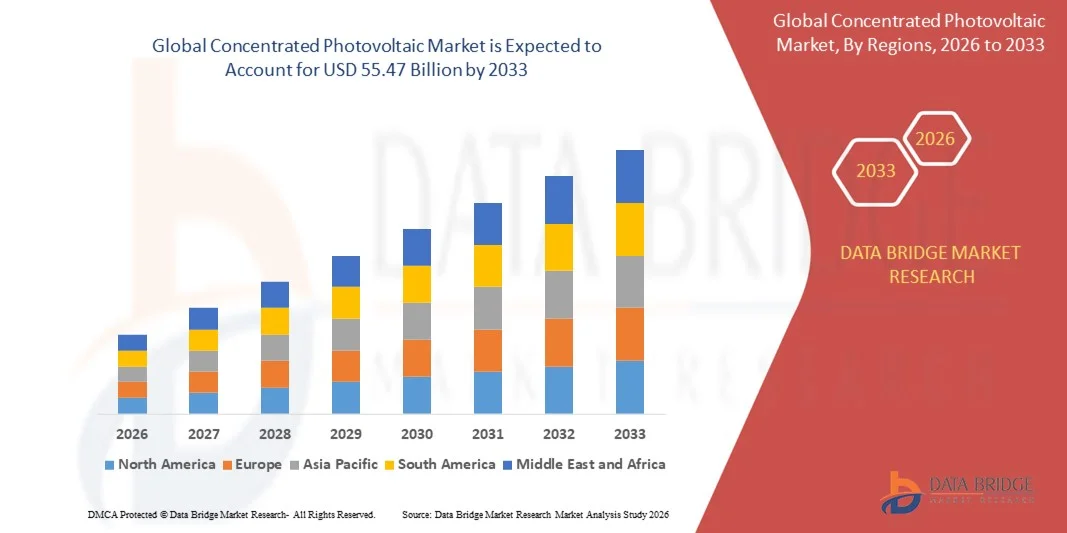
- The global concentrated photovoltaic market size was valued at USD 11.52 billion in 2025 and is expected to reach USD 55.47 billion by 2033, at a CAGR of 21.70% during the forecast period
- The market growth is largely fuelled by the rising demand for renewable energy, government incentives for solar adoption, and technological advancements in high-efficiency concentrator systems
- Increasing investments in large-scale solar projects and declining costs of photovoltaic materials are further accelerating market expansion
What are the Major Takeaways of Concentrated Photovoltaic Market?
- The market is witnessing significant innovation in multi-junction solar cells, reflective optics, and tracking systems, which are improving energy conversion efficiency
- Increasing awareness about sustainable energy and integration of CPV systems in hybrid renewable setups are contributing to market growth
- North America dominated the concentrated photovoltaic (CPV) market with the largest revenue share of 38.75% in 2025, driven by increasing investment in renewable energy infrastructure, government incentives, and the presence of leading solar technology developers
- Asia-Pacific region is expected to witness the highest growth rate in the global concentrated photovoltaic market, driven by rapid urbanization, technological advancements, increasing renewable energy adoption, and government incentives across countries such as China, Japan, and Australia
- The HCPV segment held the largest market revenue share in 2025, driven by its higher energy efficiency and superior performance in regions with high direct sunlight. HCPV systems are particularly attractive for utility-scale installations due to their ability to generate more electricity per unit area and reduce land usage, making them a preferred choice for large projects
Report Scope and Concentrated Photovoltaic Market Segmentation
|
Attributes |
Concentrated Photovoltaic Key Market Insights |
|
Segments Covered |
|
|
Countries Covered |
North America
Europe
Asia-Pacific
Middle East and Africa
South America
|
|
Key Market Players |
|
|
Market Opportunities |
|
|
Value Added Data Infosets |
In addition to the insights on market scenarios such as market value, growth rate, segmentation, geographical coverage, and major players, the market reports curated by the Data Bridge Market Research also include import export analysis, production capacity overview, production consumption analysis, price trend analysis, climate change scenario, supply chain analysis, value chain analysis, raw material/consumables overview, vendor selection criteria, PESTLE Analysis, Porter Analysis, and regulatory framework. |
What is the Key Trend in the Concentrated Photovoltaic Market?
Rise of High-Efficiency Concentrated Photovoltaic Systems
- The growing adoption of high-efficiency concentrated photovoltaic (CPV) systems is transforming the solar energy landscape by enabling higher electricity output from limited land area. These systems allow for improved energy yield and reduced land use, contributing to lower overall project costs and enhanced grid reliability. Increasing interest from utility-scale developers and commercial enterprises is further accelerating global deployment, highlighting the strategic importance of CPV in sustainable energy generation
- The demand for CPV technology in regions with high solar irradiance is accelerating deployment, particularly in utility-scale solar farms and large commercial installations. CPV systems are especially effective in maximizing energy generation in areas with direct sunlight, boosting return on investment for project developers. In addition, growing investment in smart grid integration and energy storage solutions complements CPV adoption, enhancing energy management and efficiency
- Technological advancements in multi-junction solar cells and tracking systems are making CPV solutions more attractive for investors and utilities. Enhanced efficiency, durability, and reduced maintenance requirements are driving market acceptance and adoption globally. Continuous innovation in optics, materials, and cooling systems is further improving system performance, making CPV a viable alternative to conventional PV technologies
- For instance, in 2023, several solar power developers in the Middle East reported significant improvements in energy output and project economics after installing advanced CPV systems, demonstrating their effectiveness in high-irradiance environments. The success of these projects has inspired additional investment and pilot programs in other regions with similar solar conditions, strengthening market momentum
- While CPV systems are driving growth in solar energy generation, their impact depends on continued R&D, cost reduction, and regulatory incentives. Manufacturers must focus on scalable deployment and localized solutions to fully capitalize on expanding market demand. Increasing collaboration between research institutions, governments, and private developers is expected to accelerate the adoption of next-generation CPV systems
Concentrated Photovoltaic Market Dynamics
Driver
Rising Demand for Renewable Energy and Government Incentives
- The increasing global focus on renewable energy and reducing carbon emissions is pushing utilities and governments to adopt concentrated photovoltaic solutions. The ability to generate clean, efficient electricity aligns with sustainability goals and energy transition strategies. Growing energy demand in emerging markets is also driving interest in CPV, as countries seek high-efficiency solutions to meet expanding electricity needs
- Supportive policies, subsidies, and feed-in tariffs for solar energy projects are accelerating CPV adoption. Governments in regions such as North America, the Middle East, and Asia-Pacific are incentivizing large-scale installations to meet renewable energy targets. Policy frameworks encouraging local manufacturing of CPV components are also helping reduce costs and promote domestic industry growth
- The growing need for high-efficiency solar solutions in land-constrained and high-irradiance areas further fuels demand. CPV systems provide optimal energy yield per unit area, which is particularly attractive for utility-scale solar projects. Partnerships between solar developers and technology providers are facilitating faster deployment and technology transfer, enhancing market scalability
- For instance, in 2022, several U.S. states and Gulf countries implemented incentive programs for high-efficiency solar installations, driving the deployment of CPV systems and boosting market expansion. Such programs also encouraged private sector investment in research and development of advanced solar technologies, contributing to market innovation
- While rising awareness and supportive policies are propelling growth, continued technology innovation and cost-effective deployment remain critical for long-term market sustainability. Strengthening supply chains, local manufacturing, and workforce training are expected to play an increasingly important role in sustaining CPV market momentum
Restraint/Challenge
High Capital Costs and Technological Complexity
- The high upfront investment required for CPV systems, including advanced multi-junction cells and tracking mechanisms, limits adoption for smaller developers and residential projects. The sophisticated technology increases project planning and financing complexity. Limited access to affordable financing options can further slow the adoption rate in emerging markets with high growth potential
- Maintenance and operational challenges associated with tracking systems and optical components can increase long-term operational costs. Skilled personnel and monitoring infrastructure are required to ensure optimal performance, which may deter smaller operators. In addition, unexpected downtime or component failures can negatively impact return on investment, emphasizing the need for robust service and maintenance support
- Limited adoption in regions with low direct sunlight reduces market penetration potential. CPV systems perform best under high solar irradiance, making geographic suitability a critical factor in deployment. Seasonal and weather-related fluctuations in solar exposure also affect energy generation consistency, presenting additional challenges for large-scale project planning
- For instance, in 2023, several solar projects in Europe experienced delays and higher costs due to the technical complexity and sensitivity of CPV systems, highlighting the barriers to widespread adoption. These challenges have prompted developers to conduct detailed feasibility studies and adopt hybrid approaches combining CPV with conventional PV systems to mitigate risks
- While CPV technology continues to evolve, addressing capital expenditure, technical expertise, and geographic limitations is essential for broader adoption and sustained market growth. Collaborative efforts between technology providers, governments, and investors will be crucial to overcome financial and operational hurdles and expand the global CPV market
How is the Concentrated Photovoltaic Market Segmented?
The market is segmented on the basis of type, product type, and application.
- By Type
On the basis of type, the concentrated photovoltaic (CPV) market is segmented into High Concentrated Photovoltaic (HCPV) and Low Concentrated Photovoltaic (LCPV). The HCPV segment held the largest market revenue share in 2025, driven by its higher energy efficiency and superior performance in regions with high direct sunlight. HCPV systems are particularly attractive for utility-scale installations due to their ability to generate more electricity per unit area and reduce land usage, making them a preferred choice for large projects.
The LCPV segment is expected to witness the fastest growth rate from 2026 to 2033, driven by its lower capital costs and simpler design compared to HCPV systems. LCPV solutions are especially popular for small- to medium-scale commercial installations where moderate concentration ratios meet energy generation needs efficiently. Their adaptability and lower maintenance requirements make them increasingly favored in emerging markets with growing solar adoption.
- By Product Type
On the basis of product type, the market is segmented into Reflector and Refractor. The reflector segment held the largest share in 2025 due to its ability to concentrate sunlight effectively onto photovoltaic cells, enhancing system efficiency and energy output. Reflector-based CPV systems are widely deployed in large solar farms where high energy yield is critical.
The refractor segment is expected to grow at the fastest rate during the forecast period, owing to advancements in optical materials and lens technologies. Refractor-based CPV systems provide uniform light distribution, improved thermal management, and easier integration with flat-panel PV modules, making them increasingly adopted for commercial and utility applications.
- By Application
On the basis of application, the market is segmented into Utility, Commercial, and Others. The utility segment held the largest market share in 2025, driven by large-scale solar power projects and government-backed renewable energy initiatives. Utility projects benefit from CPV’s high efficiency and optimal land utilization, reducing cost per kWh generated.
The commercial segment is projected to witness the fastest growth from 2026 to 2033, fueled by rising adoption of rooftop solar installations, corporate sustainability initiatives, and incentives for clean energy deployment. CPV solutions in commercial buildings enhance energy savings, reduce electricity bills, and contribute to corporate ESG goals.
Concentrated Photovoltaic Market Regional Analysis
- North America dominated the concentrated photovoltaic (CPV) market with the largest revenue share of 38.75% in 2025, driven by increasing investment in renewable energy infrastructure, government incentives, and the presence of leading solar technology developers
- Utilities and commercial energy producers in the region highly value the efficiency, reliability, and scalability offered by CPV systems, particularly in areas with high direct solar irradiance
- This widespread adoption is further supported by favorable policies, advanced grid infrastructure, and growing emphasis on sustainable energy solutions, positioning CPV systems as a preferred technology for large-scale solar projects
U.S. Concentrated Photovoltaic Market Insight
The U.S. CPV market captured the largest revenue share in North America in 2025, fueled by the rapid deployment of high-efficiency solar projects and federal support for renewable energy initiatives. Utilities are increasingly prioritizing CPV systems to maximize electricity output per unit area while reducing land usage. The adoption of advanced multi-junction solar cells and tracking technologies, combined with integration into utility-scale and commercial installations, is significantly boosting market growth.
Europe Concentrated Photovoltaic Market Insight
The Europe CPV market is expected to witness the fastest growth rate from 2026 to 2033, driven by strong renewable energy targets, government subsidies, and regulatory frameworks supporting clean energy adoption. Increasing urbanization, coupled with the need for efficient land use, is promoting the deployment of CPV systems. European energy producers are adopting CPV for utility and commercial applications to meet sustainability goals while ensuring high energy yields.
U.K. Concentrated Photovoltaic Market Insight
The U.K. CPV market is expected to experience rapid growth from 2026 to 2033, fueled by growing investment in solar infrastructure and the demand for high-efficiency renewable energy systems. Policy measures encouraging carbon reduction and grid modernization are boosting adoption. Furthermore, the integration of CPV systems in commercial projects and solar parks is increasing, driven by the need for reliable, high-output electricity generation.
Germany Concentrated Photovoltaic Market Insight
The Germany CPV market is projected to witness significant growth from 2026 to 2033, supported by technological innovation, renewable energy incentives, and strong infrastructure for solar deployment. German utilities and commercial energy operators are increasingly adopting CPV systems to enhance energy efficiency and optimize land use. The focus on eco-friendly, high-performance solar solutions aligns with national sustainability goals and promotes market expansion.
Asia-Pacific Concentrated Photovoltaic Market Insight
The Asia-Pacific CPV market is expected to witness the fastest growth rate from 2026 to 2033, driven by rising electricity demand, supportive government policies, and the region's high solar irradiance. Countries such as China, Japan, and India are rapidly deploying CPV systems in utility-scale and commercial projects. The growing manufacturing base for solar components in APAC is also reducing costs and improving accessibility, expanding market penetration.
Japan Concentrated Photovoltaic Market Insight
The Japan CPV market is expected to grow rapidly from 2026 to 2033 due to the country’s high technological adoption, government incentives for renewable energy, and demand for efficient electricity generation. CPV systems are increasingly integrated with smart grid solutions and commercial solar projects. Japan’s aging population and energy security concerns are further driving demand for low-maintenance, high-efficiency solar technologies.
China Concentrated Photovoltaic Market Insight
The China CPV market accounted for the largest revenue share in Asia-Pacific in 2025, driven by rapid industrialization, government support for renewable energy, and high solar potential. CPV systems are increasingly deployed in utility-scale solar farms, commercial facilities, and industrial projects. The push for smart cities, cost-competitive solar solutions, and domestic manufacturing capabilities are key factors propelling CPV adoption in China.
Which are the Top Companies in Concentrated Photovoltaic Market?
The Concentrated Photovoltaic industry is primarily led by well-established companies, including:
- SolAero Technologies (U.S.)
- Arzon Solar, LLC (U.S.)
- Cool Earth Solar (U.S.)
- Morgan Solar (Canada)
- ARIMA Group (U.S.)
- Suncore (China)
- Grupo Zytech (Spain)
- Solartron Energy Systems (U.K.)
- SOITEC (France)
- Green Rhino Energy Ltd. (U.K.)
- Sumitomo Electric Industries, Ltd. (Japan)
- RayGen Resources Pty Ltd (Australia)
- SmartSolar (Germany)
- Sunfish Solar (U.S.)
- SAINT-AUGUSTIN CANADA ELECTRIC INC. (Canada)
- Macsun Solar Energy Technology Co., Limited (China
Latest Developments in Global Concentrated Photovoltaic Market
- In July 2024, Soltec announced a strategic partnership with Fraunhofer Institute for Solar Energy Systems ISE to co-develop an innovative two-axis tracker for concentrated photovoltaic (CPV) applications. The collaboration aims to leverage Soltec’s advanced tracking technology to optimize the performance of next-generation micro-CPV modules capable of nearly 1,000 sun concentrations. This development is expected to enhance energy yield, improve project efficiency, and strengthen Soltec’s position in the high-efficiency solar market
- In April 2024, RayGen Resources secured USD 51 million in Series D funding to expand its manufacturing and engineering capabilities in Victoria. The investment will enable scaling of its unique system that integrates concentrated photovoltaic modules with a thermal water-based storage solution. This expansion is expected to accelerate domestic and international market growth, improve energy storage efficiency, and boost adoption of high-performance CPV systems globally

- Interactive Data Analysis Dashboard
- Company Analysis Dashboard for high growth potential opportunities
- Research Analyst Access for customization & queries
- Competitor Analysis with Interactive dashboard
- Latest News, Updates & Trend analysis
- Harness the Power of Benchmark Analysis for Comprehensive Competitor Tracking
Global Concentrated Photovoltaic Market, Supply Chain Analysis and Ecosystem Framework
To support market growth and help clients navigate the impact of geopolitical shifts, DBMR has integrated in-depth supply chain analysis into its Global Concentrated Photovoltaic Market research reports. This addition empowers clients to respond effectively to global changes affecting their industries. The supply chain analysis section includes detailed insights such as Global Concentrated Photovoltaic Market consumption and production by country, price trend analysis, the impact of tariffs and geopolitical developments, and import and export trends by country and HSN code. It also highlights major suppliers with data on production capacity and company profiles, as well as key importers and exporters. In addition to research, DBMR offers specialized supply chain consulting services backed by over a decade of experience, providing solutions like supplier discovery, supplier risk assessment, price trend analysis, impact evaluation of inflation and trade route changes, and comprehensive market trend analysis.
Data collection and base year analysis are done using data collection modules with large sample sizes. The stage includes obtaining market information or related data through various sources and strategies. It includes examining and planning all the data acquired from the past in advance. It likewise envelops the examination of information inconsistencies seen across different information sources. The market data is analysed and estimated using market statistical and coherent models. Also, market share analysis and key trend analysis are the major success factors in the market report. To know more, please request an analyst call or drop down your inquiry.
The key research methodology used by DBMR research team is data triangulation which involves data mining, analysis of the impact of data variables on the market and primary (industry expert) validation. Data models include Vendor Positioning Grid, Market Time Line Analysis, Market Overview and Guide, Company Positioning Grid, Patent Analysis, Pricing Analysis, Company Market Share Analysis, Standards of Measurement, Global versus Regional and Vendor Share Analysis. To know more about the research methodology, drop in an inquiry to speak to our industry experts.
Data Bridge Market Research is a leader in advanced formative research. We take pride in servicing our existing and new customers with data and analysis that match and suits their goal. The report can be customized to include price trend analysis of target brands understanding the market for additional countries (ask for the list of countries), clinical trial results data, literature review, refurbished market and product base analysis. Market analysis of target competitors can be analyzed from technology-based analysis to market portfolio strategies. We can add as many competitors that you require data about in the format and data style you are looking for. Our team of analysts can also provide you data in crude raw excel files pivot tables (Fact book) or can assist you in creating presentations from the data sets available in the report.













