


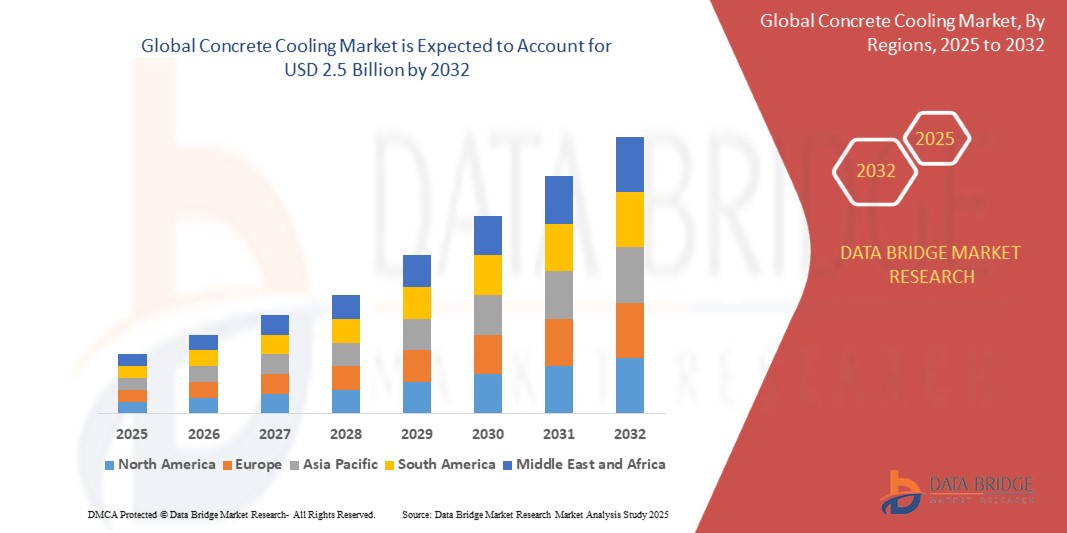
Concrete Cooling Market Size
- The global concrete cooling market size was valued at USD 1.2 billion in 2024 and is expected to reach USD 2.5 billion by 2032, at a CAGR of 8.1% during the forecast period
- The market growth is largely driven by the rising demand for temperature-controlled concrete in large-scale infrastructure projects to prevent early thermal cracking and improve durability, especially in regions with high ambient temperatures.
- Increasing urbanization, industrialization, and government investments in sustainable and resilient infrastructure facilitate widespread adoption of concrete cooling technologies.
- Growing complexity and scale of infrastructure projects such as highways, dams, and nuclear plants enhance the need for efficient hydration heat control techniques.
Concrete Cooling Market Analysis
- Concrete cooling encompasses methods to reduce the temperature of freshly poured concrete to minimize thermal stress and prevent cracking caused by heat generated during cement hydration.
- Techniques include water cooling, ice cooling, air cooling, and advanced liquid nitrogen cooling, tailored to varying project requirements and climates.
- Rising investments in infrastructure and construction globally, particularly in Asia-Pacific and the Middle East, are significant growth drivers.
- Increasing emphasis on construction quality, sustainability, and longevity of buildings motivates the use of innovative cooling technologies.
- Challenges include high capital expenditure for advanced cooling technologies and regulatory concerns about environmental impacts, but ongoing innovation in eco-efficient solutions mitigates these obstacles.
Report Scope and Concrete Cooling Market Segmentation
|
Attributes |
Concrete Cooling Key Market Insights |
|
Segments Covered |
|
|
Countries Covered |
North America
Europe
Asia-Pacific
Middle East and Africa
South America
|
|
Key Market Players |
|
|
Market Opportunities |
|
|
Value Added Data Infosets |
In addition to the insights on market scenarios such as market value, growth rate, segmentation, geographical coverage, and major players, the market reports curated by the Data Bridge Market Research also include in-depth expert analysis, pricing analysis, brand share analysis, consumer survey, demography analysis, supply chain analysis, value chain analysis, raw material/consumables overview, vendor selection criteria, PESTLE Analysis, Porter Analysis, and regulatory framework. |
Concrete Cooling Market Trends
Growing Adoption of Advanced and Sustainable Cooling Solutions
- Increasing integration of eco-friendly solutions such as liquid nitrogen cooling and automated temperature control technologies to reduce carbon footprints and energy consumption.
- Rising government investments in smart infrastructure encouraging real-time monitoring and optimized cooling efficiency.
- Infrastructure growth in hot climate areas accelerates demand for concrete cooling to prevent thermal cracking and project delays.
- Green building certifications and environmental regulations drive adoption of energy-efficient concrete cooling methods.
Concrete Cooling Market Dynamics
Driver
Expanding Infrastructure and Urbanization in Emerging and Developed Markets
- Rapid urbanization necessitates large-scale construction of highways, dams, ports, and nuclear facilities where controlling the heat of hydration is vital for durability.
- Government infrastructure spending and public-private partnerships drive demand for high-quality concrete through effective cooling methods.
- Sustainable construction practices and durability requirements encourage adoption of advanced cooling systems to extend service life of concrete structures.
- Smart city initiatives boost demand for integrated, automated cooling technologies that optimize construction timelines and quality.
Restraint/Challenge
High Initial Investments and Regulatory Compliance
- The cost of deploying advanced cooling systems such as liquid nitrogen and automated chillers can be prohibitive for smaller projects and contractors.
- Environmental regulations targeting energy consumption and emissions necessitate ongoing R&D to develop greener cooling technologies, increasing costs.
- Awareness gaps and technical limitations in emerging markets may delay adoption of sophisticated cooling solutions.
- Balancing cooling performance with energy efficiency is challenging as construction industries seek sustainable alternatives to traditional high-energy cooling methods.
Concrete Cooling Market Scope
The market is segmented on the basis of type, application, and end-user.
- By Type
On the basis of type, the concrete cooling market is segmented into water cooling, ice cooling, air cooling, and liquid nitrogen cooling. Water cooling holds the largest market share in 2024 due to its cost-effectiveness, ease of use, and adaptability across various construction projects. Ice cooling is also widely used, especially in large-scale infrastructure projects requiring significant temperature reduction. Liquid nitrogen cooling is the fastest-growing segment, favored in specialized applications such as nuclear plant construction due to its rapid and efficient cooling capabilities. Air cooling is utilized for specific scenarios where minimal moisture addition is desirable.
- By Application
On the basis of application, the market is segmented into highway construction, dams & locks, port construction, and nuclear plant construction. Highway construction dominates the market, driven by extensive road network development and maintenance needs. Dams & locks construction requires specialized cooling systems to manage large concrete pours and ensure structural integrity. Port construction is expanding with increasing global trade volumes, while nuclear plant construction demands the most advanced cooling technologies due to stringent safety and quality requirements.
- By End-User
On the basis of end-user, the market is segmented into commercial, industrial, and residential sectors. The commercial segment leads owing to large-scale infrastructure developments such as highways, bridges, and urban projects. Industrial end-users include factories and energy plants requiring durable concrete structures with temperature control. The residential segment is growing steadily, particularly in urban areas with high-rise buildings and complex construction that benefit from optimized concrete curing aided by cooling technologies.
Concrete Cooling Market Regional Analysis
- Asia-Pacific dominates the global concrete cooling market with the largest revenue share in 2024, driven by rapid urbanization, large infrastructure investments, and the need for temperature-controlled concrete in hot climate regions.
- Countries like China, India, Japan, and South Korea are leading contributors, supported by extensive manufacturing capacities and government initiatives promoting sustainable and resilient infrastructure development.
- The region's growing construction activity in highways, dams, ports, and nuclear plants fuels demand for advanced concrete cooling technologies. Affordable labor, availability of raw materials, and export-oriented construction services further strengthen the market position of Asia-Pacific.
U.S. Concrete Cooling Market Insight
The U.S. holds a significant share in the North American concrete cooling market, propelled by increasing investments in transportation infrastructure, energy projects, and urban development. Emphasis on construction quality and durability has led to widespread adoption of effective cooling methods such as water and liquid nitrogen cooling. Regulatory focus on sustainability and technological advancements in automated cooling systems are key growth drivers. The U.S. market benefits from mature construction standards demanding high-performance concrete with minimized thermal cracking.
Europe Concrete Cooling Market Insight
Europe is poised for robust growth in the concrete cooling market, driven by strict environmental and construction regulations, along with increasing infrastructure modernization projects. Countries like Germany, France, and the U.K. are frontrunners, actively deploying energy-efficient and IoT-enabled cooling systems in large-scale projects such as dams, highways, and energy plants. The region emphasizes sustainability and smart city initiatives, promoting adoption of automated cooling technologies to ensure efficient concrete curing and structural longevity.
U.K. Concrete Cooling Market Insight
The U.K. concrete cooling market is expected to experience steady growth due to expanding infrastructure projects and growing awareness of thermal management benefits in concrete construction. The construction industry is moving towards more sustainable practices, integrating advanced water and liquid nitrogen cooling technologies. Public and private infrastructure developments focused on highways, ports, and commercial buildings are major end-users driving demand.
Germany Concrete Cooling Market Insight
Germany continues to strengthen its concrete cooling market through technological innovation and adherence to stringent construction quality standards. The country’s robust industrial and infrastructure sectors, including automotive manufacturing plants and energy facilities, drive the need for optimized concrete temperature control. Environmental policies supporting energy-efficient and sustainable construction solutions foster active implementation of eco-friendly cooling methods.
Asia-Pacific Concrete Cooling Market Insight
Asia-Pacific dominates the global concrete cooling market with the largest revenue share in 2024, driven by rapid urbanization, large infrastructure investments, and the need for temperature-controlled concrete in hot climate regions. Countries like China, India, Japan, and South Korea are leading contributors, supported by extensive manufacturing capacities and government initiatives promoting sustainable and resilient infrastructure development. The region's growing construction activity in highways, dams, ports, and nuclear plants fuels demand for advanced concrete cooling technologies. Affordable labor, availability of raw materials, and export-oriented construction services further strengthen the market position of Asia-Pacific.
India Concrete Cooling Market Insight
India is expected to register the substantial CAGR in the global concrete cooling market, fueled by burgeoning urbanization, infrastructure development, and government initiatives such as “Smart Cities” and national highway expansion. Rising demand for durable and crack-free concrete structures across commercial, industrial, and residential projects amplifies adoption of effective cooling techniques including water and ice cooling. The increasing focus on sustainable construction and quality compliance further propels market growth.
China Concrete Cooling Market Insight
China leads Asia-Pacific and holds a dominant position in the global concrete cooling market, backed by massive infrastructure spending on highways, ports, and urban development. The government’s emphasis on sustainable construction, energy efficiency, and technological innovation encourages widespread use of advanced cooling technologies like liquid nitrogen cooling. Rapid urbanization, industrial growth, and smart city projects boost demand for automated and energy-saving cooling solutions, further expanding market size.
Concrete Cooling Market Share
The Concrete Cooling industry is primarily led by well-established companies, including:
- KTI-Plersch Kaltetechnik GmbH (Germany)
- Coldcrete Inc. (U.S.)
- Concool, LLC (U.S.)
- Kirloskar Pneumatic Company Limited (India)
- Lintec Germany GmbH (Germany)
- Bauer (Germany)
- Thermal Energy International (Canada)
- Gulf Coast Environmental Systems (U.S.)
- Giatec Scientific Inc. (Canada)
- Meissner Coolers GmbH (Germany)
Latest Developments in Global Concrete Cooling Market
- In April 2025 Thermal Energy International launched an IoT-enabled automated cooling system for large infrastructure projects ensuring precise thermal control.
- In March 2025 KTI-Plersch introduced an energy-efficient liquid nitrogen cooling technology tailored for nuclear plant construction.
- In February 2025 Coldcrete expanded production in Asia to meet growing demand for ice cooling in highway projects.
- In December 2024 Lintec Germany unveiled a next-generation water cooling system with enhanced scalability and energy efficiency.

- Interactive Data Analysis Dashboard
- Company Analysis Dashboard for high growth potential opportunities
- Research Analyst Access for customization & queries
- Competitor Analysis with Interactive dashboard
- Latest News, Updates & Trend analysis
- Harness the Power of Benchmark Analysis for Comprehensive Competitor Tracking
Global Concrete Cooling Market, Supply Chain Analysis and Ecosystem Framework
To support market growth and help clients navigate the impact of geopolitical shifts, DBMR has integrated in-depth supply chain analysis into its Global Concrete Cooling Market research reports. This addition empowers clients to respond effectively to global changes affecting their industries. The supply chain analysis section includes detailed insights such as Global Concrete Cooling Market consumption and production by country, price trend analysis, the impact of tariffs and geopolitical developments, and import and export trends by country and HSN code. It also highlights major suppliers with data on production capacity and company profiles, as well as key importers and exporters. In addition to research, DBMR offers specialized supply chain consulting services backed by over a decade of experience, providing solutions like supplier discovery, supplier risk assessment, price trend analysis, impact evaluation of inflation and trade route changes, and comprehensive market trend analysis.
Data collection and base year analysis are done using data collection modules with large sample sizes. The stage includes obtaining market information or related data through various sources and strategies. It includes examining and planning all the data acquired from the past in advance. It likewise envelops the examination of information inconsistencies seen across different information sources. The market data is analysed and estimated using market statistical and coherent models. Also, market share analysis and key trend analysis are the major success factors in the market report. To know more, please request an analyst call or drop down your inquiry.
The key research methodology used by DBMR research team is data triangulation which involves data mining, analysis of the impact of data variables on the market and primary (industry expert) validation. Data models include Vendor Positioning Grid, Market Time Line Analysis, Market Overview and Guide, Company Positioning Grid, Patent Analysis, Pricing Analysis, Company Market Share Analysis, Standards of Measurement, Global versus Regional and Vendor Share Analysis. To know more about the research methodology, drop in an inquiry to speak to our industry experts.
Data Bridge Market Research is a leader in advanced formative research. We take pride in servicing our existing and new customers with data and analysis that match and suits their goal. The report can be customized to include price trend analysis of target brands understanding the market for additional countries (ask for the list of countries), clinical trial results data, literature review, refurbished market and product base analysis. Market analysis of target competitors can be analyzed from technology-based analysis to market portfolio strategies. We can add as many competitors that you require data about in the format and data style you are looking for. Our team of analysts can also provide you data in crude raw excel files pivot tables (Fact book) or can assist you in creating presentations from the data sets available in the report.













