What is the Concrete Reinforcing Fiber Market Size and Growth Rate?
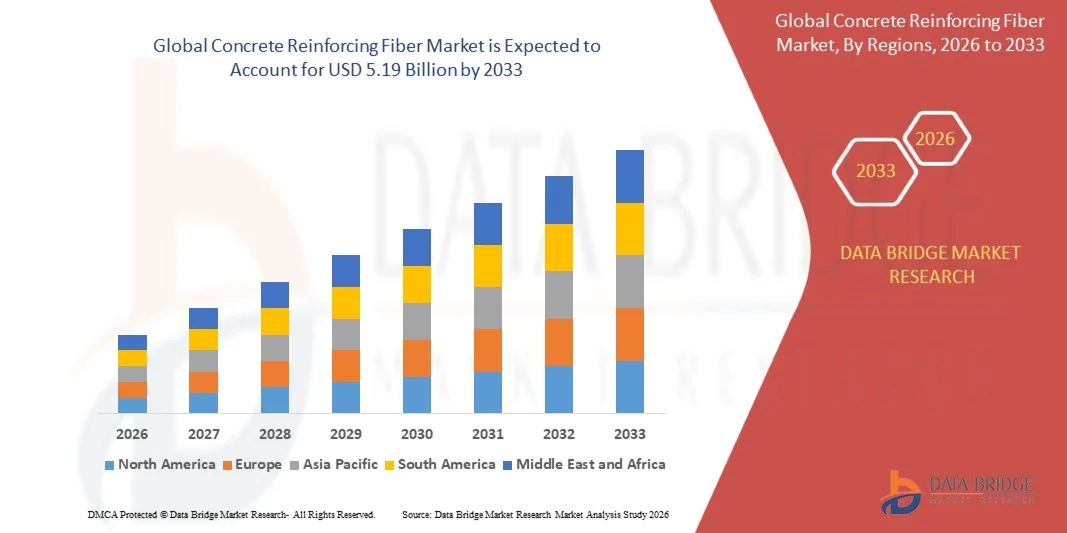
- As per Data Bridge Market Research analysis, the concrete reinforcing fiber market was valued at USD 3.26 billion in 2025 and is projected to reach USD 5.19 billion by 2033, growing at a CAGR of 6.00% from 2026 to 2033.
- The market is experiencing consistent growth driven by rising construction and infrastructure development, increasing demand for durable and high-performance concrete, and growing adoption of reinforcing fibers to improve crack resistance, load-bearing capacity, and structural longevity across residential, commercial, and industrial projects.
- Rapid urbanization and large-scale investments in transportation infrastructure, buildings, industrial facilities, and other heavy-load structures are encouraging the adoption of concrete reinforcing fibers. Polypropylene, steel, basalt, and polyethylene fibers are increasingly being used as efficient reinforcement solutions to reduce cracking, improve durability, lower maintenance requirements, and enhance the performance of concrete structures.
Market Size & Forecast
- Global Market Value (2025): USD 3.26 Billion
- Expected Market Value (2033): USD 5.19 Billion
- Forecast CAGR (2026–2033): 6.00%
- Leading Region in 2025: North America
- Fastest Growing Region: Asia Pacific
What are the Major Takeaways of the Concrete Reinforcing Fiber Market?
- North America dominated the concrete reinforcing fiber market with the largest revenue share of 35.2% in 2025, supported by significant infrastructure investments, advanced construction practices, and increasing adoption of fiber-reinforced concrete across commercial and industrial projects.
- Asia-Pacific is expected to be the fastest-growing region at a CAGR of 7.0% from 2026 to 2033, fueled by rapid urbanization, expanding infrastructure development, and rising construction activity across China, India, and Japan.
- The synthetic fiber segment led the market with a 38.6% share in 2025, driven by the increasing use of polymer-based fibers for crack control, toughness, durability, and impact resistance.
- Basalt fiber are the fastest-growing fiber type, projected to register a CAGR of 7.4%, reflecting the surge in demand for lightweight, corrosion-resistant, and durable reinforcement materials.
- The polypropylene segment dominated the vehicle type category with a 24.5% revenue share in 2025, led by its widespread application in concrete crack control and reinforcement
- Macro fibers accounted for 47% of the market share in 2025, preferred by their ability to provide structural reinforcement and improve post-cracking performance.
- The mining and tunnel segment is the fastest-growing application category, with a CAGR of 7.2%, driven by expanding underground construction, mining activities, and transportation tunnel development
Report Scope and Concrete Reinforcing Fiber Market Segmentation
|
Attributes |
Concrete Reinforcing Fiber Key Market Insights |
|
Segments Covered |
|
|
Countries Covered |
North America
Europe
Asia-Pacific
Middle East and Africa
South America
|
|
Key Market Players |
|
|
Market Opportunities |
|
|
Value Added Data Infosets |
In addition to the insights on market scenarios such as market value, growth rate, segmentation, geographical coverage, and major players, the market reports curated by the Data Bridge Market Research also include import export analysis, production capacity overview, production consumption analysis, price trend analysis, climate change scenario, supply chain analysis, value chain analysis, raw material/consumables overview, vendor selection criteria, PESTLE Analysis, Porter Analysis, and regulatory framework. |
What is the Key Trend in the Concrete Reinforcing Fiber Market?
- Construction companies are increasingly adopting advanced synthetic and macro-synthetic fibers to improve concrete durability, crack resistance, and structural performance while reducing dependence on conventional steel reinforcement and simplifying installation processes.
- For instance, in February 2025, MAPEI introduced Mapefibre ST 50 Twisted, a macro-synthetic fiber made from polypropylene and polyethylene resins for conventional concrete, precast concrete, and shotcrete. The product is designed to improve durability, reduce cracking, and in certain applications reduce the need for welded wire mesh or rebar.
- Fiber reinforcement is increasingly being integrated into tunnels, industrial floors, bridge decks, pavements, and precast structures, where corrosion resistance, durability, and faster construction are critical requirements.
- Hybrid and multi-fiber concrete systems are gaining attention as construction engineers combine different fiber types to enhance mechanical strength, crack control, durability, and thermal performance across demanding structural applications.
- For instance, in July 2025, MAPEI reported the use of Mapefibre ST 40 Plus macro-synthetic fibers in a modular precast construction project at MIND in Milan, where the fibers were incorporated into concrete-and-timber slabs and connectors to reduce conventional reinforcement while improving mechanical performance and sustainability
- As construction projects increasingly prioritize durability, faster installation, reduced reinforcement requirements, and high-performance concrete, the adoption of advanced fiber-reinforcement technologies is expected to accelerate, reinforcing fibers as an important component of modern concrete construction.
What are the Key Drivers of the Concrete Reinforcing Fiber Market?
- The rapid expansion of transportation infrastructure, tunnels, bridges, airports, industrial facilities, and urban construction has significantly increased demand for concrete reinforcing fibers capable of improving crack resistance, durability, toughness, and load-bearing performance.
- For instance, in October 2024, Bekaert, Société du Grand Paris, and Eiffage received the Solar Impulse Foundation’s Pioneer Award for using Dramix steel fibers in Line 16.1 of the Grand Paris Express. The application reduced steel and concrete requirements and was estimated to save 10,000 tons of CO₂ per 10 km of tunnels, demonstrating the role of fiber reinforcement in large-scale, sustainable infrastructure development.
- Construction contractors, infrastructure developers, and precast manufacturers are increasingly integrating fibers into concrete to reduce reinforcement congestion, accelerate installation, improve durability, and lower maintenance requirements across demanding construction environments.
- For instance, in January 2025, Bekaert highlighted the use of Dramix steel fibers in the Rishikesh–Karanprayag railway tunnel project in India, where fiber-reinforced concrete was adopted for demanding underground infrastructure conditions, demonstrating the increasing use of fiber reinforcement to improve tunnel durability and construction efficiency.
- With infrastructure development increasingly emphasizing longer service life, construction efficiency, and resilient structural materials, concrete reinforcing fibers will remain an important reinforcement solution for modern infrastructure and high-performance construction applications.
What Factors are Challenging the Growth of the Concrete Reinforcing Fiber Market?
- Concrete reinforcing fibers can involve significant material costs depending on fiber type, dosage, performance specifications, and application requirements, creating cost pressures for contractors and developers operating under strict construction budgets.
- For instance, in March 2025, article published in the Journal of CO₂ Utilization identified mixing difficulties, high cost, self-weight, and high carbon emissions as challenges associated with steel-fiber-reinforced high-performance cement composites, highlighting cost and processing barriers that can limit wider adoption of steel fibers.
- Fluctuations in steel, polypropylene, and other polymer raw-material prices can increase manufacturing costs and create pricing uncertainty for fiber producers, distributors, and construction companies.
- Contractors may also require specialized mix-design expertise, appropriate fiber dosage, and additional technical support to achieve consistent workability and reinforcement performance, particularly in large infrastructure and high-performance concrete applications.
- For instance, in April 2025, article published in Construction and Building Materials reported that low flowability is a major problem in ultra-high-performance fiber-reinforced concrete containing steel fibers, requiring the use of a specialized plasticizer to improve flowability and setting behavior, demonstrating the additional mix-design requirements associated with fiber reinforcement.
- The combination of raw-material price volatility, application-specific dosage requirements, technical design considerations, and cost sensitivity continues to challenge wider adoption, particularly in price-sensitive construction markets, despite the performance and durability benefits offered by fiber-reinforced concrete.
How is the Concrete Reinforcing Fiber Market Segmented?
The concrete reinforcing fiber market is segmented on the basis of fiber type, product, form, and application.
- By Fiber Type
On the basis of fiber type, the concrete reinforcing fiber market is segmented into synthetic fiber, steel fiber, glass fiber, natural fiber, basalt fiber, and others. The synthetic fiber segment dominated the market with a share of 38.6% in 2025, supported by the increasing use of polymer-based fibers for crack control, toughness, durability, and impact resistance. Synthetic fibers are widely incorporated into concrete mixes across residential, commercial, infrastructure, and industrial applications. Their resistance to corrosion provides an advantage over conventional metallic reinforcement in moisture-prone environments. Polypropylene-based fibers are particularly suitable for controlling shrinkage and early-age cracking. Their lightweight characteristics also simplify handling, transportation, and concrete mixing.
The basalt fiber segment is projected to register the fastest growth at CAGR of 7.4% during forecast period, driven by increasing demand for lightweight, corrosion-resistant, and durable reinforcement materials. Basalt fibers provide high tensile strength and resistance to chemicals, moisture, and elevated temperatures. They are increasingly being considered for infrastructure and construction applications exposed to aggressive environmental conditions. Growing concerns regarding corrosion of conventional steel reinforcement are encouraging interest in non-metallic alternatives. Improvements in basalt-fiber manufacturing and concrete-mix technologies are further supporting adoption. Increasing emphasis on long-lasting and low-maintenance construction materials is expected to accelerate the use of basalt fibers.
- By Product
On the basis of product, the concrete reinforcing fiber market is segmented into polyethylene, polypropylene, steel, basalt, and others. The polypropylene segment dominated the market with a share of 24.5% in 2025, supported by its widespread application in concrete crack control and reinforcement. Polypropylene fibers are lightweight, corrosion-resistant, and relatively easy to disperse throughout concrete mixtures. They are widely used in residential, commercial, industrial, and infrastructure construction. Their ability to reduce plastic shrinkage cracking makes them suitable for slabs, pavements, precast products, and other concrete applications. Polypropylene also offers a practical alternative where corrosion resistance is important.
The basalt segment is expected to witness the fastest growth at CAGR of 7.8% during forecast period, supported by increasing demand for corrosion-resistant and lightweight reinforcement solutions. Basalt fibers provide high mechanical performance while avoiding the corrosion concerns associated with metallic reinforcement. Their resistance to chemicals, moisture, and high temperatures makes them suitable for demanding construction environments. Increasing infrastructure development in harsh and corrosive conditions is creating additional demand for basalt reinforcement. Technological improvements are helping manufacturers develop basalt-fiber products with improved concrete compatibility. The growing shift toward durable and maintenance-efficient construction materials is expected to further accelerate basalt product adoption.
- By Form
On the basis of form, the concrete reinforcing fiber market is segmented into micro fibers, macro fibers, and hybrid fibers. The macro fibers segment dominated the market with share of 47% in 2025, supported by their ability to provide structural reinforcement and improve post-cracking performance. Macro fibers are widely used in industrial floors, shotcrete, pavements, tunnels, and precast applications requiring enhanced toughness. They improve crack resistance and contribute to the load-carrying performance of concrete structures. Their application can reduce reinforcement congestion and simplify concrete placement in suitable projects. Growing infrastructure development is increasing demand for macro-fiber reinforcement in demanding construction environments.
The hybrid fibers segment is projected to register the fastest growth at CAGR of 5.0% during forecast period, driven by increasing demand for concrete systems that combine multiple reinforcement characteristics. Hybrid systems can combine micro- and macro-fibers to address different stages and types of cracking. Micro fibers provide early-age crack control, while macro fibers contribute to post-cracking toughness and structural performance. This combination is attractive for high-performance concrete and demanding infrastructure applications. Increasing research into optimized fiber combinations is improving the technical performance of hybrid reinforcement systems. Growing demand for multifunctional concrete materials is encouraging adoption across specialized construction applications. The ability to tailor reinforcement performance to specific project requirements is further supporting growth.
- By Application
On the basis of application, the concrete reinforcing fiber market is segmented into infrastructure, residential and commercial, mining and tunnel, building and construction, and industrial. The infrastructure segment dominated the market with a share of 40.4% in 2025, driven by extensive use of fiber-reinforced concrete in roads, bridges, pavements, tunnels, airports, and other infrastructure projects. Fiber reinforcement improves crack resistance, durability, toughness, and service performance in structures exposed to heavy loads. Government investment in transportation and urban infrastructure is supporting demand for high-performance concrete materials. Fiber reinforcement can also reduce reinforcement congestion and improve construction efficiency. Growing emphasis on resilient infrastructure and lower maintenance requirements is further supporting adoption.
The mining and tunnel segment is expected to witness the fastest growth at CAGR of 7.2% during forecast period, supported by expanding underground construction, mining activities, and transportation tunnel development. Fiber-reinforced shotcrete is increasingly used for ground support because fibers improve toughness and crack resistance. Underground projects benefit from reduced reinforcement congestion and faster concrete application. Rising investments in metro systems, rail tunnels, highways, and mining infrastructure are further increasing demand. Steel and synthetic fibers are particularly suitable for challenging underground environments where durability and rapid installation are important. Increasing adoption of mechanized tunneling and advanced shotcrete technologies is expected to accelerate fiber usage in mining and tunnel applications.
Which Region Holds the Largest Share of the Concrete Reinforcing Fiber Market?
- North America dominated the concrete reinforcing fiber market with the largest revenue share of 35.2% in 2025, supported by significant infrastructure investments, advanced construction practices, and increasing adoption of fiber-reinforced concrete across commercial and industrial projects.
- The region also benefits from significant infrastructure rehabilitation requirements, growing demand for durable and low-maintenance construction materials, and established adoption of fiber reinforcement in roads, bridges, tunnels, industrial flooring, and other heavy-duty applications. Increasing emphasis on construction efficiency, crack resistance, and longer structural service life continues to strengthen North America’s leadership position in the global market.
U.S. Concrete Reinforcing Fiber Market Insight
The U.S. concrete reinforcing fiber market is witnessing strong growth due to rising investments in infrastructure modernization, transportation projects, industrial construction, and residential development. The country's mature construction sector, along with increasing adoption of polypropylene, steel, and advanced synthetic fibers, is driving demand across infrastructure, commercial, industrial, and building applications. In addition, growing emphasis on durable, crack-resistant, and low-maintenance concrete solutions is accelerating the adoption of reinforcing fibers in roads, bridges, industrial floors, and other construction projects.
Asia-Pacific Concrete Reinforcing Fiber Market Insight
The Asia-Pacific concrete reinforcing fiber market is expected to witness rapid growth, driven by increasing urbanization, expanding transportation infrastructure, and rising construction activity across countries such as China, India, and Japan. Growing investments in high-speed rail, metro systems, highways, industrial facilities, and residential construction are supporting demand for fiber-reinforced concrete solutions. In addition, increasing adoption of advanced reinforcement technologies, rising infrastructure development, and growing demand for durable and crack-resistant construction materials are accelerating market expansion across the region.
Japan Concrete Reinforcing Fiber Market Insight
The Japan concrete reinforcing fiber market is witnessing consistent growth due to rising infrastructure renovation requirements, advanced construction practices, and increasing demand for durable and earthquake-resilient structures. Construction companies and infrastructure developers are increasingly utilizing reinforcing fibers in concrete applications to improve crack resistance, toughness, and structural durability. Moreover, the country's focus on infrastructure rehabilitation, tunnel maintenance, and advanced construction materials is further contributing to the adoption of concrete reinforcing fibers in Japan.
China Concrete Reinforcing Fiber Market Insight
The China concrete reinforcing fiber market is growing rapidly, driven by increasing urbanization, expanding transportation infrastructure, and large-scale investments in railways, metro systems, industrial facilities, and construction projects. Growing adoption of steel and synthetic fibers for improving concrete durability, crack resistance, and structural performance is significantly boosting market demand. In addition, continued infrastructure development, expansion of industrial and warehouse construction, and increasing use of fiber-reinforced concrete in major construction projects are positioning China as a leading market for concrete reinforcing fibers in Asia-Pacific.
U.K. Concrete Reinforcing Fiber Market Insight
The U.K. concrete reinforcing fiber market is experiencing steady growth, supported by increasing infrastructure renovation, construction activity, and demand for durable and high-performance concrete solutions. Rising investments in transportation infrastructure, commercial construction, and building refurbishment are contributing to the adoption of reinforcing fibers across various applications. Furthermore, growing emphasis on sustainable construction, longer structural service life, and advanced reinforcement technologies is supporting the use of synthetic, steel, and other concrete reinforcing fibers in the U.K.
Germany Concrete Reinforcing Fiber Market Insight
The Germany concrete reinforcing fiber market is expanding steadily due to strong construction and infrastructure modernization activities, advanced engineering capabilities, and increasing demand for high-performance concrete solutions. Construction companies and infrastructure developers are increasingly adopting reinforcing fibers to enhance concrete durability, crack resistance, and structural performance across transportation, industrial, and building applications. Continuous infrastructure upgrades, stringent construction requirements, and growing demand for durable and sustainable construction materials are further driving concrete reinforcing fiber adoption in Germany.
Which are the Top Companies in Concrete Reinforcing Fiber Market?
The concrete reinforcing fiber industry is primarily led by well-established companies, including:
- Sika AG (Switzerland)
- Bekaert (Belgium)
- MAPEI (Italy)
- The Euclid Chemical Company (U.S.)
- FORTA Corporation (U.S.)
- Nycon, Inc. (U.S.)
- ABC Polymer Industries, LLC (U.S.)
- ADFIL NV (Belgium)
- Contec Fiber AG (Switzerland)
- CEMEX, S.A.B. de C.V. (Mexico)
- KrampeHarex GmbH & Co. KG (Germany)
- Officine Maccaferri S.p.A. (Italy)
- Fibercon International Inc. (U.S.)
- Advanced Fiber Solutions, Inc. (U.S.)
- Fiberfor (Israel)
- PioneerFibre Ltd. (China)
- Don Construction Products Ltd. (Jordan)
- AGT Products Inc. (U.S.)
- KURITE Materials and Services (Canada)
What are Latest Developments in Concrete Reinforcing Fiber Market?
- In July 2025, MAPEI expanded the use of Mapefibre ST 40 Plus macro-synthetic fibers in a modular precast construction project at MIND in Milan, where the fibers were incorporated into concrete-and-timber slabs and concrete connectors. The development was part of the second phase of the Modular Prefab Construction project and focused on improving mechanical performance, reducing conventional reinforcement requirements, and simplifying precast production.
- In October 2024, Bekaert, Société du Grand Paris, and Eiffage received the Solar Impulse Foundation Pioneer Award for the use of Dramix steel fiber-reinforced concrete in Line 16.1 of the Grand Paris Express. The project demonstrated the use of steel fibers as an alternative to traditional rebar reinforcement in tunnel construction, helping reduce steel and concrete consumption while supporting more sustainable infrastructure development.
- In July 2023, Sika increased production capacity for macro fibers at its Chattanooga, Tennessee plant, responding to growing demand for synthetic fiber reinforcement in the Americas. The capacity expansion strengthened Sika’s ability to supply macro fibers for concrete construction and mining applications, while supporting the use of reinforcement solutions that can reduce construction time and eliminate the need for conventional reinforcement assembly.
- In May 2023, Sika Corporation added new packaging and extrusion production lines at its SikaFiber plant in Chattanooga, Tennessee, increasing the facility’s concrete reinforcing fiber production capacity by up to 4 million pounds. The new extrusion line was designed to be approximately 30% more energy efficient than existing lines and incorporated advanced controllers, energy-efficient motors, and automated temperature controls.
- In September 2021, Sika launched SikaFiber-200 Végétal, a 100% plant-based cellulose microfiber for concrete. Developed as a natural alternative to polymer microfibers, the product is designed to improve resistance to early-age plastic-shrinkage cracking and can be used in slabs, industrial floors, decorative concrete, terraces, and other flatwork applications. The launch highlighted the industry's move toward bio-based and more sustainable concrete reinforcement technologies.

- Interactive Data Analysis Dashboard
- Company Analysis Dashboard for high growth potential opportunities
- Research Analyst Access for customization & queries
- Competitor Analysis with Interactive dashboard
- Latest News, Updates & Trend analysis
- Harness the Power of Benchmark Analysis for Comprehensive Competitor Tracking
Global Concrete Reinforcing Fiber Market, Supply Chain Analysis and Ecosystem Framework
To support market growth and help clients navigate the impact of geopolitical shifts, DBMR has integrated in-depth supply chain analysis into its Global Concrete Reinforcing Fiber Market research reports. This addition empowers clients to respond effectively to global changes affecting their industries. The supply chain analysis section includes detailed insights such as Global Concrete Reinforcing Fiber Market consumption and production by country, price trend analysis, the impact of tariffs and geopolitical developments, and import and export trends by country and HSN code. It also highlights major suppliers with data on production capacity and company profiles, as well as key importers and exporters. In addition to research, DBMR offers specialized supply chain consulting services backed by over a decade of experience, providing solutions like supplier discovery, supplier risk assessment, price trend analysis, impact evaluation of inflation and trade route changes, and comprehensive market trend analysis.
Data collection and base year analysis are done using data collection modules with large sample sizes. The stage includes obtaining market information or related data through various sources and strategies. It includes examining and planning all the data acquired from the past in advance. It likewise envelops the examination of information inconsistencies seen across different information sources. The market data is analysed and estimated using market statistical and coherent models. Also, market share analysis and key trend analysis are the major success factors in the market report. To know more, please request an analyst call or drop down your inquiry.
The key research methodology used by DBMR research team is data triangulation which involves data mining, analysis of the impact of data variables on the market and primary (industry expert) validation. Data models include Vendor Positioning Grid, Market Time Line Analysis, Market Overview and Guide, Company Positioning Grid, Patent Analysis, Pricing Analysis, Company Market Share Analysis, Standards of Measurement, Global versus Regional and Vendor Share Analysis. To know more about the research methodology, drop in an inquiry to speak to our industry experts.
Data Bridge Market Research is a leader in advanced formative research. We take pride in servicing our existing and new customers with data and analysis that match and suits their goal. The report can be customized to include price trend analysis of target brands understanding the market for additional countries (ask for the list of countries), clinical trial results data, literature review, refurbished market and product base analysis. Market analysis of target competitors can be analyzed from technology-based analysis to market portfolio strategies. We can add as many competitors that you require data about in the format and data style you are looking for. Our team of analysts can also provide you data in crude raw excel files pivot tables (Fact book) or can assist you in creating presentations from the data sets available in the report.