What is the Global Condensed Milk Market Size and Growth Rate?
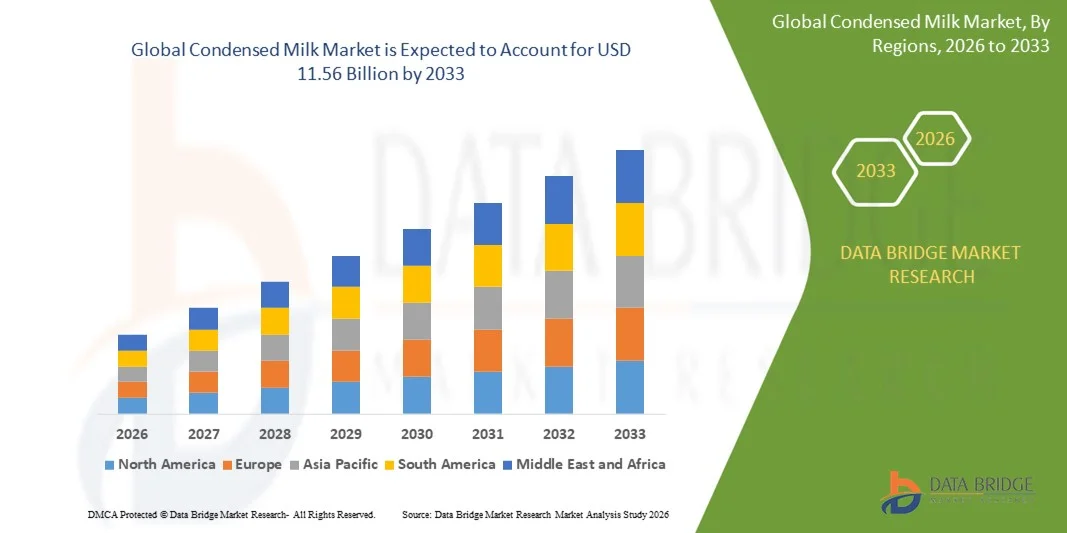
- As per Data Bridge Market Research analysis, global condensed milk market size was valued at USD 8.78 billion in 2025 and is expected to reach USD 11.56 billion by 2033, at a CAGR of 3.50% during the forecast period
- The market growth is largely fuelled by the increasing consumption of convenience dairy products, rising bakery and confectionery industries, and growing preference for shelf-stable milk products among consumers
- Expansion of organized retail and e-commerce platforms is supporting wider product accessibility and driving market adoption across both developed and emerging regions
Market Size & Forecast
Global Market Value (2025): USD 8.78 Billion
Expected Market Value (2033): USD 11.56 Billion
Forecast CAGR (2026–2033): 3.50%
What are the Major Takeaways of Condensed Milk Market?
- Growing urbanization, changing lifestyles, and increasing awareness of nutritional benefits are driving the adoption of condensed milk in households and foodservice applications
- Increasing use of condensed milk in desserts, beverages, and ready-to-eat food products is contributing to market expansion and boosting overall consumption
- North America dominated the condensed milk market with the largest revenue share of 35.42% in 2025, driven by the growing demand for convenient and fortified dairy products, as well as increasing awareness of nutritional benefits
- Asia-Pacific region is expected to witness the highest growth rate in the global condensed milk market, driven by increasing urbanization, rising health-consciousness, expansion of modern retail and online channels, and government initiatives supporting dairy consumption
- The Dairy segment held the largest market revenue share in 2025, driven by the widespread preference for milk-based condensed milk products in baking, confectionery, and beverage preparation. Dairy-based variants are favored for their rich taste, nutritional value, and versatility across multiple culinary applications
Report Scope and Condensed Milk Market Segmentation
|
Attributes |
Condensed Milk Key Market Insights |
|
Segments Covered |
|
|
Countries Covered |
North America
Europe
Asia-Pacific
Middle East and Africa
South America
|
|
Key Market Players |
|
|
Market Opportunities |
|
|
Value Added Data Infosets |
In addition to the insights on market scenarios such as market value, growth rate, segmentation, geographical coverage, and major players, the market reports curated by the Data Bridge Market Research also include in-depth expert analysis, pricing analysis, brand share analysis, consumer survey, demography analysis, supply chain analysis, value chain analysis, raw material/consumables overview, vendor selection criteria, PESTLE Analysis, Porter Analysis, and regulatory framework. |
What is the Key Trend in the Condensed Milk Market?
Rise of Value-Added and Fortified Condensed Milk
- The growing shift toward value-added and fortified condensed milk products is transforming the global condensed milk market by enabling enhanced nutrition and convenience for consumers. These products, such as flavored, low-sugar, and protein-enriched variants, allow households and foodservice providers to prepare desserts, beverages, and bakery items with ease, resulting in higher adoption across multiple applications. In addition, these innovations help brands differentiate their portfolios, attract health-conscious consumers, and expand into emerging markets
- The high demand for innovative flavors and fortified products is accelerating the introduction of diverse offerings. These products appeal to health-conscious consumers, parents seeking nutritious options for children, and small-scale food manufacturers looking for ready-to-use ingredients. Companies are increasingly investing in R&D to develop functional flavors and targeted nutrition solutions, boosting brand visibility and consumer engagement
- The affordability and wide availability of modern condensed milk products are making them attractive across various consumer segments. Supermarkets, modern trade outlets, and e-commerce platforms are increasingly stocking these products to meet evolving consumer preferences and convenience demands. Widespread distribution also allows smaller players to reach remote markets, further expanding market penetration
- For instance, in 2023, several dairy brands in North America and Europe reported significant growth in sales after launching flavored and fortified condensed milk products, catering to consumers seeking indulgence along with nutritional benefits. Such launches also contributed to increased brand loyalty and higher repeat purchase rates across retail and online channels
- While convenience and product innovation are driving market growth, long-term impact depends on continuous quality maintenance, product diversification, and addressing changing consumer expectations. Ongoing marketing campaigns and awareness initiatives are essential to educate consumers about the benefits of fortified and functional condensed milk products
Condensed Milk Market Dynamics
Driver
Rising Demand for Convenient and Nutritionally Enhanced Dairy Products
- Increasing awareness of nutrition and the need for convenient cooking ingredients are driving demand for condensed milk. Products offering enhanced taste, extended shelf life, and functional benefits are gaining traction among households and foodservice providers. This trend is further strengthened by growing adoption in cafes, bakeries, and restaurants seeking ready-to-use ingredients that reduce preparation time and maintain consistency
- Busy lifestyles and growing interest in home baking and beverage preparation are accelerating the adoption of ready-to-use condensed milk products. Consumers prefer easy-to-use solutions that provide consistent quality and flavor, boosting market penetration across urban and semi-urban areas. Social media trends and online recipe platforms are also influencing consumer behavior, creating higher engagement with DIY dessert and beverage recipes
- Expansion of retail and e-commerce channels is further supporting market growth. Organized supermarkets, specialty stores, and online platforms are enhancing product accessibility and visibility for a wide variety of condensed milk offerings. The integration of direct-to-consumer platforms and subscription models is also enabling brands to maintain steady revenue streams and strengthen customer relationships
- For instance, in 2022, several brands in the U.S. and Europe launched low-sugar and flavored condensed milk products, resulting in higher category sales and consumer acceptance. These launches also encouraged cross-promotion with other dairy and bakery products, driving incremental revenue and brand awareness
- While convenience and nutritional awareness are driving the market, ensuring product quality, safety, and continuous innovation remain essential to sustain adoption. Compliance with international food safety standards and certifications enhances consumer confidence and supports global market expansion
Restraint/Challenge
High Cost of Premium Condensed Milk and Competition from Alternative Dairy Products
- The relatively higher price of premium, fortified, or organic condensed milk compared to conventional products limits adoption among price-sensitive consumers. Cost remains a key barrier, particularly in emerging markets. In addition, fluctuating raw material costs and energy prices can further increase retail prices, impacting affordability and demand elasticity
- Intense competition from fresh milk, evaporated milk, and other dairy products reduces market penetration for condensed milk. Consumers often switch based on taste, price, and convenience preferences. The presence of private labels and store brands offering competitive pricing adds further pressure on established brands to maintain market share
- Supply chain fluctuations in raw materials such as milk solids, sugar, and flavorings can impact production costs and product pricing. Disruptions in logistics or ingredient quality may affect availability and consistency. Climate variability affecting dairy farming and transportation bottlenecks can further exacerbate supply chain vulnerabilities
- For instance, in 2023, reports indicated that rising milk and sugar prices constrained the expansion of premium condensed milk offerings in certain regions. The volatility prompted manufacturers to explore alternative sourcing strategies and cost-optimization initiatives to sustain profitability and meet demand
- While product innovation continues, addressing cost sensitivity, supply chain efficiency, and differentiation from alternative dairy products remains crucial to unlocking the full potential of the global condensed milk market. Investment in advanced processing technologies and strategic partnerships can help mitigate risks and support long-term market growth
How is the Condensed Milk Market Segmented?
The condensed milk market is segmented into five notable segments based on type, product type, packaging type, application, and distribution channel.
- By Type
On the basis of type, the market is segmented into Dairy and Non-Dairy. The Dairy segment held the largest market revenue share in 2025, driven by the widespread preference for milk-based condensed milk products in baking, confectionery, and beverage preparation. Dairy-based variants are favored for their rich taste, nutritional value, and versatility across multiple culinary applications.
The Non-Dairy segment is expected to witness the fastest growth rate from 2026 to 2033, driven by increasing consumer demand for plant-based and lactose-free alternatives. Non-dairy condensed milk products are gaining popularity among vegan and health-conscious consumers, expanding their adoption across urban and semi-urban markets.
- By Product Type
On the basis of product type, the market is segmented into Skimmed, Part Skimmed, Sweetened, Unsweetened, and Flavoured. The Sweetened segment held the largest market revenue share in 2025 due to its convenience in desserts, beverages, and bakery applications. Sweetened condensed milk provides consistent sweetness and texture, making it a preferred ingredient for both households and commercial food manufacturers.
The Flavoured segment is expected to witness the fastest growth rate from 2026 to 2033, driven by rising demand for innovative and indulgent flavors. Flavored variants such as chocolate, caramel, and coffee-infused condensed milk are increasingly incorporated into desserts and beverages, attracting young and experimental consumers.
- By Packaging Type
On the basis of packaging type, the market is segmented into Cans, Tubes, and Bottles. The Cans segment held the largest market revenue share in 2025, owing to its long shelf life, easy storage, and suitability for bulk usage in commercial and household settings.
The Tubes segment is expected to witness the fastest growth rate from 2026 to 2033, driven by convenience, portability, and single-use formats. Tube packaging appeals to on-the-go consumers and smaller households, enhancing ease of use and reducing waste.
- By Application
On the basis of application, the market is segmented into Bakery, Confectionery, Foods, Beverages, and Personal and Beauty Care. The Bakery segment held the largest market revenue share in 2025, fueled by the extensive use of condensed milk in cakes, pastries, and other baked goods. Its creamy texture and sweetness make it a key ingredient in commercial and home baking.
The Beverages segment is expected to witness the fastest growth rate from 2026 to 2033, driven by rising consumption of coffee, tea, smoothies, and other ready-to-drink beverages containing condensed milk. Increasing café culture and specialty drink trends are further supporting market growth.
- By Distribution Channel
On the basis of distribution channel, the market is segmented into Supermarkets and Hypermarkets, Convenience Stores, Specialty Stores, Online Retail, and Others. The Supermarkets and Hypermarkets segment held the largest market revenue share in 2025, owing to wide availability, competitive pricing, and promotional activities.
The Online Retail segment is expected to witness the fastest growth rate from 2026 to 2033, driven by e-commerce penetration, convenience, and the ability to access a wider variety of condensed milk products. Online platforms also enable direct-to-consumer delivery, subscription models, and targeted promotions, increasing adoption across diverse consumer segments.
Which Region Holds the Largest Share of the Condensed Milk Market?
- North America dominated the condensed milk market with the largest revenue share of 35.42% in 2025, driven by the growing demand for convenient and fortified dairy products, as well as increasing awareness of nutritional benefits
- Consumers in the region highly value the versatility, long shelf life, and ease of use offered by condensed milk across bakery, confectionery, and beverage applications
- This widespread adoption is further supported by high disposable incomes, urbanized populations, and the growing trend of home baking and culinary experimentation, establishing condensed milk as a staple ingredient for households and foodservice providers
U.S. Condensed Milk Market Insight
The U.S. condensed milk market captured the largest revenue share in 2025 within North America, fueled by the rising trend of ready-to-use and fortified dairy products. Consumers are increasingly prioritizing convenience and nutritional value in cooking and baking. The growing preference for flavored, low-sugar, and protein-enriched variants, combined with robust distribution through supermarkets and online retail platforms, further propels the condensed milk industry. Moreover, product innovation in premium and value-added offerings is significantly contributing to market expansion.
Europe Condensed Milk Market Insight
The Europe condensed milk market is expected to witness the fastest growth rate from 2026 to 2033, primarily driven by increasing demand for innovative flavors, fortified options, and ready-to-use dairy products. The rise in health-conscious consumers and the popularity of home baking are fostering the adoption of condensed milk. European consumers are also drawn to products offering long shelf life and multifunctional usage. The region is experiencing significant growth across bakery, confectionery, and beverage applications, with condensed milk being incorporated into both retail and foodservice channels.
U.K. Condensed Milk Market Insight
The U.K. condensed milk market is expected to witness the fastest growth rate from 2026 to 2033, driven by the rising trend of home baking, dessert preparation, and preference for nutritious and convenient dairy products. In addition, consumer interest in flavored and low-sugar variants is encouraging both households and small-scale food producers to use condensed milk. The U.K.’s strong retail infrastructure, alongside growing online sales channels, is expected to continue stimulating market growth.
Germany Condensed Milk Market Insight
The Germany condensed milk market is expected to witness the fastest growth rate from 2026 to 2033, fueled by increasing awareness of nutritional value, convenience, and product innovation in the dairy sector. Germany’s well-developed retail network and strong focus on quality and food safety promote the adoption of condensed milk, particularly in bakery, beverage, and confectionery applications. The integration of fortified and flavored products is becoming increasingly prevalent, aligning with evolving consumer preferences for functional and indulgent dairy options.
Asia-Pacific Condensed Milk Market Insight
The Asia-Pacific condensed milk market is expected to witness the fastest growth rate from 2026 to 2033, driven by rising urbanization, increasing disposable incomes, and growing awareness of convenience-oriented and fortified dairy products in countries such as China, India, and Japan. The region's inclination towards home cooking, supported by digital platforms promoting baking and beverage preparation, is driving adoption. Furthermore, as APAC emerges as a manufacturing hub for condensed milk products, affordability and accessibility are expanding to a wider consumer base.
Japan Condensed Milk Market Insight
The Japan condensed milk market is expected to witness the fastest growth rate from 2026 to 2033 due to the country’s growing interest in home baking, dessert preparation, and functional food products. Japanese consumers prioritize product quality, shelf life, and flavor variety, fueling demand for flavored and fortified condensed milk. The integration of convenient packaging formats such as tubes and bottles is also promoting adoption in both residential and commercial segments, alongside increasing use in cafes and bakeries.
China Condensed Milk Market Insight
The China condensed milk market accounted for the largest market revenue share in Asia Pacific in 2025, attributed to the country’s expanding middle class, rising urbanization, and high rates of consumer adoption of convenient and fortified dairy products. Condensed milk is becoming increasingly popular in bakery, beverage, and confectionery applications, both in homes and foodservice establishments. The push towards modern retail expansion and e-commerce platforms, alongside strong domestic manufacturers offering diverse product lines, are key factors propelling the market in China.
Which are the Top Companies in Condensed Milk Market?
The Condensed Milk industry is primarily led by well-established companies, including:
- Nestle (Switzerland)
- Eagle Family Foods Group LLC (U.S.)
- Puck (U.K.)
- Hochwald Foods GmbH (Germany)
- Arla Foods amba (Denmark)
- The J.M. Smucker Company (U.S.)
- GCMMF (India)
- Magnolia (Philippines)
- Goya Foods, Inc. (U.S.)
- F&N Foods Pte Ltd. (Singapore)
- Meijer, Inc. (U.S.)
- Sun Hing Foods, Inc. (Hong Kong)
- Dairy Farmers of America, Inc. (U.S.)
- Olvebra Industrial S/A (Brazil)
- Alaska Milk Corporation (Philippines)
- Borden Dairy Company (U.S.)
- Mlékárna Hlinsko, a.s. (Czech Republic)
- Dana Dairy (Slovakia)
- Santini Foods, Inc. (U.S.)
- Dutch Lady Milk Industries Bhd (Malaysia)
Latest Developments in Global Condensed Milk Market
- In April 2025, Soprole, a Chilean dairy manufacturer, expanded its product portfolio by launching condensed milk, aiming to meet growing consumer demand for versatile dairy products, enhancing its market presence and catering to dessert and beverage applications
- In January 2025, Galloway Company, a Wisconsin-based dairy ingredients manufacturer, completed a facility expansion at its Neenah operations with a custom-built evaporator, doubling its sweetened condensed milk production capacity and supporting increased supply for commercial and industrial customers
- In June 2024, Brancourts Dairy introduced condensed milk in an innovative 1.2 kg heatable, food-safe, transparent pouch, allowing bakers to visually monitor caramelization, achieve precise color and texture, and improve baking efficiency and product consistency
- In May 2024, LTH Food Industries launched Jersey Durian Flavored Sweetened Condensed Milk in the Philippines, targeting dessert manufacturing applications such as durian cakes, pie tarts, and pastillas, opening opportunities for flavor innovation and niche market growth

- Interactive Data Analysis Dashboard
- Company Analysis Dashboard for high growth potential opportunities
- Research Analyst Access for customization & queries
- Competitor Analysis with Interactive dashboard
- Latest News, Updates & Trend analysis
- Harness the Power of Benchmark Analysis for Comprehensive Competitor Tracking
Global Condensed Milk Market, Supply Chain Analysis and Ecosystem Framework
To support market growth and help clients navigate the impact of geopolitical shifts, DBMR has integrated in-depth supply chain analysis into its Global Condensed Milk Market research reports. This addition empowers clients to respond effectively to global changes affecting their industries. The supply chain analysis section includes detailed insights such as Global Condensed Milk Market consumption and production by country, price trend analysis, the impact of tariffs and geopolitical developments, and import and export trends by country and HSN code. It also highlights major suppliers with data on production capacity and company profiles, as well as key importers and exporters. In addition to research, DBMR offers specialized supply chain consulting services backed by over a decade of experience, providing solutions like supplier discovery, supplier risk assessment, price trend analysis, impact evaluation of inflation and trade route changes, and comprehensive market trend analysis.
Data collection and base year analysis are done using data collection modules with large sample sizes. The stage includes obtaining market information or related data through various sources and strategies. It includes examining and planning all the data acquired from the past in advance. It likewise envelops the examination of information inconsistencies seen across different information sources. The market data is analysed and estimated using market statistical and coherent models. Also, market share analysis and key trend analysis are the major success factors in the market report. To know more, please request an analyst call or drop down your inquiry.
The key research methodology used by DBMR research team is data triangulation which involves data mining, analysis of the impact of data variables on the market and primary (industry expert) validation. Data models include Vendor Positioning Grid, Market Time Line Analysis, Market Overview and Guide, Company Positioning Grid, Patent Analysis, Pricing Analysis, Company Market Share Analysis, Standards of Measurement, Global versus Regional and Vendor Share Analysis. To know more about the research methodology, drop in an inquiry to speak to our industry experts.
Data Bridge Market Research is a leader in advanced formative research. We take pride in servicing our existing and new customers with data and analysis that match and suits their goal. The report can be customized to include price trend analysis of target brands understanding the market for additional countries (ask for the list of countries), clinical trial results data, literature review, refurbished market and product base analysis. Market analysis of target competitors can be analyzed from technology-based analysis to market portfolio strategies. We can add as many competitors that you require data about in the format and data style you are looking for. Our team of analysts can also provide you data in crude raw excel files pivot tables (Fact book) or can assist you in creating presentations from the data sets available in the report.