


What is the Conductive Polymers Market Size and Growth Rate?
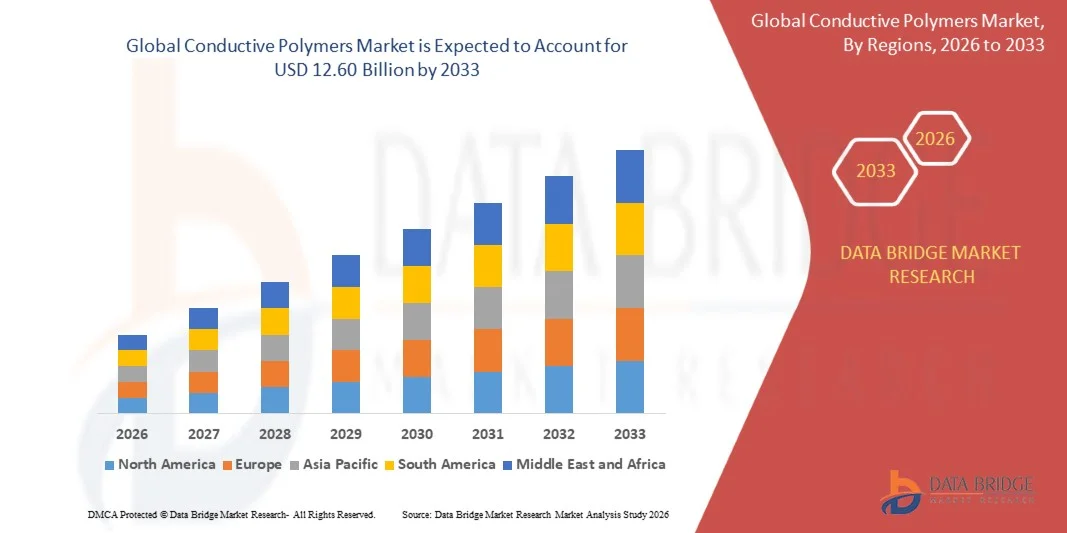
As per Data Bridge Market Research Analysis the Conductive Polymers Market was valued at USD 6.28 Billion in 2025 and is projected to reach USD 12.60 Billion by 2033, growing at a CAGR of 9.10% from 2026 to 2033. Conductive polymers, also known as intrinsically conducting polymers, are organic materials with a conjugated backbone that enables electron delocalization and supports electrical conductivity through chemical or electrochemical doping. These materials offer a unique combination of lightweight, flexibility, and biocompatibility, making them crucial for advanced applications in microelectronics, batteries, LEDs, solar cells, and biosensors.
The market is experiencing significant growth fueled by the rising demand for advanced electronic devices the proliferation of flexible and wearable electronics, growth in electric vehicles and energy storage systems, and the expansion of 5G infrastructure and IoT devices driving EMI shielding requirements. Their adoption in the electronics sector, particularly in printed circuit boards, sensors, and displays, showcases their performance and miniaturization potential. Additionally, the automotive industry leverages these materials for components including anti-static coatings and fuel systems.
Market Size & Forecast
- Global Market Value (2025): USD 6.28 Billion
- Expected Market Value (2033): USD 12.60 Billion
- Forecast CAGR (2026–2033): 9.10%
- Leading Region in 2025: Asia-Pacific
- Fastest Growing Region: North America
Key Market Trends & Insights
- Asia-Pacific dominated the Conductive Polymers Market with a share of 56.66% in 2025. The Asia-Pacific market for conductive polymers is estimated to grow from USD 5.3 billion in 2025 to USD 12.7 billion by 2033, at a CAGR of 10.5% from 2025 through 2030North America is a significant market for conductive polymers, with the North American market estimated to grow from USD 2.6 billion in 2025 to USD 3.9 billion by 2030, at a CAGR of 8%.
- The Electrically Conductive segment dominated the market by type, driven by demand for anti-static and electrostatic discharge (ESD) protection materials.
- The Electronics & Consumer Goods end-use industry accounted for the largest share, fueled by the proliferation of smartphones, wearables, and flexible .electronic devices
- The market is witnessing increased adoption of sustainable, low-impact materials and advances in scalable manufacturing such as roll-to-roll processing and conductive inks.
- Growing regulatory and OEM pressure for traceable and circular supply chains is shaping the competitive landscape.
- Intrinsically conductive polymers such as PEDOT: PSS, polyaniline (PANI), and polypyrrole (PPy) are the key materials dominating the market.
- The market faces challenges in standardizing performance benchmarks and resolving recycling cost barriers.
Report Scope and Conductive Polymers Market Segmentation
|
Attributes |
Conductive Polymers Key Market Insights |
|
Segments Covered |
|
|
Countries Covered |
North America
Europe
Asia-Pacific
Middle East and Africa
South America
|
|
Key Market Players |
|
|
Market Opportunities |
|
|
Value Added Data Infosets |
In addition to the insights on market scenarios such as market value, growth rate, segmentation, geographical coverage, and major players, the market reports curated by the Data Bridge Market Research also include import export analysis, production capacity overview, production consumption analysis, price trend analysis, climate change scenario, supply chain analysis, value chain analysis, raw material/consumables overview, vendor selection criteria, PESTLE Analysis, Porter Analysis, and regulatory framework. |
What is the Key Trend in the Conductive Polymers Market?
Trend:Rising Demand for Flexible and Wearable Electronics
The Conductive Polymers Market is experiencing significant growth driven by the increasing demand for flexible, lightweight, and efficient electronic devices across various industries such as electronics, automotive, healthcare, and energy. Conductive polymers are vital for applications such as wearables, biomedical devices, sensors, and printed/flexible circuitry. As technology advances and consumers favor smaller, lighter, and more efficient gadgets, the need for conductive polymers becomes increasingly pronounced. These materials provide superior conductivity, flexibility, and affordability, making them essential in a variety of applications such as printed circuit boards, sensors, displays, and other crucial electronic components.
Key Market Driver: Increasing Demand for Advanced Electronic Devices
A significant factor propelling the conductive polymers market is the rising demand for cutting-edge electronic devices. As technology advances and consumers favor smaller, lighter, and more efficient gadgets, the need for conductive polymers becomes increasingly pronounced. These materials provide superior conductivity, flexibility, and affordability, making them essential in a variety of applications such as printed circuit boards, sensors, displays, and other crucial electronic components. This growing preference for high-performance products drives the integration of conductive polymers across numerous industries, highlighting their vital role in enhancing the functionality and efficiency of modern electronics. The market is also benefiting from the rising demand for lightweight, flexible, and cost-effective electronic components.
Key Restraint/Challenge: High Production Costs and Standardization Issues
A significant challenge facing the conductive polymers market is the elevated production costs linked to these materials. While conductive polymers offer numerous beneficial characteristics, the processes required to manufacture them are often intricate and costly. Factors such as the expense of raw materials, the complexity of synthesis methods, and rigorous purification practices all contribute to high production costs. Additionally, the industry faces challenges in standardizing performance benchmarks and resolving recycling cost barriers. These challenges can limit market growth, particularly in cost-sensitive applications.
Key Market Opportunity: Expansion of 5G and IoT Infrastructure
The expansion of 5G infrastructure and the proliferation of Internet of Things (IoT) devices are creating significant opportunities for the conductive polymers market. These technologies require advanced EMI shielding and antistatic packaging solutions to ensure reliable performance. Conductive polymers are well-suited for these applications due to their lightweight, flexible, and processable properties. The growing demand for EMI shielding materials in telecommunications and consumer electronics is expected to drive market growth. Additionally, the development of new polymer formulations optimized for specific applications, such as 5G antennas and flexible electronics, presents further opportunities for market expansion.
Conductive Polymers Market Scope
How is the Conductive Polymers Market Segmented?
The conductive polymers market is segmented based on type, material, application, and end-use industry.
- By Type
On the basis of type, the Conductive Polymers Market is segmented into electrically conductive, thermally conductive and ESD/EMI shielding. The electrically conductive segment dominated the market, driven by demand for anti-static and electrostatic discharge (ESD) protection materials. These materials are widely used in electronics manufacturing, where static electricity can damage sensitive components. Thermally conductive polymers are gaining traction in applications requiring heat dissipation, such as LED lighting and power electronics. ESD/EMI shielding materials are increasingly important in telecommunications, automotive electronics, and aerospace applications, where electromagnetic interference must be managed to ensure device reliability and safety. The proliferation of 5G infrastructure and IoT devices is creating substantial demand for EMI shielding solutions. The growing emphasis on miniaturization and lightweighting in electronic devices is further driving the adoption of conductive polymers over traditional metal-based shielding solutions. The development of advanced polymer composites with enhanced shielding effectiveness is expanding the application scope across multiple industries.
- By Material
On the basis of material, the Conductive Polymers Market is segmented into polyaniline, polypyrrole, PEDOT:PSS, polyacetylene and others. PEDOT:PSS is a widely used conductive polymer due to its excellent transparency and conductivity, making it ideal for applications such as touch screens, OLEDs, and solar cells. Polyaniline is valued for its environmental stability and tunable conductivity, finding applications in antistatic coatings, sensors, and corrosion protection. Polypyrrole is known for its biocompatibility and is used in biomedical sensors and actuators. Other materials, such as polyacetylene and P3HT, are used in specialized applications including organic photovoltaics and flexible electronics. The increasing focus on sustainable and environmentally friendly materials is driving research into bio-based and biodegradable conductive polymers. Technological advancements in polymer synthesis and processing are improving the performance, stability, and cost-effectiveness of conductive polymer materials. The development of novel conductive polymer composites and nanocomposites is enabling enhanced electrical, thermal, and mechanical properties for advanced applications across multiple end-use industries.
- By Application
On the basis of application, the Conductive Polymers Market is segmented into ESD/EMI shielding, antistatic packaging, electrostatic coating, capacitors, sensors, printed circuit boards, displays and others. ESD/EMI shielding is the largest application segment, driven by the need to protect electronic components from electrostatic discharge and electromagnetic interference. Antistatic packaging is widely used in the electronics industry to prevent damage to sensitive components during storage and transport. Electrostatic coating applications are growing in the automotive and industrial sectors. Sensors and printed circuit boards represent high-growth application areas, supported by the proliferation of IoT devices and flexible electronics. The displays segment is benefiting from the increasing adoption of OLED and flexible display technologies. The development of printed and flexible electronics is creating new opportunities for conductive polymers in applications such as wearable devices, smart packaging, and flexible displays. Continuous innovation in conductive polymer formulations and processing techniques is expanding the range of applications and improving product performance.
- By End-Use Industry
On the basis of end-use industry, the Conductive Polymers Market is segmented into electronics & consumer goods, automotive, aerospace & defense, healthcare, energy & power, semiconductor, industrial & packaging and others. The Electronics & Consumer Goods segment accounted for the largest share, fueled by the proliferation of smartphones, wearables, and flexible electronic devices. The automotive segment is growing due to the increasing electrification of vehicles and the need for lightweight, conductive materials for batteries, sensors, and electronic control units. The Energy & Power segment is expanding with the growth of renewable energy and battery technologies. The Healthcare segment is emerging as a key growth area, driven by the development of bio-compatible conductive polymers for medical devices and biosensors. The Aerospace & Defense segment is adopting conductive polymers for lightweight electromagnetic interference shielding and antistatic coatings. The versatility of conductive polymers, combined with ongoing technological advancements, is enabling their penetration into new end-use industries. The Semiconductor and Industrial & Packaging segments are also contributing to market growth through increasing adoption of antistatic materials and electrostatic discharge protection solutions.
Which Region Holds the Largest Share of the Conductive Polymers Market?
Asia-Pacific Conductive Polymers Market Insight
Asia-Pacific dominated the Conductive Polymers Market with a share of approximately 56.66% in 2025. The region's leadership is driven by rapid industrialization, growing electronics manufacturing, and increasing demand for advanced electronic devices across countries such as China, India, Japan, and South Korea. The Asia-Pacific market for conductive polymers is estimated to grow from USD 5.3 billion in 2025 to USD 8.7 billion by 2030, at a CAGR of 10.5%. China, the world's second largest economy, is forecast to reach a projected market size of USD 1.7 billion by 2032, trailing a CAGR of 11.4%. The region's expanding electronics manufacturing base, coupled with rising investments in flexible electronics and wearable devices, is expected to maintain Asia-Pacific's dominance throughout the forecast period.
North America Conductive Polymers Market Insight
North America is a significant market for conductive polymers, with the North American market estimated to grow from USD 2.6 billion in 2025 to USD 3.9 billion by 2030, at a CAGR of 8%. The conducting polymers market in the U.S. is estimated at USD 1.3 billion in 2025. The region's strong industrial infrastructure and widespread use of conductive materials across healthcare, automotive, aerospace, and electronics applications drive market growth. The presence of key players such as DuPont, 3M, and Lubrizol, along with strong venture capital funding for advanced materials startups, further supports regional market expansion.
Europe Conductive Polymers Market Insight
Europe is a key market for conductive polymers, driven by stringent environmental regulations, strong automotive manufacturing, and growing demand for sustainable materials. Key players such as Heraeus Epurio, Covestro AG, and Merck KGaA are headquartered in Europe, strengthening the region's market position. The region's focus on innovation, sustainability, and compliance with REACH and RoHS regulations is shaping the European conductive polymers landscape. The automotive industry automotive industry's shift toward electric vehicles is also driving demand for conductive polymers in battery and electronic applications.
Latin America Conductive Polymers Market Insight
Latin America represents an emerging market for conductive polymers, with growing demand influenced by increasing investments in electronics manufacturing, automotive production, and renewable energy. Countries such as Brazil and Mexico are witnessing significant investments in electronics manufacturing and automotive assembly, creating opportunities for conductive polymer applications. The region's expanding industrial base and growing awareness of advanced materials are driving market growth. However, market growth is currently constrained by limited regulatory frameworks, higher technology costs compared to developed regions, and fragmented policy support. The development of regional supply chains and partnerships with global material technology providers is expected to accelerate market growth.
Middle East & Africa Conductive Polymers Market Insight
The Middle East and Africa region represents a nascent market for conductive polymers, with demand primarily concentrated in the GCC countries and South Africa. Governments across the region are increasing investments in advanced materials and technology sectors to diversify their economies. The UAE and Saudi Arabia are investing in electronics manufacturing and renewable energy infrastructure, creating opportunities for conductive polymer applications. South Africa is gradually adopting advanced materials to support the growing demand for electronics and automotive components. Increasing investments from global material technology providers and the availability of low-cost energy in the region are improving the commercial viability of conductive polymer projects. However, relatively low adoption of advanced materials, limited manufacturing infrastructure, and high costs continue to restrain market growth.
Conductive Polymers Market Share
The Conductive Polymers industry is primarily led by well-established companies, including:
- Heraeus Epurio (Germany)
- SABIC (Saudi Arabia)
- Covestro AG (Germany)
- DuPont de Nemours, Inc. (U.S.)
- Celanese Corporation (U.S.)
- 3M Company (U.S.)
- The Lubrizol Corporation (U.S.)
- Solvay S.A. (Belgium)
- Merck KGaA (Germany)
- Sumitomo Chemical Co., Ltd. (Japan)
- Avient Corporation (U.S.)
- RTP Company (U.S.)
- Premix OY (Finland)
- Agfa-Gevaert N.V. (Belgium)
- Henkel AG & Co. KGaA (Germany)
- Nagase & Co., Ltd. (Japan)
- Ormecon GmbH (Germany)
- Lehmann & Voss & Co. KG (Germany)
- Nofia Solutions BV (Belgium)
What are Latest Developments in Conductive Polymers Market?
- In April 2026, Covestro, in collaboration with FILK Freiberg Institute and OUT e.V., developed a flexible, conductive polymer smart textile system. The project used water-based Impranil® polyurethane dispersions from Covestro with incorporated carbon nanotubes to create a conductive surface, enabling sensor-integrated smart textiles for healthcare, personal protection, and automotive applications.
- In December 2025, Heraeus Epurio launched Clevios™ P SB, a new organic solvent-based PEDOT dispersion for transparent, antistatic pressure sensitive adhesives (AS-PSA) used in display films.
- In August 2025, Covestro successfully completed the acquisition of Pontacol, a Swiss manufacturer of multilayer adhesive films, effective August 28, 2025. The acquisition expanded Covestro's specialty films business with highly specialized flat and blown films, strengthening its advanced materials portfolio for electronics, healthcare, transportation, and textile industries.
- In June 2025, Covestro signed an agreement to acquire Pontacol, a Swiss manufacturer of multilayer adhesive films. The acquisition supports the company's "Sustainable Future" strategy by expanding its specialty films portfolio for high-performance applications.
- In June 2025, Agfa-Gevaert showcased its PEDOT:PSS conductive polymer materials and conductive polymer inks at TechBlick 2025, while highlighting its expanded electronics materials portfolio following the acquisition of Clariant's PRELECT portfolio of nano-silver inks.
- In February 2025, SABIC introduced the Noryl GTX LMX310 conductive polymer, the first in a new family of conductive PPE blends for inline paintable automotive exteriors. The material offers 85% less moisture absorption than PA-based polymers, reducing warpage risk by up to 90%, and is suitable for electric vehicle service flaps and charging port covers.
- In January 2025, Nofia Solutions BV completed the acquisition of FRX Polymers, Inc. on January 23, 2025. FRX Polymers develops and markets the patented Nofia® family of flame-retardant polymers. The acquisition strengthens the company's ability to address the growing demand for halogen- and PFAS-free flame-retardant solutions used in electrical and electronic applications.

- Interactive Data Analysis Dashboard
- Company Analysis Dashboard for high growth potential opportunities
- Research Analyst Access for customization & queries
- Competitor Analysis with Interactive dashboard
- Latest News, Updates & Trend analysis
- Harness the Power of Benchmark Analysis for Comprehensive Competitor Tracking
Global Conductive Polymers Market, Supply Chain Analysis and Ecosystem Framework
To support market growth and help clients navigate the impact of geopolitical shifts, DBMR has integrated in-depth supply chain analysis into its Global Conductive Polymers Market research reports. This addition empowers clients to respond effectively to global changes affecting their industries. The supply chain analysis section includes detailed insights such as Global Conductive Polymers Market consumption and production by country, price trend analysis, the impact of tariffs and geopolitical developments, and import and export trends by country and HSN code. It also highlights major suppliers with data on production capacity and company profiles, as well as key importers and exporters. In addition to research, DBMR offers specialized supply chain consulting services backed by over a decade of experience, providing solutions like supplier discovery, supplier risk assessment, price trend analysis, impact evaluation of inflation and trade route changes, and comprehensive market trend analysis.
Data collection and base year analysis are done using data collection modules with large sample sizes. The stage includes obtaining market information or related data through various sources and strategies. It includes examining and planning all the data acquired from the past in advance. It likewise envelops the examination of information inconsistencies seen across different information sources. The market data is analysed and estimated using market statistical and coherent models. Also, market share analysis and key trend analysis are the major success factors in the market report. To know more, please request an analyst call or drop down your inquiry.
The key research methodology used by DBMR research team is data triangulation which involves data mining, analysis of the impact of data variables on the market and primary (industry expert) validation. Data models include Vendor Positioning Grid, Market Time Line Analysis, Market Overview and Guide, Company Positioning Grid, Patent Analysis, Pricing Analysis, Company Market Share Analysis, Standards of Measurement, Global versus Regional and Vendor Share Analysis. To know more about the research methodology, drop in an inquiry to speak to our industry experts.
Data Bridge Market Research is a leader in advanced formative research. We take pride in servicing our existing and new customers with data and analysis that match and suits their goal. The report can be customized to include price trend analysis of target brands understanding the market for additional countries (ask for the list of countries), clinical trial results data, literature review, refurbished market and product base analysis. Market analysis of target competitors can be analyzed from technology-based analysis to market portfolio strategies. We can add as many competitors that you require data about in the format and data style you are looking for. Our team of analysts can also provide you data in crude raw excel files pivot tables (Fact book) or can assist you in creating presentations from the data sets available in the report.













