


What is the Conductive Textile Materials Market Size and Growth Rate?
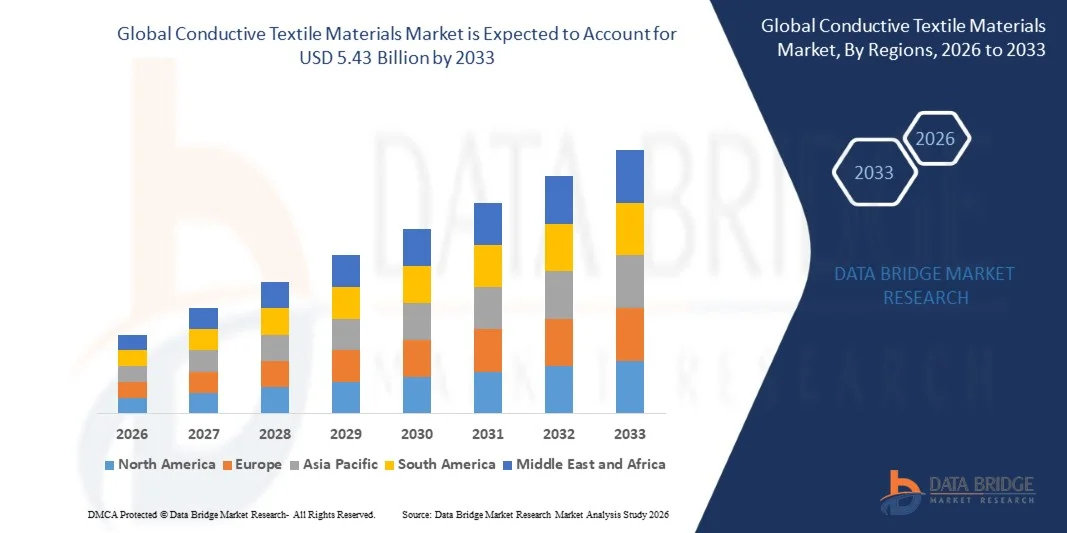
- As per Data Bridge Market Research analysis, the conductive textile materials market was valued at USD 2.75 billion in 2025 and is projected to reach USD 5.43 billion by 2033, growing at a CAGR of 8.9% from 2026 to 2033.
- The market is experiencing consistent growth driven by increasing demand for smart fabrics, wearable electronics, healthcare monitoring solutions, military applications, and advancements in textile technology. Conductive textiles, developed by integrating conductive materials such as metals and carbon into fabrics including cotton, polyester, nylon, and wool, are enabling advanced functionalities.
- The rising adoption of wearable electronics, combined with growing demand for lightweight, flexible, and multifunctional materials, is compelling industries including healthcare, defense, sports, automotive, and consumer electronics to adopt conductive textile solutions. These materials are increasingly used for electromagnetic shielding, static dissipation, signal transmission, and real-time health monitoring applications, supporting the development of next-generation smart clothing and electronic textile systems.
Market Size & Forecast
- Global Market Value (2025): USD 2.75 Billion
- Expected Market Value (2033): USD 5.43 Billion
- Forecast CAGR (2026–2033): 8.9%
- Leading Region in 2025: North America
- Fastest Growing Region: Asia-Pacific
What are the Major Takeaways of the Conductive Textile Materials Market?
- North America dominated the conductive textile materials market with the largest revenue share in 2025, supported by strong demand for smart textiles, wearable electronics, advanced healthcare monitoring solutions, and increasing adoption of conductive fabrics in defense and aerospace applications.
- Asia-Pacific is expected to be the fastest-growing region from 2026 to 2033, fueled by rising investments in smart textile manufacturing, expanding electronics and automotive industries, increasing adoption of wearable technologies, and growing demand from emerging economies such as China, India, and Japan.
- The metal-based conductive textile materials segment led the market in 2025, driven by their superior electrical conductivity, excellent electromagnetic interference (EMI) shielding performance, and widespread adoption across aerospace, defense, automotive, and electronics applications.
- Conductive polymer-based textile materials are the fastest-growing material type, reflecting the surge in demand for flexible, lightweight, and wearable electronic textile solutions.
- The synthetic fibers segment dominated the base textile material category in 2025, led by extensive utilization of polyester, nylon, and other synthetic materials due to their durability, flexibility, and compatibility with conductive coatings.
- Weaving with conductive yarns accounted for largest market share in 2025, preferred by its ability to integrate conductive properties directly into textile structures while maintaining flexibility and mechanical strength.
- The ultra-high conductivity segment is the fastest-growing electrical conductivity category, driven by rising demand for advanced conductive textiles requiring maximum electrical efficiency
Report Scope and Conductive Textile Materials Market Segmentation
|
Attributes |
Conductive Textile Materials Key Market Insights |
|
Segments Covered |
|
|
Countries Covered |
North America
Europe
Asia-Pacific
Middle East and Africa
South America
|
|
Key Market Players |
|
|
Market Opportunities |
|
|
Value Added Data Infosets |
In addition to the market insights such as market value, growth rate, market segments, geographical coverage, market players, and market scenario, the market report curated by the Data Bridge Market Research team includes in-depth expert analysis, import/export analysis, pricing analysis, production consumption analysis, and pestle analysis. |
What is the Key Trend in the Conductive Textile Materials Market?
- The increasing integration of conductive textiles with smart wearable devices is driving innovation in flexible electronics, healthcare monitoring systems, and connected clothing solutions requiring lightweight and highly functional materials.
- Conductive textile manufacturers are increasingly developing fabrics embedded with sensors, conductive fibres, and electronic components to enable real-time data collection and seamless interaction between textiles and digital systems.
- For instance, in May 2025, researchers at ETH Zurich developed “SonoTextiles,” a smart textile technology that integrates flexible glass fibres and acoustic sensing components into fabrics to enable touch, pressure, movement, and respiratory monitoring applications.
- Real-time monitoring capabilities enable conductive textiles to measure physiological parameters, transmit signals, and support applications across healthcare, sports performance, and industrial safety environments.
- Smart textile developers and research institutions are leveraging conductive materials to create self-powered, flexible, and multifunctional textile systems for emerging Internet of Things (IoT) applications.
- For instance, in February 2024, researchers published an article on porous conductive textiles, highlighting their lightweight, flexible, breathable, and wearable characteristics for next-generation electronic textiles, including healthcare monitoring and wearable electronics applications
- As demand for connected devices, wearable electronics, and intelligent textile solutions continues to expand, conductive textiles are expected to become a key component in the development of future smart and adaptive textile ecosystems.
What are the Key Drivers of the Conductive Textile Materials Market?
- The rapid growth of wearable electronics and healthcare monitoring technologies has significantly increased demand for conductive textile materials capable of enabling flexible sensors, biosignal detection, and continuous patient monitoring solutions.
- Medical device manufacturers, healthcare providers, and technology companies are integrating conductive fabrics into smart garments to improve remote monitoring, rehabilitation systems, and personalized healthcare applications.
- For instance, in May 2024, Smartex showcased its AI-powered textile manufacturing solutions at ITM 2024, highlighting real-time monitoring, quality control, and data-driven optimization capabilities for modern textile production
- Conductive textiles provide advantages such as flexibility, lightweight design, comfort, and durability, making them suitable alternatives to conventional electronic components used in wearable and connected systems.
- For instance, in April 2024, Smartex announced its Modern Textile Factory initiative focused on building data-driven textile supply chains through real-time data utilization and digital transformation of textile manufacturing processes.
- With increasing adoption of wearable healthcare devices, IoT-enabled products, and flexible electronic systems, conductive textile materials will remain essential for developing advanced connected and multifunctional textile solutions.
Which Factors are Challenging the Growth of the Conductive Textile Materials Market?
- High manufacturing costs associated with conductive fibres, advanced coating technologies, and integration of electronic components create significant challenges for widespread adoption of conductive textile materials.
- The complexity of combining textile properties with electrical conductivity increases production requirements, limiting scalability among small manufacturers and cost-sensitive end users.
- For instance, in October 2024, researchers published an article on electronic textiles highlighting that durability, washability, flexibility, and fabrication complexity remain major challenges affecting the commercialization of conductive textile-based wearable systems.
- Conductive textiles require specialized manufacturing processes and advanced material technologies, which increase investment requirements compared with conventional textile production methods.
- For instance, in January 2024, Nature Reviews Electrical Engineering highlighted that achieving scalable manufacturing, sustainable production, and cost-effective commercialization remains a significant barrier for electronic textiles before widespread market adoption.
- The high production costs, technical complexity, and limited standardization of conductive textile manufacturing continue to restrict market penetration, particularly in emerging economies and price-sensitive applications.
How is the Conductive Textile Materials Market Segmented?
The conductive textile materials market is segmented on the basis of material type, base textile material, manufacturing technology, electrical conductivity, functionality, and end user.
- By Material Type
On the basis of material type, the conductive textile materials market is segmented into metal-based conductive textile materials, carbon-based conductive textile materials, and conductive polymer-based textile materials. The metal-based conductive textile materials segment dominated the market in 2025 with the largest revenue share, owing to their superior electrical conductivity, excellent electromagnetic interference (EMI) shielding performance, and widespread adoption across aerospace, defense, automotive, and electronics applications. Metal-based conductive materials such as silver, copper, nickel, and stainless steel are extensively used for developing conductive fabrics requiring high electrical performance and durability. These materials are preferred in applications including antistatic textiles, shielding garments, and electronic textile components due to their reliable conductivity. Increasing demand for protection against electromagnetic radiation from electronic devices is supporting segment growth. Their high efficiency in signal transmission and shielding applications continues to strengthen market dominance. However, higher raw material costs compared with alternative conductive materials remain a key challenge.
The conductive polymer-based textile materials segment is projected to register the fastest growth during the forecast period, driven by increasing demand for flexible, lightweight, and wearable electronic textile solutions. Conductive polymers provide improved flexibility, stretchability, and compatibility with textile manufacturing processes compared with traditional conductive materials. These materials are increasingly used in smart clothing, healthcare monitoring systems, flexible sensors, and wearable electronics. Growing demand for comfortable and skin-friendly electronic textiles is accelerating adoption. Advancements in conductive polymer formulations are improving electrical performance, durability, and washability. Increasing research activities focused on flexible electronics and smart textile applications are expected to further support segment expansion.
- By Base Textile Material
On the basis of base textile material, the conductive textile materials market is segmented into natural fibers, synthetic fibers, and high-performance fibers. The synthetic fibers segment dominated the market in 2025 with the largest revenue share, supported by extensive utilization of polyester, nylon, and other synthetic materials due to their durability, flexibility, and compatibility with conductive coatings. Synthetic fibers provide high mechanical strength, lightweight properties, and resistance to environmental conditions, making them suitable for conductive textile applications. These fibers are widely used in wearable electronics, automotive textiles, industrial fabrics, and EMI shielding products. Their cost-effectiveness and suitability for large-scale textile manufacturing processes are strengthening adoption. Increasing demand for durable and affordable smart textile solutions is contributing to segment growth. However, sustainability concerns associated with synthetic fibers are encouraging manufacturers to explore alternative materials.
The high-performance fibers segment is projected to register the fastest growth during the forecast period, driven by increasing demand for advanced conductive textiles in aerospace, defense, and industrial safety applications. High-performance fibers offer superior strength, thermal stability, and resistance to harsh environmental conditions. These properties make them suitable for protective clothing integrated with conductive functionalities. Growing adoption of advanced military wearables and protective equipment is supporting market expansion. Increasing investments in lightweight and durable materials are further accelerating demand. The ability of high-performance fibers to maintain structural integrity under extreme conditions is expected to create new opportunities in specialized conductive textile applications.
- By Manufacturing Technology
On the basis of manufacturing technology, the conductive textile materials market is segmented into conductive fiber spinning, conductive printing, dip coating, spray coating, lamination, embroidery with conductive threads, weaving with conductive yarns, and others. The weaving with conductive yarns segment dominated the market in 2025 with the largest revenue share, owing to its ability to integrate conductive properties directly into textile structures while maintaining flexibility and mechanical strength. This technology enables the production of durable conductive fabrics used in smart clothing, EMI shielding materials, and wearable electronic applications. Conductive yarn weaving allows manufacturers to utilize existing textile production infrastructure, supporting large-scale manufacturing. These textiles provide consistent electrical pathways and improved durability compared with surface-treated materials. Growing demand for long-lasting electronic textile solutions is strengthening adoption. However, achieving uniform conductivity during high-volume production remains a technical challenge.
The conductive printing segment is projected to register the fastest growth during the forecast period, driven by increasing adoption of printed electronics and flexible textile-based sensor technologies. Conductive printing enables precise deposition of conductive materials on textile surfaces, supporting customized and lightweight electronic textile designs. This technology is increasingly used in touch sensing, biosignal monitoring, wearable devices, and flexible circuits. Advancements in conductive inks and printing methods are improving scalability and production efficiency. Rising demand for low-cost and flexible electronic systems is accelerating market adoption. Increasing research and development activities in printed smart textiles are expected to further support segment growth.
- By Electrical Conductivity
On the basis of electrical conductivity, the conductive textile materials market is segmented into low conductivity, medium conductivity, high conductivity, and ultra-high conductivity. The high conductivity segment dominated the market in 2025 with the largest revenue share, driven by increasing demand for reliable electrical performance in signal transmission, EMI shielding, and electronic textile applications. High conductivity materials provide efficient electrical pathways and are widely used in industrial, defense, telecommunications, and wearable electronics applications. These materials enable stable performance in environments requiring continuous electrical functionality. Increasing deployment of electronic devices and wireless communication systems is supporting demand for conductive shielding materials. Advancements in conductive fibers and coatings are improving product efficiency. However, higher manufacturing costs compared with low conductivity materials may limit adoption in cost-sensitive applications.
The ultra-high conductivity segment is projected to register the fastest growth during the forecast period, supported by rising demand for advanced conductive textiles requiring maximum electrical efficiency. These materials are gaining importance in aerospace electronics, high-performance sensors, flexible electronics, and next-generation wearable systems. Increasing miniaturization of electronic components is creating demand for highly efficient conductive textile solutions. Research into silver-based, copper-based, and hybrid conductive materials is improving conductivity levels and performance. Growing adoption of advanced communication and energy-related textile applications is further supporting growth. Their superior electrical characteristics make them suitable for emerging high-value applications.
- By Functionality
On the basis of functionality, the conductive textile materials market is segmented into signal transmission, heating, antenna integration, biosignal monitoring, touch sensing, pressure sensing, stretchable electronics, energy storage, energy harvesting, and others. The biosignal monitoring segment dominated the market in 2025 with the largest revenue share, owing to increasing adoption of conductive textiles in healthcare wearables and remote patient monitoring systems. Conductive fabrics enable integration of sensors into garments for continuous measurement of physiological parameters. These materials provide flexibility, comfort, and improved user experience compared with conventional electronic devices. Rising demand for personalized healthcare solutions is accelerating adoption of smart medical textiles. Increasing digital healthcare transformation and remote monitoring trends are strengthening segment growth. Advancements in textile-based biosensors are further expanding healthcare applications.
The energy harvesting segment is projected to register the fastest growth during the forecast period, driven by increasing demand for self-powered wearable electronics and sustainable smart textile solutions. Energy-harvesting conductive textiles enable conversion of mechanical movement, heat, or environmental energy into electrical power. Growing adoption of IoT-enabled wearable devices is creating opportunities for these technologies. Advancements in triboelectric and photovoltaic textile systems are improving energy generation efficiency. Increasing focus on reducing dependency on conventional batteries is supporting research and commercialization. These developments are expected to expand the role of conductive textiles in future autonomous electronic systems.
- By End User
On the basis of end user, the conductive textile materials market is segmented into healthcare, consumer electronics, automotive, aerospace, sports & fitness, industrial manufacturing, telecommunications, energy & utilities, research & academia, and others. The healthcare segment dominated the market in 2025 with the largest revenue share, supported by increasing adoption of conductive textiles in wearable medical devices, biosensors, and continuous health monitoring systems. Conductive fabrics enable comfortable integration of electronic components into smart healthcare garments. Rising demand for remote patient monitoring and personalized healthcare solutions is accelerating adoption. These materials are increasingly used for applications such as rehabilitation monitoring and physiological tracking. Growing prevalence of chronic diseases is increasing demand for wearable healthcare technologies. Continuous innovation in smart medical textiles is expected to maintain segment dominance.
The consumer electronics segment is projected to register the fastest growth during the forecast period, driven by increasing demand for smart clothing, connected wearables, and interactive electronic textile solutions. Conductive textiles are increasingly integrated into wearable devices to enable touch control, connectivity, and sensor-based functionalities. Growth in IoT ecosystems and wearable technology adoption is creating significant market opportunities. Technology companies are investing in flexible electronics and textile-based device development. Rising consumer preference for lightweight and multifunctional electronic products is supporting adoption. Expanding applications in fitness tracking, gaming, and personal electronics are expected to accelerate segment growth.
Which Region Holds the Largest Share of the Conductive Textile Materials Market?
- North America dominated the conductive textile materials market with the largest revenue share in 2025, supported by strong demand for smart textiles, wearable electronics, advanced healthcare monitoring solutions, and increasing adoption of conductive fabrics in defense and aerospace applications.
- The region also benefits from significant investments in flexible electronics research, advanced material development, and the presence of leading technology companies involved in wearable and electronic textile innovations. Increasing adoption of conductive textiles for electromagnetic interference (EMI) shielding, biosignal monitoring, and connected wearable applications continues to strengthen North America’s leadership position in the global market.
U.S. Conductive Textile Materials Market Insight
The U.S. conductive textile materials market is witnessing strong growth due to rising demand for smart wearable technologies, flexible electronics, healthcare monitoring solutions, and advanced protective textiles. The country’s strong research ecosystem, presence of leading electronics and textile technology companies, and increasing adoption of conductive materials in aerospace, defense, and medical applications are driving market expansion. In addition, growing investments in electronic textiles and wearable health devices are accelerating adoption across commercial, industrial, and research applications. The U.S. National Science Foundation (NSF) continued supporting research initiatives focused on advanced materials and wearable technologies, strengthening innovation in flexible and smart textile development.
Asia-Pacific Conductive Textile Materials Market Insight
The Asia-Pacific conductive textile materials market is expected to witness rapid growth, driven by expanding textile manufacturing capabilities, increasing electronics production, and rising adoption of wearable technologies across countries such as China, Japan, South Korea, and India. Growing investments in smart textile research, flexible electronics, and advanced manufacturing technologies are supporting regional market expansion. In addition, the presence of large-scale textile industries and increasing demand for healthcare wearables and consumer electronics are accelerating conductive textile adoption across industrial and commercial sectors. China continued strengthening its smart textile industry through government-supported innovation initiatives under the Ministry of Industry and Information Technology (MIIT), promoting high-tech textile development and intelligent manufacturing.
Japan Conductive Textile Materials Market Insight
The Japan conductive textile materials market is witnessing consistent growth due to rising investments in wearable electronics, advanced material technologies, and healthcare monitoring solutions. Japanese technology companies and research institutes are increasingly developing conductive fabrics for applications including smart clothing, biosensors, and flexible electronic systems. Moreover, the country’s strong expertise in electronics, robotics, and precision textile manufacturing is supporting the development of next-generation conductive textile applications. Researchers at the National Institute for Materials Science (NIMS), Japan, developed advanced flexible electronic materials supporting applications in wearable and electronic textile technologies.
China Conductive Textile Materials Market Insight
The China conductive textile materials market is growing rapidly, driven by expanding smart textile manufacturing, increasing electronics production, and rising demand for wearable devices and flexible electronic systems. Growing adoption of conductive textiles in healthcare monitoring, automotive electronics, and electromagnetic shielding applications is significantly boosting market demand. In addition, strong government support for advanced manufacturing, large textile production capacity, and increasing investments in intelligent textile technologies are positioning China as one of the fastest-growing markets for conductive textile materials globally. China’s Ministry of Industry and Information Technology highlighted the development of intelligent textiles and advanced fiber materials as key areas under its textile industry modernization initiatives.
U.K. Conductive Textile Materials Market Insight
The U.K. conductive textile materials market is experiencing steady growth, supported by increasing adoption of smart textiles, wearable healthcare solutions, and advanced material research. The country’s strong academic research base, growing investments in flexible electronics, and collaboration between universities and textile companies are contributing to market development. Furthermore, increasing demand for sustainable smart textile solutions and sensor-integrated fabrics is improving adoption across healthcare, sports, and industrial applications. The U.K. Engineering and Physical Sciences Research Council (EPSRC) continued funding research projects focused on wearable technologies, flexible electronics, and advanced materials innovation.
Germany Conductive Textile Materials Market Insight
The Germany conductive textile materials market is expanding steadily due to the country’s strong textile engineering capabilities, advanced manufacturing ecosystem, and increasing adoption of smart textile technologies. Automotive manufacturers, research institutions, and industrial companies are increasingly utilizing conductive textiles for applications including electromagnetic shielding, sensors, and connected wearable systems. Continuous advancements in Industry 4.0, advanced materials, and electronic textile development, along with strong research collaboration, are further driving market growth in Germany. Germany’s Federal Ministry of Education and Research (BMBF) continued supporting innovation projects related to advanced materials, digital technologies, and smart textile development through research funding programs.
Which are the Top Companies in Conductive Textile Materials Market?
The conductive textile materials industry is primarily led by well-established companies, including:
- TORAY INDUSTRIES, INC. (Japan)
- PARKER HANNIFIN CORP (U.S.)
- NV Bekaert SA (Belgium)
- Qnity Electronics, Inc. (U.S.)
- Swift Textile Metalizing LLC (U.S.)
- TEIJIN LIMITED (Japan)
- NOBLE BIOMATERIALS, INC. (U.S.)
- Herculite (U.S.)
- PARKER HANNIFIN CORP (U.S.)
- 3M (U.S.)
- DuPont (U.S.)
- SEIREN CO., LTD. (Japan)
- Baltex (U.K.)
- KGS Diamond (Switzerland)
- Holland Shielding Systems B.V. (Netherlands)
- Less EMF Inc. (U.S.)
- AI Technology, Inc. (U.S.)
- KURARAY CO., LTD. (Japan)
- EMEI Group (China)
- Arville Textiles Limited (U.K.)
- Interactive Wear AG (Germany)
What are Latest Developments in Conductive Textile Materials Market?
- In October 2025, Fraunhofer Institute for Reliability and Microintegration IZM introduced a textile-integrated soft interface technology using printable liquid metal ink to create conductive textile-based touch interfaces. The technology enables fabrics to interact with users through touch-sensitive functionality while maintaining flexibility and textile properties. This development demonstrates the advancement of conductive textile materials for interactive surfaces, smart interiors, and next-generation human machine interface applications.
- In July 2025, the Global Electronics Association released IPC-8911, the first industry standard for conductive yarns used in e-textile applications, designed to improve material classification, testing, and qualification requirements for conductive yarn products. The standard establishes guidelines for evaluating conductivity, mechanical durability, and environmental resistance, supporting greater reliability and scalability of conductive textile products for wearable electronics and smart textile applications. This development strengthens the commercialization pathway for conductive textile materials by improving consistency across manufacturers and end users
- In February 2025, ICAR–Central Institute for Research on Cotton Technology (ICAR-CIRCOT) developed cotton-based electrically conductive yarns for heat-generating smart textile products. The conductive yarn technology was designed to be stitched onto fabrics and used in applications including thermal jackets, heating gloves, automobile seat covers, and heating pads. The innovation combines lightweight textile properties with electrical heating functionality, supporting the development of smart textile products for cold-weather protection and automotive applications.
- In May 2023, Seiko Epson Corporation and Epson X Investment Corporation invested in AI Silk Corporation, a Japanese startup developing and manufacturing high-performance conductive textiles. The investment supported the expansion of AI Silk’s LEAD SKIN conductive textile technology, which is designed for applications including wearable devices, biological measurement systems, and automotive components. The development addressed key challenges in conductive textiles such as sensing accuracy, durability, comfort, and manufacturing costs, supporting broader commercialization of electronic textile solutions.
- In November 2022, Burlan Manufacturing introduced a new conductive narrow fabric designed with conductivity integrated into the fabric structure rather than applied as a surface coating. The product was developed to provide durable conductive performance that withstands wear and washing, enabling applications in seating, apparel, packaging, smart textiles, and electrostatic discharge protection products. This launch highlights the increasing commercialization of woven conductive textile solutions for industrial and consumer applications.

- Interactive Data Analysis Dashboard
- Company Analysis Dashboard for high growth potential opportunities
- Research Analyst Access for customization & queries
- Competitor Analysis with Interactive dashboard
- Latest News, Updates & Trend analysis
- Harness the Power of Benchmark Analysis for Comprehensive Competitor Tracking
Data collection and base year analysis are done using data collection modules with large sample sizes. The stage includes obtaining market information or related data through various sources and strategies. It includes examining and planning all the data acquired from the past in advance. It likewise envelops the examination of information inconsistencies seen across different information sources. The market data is analysed and estimated using market statistical and coherent models. Also, market share analysis and key trend analysis are the major success factors in the market report. To know more, please request an analyst call or drop down your inquiry.
The key research methodology used by DBMR research team is data triangulation which involves data mining, analysis of the impact of data variables on the market and primary (industry expert) validation. Data models include Vendor Positioning Grid, Market Time Line Analysis, Market Overview and Guide, Company Positioning Grid, Patent Analysis, Pricing Analysis, Company Market Share Analysis, Standards of Measurement, Global versus Regional and Vendor Share Analysis. To know more about the research methodology, drop in an inquiry to speak to our industry experts.
Data Bridge Market Research is a leader in advanced formative research. We take pride in servicing our existing and new customers with data and analysis that match and suits their goal. The report can be customized to include price trend analysis of target brands understanding the market for additional countries (ask for the list of countries), clinical trial results data, literature review, refurbished market and product base analysis. Market analysis of target competitors can be analyzed from technology-based analysis to market portfolio strategies. We can add as many competitors that you require data about in the format and data style you are looking for. Our team of analysts can also provide you data in crude raw excel files pivot tables (Fact book) or can assist you in creating presentations from the data sets available in the report.












