


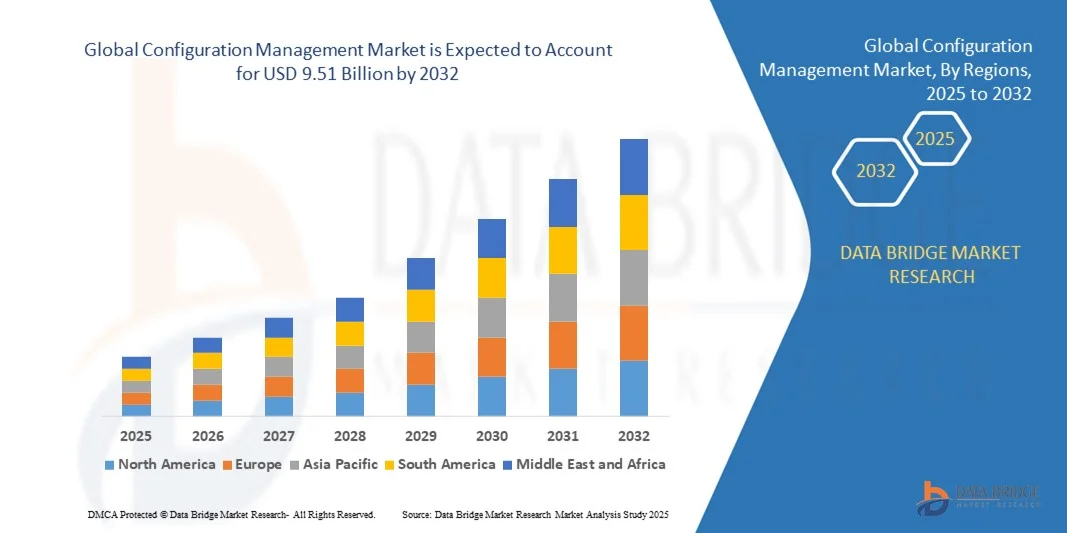
Configuration Management Market Size
- The global configuration management market size was valued at USD 3.20 billion in 2024 and is expected to reach USD 9.51 billion by 2032, at a CAGR of 14.60% during the forecast period
- The market growth is largely fuelled by the increasing adoption of DevOps and Agile methodologies, which require effective configuration management for software development, deployment, and maintenance
- Rising demand for automated IT infrastructure management, enhanced operational efficiency, and reduced system downtime is further driving market expansion
Configuration Management Market Analysis
- The market is witnessing increased investment in tools that provide real-time monitoring, version control, and compliance tracking, helping organizations maintain system stability and security
- Growing awareness about the importance of IT governance, risk management, and regulatory compliance is encouraging companies to adopt comprehensive configuration management platforms
- North America dominated the configuration management market with the largest revenue share of 38.5% in 2024, driven by the rapid adoption of cloud-based IT infrastructure, DevOps practices, and digital transformation initiatives across enterprises
- Asia-Pacific region is expected to witness the highest growth rate in the global configuration management market, driven by increasing IT modernization, SME adoption, and government initiatives promoting digital infrastructure and enterprise automation
- The software segment held the largest market revenue share in 2024, driven by the increasing need for automated, real-time monitoring and system optimization across IT infrastructures. Software-based CM solutions allow organizations to track changes, maintain compliance, and improve operational efficiency, making them a preferred choice for large enterprises
Report Scope and Configuration Management Market Segmentation
|
Attributes |
Configuration Management Key Market Insights |
|
Segments Covered |
|
|
Countries Covered |
North America
Europe
Asia-Pacific
Middle East and Africa
South America
|
|
Key Market Players |
|
|
Market Opportunities |
|
|
Value Added Data Infosets |
In addition to the market insights such as market value, growth rate, market segments, geographical coverage, market players, and market scenario, the market report curated by the Data Bridge Market Research team includes in-depth expert analysis, import/export analysis, pricing analysis, production consumption analysis, and pestle analysis. |
Configuration Management Market Trends
Rise of Cloud-Based and AI-Driven Configuration Management Solutions
- The growing shift toward cloud-based and AI-driven configuration management (CM) solutions is transforming IT operations by enabling real-time monitoring, automation, and system optimization. These solutions allow for faster deployment, error reduction, and enhanced operational efficiency, particularly in large enterprises managing complex IT infrastructures. They also facilitate better resource allocation, improved system uptime, and predictive maintenance capabilities, allowing organizations to proactively manage potential failures
- The high demand for integrated CM tools across distributed and hybrid IT environments is accelerating the adoption of platform-based and service-oriented solutions. These tools are particularly effective where traditional manual configuration methods are time-consuming and error-prone, helping reduce system downtime and improve productivity. In addition, integrated CM solutions improve cross-departmental collaboration, enable centralized management, and ensure consistency across multiple IT environments
- The scalability and flexibility of modern CM solutions are making them attractive for both SMEs and large organizations. Companies benefit from streamlined IT operations, improved change management, and reduced risk without significant infrastructure investments. These platforms also support multi-cloud environments, allow seamless system upgrades, and offer customizable workflows to align with organizational requirements
- For instance, in 2023, several multinational enterprises deployed cloud-based CM platforms integrated with AI analytics, resulting in faster incident resolution, improved compliance tracking, and enhanced operational efficiency. This implementation also led to improved service delivery, reduced operational costs, and better end-user experience across global IT networks
- While CM solutions are accelerating IT management and supporting enterprise scalability, their impact depends on continuous innovation, user training, and integration capabilities. Vendors must focus on tailored deployments, security, and cost-effective solutions to fully capitalize on growing demand. Ongoing updates, proactive support, and integration with emerging technologies are essential to sustain long-term adoption and market growth
Configuration Management Market Dynamics
Driver
Increasing Adoption of DevOps, Agile Practices, and Cloud-Based IT Infrastructure
- The growing adoption of DevOps and Agile practices is driving demand for advanced configuration management tools. Organizations require automated, real-time systems to track changes, monitor compliance, and support continuous integration and deployment workflows. These tools also enable faster software delivery cycles, reduce human error, and improve overall IT governance
- Companies across IT, telecommunications, finance, and manufacturing sectors are increasingly relying on CM solutions to optimize operations, reduce errors, and ensure regulatory compliance. This trend has led to intensified R&D efforts in AI-driven, cloud-enabled, and platform-based CM tools. CM platforms also support enhanced reporting, predictive analytics, and real-time auditing, ensuring organizations meet industry standards efficiently
- Government initiatives promoting digital transformation and secure IT operations are further supporting market growth. Investments in cloud adoption, data centers, and IT automation are boosting demand for scalable CM solutions. These initiatives also drive standardization, encourage secure cloud migration, and foster enterprise-wide adoption of automation tools
- For instance, in 2022, several European and North American IT service providers upgraded their CM platforms to integrate cloud-based monitoring and AI-driven analytics, improving operational efficiency and reducing incident resolution time. The upgrades also enhanced cybersecurity measures, allowed better compliance tracking, and supported scalable IT infrastructure management
- While demand is strong, successful deployment requires skilled personnel, robust IT infrastructure, and seamless integration with existing enterprise systems. Vendors must provide secure, scalable, and customizable CM solutions to maintain sustained growth. Emphasis on workforce training, adaptive platform design, and cross-functional collaboration is essential to ensure effective utilization of CM tools
Restraint/Challenge
High Implementation Costs and Integration Complexities
- The high cost of implementing advanced configuration management platforms, including software licensing, training, and integration, limits adoption among small and mid-sized enterprises. Budget constraints often restrict access to full-featured solutions. Additional hidden costs, such as ongoing maintenance and third-party service fees, further deter smaller organizations from adopting CM tools
- Integration complexities with legacy systems, enterprise resource planning (ERP) platforms, and existing IT infrastructure can hinder seamless deployment. Organizations require skilled IT teams and technical support to maintain system consistency and operational efficiency. Misalignment between new CM platforms and existing workflows can also create operational bottlenecks, delaying return on investment
- Security and compliance challenges around configuration data and system access pose additional concerns, requiring robust monitoring, encryption, and regulatory adherence. Companies must navigate data privacy regulations, multi-cloud security policies, and potential vulnerabilities introduced during integration. Failure to address these concerns can lead to compliance penalties and operational disruptions
- For instance, in 2023, several SMEs in Asia-Pacific faced delays in CM adoption due to integration difficulties with legacy systems and concerns over data security, affecting rollout timelines. These delays also impacted productivity, increased IT costs, and limited the scalability of IT operations
- While configuration management technologies continue to evolve, addressing cost, integration, and security challenges is crucial. Vendors must offer flexible pricing, seamless integration capabilities, and strong customer support to drive market adoption globally. Continuous updates, consulting services, and adaptive deployment options are key to overcoming barriers and fostering widespread adoption
Configuration Management Market Scope
The market is segmented on the basis of component, deployment type, module, organization size, and vertical.
- By Component
On the basis of component, the configuration management market is segmented into software and services. The software segment held the largest market revenue share in 2024, driven by the increasing need for automated, real-time monitoring and system optimization across IT infrastructures. Software-based CM solutions allow organizations to track changes, maintain compliance, and improve operational efficiency, making them a preferred choice for large enterprises.
The services segment is expected to witness the fastest growth rate from 2025 to 2032, fueled by demand for consulting, implementation, and maintenance support. Service-oriented CM offerings are particularly popular among SMEs and organizations adopting hybrid or multi-cloud environments, as they help ensure smooth deployment, customization, and ongoing management of CM tools.
- By Deployment Type
On the basis of deployment type, the market is segmented into on-premise and cloud-based solutions. The cloud-based segment held the largest share in 2024, driven by scalability, remote accessibility, and reduced infrastructure costs. Cloud-based CM solutions are increasingly adopted across industries for efficient change management and seamless integration with existing IT systems.
The on-premise segment is expected to witness the fastest growth from 2025 to 2032, fueled by demand from regulated industries and organizations requiring full control over their configuration data and IT assets. On-premise solutions provide enhanced security, customization, and compliance capabilities.
- By Module
On the basis of module, the market is categorized into service catalog, configuration management database (CMDB), service definition, and others. The CMDB segment held the largest revenue share in 2024 due to its role in centralizing IT asset information, enabling better change and incident management, and supporting ITIL-based processes.
The service catalog segment is expected to witness the fastest growth rate from 2025 to 2032, driven by increasing adoption of self-service portals and automation workflows in enterprise IT operations. Service catalog solutions enhance operational efficiency and reduce response times for internal and external requests.
- By Organization Size
On the basis of organization size, the market is segmented into large enterprises and small and medium-sized enterprises (SMEs). Large enterprises held the largest market share in 2024, driven by complex IT environments, high regulatory compliance requirements, and extensive adoption of DevOps and Agile practices.
The SMEs segment is expected to witness the fastest growth from 2025 to 2032, fueled by increasing cloud adoption, digital transformation initiatives, and cost-effective CM solutions that improve IT management efficiency and reduce operational risks.
- By Vertical
On the basis of vertical, the market is segmented into BFSI, IT and telecom, government and defense, healthcare, education, retail, manufacturing, and others. The IT and telecom vertical held the largest market share in 2024, driven by heavy reliance on IT infrastructure, network operations, and digital service delivery.
The BFSI segment is expected to witness the fastest growth rate from 2025 to 2032, fueled by stringent regulatory compliance requirements, data security needs, and the adoption of automated IT management tools to streamline operations and reduce errors.
Configuration Management Market Regional Analysis
- North America dominated the configuration management market with the largest revenue share of 38.5% in 2024, driven by the rapid adoption of cloud-based IT infrastructure, DevOps practices, and digital transformation initiatives across enterprises
- Organizations in the region highly value real-time monitoring, automation, and AI-driven analytics offered by configuration management solutions to optimize IT operations and ensure regulatory compliance
- This widespread adoption is further supported by the presence of key market players, high IT spending, and a strong focus on digital innovation, establishing configuration management solutions as essential tools for large enterprises and SMEs alike
U.S. Configuration Management Market Insight
The U.S. configuration management market captured the largest revenue share in 2024 within North America, fueled by increased investment in IT automation, cloud platforms, and DevOps adoption. Enterprises are increasingly prioritizing automated configuration tracking, compliance monitoring, and seamless integration with existing IT systems. The growing trend of hybrid and multi-cloud environments, combined with the demand for AI-driven insights and predictive analytics, further propels the market. Moreover, government initiatives promoting secure IT operations and digital infrastructure expansion are significantly contributing to market growth.
Europe Configuration Management Market Insight
The Europe configuration management market is expected to witness the fastest growth rate from 2025 to 2032, driven by stringent regulatory compliance requirements, the growing adoption of cloud technologies, and the need for efficient IT management across enterprises. Increased urbanization, digitalization in public and private sectors, and the adoption of DevOps practices are fostering market growth. Organizations in Europe are leveraging CM solutions to reduce errors, improve operational efficiency, and maintain system security, particularly in highly regulated industries such as BFSI and healthcare.
U.K. Configuration Management Market Insight
The U.K. configuration management market i is expected to witness the fastest growth rate from 2025 to 2032, supported by the increasing digital transformation initiatives across enterprises and government bodies. Businesses are focusing on automation, real-time configuration tracking, and integration of CM solutions with existing IT infrastructure. The rise of cloud adoption, hybrid IT environments, and AI-driven IT analytics is further accelerating demand. In addition, the country’s emphasis on data security and regulatory compliance is encouraging organizations to adopt advanced configuration management tools.
Germany Configuration Management Market Insight
The Germany configuration management market is expected to witness the fastest growth rate from 2025 to 2032, fueled by strong IT infrastructure, a high adoption rate of digital solutions, and the growing need for operational efficiency. Enterprises are implementing CM platforms to manage complex IT landscapes, reduce downtime, and ensure compliance with stringent EU regulations. The integration of CM solutions with AI analytics and cloud technologies is increasingly prevalent, supporting automation and predictive monitoring capabilities for organizations across multiple sectors.
Asia-Pacific Configuration Management Market Insight
The Asia-Pacific configuration management market is expected to witness the fastest growth rate from 2025 to 2032, driven by rapid digital transformation, cloud adoption, and increasing IT spending in countries such as China, India, and Japan. The region’s growing enterprise base, expanding SMEs, and government initiatives promoting secure and efficient IT operations are fueling market growth. Furthermore, as APAC becomes a hub for IT services and technology deployment, the accessibility and affordability of configuration management solutions are increasing across various industry verticals.
Japan Configuration Management Market Insight
The Japan configuration management market is expected to witness the fastest growth rate from 2025 to 2032 due to the country’s high-tech ecosystem, increasing cloud adoption, and demand for automation in IT operations. Enterprises are adopting CM solutions for real-time monitoring, AI-driven analytics, and compliance management. Integration of CM tools with existing enterprise systems, IoT infrastructure, and hybrid cloud environments is driving growth. In addition, Japan’s focus on efficiency, security, and digital innovation is expected to boost the adoption of configuration management platforms in both large enterprises and SMEs.
China Configuration Management Market Insight
The China configuration management market accounted for the largest market revenue share in Asia-Pacific in 2024, owing to rapid IT infrastructure expansion, widespread cloud adoption, and increasing digital transformation initiatives across enterprises. Chinese organizations are implementing CM solutions to enhance operational efficiency, reduce errors, and maintain compliance with local and international regulations. The presence of domestic technology providers, government support for IT modernization, and growing demand for AI-powered and cloud-based CM platforms are key factors driving the market.
Configuration Management Market Share
The Configuration Management industry is primarily led by well-established companies, including:
- Microsoft (U.S.)
- Amazon Web Services, Inc. (U.S.)
- Oracle (U.S.)
- BMC Software, Inc. (U.S.)
- IBM (U.S.)
- Alibaba Cloud (China)
- CA Technologies (U.S.)
- Red Hat, Inc. (U.S.)
- CloudBees, Inc. (U.S.)
- Micro Focus (U.K.)
- Northern.tech AS (Norway)
- Canonical Ltd. (U.K.)
- SaltStack, Inc. (U.S.)
- Octopus Deploy (U.K.)
- JetBrains s.r.o. (Czech Republic)
- Hewlett Packard Enterprise Development LP (U.S.)
- ServiceNow (U.S.)
Latest Developments in Global Configuration Management Market
- In February 2024, Kandji, a U.S.-based device management and security platform under Apple, launched an integration with ServiceNow. This development enables the automated synchronization of Apple device fleet data with the ServiceNow Configuration Management Database (CMDB). The integration aims to streamline IT asset management, improve visibility across enterprise systems, and reduce manual administrative tasks. By enhancing data accuracy and operational efficiency, this collaboration provides better user experiences and adds significant value to customers leveraging ServiceNow solutions. The move is expected to strengthen market adoption of integrated device management and CMDB solutions across enterprises.

- Interactive Data Analysis Dashboard
- Company Analysis Dashboard for high growth potential opportunities
- Research Analyst Access for customization & queries
- Competitor Analysis with Interactive dashboard
- Latest News, Updates & Trend analysis
- Harness the Power of Benchmark Analysis for Comprehensive Competitor Tracking
Data collection and base year analysis are done using data collection modules with large sample sizes. The stage includes obtaining market information or related data through various sources and strategies. It includes examining and planning all the data acquired from the past in advance. It likewise envelops the examination of information inconsistencies seen across different information sources. The market data is analysed and estimated using market statistical and coherent models. Also, market share analysis and key trend analysis are the major success factors in the market report. To know more, please request an analyst call or drop down your inquiry.
The key research methodology used by DBMR research team is data triangulation which involves data mining, analysis of the impact of data variables on the market and primary (industry expert) validation. Data models include Vendor Positioning Grid, Market Time Line Analysis, Market Overview and Guide, Company Positioning Grid, Patent Analysis, Pricing Analysis, Company Market Share Analysis, Standards of Measurement, Global versus Regional and Vendor Share Analysis. To know more about the research methodology, drop in an inquiry to speak to our industry experts.
Data Bridge Market Research is a leader in advanced formative research. We take pride in servicing our existing and new customers with data and analysis that match and suits their goal. The report can be customized to include price trend analysis of target brands understanding the market for additional countries (ask for the list of countries), clinical trial results data, literature review, refurbished market and product base analysis. Market analysis of target competitors can be analyzed from technology-based analysis to market portfolio strategies. We can add as many competitors that you require data about in the format and data style you are looking for. Our team of analysts can also provide you data in crude raw excel files pivot tables (Fact book) or can assist you in creating presentations from the data sets available in the report.













