


Confocal Laser Scanning Market Overview
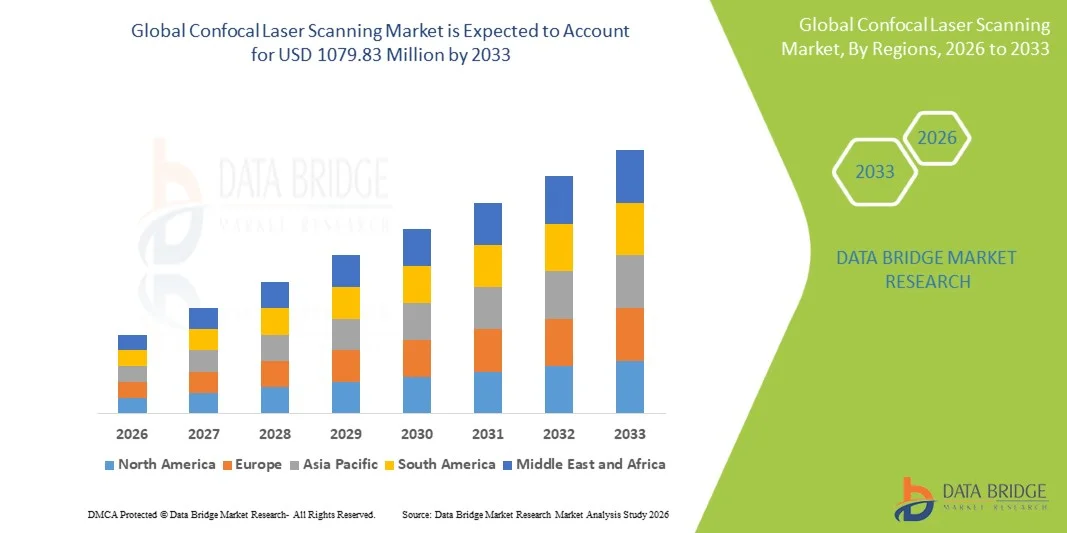
The Confocal Laser Scanning Market was valued at USD 747.80 Million in 2025 and is projected to reach USD 1079.83 Million by 2033, growing at a CAGR of 4.70% from 2026 to 2033. The Confocal Laser Scanning market is experiencing consistent growth driven by rising demand for high-resolution, non-invasive imaging technologies, rapid advancements in optical microscopy systems, and expanding applications across life sciences, materials research, and clinical diagnostics. Increasing use of confocal laser scanning microscopy (CLSM) in cell biology, cancer research, and drug discovery is significantly accelerating market adoption, as researchers require precise 3D visualization of cellular structures and real-time imaging of biological processes.
The growing prevalence of chronic diseases and the expansion of pharmaceutical and biotechnology R&D activities are further supporting market growth. In addition, increasing investments in advanced imaging infrastructure across academic institutes, research laboratories, and healthcare facilities are driving adoption. Technological advancements such as super-resolution imaging, automated scanning systems, AI-powered image analysis, and integration with digital pathology platforms are replacing traditional microscopy methods in many applications, offering higher accuracy, improved depth resolution, and enhanced research productivity.
Key Market Trends & Insights
- North America dominated the Confocal Laser Scanning Market with the largest revenue share of 38.26% in 2025, supported by advanced healthcare and life sciences research infrastructure, strong presence of leading microscopy and imaging solution providers, high R&D investment in biomedical sciences, and widespread adoption of high-resolution optical imaging systems across academic institutions, pharmaceutical companies, and clinical research laboratories. The region also benefits from strong integration of AI-assisted imaging analytics and increasing use of confocal microscopy in cell biology, neuroscience, and drug discovery applications.
- The Solutions segment dominated the market with a share of 63.8% in 2025 due to widespread adoption of integrated confocal microscopy systems in life science research, biotechnology, and clinical diagnostics.
- Asia-Pacific is expected to be the fastest-growing region at a CAGR of 8.3% from 2026 to 2033, fueled by increasing investments in biotechnology and pharmaceutical research, rapid expansion of academic and clinical research infrastructure, rising adoption of advanced imaging technologies, and growing government support for life sciences innovation across China, India, Japan, and South Korea.
- The Software segment is the fastest-growing component type, projected to register a CAGR of 8.6% from 2026 to 2033, driven by increasing adoption of AI-based image reconstruction, 3D visualization tools, and cloud-enabled microscopy data processing solutions.
- The Cell Biology Research segment dominated the application category with a 34.89% revenue share in 2025, supported by widespread use of confocal laser scanning microscopy in cellular imaging, protein localization, and intracellular structural analysis.
Market Size & Forecast
- Global Market Value (2025): USD 747.80 Million
- Expected Market Value (2033): USD 1079.83 Million
- Forecast CAGR (2026–2033): 4.70%
- Leading Region in 2025: North America
- Fastest Growing Region: Asia-Pacific
Report Scope and Confocal Laser Scanning Market Segmentation
|
Attributes |
Confocal Laser Scanning Key Market Insights |
|
Segments Covered |
|
|
Countries Covered |
North America · U.S. · Canada · Mexico Europe · Germany · France · U.K. · Netherlands · Switzerland · Belgium · Russia · Italy · Spain · Turkey · Rest of Europe Asia-Pacific · China · Japan · India · South Korea · Singapore · Malaysia · Australia · Thailand · Indonesia · Philippines · Rest of Asia-Pacific Middle East and Africa · Saudi Arabia · U.A.E. · South Africa · Egypt · Israel · Rest of Middle East and Africa South America · Brazil · Argentina · Rest of South America |
|
Key Market Players |
• Carl Zeiss Microscopy GmbH (Germany) |
|
Market Opportunities |
· Expansion of Live Cell Imaging and Advanced Biomedical Research Applications · Integration of AI, Automation, and Digital Image Analysis Platforms · Growing Adoption in Clinical Diagnostics and Translational Research |
|
Value Added Data Infosets |
In addition to the insights on market scenarios such as market value, growth rate, segmentation, geographical coverage, and major players, the market reports curated by the Data Bridge Market Research also include in-depth expert analysis, geographically represented company-wise production and capacity, network layouts of distributors and partners, detailed and updated price trend analysis and deficit analysis of supply chain and demand. |
Confocal Laser Scanning Market Trends
Trend: Growth in Advanced Biomedical Imaging & Precision Research
Confocal Laser Scanning systems are increasingly being adopted in biomedical and life sciences research to enable high-resolution, non-invasive imaging of cells and tissues. Researchers are leveraging these systems for 3D reconstruction of biological structures, enabling deeper insights into cellular processes, protein interactions, and disease progression. The integration of AI-based image analysis and automated microscopy workflows is further improving imaging speed, accuracy, and reproducibility. Academic institutes and pharmaceutical companies are increasingly using confocal imaging in oncology, neuroscience, and regenerative medicine research, while advanced fluorescence imaging techniques such as FRAP and live-cell imaging are expanding application scope.
Confocal Laser Scanning Market Dynamics
Key Market Driver: Rising Demand for High-Resolution Cellular and Molecular Imaging
The increasing prevalence of chronic diseases such as cancer, neurological disorders, and cardiovascular conditions is driving strong demand for advanced imaging technologies like confocal laser scanning systems. These systems enable researchers and clinicians to visualize biological samples at subcellular resolution, supporting early disease detection, drug discovery, and precision medicine development.
For instance, cancer research studies require high-resolution imaging of tumor microenvironments, where confocal microscopy is widely used to analyze cellular behavior and drug response. Pharmaceutical companies are increasingly integrating confocal imaging into preclinical research workflows to improve target validation and accelerate drug development timelines.
Key Restraint/Challenge: High Cost of Advanced Imaging Systems and Technical Complexity
A major challenge in the Confocal Laser Scanning Market is the high cost of advanced imaging systems, including optical components, laser modules, and high-performance detection systems. In addition to equipment costs, laboratories require specialized infrastructure and trained personnel to operate and maintain these systems effectively.
In many emerging economies, limited access to funding for advanced research equipment and shortage of skilled imaging specialists restrict widespread adoption. Furthermore, system complexity and the need for continuous calibration and maintenance increase operational burden for end users, particularly in smaller research institutes.
Key Market Opportunity: Integration of AI, Automation, and Multiplex Imaging Technologies
The integration of artificial intelligence and machine learning with confocal laser scanning systems is creating significant growth opportunities. AI-powered imaging platforms can automatically detect cellular structures, reduce image processing time, and enhance quantitative analysis of biological samples.
For instance, automated confocal imaging systems are increasingly being used in high-throughput drug screening applications, where thousands of samples are analyzed for cellular response in pharmaceutical research. In addition, advancements in multiplex fluorescence imaging and 3D reconstruction technologies are enabling more detailed visualization of complex biological systems. Growing investments in biotechnology research infrastructure across Asia-Pacific and Europe are expected to further accelerate adoption of advanced confocal imaging systems.
Confocal Laser Scanning Market Scope
The Confocal Laser Scanning market is segmented on the basis of component type, application, end user, and distribution channel.
- By Component Type
On the basis of component type, the Confocal Laser Scanning Market is segmented into solutions and software. The Solutions segment dominated the market with a share of 63.8% in 2025 due to widespread adoption of integrated confocal microscopy systems in life science research, biotechnology, and clinical diagnostics. These solutions include laser scanning units, detectors, optical systems, and imaging platforms used for high-resolution 3D imaging. Increasing demand for advanced visualization of cellular structures is driving segment growth. Rising investments in pharmaceutical R&D and drug discovery further support adoption. Academic and research institutes heavily rely on full system solutions for experimental imaging. The integration of automated scanning systems improves imaging accuracy. Enhanced optical sectioning capability strengthens research efficiency. Growing demand for real-time imaging in biological studies supports market expansion. The software segment is also gaining traction due to advanced image processing tools. Increasing use of AI-based reconstruction and analytics improves diagnostic accuracy. Overall, hardware-based solutions remain dominant due to high installation base and reliability.
The Software segment is expected to witness the fastest growth with a CAGR of 8.4% from 2026 to 2033, driven by increasing demand for AI-enabled image analysis, automated segmentation, and 3D reconstruction. Growing adoption of digital pathology and computational microscopy is accelerating demand. Rising use of cloud-based imaging platforms supports scalability and remote access. Integration of machine learning for pattern recognition enhances research efficiency. Increasing demand for high-throughput imaging in drug discovery is boosting adoption. Software tools reduce manual interpretation errors and improve reproducibility. Expansion of biomedical research funding supports digital transformation. Growing focus on precision medicine is increasing analytical requirements. Academic institutes are rapidly adopting advanced imaging software. Pharmaceutical companies are investing in automated analysis platforms. Increasing complexity of biological data is driving AI integration. Overall, software adoption is rising rapidly due to digitalization trends.
- By Application
On the basis of application, the Confocal Laser Scanning Market is segmented into cell biology research, materials analysis, live cell imaging, neuroscience research, stem cell research, photoactivation, FRAP imaging, colocalization, and others. The Cell Biology Research segment dominated the market with a share of 28.4% in 2025 due to extensive usage in studying cellular structures and molecular interactions. Confocal microscopy enables high-resolution 3D visualization of cells. Increasing research in cancer biology and immunology supports adoption. Pharmaceutical companies use confocal systems for drug mechanism studies. Academic institutes rely heavily on cell imaging experiments. Live-cell imaging capability improves biological understanding. Demand for high-precision imaging in cellular dynamics is increasing. Advanced fluorescence techniques enhance research quality. Growing focus on molecular biology supports segment growth. Rising funding for life science research strengthens demand. Confocal systems enable non-invasive imaging of live cells. Overall, cell biology remains the core application area driving market demand.
The Live Cell Imaging segment is expected to witness the fastest growth with a CAGR of 8.2% from 2026 to 2033, driven by increasing demand for real-time monitoring of biological processes. Researchers are focusing on dynamic cellular behavior analysis. Drug discovery applications require live response monitoring. Advances in low-phototoxic imaging systems support growth. High-speed scanning technologies improve time-lapse imaging accuracy. Increasing adoption in cancer research boosts demand. Stem cell research applications are expanding rapidly. Rising use in neuroscience enhances segment adoption. Improved fluorescence markers increase imaging efficiency. Integration with AI-based analysis improves interpretation. Growing demand for precision medicine supports expansion. Overall, live imaging is emerging as a key innovation-driven segment.
- By End User
On the basis of end user, the Confocal Laser Scanning Market is segmented into industrial users, clinical laboratories, academic and research institutes, diagnostic centers, and others. The Academic and Research Institutes segment dominated the market with a share of 42.6% in 2025 due to strong utilization in life sciences and materials research. Universities and government labs are primary users of confocal systems. Increasing research funding supports equipment adoption. High demand for advanced microscopy in biological studies drives usage. Institutes focus on cellular imaging and molecular research. Confocal systems are widely used in neuroscience and cancer studies. Availability of research grants boosts procurement. Strong collaboration with biotech companies supports adoption. Academic publications rely on high-resolution imaging systems. Training and education purposes further increase usage. Government-funded research programs strengthen demand. Overall, academic institutes remain the largest end-user base.
The Clinical Laboratories segment is expected to witness the fastest growth with a CAGR of 7.9% from 2026 to 2033, driven by increasing adoption in diagnostic imaging applications. Confocal microscopy is being used in dermatology and ophthalmology. Rising demand for non-invasive diagnostic techniques supports growth. Hospitals are integrating confocal systems for pathology imaging. Early disease detection requirements are increasing adoption. Advances in imaging speed improve clinical usability. Growing prevalence of chronic diseases drives demand. AI-based diagnostic support enhances accuracy. Increasing healthcare infrastructure investments support expansion. Point-of-care imaging demand is rising globally. Regulatory approvals for clinical use are expanding applications. Overall, clinical diagnostics represent a fast-growing segment.
- By Distribution Channel
On the basis of distribution channel, the Confocal Laser Scanning Market is segmented into direct tender and retail sales. The Direct Tender segment dominated the market with a share of 71.3% in 2025 due to large-scale procurement by hospitals, research institutes, and government organizations. Bulk purchasing ensures cost efficiency and long-term maintenance support. Institutions prefer customized system configurations. Strong vendor-government contracts support adoption. High-value imaging systems are mostly procured through tenders. Academic and healthcare sectors rely on centralized procurement. Installation and service contracts are bundled in tenders. Manufacturers prefer direct institutional sales channels. Long replacement cycles support dominance of this segment. Strong funding for research projects drives procurement. High equipment cost favors tender-based acquisition. Overall, direct tender remains the dominant distribution model.
The Retail Sales segment is expected to witness the fastest growth with a CAGR of 6.8% from 2026 to 2033, driven by increasing demand from private laboratories and smaller research centers. Growing accessibility of compact confocal systems supports retail adoption. Rising number of diagnostic clinics fuels demand. Expansion of private biotech startups is increasing purchases. E-commerce and distributor networks are improving availability. Lower-cost systems are entering the market. Increasing decentralization of research facilities supports growth. Demand for plug-and-play imaging systems is rising. Small academic institutions are adopting retail procurement models. Flexible financing options are expanding accessibility. Technological miniaturization is supporting adoption. Overall, retail segment is growing steadily in emerging markets.
Confocal Laser Scanning Market Regional Analysis
North America dominated the Confocal Laser Scanning market and accounted for the largest revenue share of 38.26% in 2025, supported by advanced healthcare and life sciences research infrastructure, strong presence of leading microscopy and imaging solution providers, high R&D investment in biomedical sciences, and widespread adoption of high-resolution optical imaging systems across academic institutions, pharmaceutical companies, and clinical research laboratories. The region also benefits from strong integration of AI-assisted imaging analytics and increasing use of confocal microscopy in cell biology, neuroscience, and drug discovery applications. Growing demand for precision medicine and advanced diagnostic research continues to strengthen North America’s leadership position in the global market.
U.S. Confocal Laser Scanning Market Insight
The U.S. Confocal Laser Scanning market is witnessing strong growth due to rising investments in biomedical research, increasing adoption of advanced imaging technologies in pharmaceutical R&D, and expanding applications in oncology, immunology, and neuroscience studies. The country’s strong ecosystem of biotech companies, research universities, and clinical laboratories is driving demand for high-resolution confocal microscopy systems. In addition, increasing use of AI-powered image analysis and automated microscopy platforms is improving research efficiency and accelerating drug discovery workflows.
Europe Confocal Laser Scanning Market Insight
The Europe Confocal Laser Scanning market remains a major contributor to global revenue, supported by strong government funding for life sciences research, advanced healthcare infrastructure, and high adoption of cutting-edge imaging technologies. Research institutions and pharmaceutical companies across the region are increasingly using confocal laser scanning systems for molecular imaging, disease mechanism studies, and drug development. Rising focus on translational research and precision medicine is further strengthening market expansion across Europe.
U.K. Confocal Laser Scanning Market Insight
The U.K. Confocal Laser Scanning market is experiencing steady growth due to increasing investments in life sciences research, strong academic research ecosystem, and growing adoption of advanced microscopy technologies in biomedical studies. Universities and research institutes are widely using confocal imaging for cell biology, cancer research, and neuroscience applications. Integration of digital imaging platforms and AI-based analysis tools is further improving research productivity and accuracy.
Germany Confocal Laser Scanning Market Insight
The Germany Confocal Laser Scanning market is expanding steadily due to strong pharmaceutical research capabilities, advanced biotechnology infrastructure, and increasing use of high-resolution imaging systems in academic and industrial research. The country’s focus on innovation in life sciences and strong presence of global imaging technology companies are driving adoption of confocal laser scanning systems across research and clinical environments.
Asia-Pacific Confocal Laser Scanning Market Insight
The Asia-Pacific Confocal Laser Scanning market is expected to witness rapid growth, driven by increasing investments in biotechnology and pharmaceutical research, expanding academic and clinical research infrastructure, and rising adoption of advanced imaging technologies across emerging economies. Countries such as China, India, Japan, and South Korea are significantly increasing funding for life sciences innovation. Growing focus on early disease detection and molecular research is further supporting regional market expansion.
Japan Confocal Laser Scanning Market Insight
The Japan Confocal Laser Scanning market is witnessing consistent growth due to strong advancements in biomedical research, increasing adoption of high-resolution imaging systems, and rising focus on regenerative medicine and neuroscience studies. Research institutes and universities are increasingly using confocal microscopy for cellular imaging and disease mechanism analysis, supported by government funding in life sciences innovation.
China Confocal Laser Scanning Market Insight
The China Confocal Laser Scanning market is growing rapidly, driven by expanding biotechnology and pharmaceutical industries, increasing government investment in scientific research, and rising adoption of advanced imaging technologies in hospitals and research institutes. Growing focus on precision medicine, cancer research, and drug discovery is significantly boosting demand for confocal laser scanning systems across the country.
Confocal Laser Scanning Market Share
The Confocal Laser Scanning industry is primarily led by well-established companies, including:
- Moog Inc. (U.S.)
- Dallara (Italy)
- Exail (France)
- IPG Automotive GmbH (Germany)
- aiMotive (Hungary)
- VI‑grade GmbH (Germany)
- Cruden B.V. (Netherlands)
- Dynisma Ltd. (UK)
- Applied Intuition Inc. (U.S.)
- rFpro (rFpro Limited) (England)
- Siemens AG (Germany)
- Dassault Systèmes SE (France)
- MTS Systems Corporation (U.S.)
- CAE Inc. (Canada)
- NVIDIA Corporation (U.S.)
- AB Dynamics PLC (U.K.)
- Forum8 (Japan)
- Mitsubishi Precision Co., Ltd. (Japan)
- FAAC Incorporated (U.S.)
- DriveSafety (U.S.)
- Simtec Simulation Technology GmbH (Germany)
- MB Dynamics Inc. (U.S.)
- Sanlab Simulation (India)
- SimCraft (U.S.)
- CXC Simulations (U.S.)
- XPI Simulation (United Kingdom)
- Tecknotrove Simulator Systems Pvt. Ltd. (India)
- Zhejiang Kechi Intelligent Technology Co., Ltd. (China)
- Shenzhen Zhongzhi Simulation (China)
- Hindustan Simulators (India)
- DriveSimSolutions (U.S.)
- Teksim Technologies (India)
- iMVR Inc. (U.S.)
- SimXperience (U.S.)
Latest Developments in Confocal Laser Scanning Market
- In April 2021, Nikon Corporation advanced its confocal microscopy portfolio with continued deployment of its AX/AX R laser scanning confocal systems featuring NSPARC super-resolution technology, enabling ultra-sensitive imaging for deep-tissue biological research and high-speed cellular analysis. The system strengthened applications in neuroscience, cancer research, and live-cell imaging by improving resolution and signal detection efficiency, supporting growing demand for advanced bioimaging platforms
- In June 2022, ZEISS expanded adoption of its LSM confocal laser scanning microscopy platform with enhanced spectral imaging and Airyscan-based super-resolution capabilities, supporting multi-channel fluorescence imaging in cell biology and materials science research. The system was increasingly used in academic and pharmaceutical laboratories for high-precision 3D imaging and live-cell dynamics studies, reinforcing ZEISS’s leadership in advanced optical microscopy solutions
- In November 2023, Loma Linda University School of Medicine installed the ZEISS LSM 900 confocal laser scanning microscope funded through an NIH equipment grant, enabling advanced histological imaging and real-time cellular visualization for cancer biology, neurobiology, and regenerative medicine research. This installation reflects the growing institutional investment in high-resolution confocal imaging infrastructure across North America
- In March 2024, Leica Microsystems continued expansion of its STELLARIS confocal platform ecosystem with AI-powered imaging workflows designed to improve sensitivity, spectral detection, and automation in fluorescence microscopy. The upgrades supported faster image acquisition and improved reproducibility in biomedical research applications, particularly in drug discovery and molecular diagnostics
- In October 2024, ZEISS further advanced confocal imaging capabilities through increased integration of AI-driven image processing and spectral unmixing in its LSM product line, enabling improved visualization of complex biological samples and supporting high-content screening in pharmaceutical research pipelines
- In February 2025, Nikon enhanced its confocal microscopy systems with expanded deep-learning-based image reconstruction tools, improving low-signal detection in thick biological specimens and enabling faster 3D reconstruction for high-throughput biomedical research workflows. These advancements strengthened the role of confocal laser scanning systems in precision medicine and advanced life sciences imaging

- Interactive Data Analysis Dashboard
- Company Analysis Dashboard for high growth potential opportunities
- Research Analyst Access for customization & queries
- Competitor Analysis with Interactive dashboard
- Latest News, Updates & Trend analysis
- Harness the Power of Benchmark Analysis for Comprehensive Competitor Tracking
Data collection and base year analysis are done using data collection modules with large sample sizes. The stage includes obtaining market information or related data through various sources and strategies. It includes examining and planning all the data acquired from the past in advance. It likewise envelops the examination of information inconsistencies seen across different information sources. The market data is analysed and estimated using market statistical and coherent models. Also, market share analysis and key trend analysis are the major success factors in the market report. To know more, please request an analyst call or drop down your inquiry.
The key research methodology used by DBMR research team is data triangulation which involves data mining, analysis of the impact of data variables on the market and primary (industry expert) validation. Data models include Vendor Positioning Grid, Market Time Line Analysis, Market Overview and Guide, Company Positioning Grid, Patent Analysis, Pricing Analysis, Company Market Share Analysis, Standards of Measurement, Global versus Regional and Vendor Share Analysis. To know more about the research methodology, drop in an inquiry to speak to our industry experts.
Data Bridge Market Research is a leader in advanced formative research. We take pride in servicing our existing and new customers with data and analysis that match and suits their goal. The report can be customized to include price trend analysis of target brands understanding the market for additional countries (ask for the list of countries), clinical trial results data, literature review, refurbished market and product base analysis. Market analysis of target competitors can be analyzed from technology-based analysis to market portfolio strategies. We can add as many competitors that you require data about in the format and data style you are looking for. Our team of analysts can also provide you data in crude raw excel files pivot tables (Fact book) or can assist you in creating presentations from the data sets available in the report.













