


What is the Connected Care Market Size and Growth Rate?
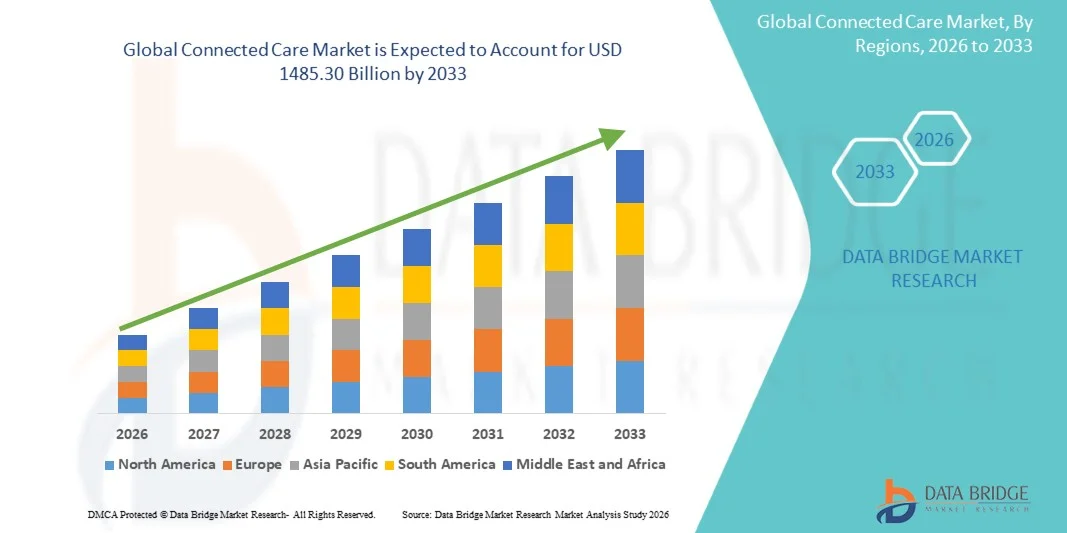
The Connected Care Market was valued at USD 145.38 billion in 2025 and is projected to reach USD 1485.30 billion by 2033, growing at a CAGR of 33.71% from 2026 to 2033. The Connected Care Market is experiencing strong growth driven by the increasing adoption of digital health technologies, rising prevalence of chronic diseases, expanding use of remote patient monitoring solutions, and growing demand for integrated healthcare delivery systems. Advancements in cloud computing, Internet of Things (IoT)-enabled medical devices, artificial intelligence, and telehealth platforms are enabling healthcare providers to deliver more efficient, patient-centered, and data-driven care across diverse healthcare settings.
The growing burden of chronic conditions such as cardiovascular diseases, diabetes, respiratory disorders, and cancer, combined with aging populations worldwide, is compelling healthcare systems to adopt connected care solutions that facilitate continuous patient monitoring and real-time clinical decision-making. Remote patient monitoring devices, telehealth platforms, mobile health applications, and integrated electronic health record systems are increasingly replacing traditional episodic care models by enabling proactive disease management and improved patient engagement. In addition, favorable government initiatives promoting digital healthcare transformation, increasing healthcare IT investments, and rising demand for cost-effective care delivery are accelerating adoption across hospitals, clinics, home healthcare settings, and long-term care facilities. The integration of AI-powered analytics, wearable health technologies, and interoperable healthcare networks is further enhancing care coordination, improving clinical outcomes, and supporting the continued expansion of the Connected Care Market.
Market Size & Forecast
- Global Market Value (2025): USD 145.38 Billion
- Expected Market Value (2033): USD 1485.30 Billion
- Forecast CAGR (2026–2033): 33.71%
- Leading Region in 2025: North America
- Fastest Growing Region: Asia-Pacific
What are the Major Takeaways of Connected Care Market?
- North America dominated the Connected Care Market with the largest revenue share of 38.46% in 2025, supported by advanced digital healthcare infrastructure, high adoption of telemedicine platforms, strong penetration of wearable health devices, and favorable reimbursement frameworks for remote patient monitoring and virtual care services. The region also benefits from the presence of leading healthcare technology companies, widespread integration of AI-driven health analytics, and increasing demand for home-based healthcare solutions.
- The M-Health Services segment dominated the market with a 44.12% share in 2025 due to the rapid adoption of mobile health platforms, telemedicine applications, and remote patient monitoring services across both developed and emerging economies.
- Asia-Pacific is expected to be the fastest-growing region at a CAGR of 9.1% from 2026 to 2033, fueled by rapid digitalization of healthcare systems, increasing government investments in telehealth infrastructure, expanding smartphone usage, and rising demand for affordable remote healthcare solutions across China, India, Japan, and Southeast Asia.
- The Telemedicine segment is projected to be the fastest-growing function category, registering a CAGR of 9.3%, driven by increasing acceptance of virtual consultations, rising shortage of healthcare professionals in rural areas, and growing demand for convenient, real-time medical access.
- The Monitoring application segment dominates the market with a 39.72% revenue share in 2025, supported by the widespread use of remote patient monitoring devices, chronic disease tracking systems, and wearable sensors for continuous health assessment.
- The Home Monitoring function segment accounts for 44.05% of the market in 2025, driven by rising preference for home-based care, aging population, and increasing adoption of connected wearable devices for continuous health tracking and early disease detection.
- The Medical Device Manufacturers segment leads the target audience category with a 35.61% share in 2025, owing to their strong involvement in developing connected healthcare devices, wearable sensors, and integrated digital health platforms.
- The E-Prescription segment is expected to be the fastest-growing type, registering a CAGR of 8.7%, driven by increasing adoption of digital prescribing systems, reduced medication errors, and growing integration with electronic health records (EHRs) and telemedicine platforms.
Report Scope and Connected Care Market Segmentation
|
Attributes |
Connected Care Key Market Insights |
|
Segments Covered |
|
|
Countries Covered |
North America · U.S. · Canada · Mexico Europe · Germany · France · U.K. · Netherlands · Switzerland · Belgium · Russia · Italy · Spain · Turkey · Rest of Europe Asia-Pacific · China · Japan · India · South Korea · Singapore · Malaysia · Australia · Thailand · Indonesia · Philippines · Rest of Asia-Pacific Middle East and Africa · Saudi Arabia · U.A.E. · South Africa · Egypt · Israel · Rest of Middle East and Africa South America · Brazil · Argentina · Rest of South America |
|
Key Market Players |
• Teladoc Health (U.S.) |
|
Market Opportunities |
· Expansion of Remote Patient Monitoring (RPM) and Home Healthcare Solutions · Integration of AI, Big Data Analytics, and Predictive Healthcare Systems · Growth of Telemedicine and Digital Health Ecosystems in Emerging Markets |
|
Value Added Data Infosets |
In addition to the insights on market scenarios such as market value, growth rate, segmentation, geographical coverage, and major players, the market reports curated by the Data Bridge Market Research also include in-depth expert analysis, geographically represented company-wise production and capacity, network layouts of distributors and partners, detailed and updated price trend analysis and deficit analysis of supply chain and demand. |
What is the Key Trend in the Connected Care Market?
Trend: Expansion of Remote Patient Monitoring and Digital Health Ecosystems
The Connected Care Market is witnessing a strong trend toward the adoption of remote patient monitoring (RPM), telehealth platforms, and wearable health technologies that enable continuous, real-time health tracking outside traditional clinical settings. The COVID-19 pandemic significantly accelerated this shift, with telehealth utilization in the U.S. increasing by over 38x compared to pre-pandemic levels (CDC data). Healthcare providers are increasingly integrating IoT-enabled medical devices, mobile health applications, and cloud-based health platforms to monitor chronic disease patients, reduce hospital readmissions, and improve long-term care outcomes. The rising prevalence of chronic conditions such as diabetes and cardiovascular diseases—responsible for nearly 74% of global deaths according to WHO—is further driving demand for connected care solutions. In addition, the widespread adoption of wearable devices such as smartwatches and biosensors is enabling continuous monitoring of vital parameters like heart rate, oxygen saturation, and glucose levels, improving early diagnosis and preventive care.
Connected Care Market Dynamics
Key Market Driver: Rising Burden of Chronic Diseases and Growing Adoption of Digital Healthcare Solutions
The increasing global burden of chronic diseases is a major driver of the Connected Care market. According to the World Health Organization (WHO), chronic diseases account for approximately 41 million deaths annually, representing more than 70% of total global mortality. Conditions such as diabetes, hypertension, respiratory disorders, and cardiovascular diseases require long-term monitoring and continuous patient engagement, significantly boosting demand for connected care solutions. Healthcare systems are increasingly adopting remote patient monitoring systems, AI-powered diagnostics, and telemedicine platforms to improve disease management efficiency and reduce healthcare costs. For instance, studies indicate that remote monitoring can reduce hospital readmissions by up to 25–30% in chronic heart failure patients, highlighting its clinical and economic value. Additionally, increasing smartphone penetration, expansion of 5G networks, and government initiatives promoting digital health infrastructure are further accelerating adoption across both developed and emerging markets.
Key Restraint/Challenge: Data Privacy Concerns and High Implementation Costs
A significant challenge in the Connected Care Market is the high cost of implementing advanced digital health infrastructure combined with growing concerns over data privacy and cybersecurity. Connected care systems rely on continuous transmission of sensitive patient health data through cloud platforms, IoT devices, and mobile applications, increasing the risk of data breaches and unauthorized access. According to IBM’s Cost of a Data Breach Report, healthcare remains one of the most expensive industries for data breaches, with average breach costs exceeding USD 10 million per incident in recent years. In addition, integrating interoperable systems across hospitals, insurance providers, and device manufacturers requires significant capital investment in software, hardware, and cybersecurity frameworks. Many small and mid-sized healthcare providers face financial and technical barriers in adopting these systems. Regulatory compliance requirements such as HIPAA in the U.S. and GDPR in Europe further add complexity and operational costs, slowing down widespread adoption in certain regions.
Key Market Opportunity: AI-Driven Predictive Healthcare and Expansion of Virtual Care Networks
The integration of artificial intelligence and predictive analytics presents a significant opportunity for the Connected Care market. AI-enabled platforms can analyze large volumes of real-time patient data from wearables, electronic health records, and remote monitoring devices to predict disease risks, personalize treatment plans, and improve clinical decision-making. The global AI in healthcare market is projected to grow rapidly, reflecting increasing investments in intelligent diagnostics and automated care management systems. Furthermore, expanding virtual care ecosystems are enabling healthcare providers to deliver consultations, prescriptions, and follow-up care entirely through digital platforms. Countries such as India, China, and Brazil are witnessing rapid expansion of telemedicine services supported by government initiatives and increasing digital infrastructure investments. The continued evolution of 5G connectivity, cloud computing, and interoperable health platforms is expected to further democratize access to high-quality healthcare services, particularly in rural and underserved regions.
How is the Connected Care Market Segmented?
The Connected Care market is segmented on the basis of Type, Application, Function, and Target Audience.
- By Type
On the basis of type, the Connected Care Market is segmented into M-Health Services, M-Health Devices and E-Prescription. The M-Health Services segment dominated the market with a 44.12% share in 2025 due to the rapid adoption of mobile health platforms, telemedicine applications, and remote patient monitoring services across both developed and emerging economies. The increasing penetration of smartphones, rising internet connectivity, and growing demand for real-time healthcare access are significantly driving this segment. Healthcare providers are leveraging m-health services to improve chronic disease management, patient engagement, and virtual care delivery. The integration of AI-based health tracking, cloud computing, and wearable connectivity is further strengthening adoption. Rising burden of cardiovascular diseases and diabetes is also supporting continuous demand. Government initiatives promoting digital health ecosystems are accelerating deployment across hospitals and clinics. In addition, cost-effectiveness compared to traditional healthcare systems is boosting adoption. Increasing awareness of preventive healthcare is also contributing to growth. The expansion of 5G networks is further improving service reliability. Strong investments by healthcare IT companies are enhancing platform capabilities. Growing use in home healthcare settings is expanding market penetration.
The E-Prescription segment is expected to witness the fastest CAGR of 9.2% from 2026 to 2033 due to increasing digital transformation of healthcare systems and regulatory push toward paperless medical workflows. Adoption is growing across hospitals, pharmacies, and clinics to reduce medication errors and improve prescription accuracy. Integration with electronic health records (EHRs) is enabling seamless data sharing between providers. Rising focus on improving patient safety and reducing prescription fraud is driving adoption. Government mandates in several countries are supporting implementation of digital prescribing systems. Growing telemedicine usage is further boosting demand for e-prescriptions. Increasing healthcare digitization in emerging markets is expanding growth opportunities. Cloud-based healthcare platforms are enhancing accessibility and scalability. AI-driven prescription validation tools are improving clinical decision-making. Rising demand for efficient pharmacy management systems is supporting adoption. Expansion of online pharmacies is further accelerating segment growth.
- By Application
On the basis of application, the Connected Care Market is segmented into Monitoring, Diagnosis and Treatment, Education and Awareness, Healthcare Management and Wellness, and Prevention. The Monitoring segment dominated the market with a 39.85% share in 2025 due to widespread adoption of remote patient monitoring systems, wearable health devices, and continuous tracking solutions. Increasing prevalence of chronic diseases such as diabetes, cardiovascular disorders, and respiratory illnesses is driving demand for real-time monitoring. Hospitals and healthcare providers are increasingly relying on connected devices to track patient vitals remotely. Growing adoption of IoT-based healthcare systems is strengthening segment penetration. Rising geriatric population is further boosting demand for continuous monitoring. Integration of AI-based analytics is improving early detection of health risks. Increasing focus on reducing hospital readmissions is supporting adoption. Wearable devices such as smartwatches and biosensors are expanding usage. Expansion of home healthcare services is driving market growth. Government healthcare digitization programs are encouraging adoption. Rising awareness about preventive health monitoring is further supporting demand. Telehealth integration is also enhancing monitoring capabilities.
The Prevention segment is expected to register the fastest CAGR of 8.8% from 2026 to 2033 due to rising focus on preventive healthcare and early disease detection. Increasing adoption of predictive analytics and AI-based risk assessment tools is driving growth. Healthcare providers are shifting toward proactive rather than reactive care models. Rising healthcare costs are encouraging preventive strategies. Wearable biosensors are enabling early identification of health risks. Growing awareness of lifestyle-related diseases is boosting adoption. Expansion of wellness programs by healthcare organizations is supporting growth. Government initiatives promoting preventive healthcare are increasing demand. Integration of big data analytics is improving disease prediction accuracy. Rising use of personalized healthcare solutions is further accelerating growth. Increasing adoption of remote screening tools is expanding access.
- By Function
On the basis of function, the Connected Care Market is segmented into Home Monitoring, Clinical Monitoring, Assisted Living, and Telemedicine. The Home Monitoring segment dominated the market with a 41.36% share in 2025 due to increasing demand for home-based healthcare solutions and rising aging population globally. Patients are increasingly preferring home monitoring for chronic disease management due to convenience and cost efficiency. Wearable devices and smart health sensors are enabling continuous tracking of vital parameters. Healthcare providers are reducing hospital burden through home-based care models. Rising prevalence of lifestyle diseases is boosting demand. Increasing healthcare expenditure is encouraging shift to home-based care. Integration of IoT devices is improving monitoring accuracy. Growing adoption of telehealth platforms is supporting remote care delivery. Government initiatives promoting aging-in-place policies are strengthening demand. Expansion of home healthcare services is accelerating growth. Rising awareness of self-health management is further supporting adoption. AI-based monitoring systems are improving patient outcomes.
The Telemedicine segment is expected to witness the fastest CAGR of 9.5% from 2026 to 2033 due to increasing demand for virtual healthcare consultations and digital medical services. Shortage of healthcare professionals in rural areas is driving adoption. Rising smartphone penetration and internet connectivity are supporting expansion. Healthcare providers are increasingly offering virtual consultations to improve accessibility. Integration of AI-powered diagnostic tools is enhancing service quality. Cloud-based platforms are improving scalability and reach. Government support for digital healthcare infrastructure is boosting growth. Increasing acceptance of virtual care among patients is accelerating adoption. Expansion of 5G networks is improving connectivity and reliability. Rising demand for cost-effective healthcare delivery is supporting growth. Cross-border telemedicine services are expanding global reach.
- By Target Audience
On the basis of target audience, the Connected Care Market is segmented into Medical Device Manufacturers, Medical Device Suppliers, Government Research Laboratories, R&D Companies, Marketing Research & Consulting Service Providers, and Medical Research Laboratories. The Medical Device Manufacturers segment dominated the market with a 36.78% share in 2025 due to their strong role in developing connected healthcare devices, wearable sensors, and remote monitoring systems. Increasing investment in digital health technologies is supporting segment growth. Manufacturers are integrating AI, IoT, and cloud computing into healthcare devices. Rising demand for smart medical devices is boosting adoption. Strong R&D capabilities are enabling innovation in connected care solutions. Partnerships with healthcare providers are expanding market reach. Increasing chronic disease burden is driving product demand. Government funding for medical device innovation is supporting growth. Expansion of telehealth infrastructure is increasing usage. Growing focus on preventive healthcare is strengthening demand. Rising adoption of personalized medicine is further boosting growth. Increasing global healthcare digitization is accelerating expansion.
The R&D Companies segment is expected to witness the fastest CAGR of 8.6% from 2026 to 2033 due to rising investment in healthcare innovation and digital transformation. Increasing focus on AI-driven healthcare analytics is driving research activities. Collaboration between technology firms and healthcare organizations is expanding. Growing demand for next-generation connected care solutions is boosting R&D spending. Government grants and funding programs are supporting innovation. Rising need for advanced predictive healthcare systems is driving adoption. Expansion of clinical trials using connected technologies is increasing demand. Integration of big data and machine learning is improving research efficiency. Increasing focus on personalized healthcare solutions is accelerating development. Growth in digital health startups is further supporting expansion. Rising global healthcare challenges are driving innovation-focused research.
Which Region Holds the Largest Share of the Connected Care Market?
North America dominated the Connected Care Market and accounted for the largest revenue share of 38.46% in 2025, supported by advanced digital healthcare infrastructure, high adoption of telemedicine platforms, strong penetration of wearable health devices, and favorable reimbursement frameworks for remote patient monitoring and virtual care services. The region benefits from the presence of leading healthcare technology companies, widespread integration of AI-driven health analytics, and rapid adoption of cloud-based healthcare ecosystems. Increasing prevalence of chronic diseases such as diabetes and cardiovascular disorders is driving continuous demand for connected healthcare solutions. Hospitals and healthcare providers are increasingly deploying remote patient monitoring systems to reduce readmission rates and improve patient outcomes. Rising geriatric population is further strengthening demand for home-based healthcare services. Strong regulatory support for digital health adoption is accelerating market expansion. The U.S. FDA’s increasing approvals for digital therapeutics and connected medical devices is further boosting innovation. Growing investment in healthcare cybersecurity is improving system reliability. Expansion of 5G connectivity is enabling real-time patient monitoring. Increasing collaboration between tech companies and healthcare providers is enhancing ecosystem integration. Rising healthcare expenditure is supporting large-scale deployment of connected care platforms. The region continues to lead in innovation-driven healthcare transformation.
U.S. Connected Care Market Insight
The U.S. Connected Care market is witnessing strong growth due to rising adoption of telehealth platforms, remote patient monitoring systems, and AI-enabled healthcare solutions. The country has one of the highest penetrations of wearable health devices globally, supporting continuous health tracking and chronic disease management. Increasing healthcare digitization and strong presence of companies such as Teladoc Health and Amwell are driving market expansion. Hospitals are increasingly integrating connected care solutions to improve operational efficiency and patient outcomes. Rising burden of chronic diseases is boosting demand for long-term monitoring solutions. Strong insurance coverage for telemedicine services is encouraging adoption. Increasing focus on reducing healthcare costs is supporting digital healthcare transformation. Advanced data analytics and AI-based diagnostics are improving clinical decision-making. Expansion of hospital-at-home programs is accelerating adoption of connected care systems. Growing investments in 5G-enabled healthcare infrastructure are enhancing connectivity. Regulatory support for digital health innovation is further strengthening market growth.
Europe Connected Care Market Insight
The Europe Connected Care market remains a major contributor to global revenue, driven by strong government support, advanced healthcare systems, and increasing adoption of digital health technologies. The region is witnessing growing deployment of telemedicine platforms, remote monitoring systems, and AI-powered healthcare analytics. Increasing focus on reducing hospital burden and improving patient accessibility is supporting market growth. Strong regulatory frameworks such as GDPR ensure secure handling of patient data, increasing trust in digital health systems. Rising aging population across countries such as Germany, Italy, and France is boosting demand for home-based healthcare services. Healthcare providers are increasingly adopting connected care solutions to improve efficiency and reduce costs. Expansion of national digital health programs is accelerating adoption. Integration of wearable devices and IoT-based health monitoring systems is improving patient outcomes. Increasing collaboration between healthcare institutions and technology providers is strengthening innovation. Growing investment in preventive healthcare is further driving market expansion.
U.K. Connected Care Market Insight
The U.K. Connected Care market is experiencing steady growth due to strong adoption of NHS-backed digital health initiatives and increasing use of telemedicine platforms. Rising demand for virtual consultations and remote patient monitoring is driving market expansion. Healthcare providers are increasingly using connected care systems to improve efficiency and reduce hospital pressure. Integration of AI and predictive analytics is enhancing patient management capabilities. Growing adoption of wearable health devices is supporting continuous monitoring. Increasing focus on elderly care is boosting demand for home-based healthcare solutions. Government initiatives promoting digital transformation of healthcare services are accelerating adoption. Expansion of 5G and cloud healthcare infrastructure is improving system connectivity. Rising prevalence of chronic diseases is increasing demand for long-term monitoring solutions. Healthcare startups are contributing to innovation in digital health platforms.
Germany Connected Care Market Insight
The Germany Connected Care market is expanding steadily due to strong healthcare infrastructure and rapid digital transformation in medical services. Increasing adoption of telehealth platforms and remote monitoring systems is driving market growth. Hospitals and clinics are integrating AI-based diagnostics and connected medical devices to improve efficiency. Strong government support for digital healthcare initiatives is accelerating adoption. Rising aging population is increasing demand for home healthcare services. Expansion of electronic health record systems is improving data integration. Germany’s strong focus on data security and healthcare compliance is boosting trust in connected care systems. Increasing use of wearable devices is supporting continuous patient monitoring. Healthcare providers are investing in predictive analytics to improve outcomes. Growing collaboration between medtech companies and IT firms is strengthening innovation.
Asia-Pacific Connected Care Market Insight
The Asia-Pacific Connected Care market is expected to witness rapid growth, registering a CAGR of 9.1% from 2026 to 2033, driven by rapid digitalization of healthcare systems and increasing government investments in telehealth infrastructure. Expanding smartphone penetration and internet connectivity are supporting widespread adoption of mobile health solutions. Rising healthcare demand due to large population base is boosting market growth. Increasing prevalence of chronic diseases is driving adoption of remote monitoring systems. Governments across China, India, and Japan are promoting digital health initiatives. Growing adoption of affordable healthcare technologies is expanding access in rural areas. Healthcare providers are increasingly using AI-powered diagnostics and cloud platforms. Expansion of private healthcare investments is accelerating innovation. Rising awareness of preventive healthcare is supporting market adoption. Increasing use of wearable devices is improving real-time health monitoring.
Japan Connected Care Market Insight
The Japan Connected Care market is witnessing consistent growth due to advanced healthcare infrastructure and strong focus on elderly care. Increasing adoption of robotics, AI, and IoT in healthcare is driving digital transformation. Hospitals are integrating remote monitoring systems to manage aging population needs. Rising prevalence of chronic diseases is increasing demand for continuous care solutions. Government initiatives promoting smart healthcare systems are supporting adoption. Strong presence of medical technology companies is boosting innovation. Increasing use of wearable health devices is enhancing patient monitoring. Expansion of telemedicine services is improving healthcare accessibility. Integration of AI-based diagnostics is improving clinical outcomes. Japan’s focus on precision healthcare is further strengthening market growth.
China Connected Care Market Insight
The China Connected Care market is growing rapidly due to large-scale digital healthcare transformation and government support for telemedicine expansion. Increasing smartphone penetration and internet connectivity are driving adoption of mobile health platforms. Rising burden of chronic diseases is boosting demand for remote monitoring systems. Government initiatives such as “Healthy China 2030” are accelerating healthcare digitization. Hospitals are increasingly adopting AI-based diagnostic tools and cloud healthcare systems. Expansion of 5G networks is enabling real-time health monitoring. Growing investment in healthcare infrastructure is supporting market expansion. Rising adoption of wearable health devices is improving preventive care. Increasing presence of domestic health tech companies is strengthening innovation. Expansion of rural healthcare access programs is further driving growth.
Which are the Top Companies in Connected Care Market?
The Connected Care industry is primarily led by well-established companies, including:
- Teladoc Health (U.S.)
- Amwell (U.S.)
- Cerner Corporation (U.S.)
- Philips Healthcare (Netherlands)
- Siemens Healthineers (Germany)
- GE HealthCare (U.S.)
- Medtronic (Ireland/U.S.)
- Abbott Laboratories (U.S.)
- ResMed (U.S./Australia)
- AliveCor (U.S.)
- Dexcom (U.S.)
- Omron Healthcare (Japan)
- Allscripts (U.S.)
- Epic Systems Corporation (U.S.)
- IBM Watson Health (U.S.)
- Honeywell Life Sciences (U.S.)
- Veradigm (U.S.)
- Masimo (U.S.)
- iRhythm Technologies (U.S.)
- BioTelemetry (U.S.)
- Siilo (Netherlands)
- Doctolib (France)
- Babylon Health (U.K.)
- Practo (India)
- Tricog Health (India)
- Tata 1mg (India)
- Ping An Good Doctor (China)
- WeDoctor (China)
- HealthTap (U.S.)
- Zocdoc (U.S.)
What are Latest Developments in Connected Care Market?
- In March 2021, Teladoc Health announced the expansion of its Remote Patient Monitoring (RPM) and chronic care platform following its integration of Livongo Health. The combined platform enabled large-scale AI-driven health tracking for diabetes, hypertension, and heart disease patients. This development strengthened Teladoc’s position as a global leader in connected care by integrating behavioral analytics with real-time physiological monitoring, improving long-term chronic disease management outcomes
- In February 2022, Philips launched enhancements to its HealthSuite digital health platform to expand remote patient monitoring and hospital-at-home capabilities. The updated platform enabled healthcare providers to integrate wearable devices, hospital systems, and cloud-based analytics for continuous patient monitoring. This initiative reflected the growing shift toward hybrid care models combining in-hospital and at-home treatment pathways
- In April 2023, Apple expanded its connected healthcare ecosystem by introducing advanced health tracking features through its Apple Watch and Health app ecosystem upgrades. The update improved real-time monitoring of heart rate irregularities, oxygen saturation, and mobility metrics, while enabling better integration with healthcare providers through HealthKit APIs. This development reinforced Apple’s role in mainstreaming consumer-driven connected health monitoring globally
- In January 2024, Teladoc Health announced the acquisition of remote monitoring platform provider HealthSnap to strengthen its chronic care management and virtual care capabilities. The acquisition enhanced Teladoc’s ability to deliver integrated connected care services combining RPM, AI-based analytics, and virtual consultations. This move reflected increasing consolidation in the digital health and connected care ecosystem
- In March 2024, Koninklijke Philips N.V. expanded its remote patient monitoring solutions in the U.S. with upgrades to its HealthSuite platform for AI-enabled clinical decision support. The enhanced system allowed hospitals to remotely monitor high-risk patients using real-time data streams and predictive analytics, reducing hospital readmissions and improving care efficiency. This development reinforced Philips’ leadership in hospital-to-home connected care solutions
- In July 2025, Masimo Corporation expanded its wearable biosensor portfolio for continuous patient monitoring across hospital and home care settings. The upgraded devices enabled real-time tracking of oxygen saturation, respiration rate, and cardiac parameters with improved wireless connectivity. This innovation supported the growing demand for scalable remote monitoring systems in both acute and chronic care management globally

- Interactive Data Analysis Dashboard
- Company Analysis Dashboard for high growth potential opportunities
- Research Analyst Access for customization & queries
- Competitor Analysis with Interactive dashboard
- Latest News, Updates & Trend analysis
- Harness the Power of Benchmark Analysis for Comprehensive Competitor Tracking
Data collection and base year analysis are done using data collection modules with large sample sizes. The stage includes obtaining market information or related data through various sources and strategies. It includes examining and planning all the data acquired from the past in advance. It likewise envelops the examination of information inconsistencies seen across different information sources. The market data is analysed and estimated using market statistical and coherent models. Also, market share analysis and key trend analysis are the major success factors in the market report. To know more, please request an analyst call or drop down your inquiry.
The key research methodology used by DBMR research team is data triangulation which involves data mining, analysis of the impact of data variables on the market and primary (industry expert) validation. Data models include Vendor Positioning Grid, Market Time Line Analysis, Market Overview and Guide, Company Positioning Grid, Patent Analysis, Pricing Analysis, Company Market Share Analysis, Standards of Measurement, Global versus Regional and Vendor Share Analysis. To know more about the research methodology, drop in an inquiry to speak to our industry experts.
Data Bridge Market Research is a leader in advanced formative research. We take pride in servicing our existing and new customers with data and analysis that match and suits their goal. The report can be customized to include price trend analysis of target brands understanding the market for additional countries (ask for the list of countries), clinical trial results data, literature review, refurbished market and product base analysis. Market analysis of target competitors can be analyzed from technology-based analysis to market portfolio strategies. We can add as many competitors that you require data about in the format and data style you are looking for. Our team of analysts can also provide you data in crude raw excel files pivot tables (Fact book) or can assist you in creating presentations from the data sets available in the report.













