


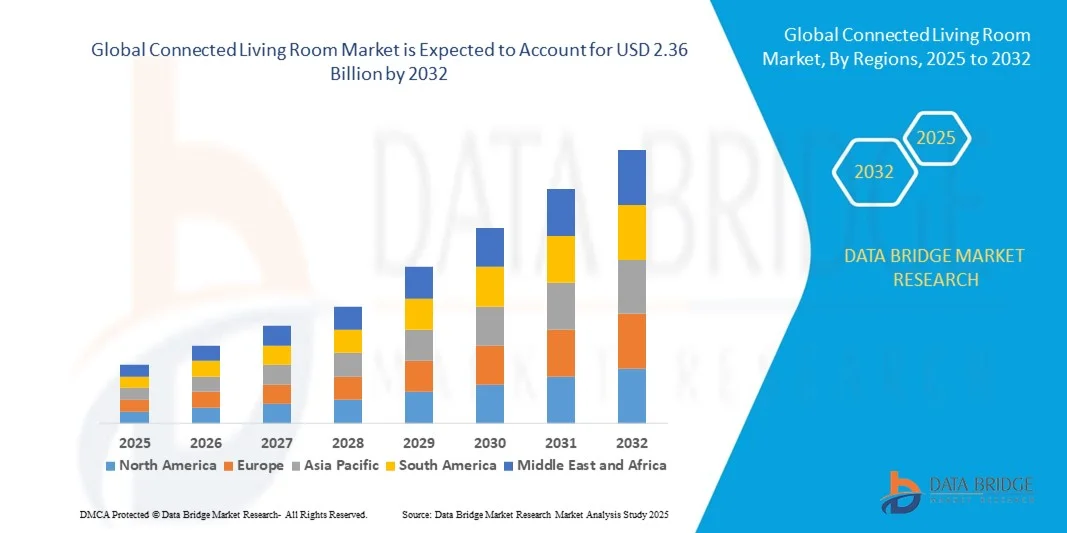
Global Connected Living Room Market Size
- The global connected living room market was valued at USD 1.36 billion in 2024 and is projected to reach USD 2.36 billion by 2032, growing at a CAGR of 7.10% during the forecast period.
- The market is experiencing strong momentum due to the increasing integration of smart TVs, streaming devices, gaming consoles, and home automation systems, which are reshaping digital entertainment experiences.
- In addition, the rising preference for seamless content sharing, voice-controlled interfaces, and personalized user experiences is driving consumer interest, accelerating adoption, and propelling the overall market forward.
Global Connected Living Room Market Analysis
- The Connected Living Room Market, integrating smart entertainment and automation technologies, is becoming a central element of modern digital lifestyles in both residential and commercial spaces, driven by the seamless connectivity of smart TVs, audio systems, gaming consoles, and IoT-enabled devices.
- Growing demand is primarily fueled by the rising adoption of smart home ecosystems, increased content streaming, and the preference for personalized, on-demand entertainment experiences with voice and app-based control.
- Asia-Pacific dominated the connected living room market with the largest revenue share of 38% in 2024, supported by early adoption of smart home tech, a robust consumer electronics industry, and strong demand for integrated digital entertainment platforms, particularly in the U.S., where innovations in content delivery and AI-driven interfaces are driving market penetration.
- North America is projected to be the fastest growing region over the forecast period, driven by rapid urbanization, increasing smartphone penetration, and a growing middle class with rising digital consumption habits.
- The Smart TVs & Streaming Devices/STBs segment dominated the market with the largest revenue share of 45.7% in 2024, due to its pivotal role in digital content consumption.
Report Scope and Global Connected Living Room Market Segmentation
|
Attributes |
Connected Living Room Key Market Insights |
|
Segments Covered |
|
|
Countries Covered |
North America
Europe
Asia-Pacific
Middle East and Africa
South America
|
|
Key Market Players |
|
|
Market Opportunities |
|
|
Value Added Data Infosets |
In addition to the insights on market scenarios such as market value, growth rate, segmentation, geographical coverage, and major players, the market reports curated by the Data Bridge Market Research also include in-depth expert analysis, pricing analysis, brand share analysis, consumer survey, demography analysis, supply chain analysis, value chain analysis, raw material/consumables overview, vendor selection criteria, PESTLE Analysis, Porter Analysis, and regulatory framework. |
Global Connected Living Room Market Trends
Enhanced Convenience Through AI and Voice Integration
- A significant and accelerating trend in the global Connected Living Room Market is the growing integration of artificial intelligence (AI) and voice-controlled ecosystems such as Amazon Alexa, Google Assistant, and Apple HomeKit. This convergence is redefining user interaction, enabling more intuitive and seamless control over entertainment systems, lighting, and other connected devices.
- For Instance, Amazon Fire TV Cube and Apple TV 4K integrate AI and voice assistance to allow users to control playback, search content, and even adjust smart lighting or thermostats—all through voice commands. Similarly, Google Chromecast with Google TV uses Google Assistant for content recommendations based on user preferences and viewing history.
- AI plays a pivotal role in personalizing entertainment by learning viewing habits, suggesting tailored content, and optimizing sound and display settings in real time. Advanced systems can automatically adjust ambient lighting, screen brightness, or even switch input modes based on user behavior or room conditions, enhancing the overall viewing experience
- Voice integration brings hands-free convenience, enabling users to operate multiple devices—such as smart TVs, speakers, and even connected blinds or lighting—through a centralized digital assistant. This not only simplifies daily interactions but also improves accessibility for users with mobility limitations.
- The seamless connectivity between smart living room devices and broader home automation platforms enables centralized control through unified dashboards or apps. Consumers can manage entertainment, ambiance, and home functions simultaneously, creating a synchronized and immersive environment tailored to their lifestyle.
- This shift toward more intelligent, user-centric, and connected living spaces is driving manufacturers like Samsung, Sony, and LG to develop AI-powered smart TVs and home hubs that support multi-device orchestration. These innovations are setting new standards for home entertainment, making AI and voice integration a core expectation in the modern connected living room.
Global Connected Living Room Market Dynamics
Driver
Growing Need Due to Rising Demand for Seamless Entertainment and Smart Home Integration
-
The accelerating adoption of smart home ecosystems and the rising demand for seamless, immersive entertainment experiences are major drivers for the growth of the Connected Living Room Market. Consumers are increasingly seeking integrated environments where devices communicate effortlessly to deliver convenience, personalization, and enhanced user engagement.
- For instance, in March 2024, Samsung announced advancements in its SmartThings platform, enhancing cross-device compatibility and enabling centralized control of entertainment, lighting, and ambiance—all from a single interface. Such innovations are reinforcing the connected living room as the core hub of the smart home experience.
- With the explosion of streaming services, smart TVs, and IoT-enabled devices, consumers demand instant access to content, voice-controlled convenience, and the ability to control multiple smart devices from one location. This shift has positioned the connected living room as a focal point for both entertainment and home automation.
- Consumers now expect devices like smart speakers, displays, lighting systems, and media consoles to work in harmony, allowing them to control everything—from changing the lighting for movie night to adjusting the thermostat—without leaving the couch.
- The convenience of voice assistants, AI-powered recommendations, and interoperable devices is significantly enhancing the appeal of connected living rooms across residential and commercial applications. Hotels, coworking spaces, and luxury apartments are adopting such systems to offer users a premium, tech-enabled experience. The increasing availability of DIY setups and modular systems is also helping the market expand into mid-tier and budget-conscious demographics.
Restraint/Challenge
Interoperability Issues and High Initial Setup Costs
- A key challenge hindering the widespread adoption of connected living room solutions is the lack of interoperability among devices from different manufacturers. Consumers often face compatibility issues when integrating multiple smart devices into a unified system, especially when they use different operating systems or voice platforms.
- For Instance, some smart TVs may not fully support voice control through all digital assistants, or streaming devices may have limited integration with lighting or speaker systems. This fragmentation frustrates users and reduces the overall value proposition of the connected living room.
- In addition, the high initial setup cost associated with building a fully connected living room—including smart TVs, sound systems, voice assistants, lighting controls, and hubs—can be prohibitive for some consumers. While entry-level products exist, achieving a truly integrated and seamless experience often requires premium equipment and ecosystem alignment.
- To address these concerns, major players such as Google, Amazon, and Apple are investing in the development of Matter, a new universal smart home standard aimed at improving device compatibility and simplifying setup. This initiative is expected to mitigate fragmentation over time.
- Nevertheless, consumer education, streamlined onboarding processes, and the availability of more affordable, interoperable solutions will be essential to accelerate market growth and ensure user confidence in connected living room technologies.
Global Connected Living Room Market Scope
The market is segmented on the basis of product type, connectivity, application, and end user.
- By Product Type
On the basis of product type, the connected living room market is segmented into Smart TVs & Streaming Devices/STBs, Gaming Consoles, Smart Speakers & Voice Assistants, Home Theater Systems & Soundbars, Computers and Laptops, Connected Security Systems, and Others. The Smart TVs & Streaming Devices/STBs segment dominated the market with the largest revenue share of 45.7% in 2024, due to its pivotal role in digital content consumption. These devices serve as the centerpiece of connected entertainment ecosystems, offering compatibility with major streaming platforms, voice assistants, and home automation hubs.
The smart speakers & voice assistants segment is projected to grow at the fastest CAGR from 2025 to 2032, driven by the increasing adoption of voice-controlled systems for home automation. Consumers favor these devices for their ability to manage multiple functions—entertainment, lighting, security, and more—via simple voice commands, enhancing convenience and accessibility across demographics.
- By Connectivity Type
On the basis of connectivity, the connected living room market is bifurcated into Wired Devices and Wireless Devices. Wireless Devices held the largest revenue share of 68.4% in 2024, owing to widespread adoption of Wi-Fi, Bluetooth, Zigbee, and Z-Wave technologies that enable easy installation and integration into modern smart homes. Consumers increasingly prefer wireless setups that are scalable, user-friendly, and compatible with mobile and voice control applications.
Wireless Devices are also expected to witness the fastest CAGR from 2025 to 2032, as technological advancements make them more affordable, reliable, and power-efficient. Growth is further supported by trends in DIY smart home installations and flexible retrofit solutions.While Wired Devices still maintain relevance in high-end home theater systems and professional installations where performance and reliability are paramount, the market is clearly shifting towards wireless due to the flexibility and minimal infrastructure requirements.
- By Application
On the basis of application, the connected living room market is segmented into New Installation and Retrofit Installation. The New Installation segment captured the largest market revenue share of 58.9% in 2024, as developers and consumers incorporate connected technologies into new residential projects from the outset. This approach allows for a more integrated and aesthetically cohesive setup, with pre-installed smart wiring, automation hubs, and device ecosystems.
The Retrofit Installation segment is projected to register the fastest CAGR from 2025 to 2032, driven by the increasing affordability and availability of modular, plug-and-play smart devices. Existing homeowners are seeking to upgrade their current entertainment setups without major renovations. Growth is also supported by demand in rental and urban properties where occupants seek flexible, non-permanent connected solutions. Both applications contribute to market expansion, but retrofitting presents a massive opportunity in mature markets where most homes were built before the smart home boom.
- By End-user
On the basis end-user, the connected living room market is segmented into Individual Households, Luxury Apartments, and the Hospitality Sector. Individual Households dominated the market with the largest revenue share of 61.3% in 2024, supported by increased adoption of smart home devices, rising digital literacy, and the availability of affordable consumer electronics. Households are investing in connected living room setups to enhance entertainment, convenience, and home automation.
The Luxury Apartments segment is expected to experience the fastest CAGR from 2025 to 2032, as premium property developers differentiate their offerings with built-in smart systems. These high-end units often include pre-installed smart TVs, audio systems, lighting, and voice control capabilities, aligning with the lifestyle preferences of affluent buyers and tenants.the Hospitality Sector is also integrating connected living room technologies in upscale hotels and resorts to improve guest experience through in-room automation, voice control, and streaming services, further contributing to market growth.
Global Connected Living Room Market Regional Analysis
- Asia-Pacific dominated the global connected living room market with the largest revenue share of 38% in 2024, driven by rapid adoption of smart home technologies and increasing consumer demand for integrated entertainment and automation systems.
- Consumers in the region prioritize convenience, advanced connectivity, and seamless integration of devices such as smart TVs, speakers, and home theater systems within a unified ecosystem.
- This widespread adoption is further supported by high disposable incomes, strong technological infrastructure, and a tech-savvy population. Additionally, the growing trend of smart home renovations and new smart home constructions is accelerating market growth, positioning North America as a key driver in the connected living room space for both residential and commercial applications.
U.S. Connected Living Room Market Insight
The U.S. connected living room market captured the largest revenue share of 82% in 2024 within North America, driven by the rapid adoption of smart entertainment devices and home automation systems. Consumers are increasingly seeking seamless integration of smart TVs, voice assistants, streaming devices, and home theater systems to enhance convenience and immersive entertainment experiences. The growing popularity of voice-controlled devices and mobile app connectivity further fuels market growth. Additionally, the rising trend of smart home renovations and new constructions embedding connected living room technologies is accelerating the industry expansion.
Europe Connected Living Room Market Insight
The Europe connected living room market is projected to grow steadily at a significant CAGR during the forecast period, supported by increasing consumer awareness and demand for integrated smart home entertainment solutions. Stricter energy efficiency regulations and a focus on sustainability are encouraging adoption of energy-saving smart devices such as smart TVs and speakers. Urbanization and a shift towards connected lifestyles are boosting demand across residential and commercial segments, with smart living rooms becoming a standard feature in new builds and retrofits across the region.
U.K. Connected Living Room Market Insight
The U.K. connected living room market is expected to grow at a notable CAGR through the forecast period, driven by rising home automation adoption and a strong consumer preference for multi-device integration in entertainment setups. Concerns around convenience, personalization, and immersive experience are encouraging households and businesses to upgrade to connected living room ecosystems. The U.K.’s advanced digital infrastructure and widespread e-commerce adoption facilitate access to smart living room products, further propelling market growth.
Germany Connected Living Room Market Insight
Germany’s connected living room market is anticipated to witness robust growth, supported by the country’s strong emphasis on technological innovation and sustainable living. Consumers are increasingly integrating smart TVs, connected speakers, and home automation devices to create efficient, energy-conscious living environments. The market benefits from Germany’s well-developed infrastructure and high consumer awareness around smart home benefits, with growing adoption in both urban residential and commercial sectors.
Asia-Pacific Connected Living Room Market Insight
The Asia-Pacific connected living room market is set to grow at the fastest CAGR of 22% from 2025 to 2032, driven by rapid urbanization, rising disposable incomes, and expanding smart home ecosystems in key countries such as China, Japan, and India. Government initiatives promoting digital infrastructure and smart city developments are accelerating adoption. Increasing affordability of connected devices and a young, tech-savvy population are further propelling market penetration across both residential and hospitality sectors.
Japan Connected Living Room Market Insight
Japan’s connected living room market is gaining strong traction due to the nation’s technological advancement and high consumer demand for convenience and immersive entertainment. The integration of voice assistants, AI-powered devices, and IoT connectivity in living room setups is expanding rapidly. Additionally, Japan’s aging population is stimulating demand for intuitive, user-friendly smart home entertainment solutions in both private and assisted living environments.
China Connected Living Room Market Insight
China accounted for the largest market revenue share in Asia-Pacific in 2024, driven by the country’s expanding middle class, urbanization, and rapid technology adoption. The connected living room is becoming a focal point for smart home investments in residential and commercial properties alike. Strong government support for smart city projects and innovation hubs, combined with competitive domestic manufacturing, is making connected living room products more accessible and affordable, fueling significant market growth.
Global Connected Living Room Market Share
The Connected Living Room industry is primarily led by well-established companies, including:
- ABB (Switzerland)
- Amazon (U.S.)
- Apple Inc. (U.S.)
- ASSA ABLOY (Sweden)
- Google LLC (U.S.)
- Honeywell International Inc. (U.S.)
- Legrand SA (France)
- LG Electronics (South Korea)
- Signify Holding (Netherlands)
- Robert Bosch GmbH (Germany)
- SAMSUNG (South Korea)
- Schneider Electric (France)
- Siemens (Germany)
- Sony Corporation (Japan)
What are the Recent Developments in Global Connected Living Room Market?
- In April 2023, Samsung Electronics launched its latest smart TV lineup featuring enhanced AI-driven voice assistant integration and advanced connectivity options in South Africa. This strategic move aims to elevate the connected living room experience by providing seamless entertainment and smart home control tailored to regional consumer preferences. By combining global innovation with local market insights, Samsung is reinforcing its leadership in the rapidly expanding global connected living room market.
- In March 2023, Sonos, Inc., a renowned smart speaker and home audio company, introduced the new Sonos Move 2 portable smart speaker designed specifically for commercial and institutional environments. The device offers superior sound quality, robust wireless connectivity, and enhanced voice assistant capabilities. This launch underscores Sonos’ dedication to delivering versatile and scalable audio solutions that improve user experience in diverse connected living room settings.
- In March 2023, LG Electronics successfully completed the rollout of its Smart Living Room initiative as part of the Smart Bengaluru Project. The program integrates LG’s advanced smart TVs, soundbars, and IoT-enabled lighting systems to create a fully connected living environment aimed at boosting urban lifestyle convenience and entertainment quality. This initiative highlights LG’s commitment to smart technology adoption and creating safer, more immersive connected home ecosystems.
- In February 2023, Amazon announced a strategic partnership with the National Association of Realtors (NAR) to introduce Alexa-enabled smart home devices specifically designed for real estate showrooms. This collaboration is aimed at streamlining property showcasing by allowing potential buyers to experience connected living rooms with voice-activated controls and integrated entertainment systems. The partnership reflects Amazon’s focus on innovation and operational efficiency in the real estate and smart home sectors.
- In January 2023, Sony Corporation unveiled its latest Home Theater System with integrated Google Assistant compatibility at the Consumer Electronics Show (CES) 2023. The system features advanced sound calibration, multi-device connectivity, and app-based control, providing users with a seamless and immersive entertainment experience. Sony’s launch emphasizes its commitment to incorporating cutting-edge technology into connected living room solutions, offering enhanced convenience and premium audiovisual performance to consumers worldwide.

- Interactive Data Analysis Dashboard
- Company Analysis Dashboard for high growth potential opportunities
- Research Analyst Access for customization & queries
- Competitor Analysis with Interactive dashboard
- Latest News, Updates & Trend analysis
- Harness the Power of Benchmark Analysis for Comprehensive Competitor Tracking
Global Connected Living Room Market, Supply Chain Analysis and Ecosystem Framework
To support market growth and help clients navigate the impact of geopolitical shifts, DBMR has integrated in-depth supply chain analysis into its Global Connected Living Room Market research reports. This addition empowers clients to respond effectively to global changes affecting their industries. The supply chain analysis section includes detailed insights such as Global Connected Living Room Market consumption and production by country, price trend analysis, the impact of tariffs and geopolitical developments, and import and export trends by country and HSN code. It also highlights major suppliers with data on production capacity and company profiles, as well as key importers and exporters. In addition to research, DBMR offers specialized supply chain consulting services backed by over a decade of experience, providing solutions like supplier discovery, supplier risk assessment, price trend analysis, impact evaluation of inflation and trade route changes, and comprehensive market trend analysis.
Data collection and base year analysis are done using data collection modules with large sample sizes. The stage includes obtaining market information or related data through various sources and strategies. It includes examining and planning all the data acquired from the past in advance. It likewise envelops the examination of information inconsistencies seen across different information sources. The market data is analysed and estimated using market statistical and coherent models. Also, market share analysis and key trend analysis are the major success factors in the market report. To know more, please request an analyst call or drop down your inquiry.
The key research methodology used by DBMR research team is data triangulation which involves data mining, analysis of the impact of data variables on the market and primary (industry expert) validation. Data models include Vendor Positioning Grid, Market Time Line Analysis, Market Overview and Guide, Company Positioning Grid, Patent Analysis, Pricing Analysis, Company Market Share Analysis, Standards of Measurement, Global versus Regional and Vendor Share Analysis. To know more about the research methodology, drop in an inquiry to speak to our industry experts.
Data Bridge Market Research is a leader in advanced formative research. We take pride in servicing our existing and new customers with data and analysis that match and suits their goal. The report can be customized to include price trend analysis of target brands understanding the market for additional countries (ask for the list of countries), clinical trial results data, literature review, refurbished market and product base analysis. Market analysis of target competitors can be analyzed from technology-based analysis to market portfolio strategies. We can add as many competitors that you require data about in the format and data style you are looking for. Our team of analysts can also provide you data in crude raw excel files pivot tables (Fact book) or can assist you in creating presentations from the data sets available in the report.













