


Connected Packaging Market Overview
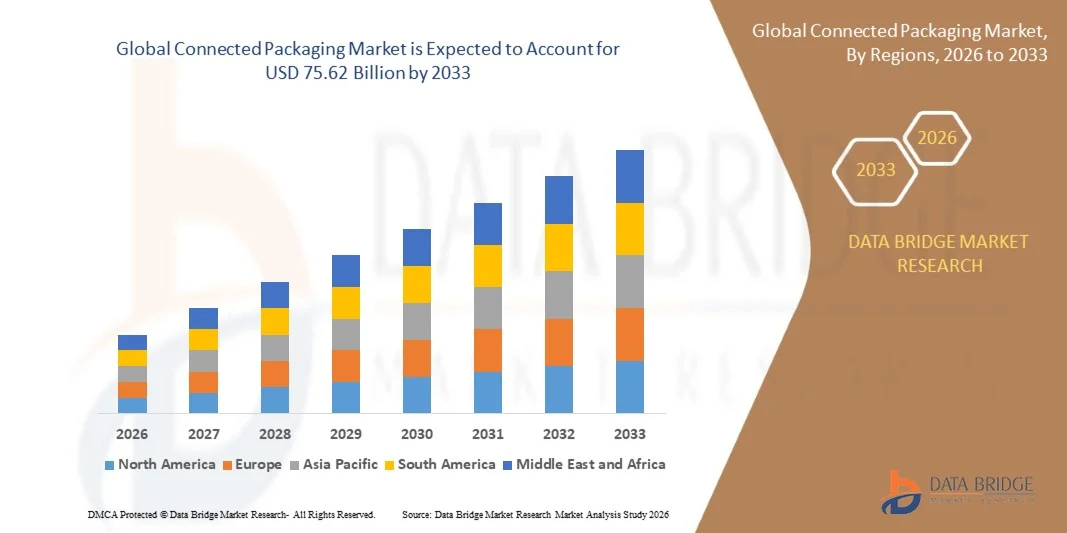
The Connected Packaging Market was valued at USD 42.72 Billion in 2025 and is projected to reach USD 75.62 Billion by 2033, growing at a CAGR of 7.4% from 2026 to 2033. The market is experiencing consistent growth driven by rising demand for product traceability, increasing adoption of smart labeling technologies such as RFID, NFC, QR codes, and sensors, and growing focus on supply chain transparency across food, beverages, healthcare, and personal care industries. Expanding integration of IoT-enabled packaging solutions and advancements in digital product authentication technologies are further accelerating market expansion across global manufacturing and retail ecosystems.
The increasing global emphasis on product safety, anti-counterfeiting measures, and sustainability compliance, combined with stringent regulatory requirements for traceability in pharmaceuticals and packaged food sectors, is driving widespread adoption of connected packaging solutions. Brands are increasingly leveraging intelligent packaging systems to enhance consumer engagement, enable real-time product information access, and improve circular economy tracking, thereby strengthening operational efficiency and reinforcing end-to-end supply chain visibility.
Key Market Trends & Insights
- North America dominated the Connected Packaging Market with the largest revenue share of 38.52% in 2025, supported by high adoption of smart packaging technologies, strong presence of advanced retail and e commerce ecosystems, and widespread integration of IoT and data driven supply chain solutions
- The intelligent packaging segment led the market with a 45.62% share in 2025, driven by rising adoption of sensor-enabled and data-driven packaging systems that enable real-time product monitoring across supply chains
- Asia-Pacific is expected to be the fastest-growing region at a CAGR of 10.29% from 2026 to 2033, fueled by rapid e commerce expansion, increasing smartphone penetration, and strong growth in packaged food and pharmaceutical industries
- Active packaging is the fastest-growing technology used type, projected to register a CAGR of 9.95% from 2026 to 2033, supported by increasing demand for extended shelf life and improved product safety in perishable goods
- The food segment dominated the end-user category with a 30.76% revenue share in 2025, led by increasing demand for traceability, freshness monitoring, and anti-counterfeit solutions in packaged food supply chains
- The healthcare segment is the fastest-growing end-user category, with a CAGR of 11.31% from 2026 to 2033, driven by rising demand for medication authentication, patient compliance tracking, and temperature-sensitive drug monitoring
Market Size & Forecast
- Global Market Value (2025): USD 42.72 Billion
- Expected Market Value (2033): USD 75.62 Billion
- Forecast CAGR (2026–2033): 7.4%
- Leading Region in 2025: North America
- Fastest Growing Region: Asia-Pacific
Report Scope and Connected Packaging Market Segmentation
|
Attributes |
Connected Packaging Key Market Insights |
|
Segments Covered |
|
|
Countries Covered |
North America · U.S. · Canada · Mexico Europe · Germany · France · U.K. · Netherlands · Switzerland · Belgium · Russia · Italy · Spain · Turkey · Rest of Europe Asia-Pacific · China · Japan · India · South Korea · Singapore · Malaysia · Australia · Thailand · Indonesia · Philippines · Rest of Asia-Pacific Middle East and Africa · Saudi Arabia · U.A.E. · South Africa · Egypt · Israel · Rest of Middle East and Africa South America · Brazil · Argentina · Rest of South America |
|
Key Market Players |
· BALL CORPORATION (U.S.) · Amcor plc (Switzerland) · 3M (U.S.) · Temptime Corporation (U.S.) · CONSTANTIA FLEXIBLES (Austria) · Klöckner Pentaplast (Germany) · Graham Packaging Company (U.S.) · Avery Dennison Corporation (U.S.) · DS Smith (U.K.) · Cryolog (France) · Emerson Electric Co (U.S.) · American Thermal Instruments (U.S.) · BASF SE (Germany) · International Paper (U.S.) · R.R. Donnelley & Sons Company (U.S.) · Stora Enso (Finland) · Thin Film Electronics ASA (Norway) · Huhtamaki (Finland) |
|
Market Opportunities |
· Expansion of RFID and NFC Smart Label Adoption · Growth in Pharmaceutical Temperature Monitoring Packaging · Rising Demand for Sustainable and Circular Packaging Solutions |
|
Value Added Data Infosets |
In addition to the insights on market scenarios such as market value, growth rate, segmentation, geographical coverage, and major players, the market reports curated by the Data Bridge Market Research also include import export analysis, production capacity overview, production consumption analysis, price trend analysis, climate change scenario, supply chain analysis, value chain analysis, raw material/consumables overview, vendor selection criteria, PESTLE Analysis, Porter Analysis, and regulatory framework. |
Connected Packaging Market Trends
Trend: Increasing IoT Enabled Intelligent Packaging Adoption
The Connected Packaging market is witnessing rapid adoption of IoT enabled intelligent packaging solutions, driven by rising demand for real time product tracking, authentication, and consumer engagement across global supply chains. Technologies such as RFID, NFC, QR codes, and sensor based labels are increasingly integrated into packaging formats to enable end to end visibility and improve brand protection. The food, beverage, and pharmaceutical sectors are leading adoption due to strict traceability and safety requirements.
Avery Dennison Corporation is actively expanding RFID and digital ID based packaging solutions, enabling large scale deployment of smart labels across retail and logistics networks, strengthening real time data capture and product lifecycle tracking capabilities.
Connected Packaging Market Dynamics
Key Market Driver: Rising Demand for Traceability and Anti Counterfeit Solutions
The growing need for product authenticity, supply chain transparency, and anti counterfeit protection is a major driver of the Connected Packaging market. Regulatory pressure in pharmaceuticals and food safety standards is pushing companies to adopt serialized packaging, digital tracking systems, and cloud connected labeling solutions. Rising consumer awareness regarding product origin and safety is further accelerating demand for intelligent packaging formats.
For instance, UPM Raflatac has introduced product carbon footprint integration into labeling solutions, enabling brands to provide transparent sustainability and traceability data directly to end users, supporting compliance and trust building across global markets.
Key Restraint/Challenge: High Cost and Integration Complexity
High implementation costs and technical complexity associated with integrating connected packaging technologies into existing production systems remain a key challenge for market growth. Deployment requires investment in smart labels, IoT sensors, data platforms, and backend digital infrastructure, which increases overall operational expenditure for manufacturers. Integration with legacy packaging lines and ensuring data interoperability across supply chains further adds complexity.
Thin Film Electronics ASA’s NFC enabled smart packaging solutions highlight the technological advancement required, but also reflect the cost sensitivity and scalability challenges faced by mass market adoption, particularly in high volume consumer goods industries.
Key Market Opportunity: Expansion of RFID and NFC Smart Label Adoption
The increasing adoption of RFID and NFC based smart labels presents significant growth opportunities in the Connected Packaging market, driven by rising demand for real time tracking, inventory optimization, and enhanced consumer interaction. Retail, logistics, and healthcare sectors are rapidly deploying smart label technologies to improve operational efficiency and reduce losses from counterfeiting and theft.
Major packaging players such as Avery Dennison Corporation and 3M are expanding their RFID and NFC enabled product portfolios, supporting large scale digital transformation of packaging ecosystems and enabling seamless integration of physical products with digital information platforms across global supply chains.
Connected Packaging Market Scope
The connected packaging market is segmented on the basis of technology used and end-user.
- By Technology Used
On the basis of technology used, the Connected Packaging Market is segmented into active packaging, interactive packaging, and intelligent packaging. The Intelligent Packaging segment dominated the market with the largest share of 45.62% in 2025, driven by rising adoption of sensor-enabled and data-driven packaging systems that enable real-time product monitoring across supply chains. These solutions support traceability, authenticity verification, and condition tracking, which is increasingly important in food, pharmaceutical, and premium consumer goods sectors. Growing integration of QR codes, RFID, and IoT-enabled labels strengthens visibility and improves consumer engagement. Strong deployment across large-scale retail and healthcare distribution networks further reinforces its leading position.
The Active Packaging segment is projected to register the fastest growth at a CAGR of 9.95% from 2026 to 2033, supported by increasing demand for extended shelf life and improved product safety in perishable goods. It enables oxygen scavenging, moisture control, and antimicrobial protection, which reduces spoilage and enhances freshness retention. Rising consumption of packaged food and pharmaceuticals is accelerating adoption across global markets. Advancements in biodegradable and smart material technologies are further improving performance efficiency. Expanding sustainability requirements across supply chains are reinforcing long-term growth momentum for this segment.
- By End-User
On the basis of end-user, the Connected Packaging Market is segmented into food, beverages, healthcare, personal care, and others. The Food segment dominated the market with the largest share of 30.76% in 2025, driven by increasing demand for traceability, freshness monitoring, and anti-counterfeit solutions in packaged food supply chains. Growing consumer awareness regarding product origin and safety is encouraging adoption of connected labeling and smart packaging solutions. Large-scale retail distribution and cold chain expansion further strengthen deployment across processed and perishable food categories. Continuous innovation in packaging materials and digital tracking systems reinforces its dominant market position.
The Healthcare segment is projected to register the fastest growth at a CAGR of 11.31% from 2026 to 2033, driven by rising demand for medication authentication, patient compliance tracking, and temperature-sensitive drug monitoring. Increasing prevalence of counterfeit medicines is accelerating adoption of intelligent packaging solutions across pharmaceutical supply chains. Regulatory requirements for serialization and track-and-trace systems are further supporting market expansion. Advancements in IoT-enabled blister packs and smart labels are improving patient safety and operational efficiency. Growing investment in digital healthcare infrastructure is reinforcing rapid adoption across global pharmaceutical networks.
Connected Packaging Market Regional Analysis
North America dominated the connected packaging market and accounted for the largest revenue share of 38.52% in 2025, driven by high adoption of smart packaging technologies, strong presence of advanced retail and e commerce ecosystems, and widespread integration of IoT and data driven supply chain solutions. The region benefits from a mature digital infrastructure, high penetration of RFID, NFC, and QR based packaging systems, and increasing demand for product traceability and anti counterfeiting solutions. Enterprises across food, beverages, healthcare, and personal care industries are increasingly investing in connected packaging to enhance consumer engagement and improve supply chain transparency. In addition, the presence of leading packaging technology providers and strong investments in smart labeling innovation continue to reinforce North America’s leadership position in the global market.
U.S. Connected Packaging Market Insight
The U.S. Connected Packaging market is experiencing strong growth driven by rapid adoption of intelligent packaging solutions, increasing demand for real time product authentication, and large scale implementation of digital supply chain tracking systems across industries. Food and pharmaceutical companies are heavily investing in IoT enabled packaging to ensure safety, compliance, and transparency throughout distribution networks. The country’s advanced retail ecosystem and strong presence of technology driven packaging innovators are enabling widespread deployment of smart labels and sensor based packaging solutions. In addition, rising consumer demand for transparency and sustainability focused packaging is further accelerating market expansion across the U.S.
Canada Connected Packaging Market Insight
The Canada Connected Packaging market is witnessing steady growth supported by increasing adoption of traceability solutions in food safety and pharmaceutical supply chains, along with rising investments in digital labeling technologies. Businesses across retail, healthcare, and packaged food sectors are increasingly using connected packaging to improve inventory visibility and reduce counterfeit risks. The country’s strong regulatory framework for food and drug safety is encouraging adoption of intelligent packaging systems with tracking and authentication capabilities. In addition, growing e commerce penetration and expansion of cold chain logistics are further contributing to market growth in Canada.
Europe Connected Packaging Market Insight
The Europe Connected Packaging market is expanding steadily due to strong regulatory focus on product traceability, increasing adoption of sustainable packaging technologies, and rising demand for digital consumer engagement solutions. The region benefits from strict compliance standards in food and pharmaceutical industries, which drive the adoption of intelligent and interactive packaging systems. Enterprises across retail, healthcare, and personal care sectors are increasingly investing in connected packaging to improve transparency and customer interaction. Rising integration of IoT enabled packaging solutions and smart labeling technologies continues to support regional market growth.
U.K. Connected Packaging Market Insight
The U.K. Connected Packaging market is growing steadily, driven by high digital adoption in retail and FMCG sectors, increasing focus on product authenticity, and strong demand for consumer engagement through smart packaging solutions. Businesses are increasingly implementing QR code and NFC enabled packaging to enhance brand interaction and provide real time product information. The presence of a well developed retail and e commerce ecosystem is further supporting adoption of connected packaging technologies. In addition, rising sustainability initiatives and regulatory emphasis on packaging transparency are strengthening market expansion in the U.K.
Germany Connected Packaging Market Insight
The Germany Connected Packaging market is expanding due to strong industrial digitization, increasing demand for supply chain transparency, and growing adoption of advanced packaging automation technologies. Automotive, healthcare, and food industries are increasingly integrating intelligent packaging systems to improve traceability and operational efficiency. The country’s strong emphasis on regulatory compliance and product safety is driving demand for secure and data enabled packaging solutions. In addition, rising investment in Industry 4.0 technologies is further accelerating adoption of connected packaging systems in Germany.
Asia-Pacific Connected Packaging Market Insight
The Asia-Pacific Connected Packaging market is expected to register the fastest growth with a CAGR of 10.29% from 2026 to 2033, driven by rapid e commerce expansion, increasing smartphone penetration, and strong growth in packaged food and pharmaceutical industries. Rising adoption of digital labeling and smart packaging technologies among manufacturers and retailers is significantly boosting regional demand. Countries such as China, India, Japan, and South Korea are witnessing strong investments in IoT enabled packaging and supply chain digitization. In addition, expanding retail infrastructure and growing consumer awareness regarding product authenticity are further accelerating market growth in the region.
Japan Connected Packaging Market Insight
The Japan Connected Packaging market is witnessing steady growth supported by advanced manufacturing capabilities, strong focus on quality control, and increasing adoption of smart packaging technologies in food and healthcare sectors. Enterprises are leveraging connected packaging to enhance product traceability, reduce waste, and improve customer engagement. The country’s highly developed technological infrastructure and strong emphasis on automation are further supporting market adoption. In addition, rising use of QR code based information systems and digital consumer engagement platforms is strengthening demand in Japan.
China Connected Packaging Market Insight
The China Connected Packaging market is growing rapidly due to massive e commerce expansion, high smartphone penetration, and increasing adoption of intelligent packaging solutions across food, beverage, and pharmaceutical industries. Companies are heavily investing in IoT enabled packaging and AI driven supply chain tracking systems to enhance efficiency and reduce counterfeit risks. The country’s strong digital ecosystem and presence of major technology providers are enabling large scale deployment of smart packaging solutions. In addition, rising consumer demand for product transparency and real time information access is further driving market growth in China.
Connected Packaging Market Share
The connected packaging industry is primarily led by well-established companies, including:
- BALL CORPORATION (U.S.)
- Amcor plc (Switzerland)
- 3M (U.S.)
- Temptime Corporation (U.S.)
- CONSTANTIA FLEXIBLES (Austria)
- Klöckner Pentaplast (Germany)
- Graham Packaging Company (U.S.)
- Avery Dennison Corporation (U.S.)
- DS Smith (U.K.)
- Cryolog (France)
- Emerson Electric Co (U.S.)
- American Thermal Instruments (U.S.)
- BASF SE (Germany)
- International Paper (U.S.)
- R. Donnelley & Sons Company (U.S.)
- Stora Enso (Finland)
- Thin Film Electronics ASA (Norway)
- Huhtamaki (Finland)
Latest Developments in Connected Packaging Market
- In June 2025, r-pac CNCT, SharpEnd, and Moose Knuckles demonstrated a consumer facing Digital Product Passport at the Global Fashion Summit, strengthening the Connected Packaging market by advancing transparent product lifecycle visibility and enhancing brand consumer engagement through verifiable digital identity systems. This development improves traceability in fashion supply chains and supports growing demand for authenticity and sustainability focused consumer experiences
- In May 2025, Polytag integrated UV watermark technology with Pellenc ST sorting lines, significantly enhancing recycling traceability within the Connected Packaging market by enabling automated detection and sorting of packaging materials at industrial scale. This advancement improves circular economy efficiency by increasing accuracy in waste segregation and supporting regulatory compliance for packaging sustainability initiatives
- In May 2025, Identiv and InPlay collaborated to develop next generation BLE smart labels priced between USD 1 and 2 for high volume logistics applications, strengthening the Connected Packaging market by making Bluetooth enabled tracking solutions more cost efficient and scalable. This innovation enhances real time asset tracking capabilities across supply chains and expands adoption potential in logistics intensive industries
- In April 2025, Amcor and Berry Global announced an all stock merger valued at USD 24 billion, creating a leading global packaging entity with planned annual synergies of USD 650 million, significantly impacting the Connected Packaging market by consolidating innovation capabilities and accelerating investment in smart and sustainable packaging solutions. This consolidation is expected to strengthen R&D in intelligent packaging and expand global deployment capabilities
- In April 2025, UPM Raflatac became the first label manufacturer to incorporate product carbon footprint data directly into customer quotations, reinforcing the Connected Packaging market by advancing sustainability transparency and enabling data driven purchasing decisions. This initiative enhances environmental accountability across supply chains and supports increasing regulatory and consumer pressure for low carbon packaging solutions

- Interactive Data Analysis Dashboard
- Company Analysis Dashboard for high growth potential opportunities
- Research Analyst Access for customization & queries
- Competitor Analysis with Interactive dashboard
- Latest News, Updates & Trend analysis
- Harness the Power of Benchmark Analysis for Comprehensive Competitor Tracking
Global Connected Packaging Market, Supply Chain Analysis and Ecosystem Framework
To support market growth and help clients navigate the impact of geopolitical shifts, DBMR has integrated in-depth supply chain analysis into its Global Connected Packaging Market research reports. This addition empowers clients to respond effectively to global changes affecting their industries. The supply chain analysis section includes detailed insights such as Global Connected Packaging Market consumption and production by country, price trend analysis, the impact of tariffs and geopolitical developments, and import and export trends by country and HSN code. It also highlights major suppliers with data on production capacity and company profiles, as well as key importers and exporters. In addition to research, DBMR offers specialized supply chain consulting services backed by over a decade of experience, providing solutions like supplier discovery, supplier risk assessment, price trend analysis, impact evaluation of inflation and trade route changes, and comprehensive market trend analysis.
Data collection and base year analysis are done using data collection modules with large sample sizes. The stage includes obtaining market information or related data through various sources and strategies. It includes examining and planning all the data acquired from the past in advance. It likewise envelops the examination of information inconsistencies seen across different information sources. The market data is analysed and estimated using market statistical and coherent models. Also, market share analysis and key trend analysis are the major success factors in the market report. To know more, please request an analyst call or drop down your inquiry.
The key research methodology used by DBMR research team is data triangulation which involves data mining, analysis of the impact of data variables on the market and primary (industry expert) validation. Data models include Vendor Positioning Grid, Market Time Line Analysis, Market Overview and Guide, Company Positioning Grid, Patent Analysis, Pricing Analysis, Company Market Share Analysis, Standards of Measurement, Global versus Regional and Vendor Share Analysis. To know more about the research methodology, drop in an inquiry to speak to our industry experts.
Data Bridge Market Research is a leader in advanced formative research. We take pride in servicing our existing and new customers with data and analysis that match and suits their goal. The report can be customized to include price trend analysis of target brands understanding the market for additional countries (ask for the list of countries), clinical trial results data, literature review, refurbished market and product base analysis. Market analysis of target competitors can be analyzed from technology-based analysis to market portfolio strategies. We can add as many competitors that you require data about in the format and data style you are looking for. Our team of analysts can also provide you data in crude raw excel files pivot tables (Fact book) or can assist you in creating presentations from the data sets available in the report.













