


What is the Connected Worker Market Size and Growth Rate?
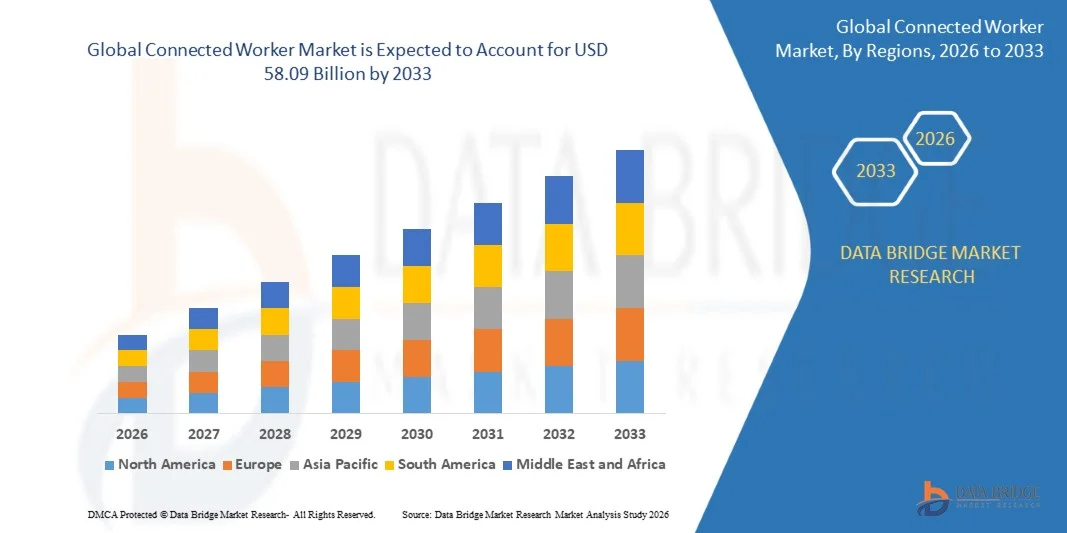
- As per Data Bridge Market Research analysis, the connected worker market was valued at USD 9.50 billion in 2025 and is projected to reach USD 58.09 billion by 2033, growing at a CAGR of 25.40% from 2026 to 2033.
- The market is experiencing consistent growth driven by rising industrial digitalization, increasing emphasis on workforce safety and productivity, and rapid adoption of IoT, wearable technologies, artificial intelligence, and real-time workforce collaboration solutions.
- The increasing need to improve frontline workforce safety and operational efficiency, combined with growing adoption of cloud platforms and connected devices, is compelling organizations across manufacturing, construction, energy and utilities, oil and gas, and logistics to deploy connected worker solutions. Cloud-based platforms, wearable devices, and real-time monitoring technologies are increasingly replacing fragmented workforce processes, offering scalable, data-driven, and connected environments for worker communication, task management, safety monitoring, and remote assistance.
Market Size & Forecast
- Global Market Value (2025): USD 9.50 Billion
- Expected Market Value (2033): USD 58.09 Billion
- Forecast CAGR (2026–2033): 25.40%
- Leading Region in 2025: North America
- Fastest Growing Region: Asia Pacific
What are the Major Takeaways of the Connected Worker Market?
- North America dominated the connected worker market with the largest revenue share of 39% in 2025, supported by advanced industrial infrastructure, high adoption of digital technologies, and strong investments in workforce safety and productivity solutions.
- Asia-Pacific is expected to be the fastest-growing region at a CAGR of 27% from 2026 to 2033, fueled by rapid industrialization, increasing digital transformation investments, and growing adoption across manufacturing, construction, energy, and logistics.
- The software segment led the market with a 40.6% share in 2025, driven by increasing demand for centralized platforms that orchestrate frontline workflows, standardize work processes, and provide real-time operational visibility.
- Services are the fastest-growing component type, projected to register a CAGR of 27%, reflecting the surge in demand for implementation, integration, customization, training, technical support, and managed services
- The Wi-Fi segment dominated the technology category with a 32% revenue share in 2025, led by its widespread availability across industrial facilities and compatibility with connected worker devices.
- Cloud accounted for 67.1% of the market share in 2025, preferred by the growing need for rapid scalability and centralized administration of connected worker applications
- The on-premises segment is the fastest-growing deployment category, with a CAGR of 25%, driven by organizations requiring greater control over sensitive workforce and operational data.
Report Scope and Connected Worker Market Segmentation
|
Attributes |
Connected Worker Key Market Insights |
|
Segments Covered |
|
|
Countries Covered |
North America
Europe
Asia-Pacific
Middle East and Africa
South America
|
|
Key Market Players |
|
|
Market Opportunities |
|
|
Value Added Data Infosets |
In addition to the insights on market scenarios such as market value, growth rate, segmentation, geographical coverage, and major players, the market reports curated by the Data Bridge Market Research also include in-depth expert analysis, patient epidemiology, pipeline analysis, pricing analysis, and regulatory framework. |
What is the Key Trend in the Connected Worker Market?
- Organizations are increasingly adopting AI-powered connected worker platforms to provide frontline employees with real-time guidance, contextual information, automated workflows, and decision support, improving productivity and operational efficiency across industrial environments.
- For instance, in June 2025, Innovapptive launched 15 AI agents embedded within its Connected Worker Platform to automate frontline workflows and provide real-time insights for improving safety, reliability, and reducing downtime.
- Connected worker solutions are increasingly integrating wearables, IoT sensors, location tracking, and real-time alerts to improve worker safety, enable faster emergency response, and provide organizations with continuous visibility into frontline operations.
- Digital work instructions and remote assistance are becoming increasingly important as manufacturers seek to standardize frontline tasks, transfer institutional knowledge, reduce errors, and support less-experienced workers through real-time expert guidance.
- For instance, in July 2024, PTC highlighted the integration of IIoT and augmented reality to provide frontline workers with digital work instructions, expert training, remote assistance, and real-time data insights for manufacturing operations.
- As industrial organizations continue to combine AI, IoT, wearables, AR, and connected workflows, connected worker platforms are expected to evolve from basic communication tools into intelligent frontline systems that continuously support safety, productivity, training, and operational decision-making.
What are the Key Drivers of the Connected Worker Market?
- The rapid adoption of AI, industrial IoT, wearable technologies, and real-time analytics is significantly increasing demand for connected worker solutions capable of improving frontline decision-making, productivity, safety, and operational visibility across asset-intensive industries.
- For instance, in August 2025, Rockwell Automation reported that 61% of cybersecurity and IT professionals planned AI and machine-learning adoption for security within the following 12 months, highlighting the accelerating integration of AI into connected industrial environments.
- Industrial organizations, particularly manufacturers, energy companies, utilities, and logistics providers, are integrating connected worker technologies to address skilled-labor shortages, rising operational costs, and the need to preserve workforce knowledge while improving efficiency and workforce performance.
- For instance, in June 2025, Rockwell Automation reported that 26% of life sciences manufacturing leaders identified finding skilled workers as their biggest barrier to growth, while nearly half were using AI and automation to support their workforce.
- With organizations increasingly connecting frontline employees with machines, enterprise systems, operational data, and remote experts, connected worker technologies will remain essential for improving workforce resilience, accelerating knowledge transfer, and supporting safer and more efficient industrial operations.
Which Factors are Challenging the Growth of the Connected Worker Market?
- Connected worker deployments can require significant investment in devices, software platforms, IoT infrastructure, cybersecurity, system integration, and workforce training, creating financial and technical barriers for organizations with complex or legacy operational environments.
- For instance, in August 2025, Rockwell Automation reported that 48% of cybersecurity professionals identified securing converging IT/OT architectures as a key factor for positive outcomes over the next five years, demonstrating the growing complexity of connected industrial environments.
- The complexity of integrating connected worker platforms with existing IT and operational technology (OT) systems can delay deployment, particularly where organizations operate legacy infrastructure, fragmented data systems, and isolated industrial networks.
- The increasing volume of worker, location, operational, and performance data also raises cybersecurity and privacy concerns, while inadequate digital skills and limited workforce readiness can restrict adoption and reduce the effectiveness of connected worker technologies.
- For instance, in September 2024, the U.S. Government Accountability Office reported that it reviewed 217 stakeholder comments concerning digital worker surveillance, with some workers and unions reporting increased stress and negative effects on morale from monitoring technologies.
- These integration, cybersecurity, privacy, cost, and workforce-readiness challenges continue to complicate connected worker implementation, particularly for organizations operating legacy systems or highly regulated industrial environments, limiting the speed of widespread deployment.
How is the Connected Worker Market Segmented?
The connected worker market is segmented on the basis of component, technology, deployment, and end user.
- By Component
On the basis of component, the connected worker market is segmented into hardware, software, and services. The software segment dominated the market with a 40.6% share in 2025, owing to increasing demand for centralized platforms that orchestrate frontline workflows, standardize work processes, and provide real-time operational visibility. Connected worker software enables digital task assignment, workflow automation, digital checklists, skills management, and knowledge capture. Enterprises are increasingly adopting software platforms to connect geographically distributed frontline teams with operational and enterprise systems. Integration with artificial intelligence, analytics, IoT, and mobile technologies is further strengthening software adoption. The growing shift from fragmented workforce processes toward integrated digital platforms is supporting segment expansion.
The services segment is projected to register the fastest growth at an estimated CAGR of 27% from 2026 to 2033, driven by increasing demand for implementation, integration, customization, training, technical support, and managed services. Organizations require specialized expertise to integrate connected worker technologies with existing operational and enterprise systems. The complexity of multi-site deployments is increasing demand for consulting and implementation support. Service providers also help organizations customize workflows according to specific operational requirements. Growing adoption among enterprises without extensive internal digital capabilities is further supporting demand. Ongoing system upgrades, maintenance, workforce training, and optimization are creating recurring service requirements.
- By Technology
On the basis of technology, the connected worker market is segmented into RFID Location Triangulation, Wi-Fi, Cellular, Bluetooth, Low-Power Wide-Area Network (LPWAN), Wireless Field Area Network (WFAN), and Zigbee. The Wi-Fi segment dominated the market with an estimated share of 32% in 2025, supported by its widespread availability across industrial facilities and compatibility with connected worker devices. Wi-Fi provides reliable connectivity for tablets, handheld devices, scanners, wearables, and industrial applications. Manufacturing facilities and warehouses increasingly use Wi-Fi infrastructure to provide frontline employees with real-time access to operational information. Its ability to support high data-transfer requirements makes it suitable for video collaboration, digital work instructions, and cloud applications.
The cellular segment is projected to register the fastest growth at an estimated CAGR of 28% from 2026 to 2033, driven by increasing demand for reliable connectivity across remote and geographically distributed work environments. Cellular networks enable connected workers to remain connected beyond the boundaries of fixed industrial networks. This capability is particularly valuable across construction sites, utilities, oil and gas operations, mining locations, and transportation networks. Increasing deployment of advanced cellular connectivity is improving real-time communication and remote monitoring capabilities. Cellular-enabled wearables and mobile devices can support location tracking, emergency communication, and field-service applications. Growing demand for continuous connectivity across mobile workforces is further strengthening adoption.
- By Deployment
On the basis of deployment, the connected worker market is segmented into cloud and on-premises. The cloud segment dominated the market with a 67.1% share in 2025, driven by the growing need for rapid scalability and centralized administration of connected worker applications. Cloud platforms enable organizations to deploy software consistently across multiple facilities and geographically distributed workforces. They also simplify application updates, user management, workflow administration, and connected-device integration. Cloud deployment reduces dependence on site-specific IT infrastructure and supports faster implementation. Integration with analytics, artificial intelligence, IoT, and enterprise applications is further increasing the attractiveness of cloud-based solutions.
The on-premises segment is projected to register the fastest growth at an estimated CAGR of 25% from 2026 to 2033, supported by organizations requiring greater control over sensitive workforce and operational data. Locally hosted platforms allow enterprises to maintain tighter control over data access, cybersecurity policies, infrastructure configuration, and system availability. This deployment model is particularly relevant for organizations operating in critical or highly regulated environments. Companies with established internal IT infrastructure may also prefer on-premises systems for integration with existing operational technologies. Growing concerns surrounding data security and residency are supporting demand for locally controlled platforms.
- By End User
On the basis of end user, the connected worker market is segmented into manufacturing, construction, energy & utilities, oil & gas, mining, transportation & logistics, healthcare, retail, and others. The manufacturing segment dominated the market with an estimated share of 35.4% in 2025, supported by increasing adoption of connected worker technologies across production, quality, maintenance, material handling, and machine operations. Manufacturers are increasingly using digital work instructions to standardize frontline activities and improve operational consistency. Connected worker platforms enable real-time communication between operators, supervisors, maintenance teams, and technical personnel. Integration with industrial IoT systems provides workers with contextual operational information and improves decision-making.
The healthcare segment is projected to register the fastest growth at an estimated CAGR of 27% from 2026 to 2033, driven by increasing demand for coordinated frontline workforce operations and timely information exchange. Healthcare organizations are adopting connected technologies to improve communication among clinical and non-clinical personnel. Mobile workflows can help healthcare workers access operational information and complete tasks more efficiently. Connected devices can also support personnel and asset-location awareness across hospitals and care facilities. Integration of digital task management and communication platforms is improving workforce coordination. Growing demand for efficient workforce management amid increasing operational complexity is supporting adoption.
Which Region Holds the Largest Share of the Connected Worker Market?
- North America dominated the connected worker market with the largest revenue share of 39% in 2025, supported by advanced industrial infrastructure, high adoption of digital technologies, and strong investments in workforce safety and productivity solutions.
- The region also benefits from increasing emphasis on workforce safety and productivity, widespread deployment of wearables and mobile technologies, and growing integration of connected worker platforms with enterprise software and operational systems. Strong demand for real-time workforce collaboration, digital workflows, and solutions addressing frontline skills availability continues to strengthen North America's leadership position in the global market.
U.S. Connected Worker Market Insight
The U.S. connected worker market is witnessing strong growth due to rising investments in industrial digitalization, workforce safety, and frontline productivity technologies. The country’s mature manufacturing, logistics, energy, and technology ecosystem, along with increasing adoption of AI-powered, IoT-enabled, wearable, and cloud-based connected worker solutions, is driving demand across industrial and field-service applications. In addition, growing emphasis on addressing skilled labor shortages, improving operational efficiency, and strengthening workplace safety is accelerating connected worker adoption across enterprises.
Asia-Pacific Connected Worker Market Insight
The Asia-Pacific connected worker market is expected to witness rapid growth, driven by increasing industrialization, expanding manufacturing activities, and rising investments in digital workforce infrastructure across countries such as China, India, and Japan. Growing awareness regarding worker safety, rising adoption of IoT and cloud technologies, and increasing demand for scalable workforce management solutions are supporting regional market expansion. In addition, the growing presence of smart factories, logistics networks, and digitally enabled industrial facilities is accelerating connected worker adoption across manufacturing and field-based sectors.
Japan Connected Worker Market Insight
The Japan connected worker market is witnessing consistent growth due to rising investments in industrial automation, workforce digitalization, and advanced worker safety technologies. Manufacturers, logistics companies, utilities, and other industrial organizations are increasingly adopting connected platforms, wearable devices, and digital work solutions to improve workforce productivity and operational visibility. Moreover, increasing integration of AI, IoT, robotics, and cloud technologies, along with the country’s focus on addressing workforce shortages and improving operational efficiency, is further contributing to market growth.
China Connected Worker Market Insight
The China connected worker market is growing rapidly, driven by expanding manufacturing activities, increasing industrial automation, and rising government focus on smart manufacturing and digital transformation. Growing adoption of AI-enabled, IoT-connected, and cloud-based workforce platforms across manufacturing, logistics, construction, and energy sectors is significantly boosting market demand. In addition, rising investments in smart factories, increasing emphasis on workplace safety, and rapid development of industrial digital infrastructure are positioning China as one of the fastest-growing markets for connected worker solutions globally.
U.K. Connected Worker Market Insight
The U.K. connected worker market is experiencing steady growth, supported by rising adoption of digital workforce technologies across manufacturing, construction, utilities, healthcare, and logistics applications. Increasing investments in connected worker platforms and growing demand for real-time communication, digital workflows, and workforce safety solutions are contributing to market growth. Furthermore, integration of AI, IoT, cloud computing, and wearable technologies is improving frontline productivity and operational efficiency, positioning the U.K. as a key market for connected worker technology adoption.
Germany Connected Worker Market Insight
The Germany connected worker market is expanding steadily due to the country’s strong manufacturing base, advanced industrial ecosystem, and increasing adoption of Industry 4.0 technologies. Manufacturers, logistics companies, energy organizations, and industrial service providers are increasingly utilizing connected worker platforms, wearable devices, and digital work instructions for workforce management and operational optimization. Continuous advancements in AI, IoT, industrial automation, and cloud technologies, along with strong focus on worker safety, productivity, and smart manufacturing, are further driving market growth in Germany.
Which are the Top Companies in Connected Worker Market?
The connected worker industry is primarily led by well-established companies, including:
- Innovapptive Inc. (U.S.)
- PTC Inc. (U.S.)
- SafetyCulture Pty Ltd (Australia)
- Tulip Interfaces, Inc. (U.S.)
- Poka Inc. (Canada)
- Leading2Lean, LLC (U.S.)
- Librestream Technologies Incorporated (Canada)
- Workerbase GmbH (Germany)
- Sigga Technologies (U.S.)
- Samsara Inc. (U.S.)
- Zebra Technologies Corp. (U.S.)
- Honeywell International Inc. (U.S.)
- Rockwell Automation, Inc. (U.S.)
- Siemens (Germany)
- Schneider Electric (France)
- ABB Asea Brown Boveri Ltd (Switzerland)
- Hitachi Energy Ltd (Switzerland)
- SAP SE (Germany)
- Oracle (U.S.)
- Trimble Inc. (U.S.)
What are Latest Developments in Connected Worker Market?
- In June 2025, Samsara announced new AI-powered technologies for physical operations, including the Samsara Wearable, a connected device designed to protect frontline workers outside vehicles through one-click emergency assistance and precise location capabilities. The wearable provides more than one year of battery life and expands connected-worker safety capabilities across remote and job-site environments.
- In August 2025, Innovapptive announced a strategic collaboration agreement with Amazon Web Services (AWS) to accelerate development and delivery of cloud-based connected worker solutions. The collaboration focuses on unifying frontline operations across maintenance, safety, inventory, and plant operations while expanding the scalability of Innovapptive’s connected worker technology.
- In November 2024, Innovapptive joined the AWS ISV Accelerate Program to strengthen the global delivery of its AI-powered connected worker solutions. The initiative was intended to enhance access to Innovapptive’s connected worker technology through AWS and support organizations seeking to improve frontline operational efficiency and digital transformation.
- In November 2023, Innovapptive launched a computer vision and AI/ML inspection solution with Deloitte Australia, designed to improve frontline operations productivity and asset reliability. The solution applies AI-based visual inspection capabilities to industrial operations, supporting connected workers with more efficient inspection and asset-management processes.
- In April 2022, SafetyCulture released research highlighting significant gaps in workplace health and safety training among frontline workers in the U.S., U.K., and Australia. The findings showed that only 44% of surveyed frontline workers had received workplace health and safety training during the previous year, underscoring the need for accessible digital training and connected-worker technologies that improve frontline communication and safety management

- Interactive Data Analysis Dashboard
- Company Analysis Dashboard for high growth potential opportunities
- Research Analyst Access for customization & queries
- Competitor Analysis with Interactive dashboard
- Latest News, Updates & Trend analysis
- Harness the Power of Benchmark Analysis for Comprehensive Competitor Tracking
Data collection and base year analysis are done using data collection modules with large sample sizes. The stage includes obtaining market information or related data through various sources and strategies. It includes examining and planning all the data acquired from the past in advance. It likewise envelops the examination of information inconsistencies seen across different information sources. The market data is analysed and estimated using market statistical and coherent models. Also, market share analysis and key trend analysis are the major success factors in the market report. To know more, please request an analyst call or drop down your inquiry.
The key research methodology used by DBMR research team is data triangulation which involves data mining, analysis of the impact of data variables on the market and primary (industry expert) validation. Data models include Vendor Positioning Grid, Market Time Line Analysis, Market Overview and Guide, Company Positioning Grid, Patent Analysis, Pricing Analysis, Company Market Share Analysis, Standards of Measurement, Global versus Regional and Vendor Share Analysis. To know more about the research methodology, drop in an inquiry to speak to our industry experts.
Data Bridge Market Research is a leader in advanced formative research. We take pride in servicing our existing and new customers with data and analysis that match and suits their goal. The report can be customized to include price trend analysis of target brands understanding the market for additional countries (ask for the list of countries), clinical trial results data, literature review, refurbished market and product base analysis. Market analysis of target competitors can be analyzed from technology-based analysis to market portfolio strategies. We can add as many competitors that you require data about in the format and data style you are looking for. Our team of analysts can also provide you data in crude raw excel files pivot tables (Fact book) or can assist you in creating presentations from the data sets available in the report.













