


Connectivity Constraint Computing Market Overview
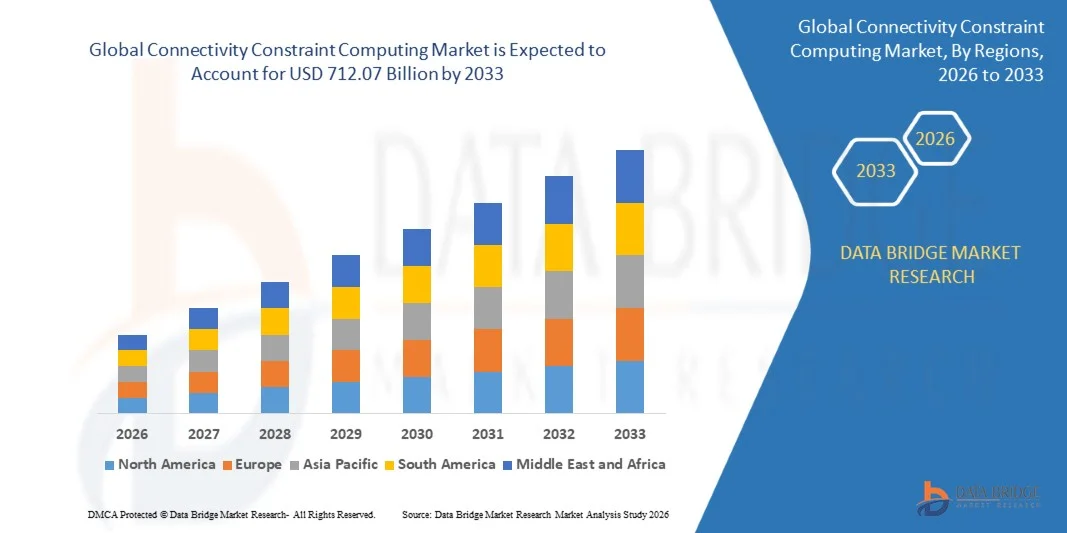
The Connectivity Constraint Computing Market was valued at USD 17.52 Billion in 2025 and is projected to reach USD 712.07 Billion by 2033, growing at a CAGR of 58.90% from 2026 to 2033. The market is experiencing consistent growth driven by increasing adoption of edge computing architectures, rising deployment of Internet of Things (IoT) devices, and growing demand for reliable computing in bandwidth-constrained environments. Expanding digital transformation initiatives across healthcare, logistics, industrial automation, and smart infrastructure sectors are further supporting market expansion. Advancements in artificial intelligence, distributed computing, and intelligent network optimization technologies are also accelerating adoption across both developed and emerging economies.
The increasing need for real-time data processing and uninterrupted operations in remote, mobile, and network-limited environments is encouraging organizations to deploy connectivity constraint computing solutions. Enterprises are increasingly leveraging these technologies to reduce latency, improve operational resilience, and ensure efficient decision-making even under intermittent connectivity conditions. Growing investments in edge intelligence, private wireless networks, and distributed computing infrastructure are further enhancing market growth. In addition, the rising emphasis on resilient digital ecosystems and efficient resource utilization is creating significant opportunities for connectivity constraint computing providers worldwide.
Key Market Trends & Insights
- North America dominated the Connectivity Constraint Computing Market with the largest revenue share of 35% in 2025, supported by early adoption of edge computing technologies, advanced digital infrastructure, and strong investments in intelligent network optimization solutions
- The healthcare segment led the market with a 41.5% share in 2025, driven by the rapid digital transformation of healthcare systems and growing reliance on connected medical technologies
- Asia-Pacific is expected to be the fastest-growing region at a CAGR of 17.1% from 2026 to 2033, fueled by rapid digitalization, expanding IoT deployments, and increasing adoption of edge computing technologies across emerging economies
- Logistic is the fastest-growing end user type, projected to register a CAGR of 15.1% from 2026 to 2033, supported by the rising need for efficient connectivity management across complex supply chain and transportation networks
- The security segment dominated the application category with a 38.7% revenue share in 2025, led by the growing need to manage connectivity limitations in cybersecurity infrastructure, distributed networks, and mission-critical communication systems
- The ecosystem and healthcare management system segment is the fastest-growing application category, with a CAGR of 14.2% from 2026 to 2033, driven by the increasing adoption of connected healthcare platforms, remote patient monitoring systems, and smart healthcare ecosystems
Market Size & Forecast
- Global Market Value (2025): USD 17.52 Billion
- Expected Market Value (2033): USD 712.07 Billion
- Forecast CAGR (2026–2033): 58.90%
- Leading Region in 2025: North America
- Fastest Growing Region: Asia-Pacific
Report Scope and Connectivity Constraint Computing Market Segmentation
|
Attributes |
Connectivity Constraint Computing Key Market Insights |
|
Segments Covered |
|
|
Countries Covered |
North America · U.S. · Canada · Mexico Europe · Germany · France · U.K. · Netherlands · Switzerland · Belgium · Russia · Italy · Spain · Turkey · Rest of Europe Asia-Pacific · China · Japan · India · South Korea · Singapore · Malaysia · Australia · Thailand · Indonesia · Philippines · Rest of Asia-Pacific Middle East and Africa · Saudi Arabia · U.A.E. · South Africa · Egypt · Israel · Rest of Middle East and Africa South America · Brazil · Argentina · Rest of South America |
|
Key Market Players |
· Oracle Corporation (U.S.) · IBM (U.S.) · Broadcom Inc. (U.S.) · Microsoft Corporation (U.S.) · Google LLC (U.S.) · Amazon.com, Inc. (U.S.) · Walmart Inc. (U.S.) · Tata Consultancy Services Limited (India) · Cognizant (U.S.) · Phoenix Software Limited (U.K.) · Alphabet Inc. (U.S.) · Apple Inc. (U.S.) · Qualcomm Technologies, Inc. (U.S.) · Saffron Tech Pvt Ltd (India) · Sony Depthsensing Solutions (Japan) · Affectiva (U.S.) · Pyreos Limited (U.K.) · Cognitec Systems GmbH (Germany) |
|
Market Opportunities |
· Expansion of Remote Healthcare and Telemedicine Networks · Growing Deployment of Smart Logistics and Connected Supply Chain Systems · Increasing Adoption of Private 5G and Industrial Edge Computing Solutions |
|
Value Added Data Infosets |
In addition to the market insights such as market value, growth rate, market segments, geographical coverage, market players, and market scenario, the market report curated by the Data Bridge Market Research team includes in-depth expert analysis, import/export analysis, pricing analysis, production consumption analysis, and pestle analysis. |
Connectivity Constraint Computing Market Trends
Trend: Rising Adoption of Edge AI and Distributed Computing Architectures
Organizations are increasingly deploying edge AI and distributed computing platforms to process data closer to its source, reducing dependence on continuous cloud connectivity and enabling real-time decision-making in bandwidth-constrained environments. The rapid growth of connected devices, industrial IoT networks, autonomous systems, and remote operations is accelerating demand for computing architectures capable of operating effectively despite network limitations. Edge-based processing is becoming particularly important across healthcare, manufacturing, logistics, and smart city applications where latency and connectivity reliability are critical.
Companies such as Microsoft are expanding edge computing capabilities through Azure IoT Edge and Azure Arc solutions, enabling enterprises to process and analyze data locally while maintaining operational continuity in environments with intermittent connectivity.
Connectivity Constraint Computing Market Dynamics
Key Market Driver: Rising Demand for Real-Time Processing
The increasing need for real-time data analysis and immediate decision-making across connected environments is significantly driving demand for connectivity constraint computing solutions. Industries including healthcare, logistics, industrial automation, and public safety require computing systems that can function efficiently even when network bandwidth is limited or connectivity is unstable. Processing data locally reduces latency, minimizes transmission costs, and ensures uninterrupted operations in critical environments. Growing adoption of IoT devices and edge-enabled infrastructure is further strengthening market demand.
Major technology providers such as Amazon Web Services are expanding edge computing offerings through AWS Outposts and AWS IoT Greengrass, enabling organizations to perform low-latency processing and analytics closer to operational environments where reliable connectivity cannot always be guaranteed.
Key Restraint/Challenge: Network Interoperability Complexity
A major challenge in the Connectivity Constraint Computing market is ensuring seamless interoperability across diverse networks, devices, communication protocols, and computing platforms. Organizations often operate complex environments that combine legacy infrastructure with modern cloud, edge, and IoT systems, creating integration challenges and increasing deployment complexity. Variations in network standards, security frameworks, and data management architectures can hinder efficient communication and workload distribution. These factors increase implementation costs and require significant technical expertise for successful deployment.
The integration of multi-vendor industrial IoT ecosystems across manufacturing and logistics operations demonstrates the ongoing challenge of achieving standardized communication and interoperability between connected devices and distributed computing platforms.
Key Market Opportunity: Expansion of Remote Healthcare and Telemedicine Networks
The rapid expansion of remote healthcare services and telemedicine infrastructure is creating significant growth opportunities for the Connectivity Constraint Computing market. Healthcare providers increasingly require reliable computing systems capable of supporting remote diagnostics, patient monitoring, and clinical data processing in locations with limited network availability. Connectivity constraint computing enables local processing of critical healthcare information, ensuring continuity of care and faster medical decision-making even during connectivity disruptions. Growing investments in digital healthcare transformation are further supporting adoption.
Organizations such as the World Health Organization and healthcare providers globally are expanding telehealth and remote patient monitoring initiatives, increasing demand for resilient edge computing solutions that can operate effectively across rural and connectivity-constrained healthcare environments.
Connectivity Constraint Computing Market Scope
The Connectivity Constraint Computing market is segmented on the basis of application and end user.
- By Application
On the basis of application, the Connectivity Constraint Computing Market is segmented into Ecosystem and Healthcare Management System, Social Management, Logistic and Other Network Designing, and Security. The Security segment dominated the market with the largest share of 38.7% in 2025, driven by the growing need to manage connectivity limitations in cybersecurity infrastructure, distributed networks, and mission-critical communication systems. Organizations are increasingly deploying connectivity constraint computing solutions to ensure uninterrupted threat detection and secure data transmission across constrained environments. The segment benefits from rising cyber threats, increasing adoption of edge computing architectures, and the expansion of connected devices across industries. Advanced network optimization and real-time monitoring capabilities further enhance operational resilience. Growing investments in secure digital infrastructure continue to reinforce the segment’s leading market position.
The Ecosystem and Healthcare Management System segment is projected to register the fastest growth at a CAGR of 14.2% from 2026 to 2033, driven by the increasing adoption of connected healthcare platforms, remote patient monitoring systems, and smart healthcare ecosystems. Connectivity constraint computing enables efficient processing and transmission of healthcare data in environments with limited bandwidth and intermittent network availability. Rising demand for telemedicine services and digital health solutions is accelerating deployment across hospitals and healthcare networks. Advancements in IoT-enabled medical devices and edge-based healthcare analytics are further supporting segment expansion. Increasing focus on improving healthcare accessibility and operational efficiency is expected to drive substantial growth throughout the forecast period.
- By End User
On the basis of end user, the Connectivity Constraint Computing Market is segmented into Healthcare, Environment, Logistic, and Other. The Healthcare segment dominated the market with a share of 41.5% in 2025, supported by the rapid digital transformation of healthcare systems and growing reliance on connected medical technologies. Connectivity constraint computing helps healthcare providers manage large volumes of patient data while maintaining performance in bandwidth-constrained environments. The segment benefits from increasing deployment of remote monitoring solutions, wearable medical devices, and cloud-integrated healthcare platforms. Enhanced reliability of critical healthcare communications and real-time data processing capabilities further strengthen adoption. Continuous investments in smart healthcare infrastructure are contributing significantly to the segment’s market leadership.
The Logistic segment is projected to witness the fastest growth at a CAGR of 15.1% from 2026 to 2033, driven by the rising need for efficient connectivity management across complex supply chain and transportation networks. Logistics operators are increasingly utilizing connectivity constraint computing to optimize fleet tracking, route planning, warehouse automation, and real-time asset monitoring in areas with unstable network coverage. Growing adoption of IoT sensors and edge-enabled logistics platforms is improving operational visibility and decision-making capabilities. Expanding e-commerce activities and increasing demand for resilient logistics infrastructure are further accelerating market growth. Continuous advancements in intelligent transportation systems are expected to create strong growth opportunities for the segment over the forecast period.
Connectivity Constraint Computing Market Regional Analysis
North America dominated the Connectivity Constraint Computing market and accounted for the largest revenue share of 35% in 2025, driven by early adoption of edge computing technologies, advanced digital infrastructure, and strong investments in intelligent network optimization solutions. The region benefits from widespread deployment of IoT devices, growing demand for real-time data processing, and increasing reliance on distributed computing environments across industries. Organizations in healthcare, logistics, defense, and telecommunications are increasingly implementing connectivity constraint computing platforms to ensure operational continuity in bandwidth-limited environments. Rising adoption of AI-enabled network management systems and resilient computing architectures is further supporting market expansion. In addition, the presence of major technology innovators and strong cloud-edge ecosystem development continues to reinforce North America’s leadership position in the global market.
U.S. Connectivity Constraint Computing Market Insight
The U.S. Connectivity Constraint Computing market is experiencing strong growth driven by increasing deployment of edge intelligence solutions, expanding IoT ecosystems, and rising demand for uninterrupted computing in remote and mission-critical environments. Enterprises are investing heavily in advanced connectivity management technologies to improve operational efficiency and data accessibility across distributed networks. The country’s highly developed digital infrastructure and strong innovation ecosystem support rapid implementation of next-generation computing architectures. Growing adoption across healthcare, logistics, defense, and industrial automation sectors is further accelerating market demand. In addition, increasing investments in AI-powered network optimization solutions continue to strengthen market growth across the U.S.
Canada Connectivity Constraint Computing Market Insight
The Canada Connectivity Constraint Computing market is witnessing steady growth supported by increasing digital transformation initiatives and growing demand for reliable connectivity solutions across geographically dispersed regions. Organizations are adopting connectivity constraint computing technologies to improve data processing efficiency and maintain operational performance in remote environments. Rising investments in smart infrastructure, environmental monitoring systems, and connected healthcare platforms are contributing significantly to market expansion. The country's focus on technological innovation and resilient communication networks is encouraging wider adoption across multiple sectors. In addition, growing deployment of edge computing solutions is further supporting market development in Canada.
Europe Connectivity Constraint Computing Market Insight
The Europe Connectivity Constraint Computing market is expanding steadily due to increasing adoption of industrial digitalization strategies, strong emphasis on operational efficiency, and growing investments in intelligent network infrastructure. The region benefits from widespread implementation of Industry 4.0 technologies and increasing deployment of connected devices across manufacturing, healthcare, and transportation sectors. Enterprises are utilizing connectivity constraint computing solutions to ensure seamless operations in environments with limited or unstable network availability. Growing demand for secure and efficient distributed computing architectures is further supporting market growth. Rising investments in edge computing and smart infrastructure projects continue to strengthen regional market expansion.
U.K. Connectivity Constraint Computing Market Insight
The U.K. Connectivity Constraint Computing market is growing steadily, driven by increasing adoption of smart technologies, rising investments in digital infrastructure, and growing demand for efficient network management solutions. Organizations are focusing on advanced computing platforms that can maintain performance in constrained connectivity environments. The country's strong technology sector and expanding deployment of IoT-enabled applications are supporting market adoption across healthcare, logistics, and public services. Increasing emphasis on operational resilience and real-time analytics is further contributing to growth. In addition, continuous innovation in edge computing technologies is strengthening market development in the U.K.
Germany Connectivity Constraint Computing Market Insight
The Germany Connectivity Constraint Computing market is expanding due to strong industrial automation adoption, increasing deployment of smart manufacturing technologies, and growing reliance on distributed computing systems. Enterprises are implementing connectivity constraint computing solutions to support real-time operations and data processing across complex industrial environments. The country's leadership in advanced manufacturing and Industry 4.0 initiatives is creating significant demand for resilient computing architectures. Rising integration of AI, IoT, and edge technologies is further accelerating adoption. In addition, increasing investments in secure and efficient digital infrastructure are contributing to market growth in Germany.
Asia-Pacific Connectivity Constraint Computing Market Insight
The Asia-Pacific Connectivity Constraint Computing market is expected to register the fastest growth with a CAGR of 17.1% from 2026 to 2033, driven by rapid digitalization, expanding IoT deployments, and increasing adoption of edge computing technologies across emerging economies. Growing investments in smart cities, connected healthcare systems, and intelligent transportation networks are significantly boosting demand for connectivity constraint computing solutions. Countries such as China, India, Japan, and South Korea are witnessing strong implementation of advanced digital infrastructure projects and distributed computing platforms. Increasing need for efficient data processing in bandwidth-constrained environments is further supporting market expansion. In addition, rising enterprise focus on operational efficiency and real-time decision-making is accelerating regional growth.
Japan Connectivity Constraint Computing Market Insight
The Japan Connectivity Constraint Computing market is witnessing steady growth supported by high technology adoption, advanced digital infrastructure, and increasing deployment of intelligent automation systems. Enterprises are leveraging connectivity constraint computing solutions to enhance operational continuity and support data-intensive applications across industrial and healthcare sectors. The country's strong focus on robotics, IoT integration, and smart infrastructure development is creating favorable market conditions. Growing demand for reliable computing in remote and distributed environments is further driving adoption. In addition, continuous innovation in edge computing and AI technologies is strengthening market growth in Japan.
China Connectivity Constraint Computing Market Insight
The China Connectivity Constraint Computing market is growing rapidly due to large-scale digital transformation initiatives, expanding industrial automation, and increasing deployment of connected devices across multiple industries. Enterprises are actively adopting advanced computing solutions to improve network efficiency and maintain reliable operations in constrained connectivity environments. The country's strong investments in smart manufacturing, smart city development, and next-generation communication infrastructure are supporting widespread adoption. Growing demand for real-time analytics and edge-based data processing is further accelerating market expansion. In addition, continuous advancements in AI-driven network optimization technologies are contributing significantly to market growth in China.
Connectivity Constraint Computing Market Share
The Connectivity Constraint Computing industry is primarily led by well-established companies, including:
- Oracle Corporation (U.S.)
- IBM (U.S.)
- Broadcom Inc. (U.S.)
- Microsoft Corporation (U.S.)
- Google LLC (U.S.)
- com, Inc. (U.S.)
- Walmart Inc. (U.S.)
- Tata Consultancy Services Limited (India)
- Cognizant (U.S.)
- Phoenix Software Limited (U.K.)
- Alphabet Inc. (U.S.)
- Apple Inc. (U.S.)
- Qualcomm Technologies, Inc. (U.S.)
- Saffron Tech Pvt Ltd (India)
- Sony Depthsensing Solutions (Japan)
- Affectiva (U.S.)
- Pyreos Limited (U.K.)
- Cognitec Systems GmbH (Germany)
Latest Developments in Connectivity Constraint Computing Market
- In July 2025, HPE completed its acquisition of Juniper Networks, significantly strengthening its AI-driven networking and edge infrastructure portfolio. The acquisition enhances capabilities for managing distributed computing environments where network limitations and connectivity constraints are common. The combined expertise is expected to accelerate the deployment of intelligent edge computing solutions, supporting greater efficiency, reliability, and scalability across connectivity-constrained computing applications
- In March 2025, NVIDIA launched the AI Data Platform in collaboration with multiple storage and infrastructure technology partners. The platform enables faster real-time data processing and AI inference at the edge, reducing dependence on centralized cloud connectivity. This development is strengthening the Connectivity Constraint Computing market by improving local computing capabilities and enabling faster decision-making in bandwidth-limited environments
- In November 2024, Nokia and Honeywell announced a strategic partnership focused on industrial digitalization and private wireless networking solutions. The collaboration supports the deployment of resilient edge computing infrastructure across industrial facilities where continuous connectivity cannot always be guaranteed. This initiative is contributing to market growth by enabling more reliable data processing and operational continuity in constrained network environments
- In March 2024, Cisco completed its acquisition of Splunk, integrating advanced observability, analytics, and security capabilities into its networking portfolio. The acquisition enhances visibility and performance management across distributed computing systems operating under connectivity limitations. This development is driving innovation in the Connectivity Constraint Computing market by improving network resilience, operational intelligence, and real-time monitoring capabilities
- In October 2023, Nokia and Kyndryl expanded their global collaboration to advance private wireless and edge computing solutions for enterprise customers. The partnership supports organizations seeking reliable computing and communications infrastructure in remote and network-constrained locations. The initiative is helping accelerate adoption of connectivity constraint computing technologies by enhancing low-latency processing, network reliability, and distributed operational efficiency

- Interactive Data Analysis Dashboard
- Company Analysis Dashboard for high growth potential opportunities
- Research Analyst Access for customization & queries
- Competitor Analysis with Interactive dashboard
- Latest News, Updates & Trend analysis
- Harness the Power of Benchmark Analysis for Comprehensive Competitor Tracking
Data collection and base year analysis are done using data collection modules with large sample sizes. The stage includes obtaining market information or related data through various sources and strategies. It includes examining and planning all the data acquired from the past in advance. It likewise envelops the examination of information inconsistencies seen across different information sources. The market data is analysed and estimated using market statistical and coherent models. Also, market share analysis and key trend analysis are the major success factors in the market report. To know more, please request an analyst call or drop down your inquiry.
The key research methodology used by DBMR research team is data triangulation which involves data mining, analysis of the impact of data variables on the market and primary (industry expert) validation. Data models include Vendor Positioning Grid, Market Time Line Analysis, Market Overview and Guide, Company Positioning Grid, Patent Analysis, Pricing Analysis, Company Market Share Analysis, Standards of Measurement, Global versus Regional and Vendor Share Analysis. To know more about the research methodology, drop in an inquiry to speak to our industry experts.
Data Bridge Market Research is a leader in advanced formative research. We take pride in servicing our existing and new customers with data and analysis that match and suits their goal. The report can be customized to include price trend analysis of target brands understanding the market for additional countries (ask for the list of countries), clinical trial results data, literature review, refurbished market and product base analysis. Market analysis of target competitors can be analyzed from technology-based analysis to market portfolio strategies. We can add as many competitors that you require data about in the format and data style you are looking for. Our team of analysts can also provide you data in crude raw excel files pivot tables (Fact book) or can assist you in creating presentations from the data sets available in the report.













