


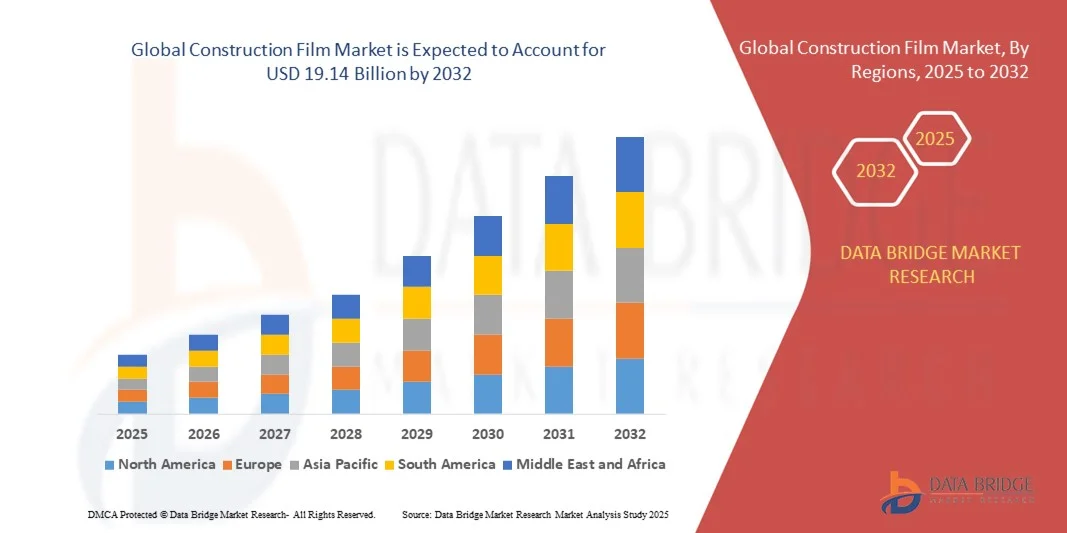
What is the Global Construction Film Market Size and Growth Rate?
- The global construction film market size was valued at USD 12.33 billion in 2024 and is expected to reach USD 19.14 billion by 2032, at a CAGR of 5.65% during the forecast period
- The increase in number of green building projects across the globe acts as one of the major factors driving the growth of construction film market. The rise in investment in infrastructure development and residential projects because of the liberalization of foreign investment regulations, and high demand for construction film owning to the cost advantages, durability, and availability of application-specific products accelerate the market growth
- The implementation of stringent regulations aimed at reducing the carbon and Greenhouse Gas (GHG) emissions, and stimulus packages by US government for construction industry to recover from COVID-19 further influence the market
What are the Major Takeaways of Construction Film Market?
- Growth in consumer awareness, rapid industrialization and urbanization, and increase in demand for water barrier and protective films positively affect the construction film market
- Furthermore, use of recyclable plastic products and quick recovery of construction industry from pandemic in China and other countries extends profitable opportunities to the market players
- Asia-Pacific dominated the construction film market with the largest revenue share of 35.3% in 2024, driven by rapid urbanization, robust infrastructure development, and a strong focus on sustainable construction practices
- The North America construction film market is expected to grow at the fastest CAGR of 11.8% from 2025 to 2032, driven by increasing renovation activities, the growing focus on energy-efficient building materials, and stringent building code regulations
- The vapor barrier films segment dominated the market with the largest revenue share of 41.3% in 2024, driven by their critical role in preventing moisture infiltration and enhancing building durability
Report Scope and Construction Film Market Segmentation
|
Attributes |
Construction Film Key Market Insights |
|
Segments Covered |
|
|
Countries Covered |
North America
Europe
Asia-Pacific
Middle East and Africa
South America
|
|
Key Market Players |
|
|
Market Opportunities |
|
|
Value Added Data Infosets |
In addition to the insights on market scenarios such as market value, growth rate, segmentation, geographical coverage, and major players, the market reports curated by the Data Bridge Market Research also include in-depth expert analysis, pricing analysis, brand share analysis, consumer survey, demography analysis, supply chain analysis, value chain analysis, raw material/consumables overview, vendor selection criteria, PESTLE Analysis, Porter Analysis, and regulatory framework. |
What is the Key Trend in the Construction Film Market?
Rising Adoption of Sustainable and High-Performance Film Solutions
- A prominent and accelerating trend in the global construction film market is the growing focus on eco-friendly, recyclable, and high-performance film materials designed to reduce environmental impact and enhance building efficiency. Manufacturers are increasingly adopting biodegradable polymers and recycled plastics to meet stringent environmental regulations and consumer expectations
- For instance, Saint-Gobain introduced a new line of low-carbon construction films in 2025, utilizing advanced polymer technologies to minimize CO₂ emissions during production while ensuring superior durability and UV resistance
- The market is also witnessing a strong shift toward multi-layered barrier films that offer enhanced protection against moisture, chemicals, and temperature fluctuations, improving the longevity of construction projects. Companies such as Berry Global Inc. are leading innovations in multi-functional films with optimized tensile strength and recyclability
- Another emerging development is the integration of smart and adaptive film technologies, which adjust opacity or thermal insulation in response to environmental conditions. Such innovations are gaining traction in green building projects and sustainable urban infrastructure
- This transition toward sustainable and intelligent film solutions is reshaping the industry landscape, positioning environmentally responsible and energy-efficient materials as a central focus for long-term growth in the construction film market
What are the Key Drivers of Construction Film Market?
- The rapid expansion of construction activities in residential, commercial, and industrial sectors, along with growing emphasis on energy-efficient and sustainable building materials, is a major driver of the construction film market
- For instance, in March 2025, Mitsubishi Chemical Corporation launched a new range of low-VOC polyethylene films for infrastructure applications, aimed at reducing environmental emissions while enhancing structural protection.
- Increasing awareness about moisture control, insulation, and weather protection is propelling the demand for vapor barriers, protective membranes, and greenhouse films in modern construction projects
- Furthermore, technological advancements in polymer science have led to films with greater strength, flexibility, and chemical resistance—making them ideal for demanding construction environments
- Supportive government initiatives promoting green construction and sustainable materials, particularly in regions such as Europe and Asia-Pacific, are further boosting adoption. This growing focus on durable, recyclable, and energy-efficient film solutions is expected to sustain market growth through 2030
Which Factor is Challenging the Growth of the Construction Film Market?
- The fluctuating prices of raw materials, particularly polyethylene, polypropylene, and PVC resins, pose a significant challenge to manufacturers in maintaining profitability and price stability. Volatility in crude oil markets directly impacts the cost structure of these key film components
- For instance, in 2024, rising global oil prices led to a sharp increase in polymer costs, forcing companies such as Toray Industries, Inc. and Solvay to adjust pricing strategies and reduce profit margins to stay competitive.
- Another major restraint is the limited recycling infrastructure in several developing countries, which hampers the adoption of eco-friendly construction films and increases environmental concerns related to plastic waste disposal
- Moreover, the availability of cheaper substitutes such as conventional tarpaulins and non-film-based insulation materials can restrict market penetration, particularly in cost-sensitive regions
- Addressing these challenges through investment in recycling technologies, adoption of bio-based raw materials, and strategic supply chain management will be essential for ensuring long-term growth and stability in the global Construction Film market
How is the Construction Film Market Segmented?
The market is segmented on the basis of product, resin type, function, and end use.
- By Product
On the basis of product, the construction film market is segmented into vapor barrier films, gas barrier films, window films, solar films, and others. The vapor barrier films segment dominated the market with the largest revenue share of 41.3% in 2024, driven by their critical role in preventing moisture infiltration and enhancing building durability. These films are extensively used in flooring, roofing, and wall applications to maintain insulation performance and prevent structural damage caused by humidity. Growing awareness about energy-efficient construction practices is further boosting their adoption in both residential and commercial projects.
The solar films segment is anticipated to witness the fastest growth rate of 22.1% from 2025 to 2032, propelled by rising green building initiatives and the increasing integration of solar control technologies to minimize heat gain and reduce cooling energy consumption.
- By Resin Type
Based on resin type, the construction film market is segmented into polyolefin films, polyester films, nylon films, ethylene vinyl alcohol (EVOH) films, polyvinyl butyral (PVB) films, fluoropolymer films, polyvinylidene chloride (PVDC) films, polyimide films, bio-based polymer films, polyvinyl chloride (PVC) films, LLDPE, LDPE, HDPE, PP/BOPP, PET/BOPET, and others. The polyethylene-based films (LLDPE, LDPE, and HDPE) collectively dominated the market with a market revenue share of 48.7% in 2024, owing to their cost-effectiveness, flexibility, and moisture-resistant characteristics that make them ideal for various construction applications. Their compatibility with recycling technologies also supports sustainability goals.
The bio-based polymer films segment is projected to register the fastest CAGR of 23.4% from 2025 to 2032, driven by the global push toward sustainable building materials, government regulations promoting carbon neutrality, and increasing demand for biodegradable solutions in the construction industry.
- By Function
On the basis of function, the construction film market is segmented into bonding, protection, insulation, glazing, soundproofing, and cable management. The protection segment held the largest revenue share of 39.5% in 2024, primarily due to its essential application in safeguarding surfaces, materials, and equipment from dust, moisture, and mechanical damage during construction activities. Protective films are widely adopted across residential and commercial projects to ensure durability and maintain surface quality post-installation.
The insulation segment is anticipated to experience the fastest growth rate of 20.9% from 2025 to 2032, fueled by increasing energy efficiency regulations and the need for thermally efficient building envelopes. With rising urbanization and temperature fluctuations, demand for high-performance insulation films in walls and windows continues to grow substantially.
- By End-Use
On the basis of end-use, the construction film market is segmented into residential, commercial, and industrial. The residential segment dominated the market with the largest revenue share of 44.8% in 2024, driven by increasing demand for moisture-resistant and UV-protective films in housing construction and renovation projects. Expanding urban housing development and growing awareness of sustainable construction materials also support segment growth.
The industrial segment is expected to witness the fastest CAGR of 21.3% from 2025 to 2032, propelled by rising infrastructure investments, the development of manufacturing zones, and the increasing need for films offering chemical resistance and environmental protection for heavy-duty applications. The shift toward industrial sustainability and compliance with environmental standards will further strengthen segment growth through the forecast period.
Which Region Holds the Largest Share of the Construction Film Market?
- Asia-Pacific dominated the construction film market with the largest revenue share of 35.3% in 2024, driven by rapid urbanization, robust infrastructure development, and a strong focus on sustainable construction practices. The growing demand for high-performance films that provide moisture resistance, UV protection, and thermal insulation across residential and commercial sectors is significantly propelling regional growth
- Expanding construction activities in emerging economies, coupled with rising government initiatives promoting green building materials and energy-efficient construction, are further fueling market expansion. In addition, the increasing presence of global film manufacturers and cost-efficient raw material availability strengthen Asia-Pacific’s leadership position
- The region’s large population base and increasing investments in smart infrastructure projects continue to support the adoption of advanced construction films across various applications, from glazing and insulation to vapor barriers and protective layering
China Construction Film Market Insight
The China construction film market captured the largest revenue share of 46% in 2024 within Asia-Pacific, supported by extensive infrastructure investments, urban housing projects, and growing sustainability awareness. The government’s emphasis on energy-efficient buildings and the development of smart city initiatives are fueling adoption of solar and vapor barrier films. China’s strong domestic production capabilities, combined with cost-effective raw material supply chains, have positioned it as a global manufacturing hub for construction films. Increasing demand for eco-friendly and durable building materials continues to bolster market expansion in both commercial and residential segments.
Japan Construction Film Market Insight
The Japan construction film market is witnessing steady growth, driven by technological innovation, environmental regulations, and the widespread use of advanced polymer-based films in modern architecture. The country’s focus on thermal insulation and soundproofing solutions in compact urban environments promotes the adoption of high-performance films. Furthermore, Japan’s aging infrastructure and frequent renovation projects have led to rising demand for solar and gas barrier films designed to improve building efficiency and occupant comfort. Government efforts to achieve carbon neutrality by 2050 are also supporting the shift toward bio-based and recyclable film solutions.
India Construction Film Market Insight
The India construction film market is projected to grow at a noteworthy CAGR during the forecast period, fueled by expanding urbanization, government housing schemes, and the growing demand for moisture-resistant films in infrastructure and residential construction. Rising investments in industrial and commercial spaces, coupled with awareness about sustainable construction materials, are fostering market adoption. In addition, the increasing presence of local manufacturers and collaborations with international players are enhancing the availability of affordable yet high-quality construction films. The market’s growth is further reinforced by ongoing developments in transportation, energy, and smart city projects.
Which Region is the Fastest Growing Region in the Construction Film Market?
The North America construction film market is expected to grow at the fastest CAGR of 11.8% from 2025 to 2032, driven by increasing renovation activities, the growing focus on energy-efficient building materials, and stringent building code regulations. The region’s demand for vapor barrier and solar control films is expanding due to the rising emphasis on sustainability and indoor environmental quality. Consumers and builders across the U.S. and Canada are prioritizing advanced polymer films that improve insulation, reduce carbon footprint, and enhance the durability of structures. Furthermore, ongoing investments in commercial infrastructure, combined with the adoption of green construction technologies, continue to accelerate market growth.
U.S. Construction Film Market Insight
The U.S. construction film market accounted for the largest revenue share of 79% in North America in 2024, driven by the growing adoption of high-performance materials in residential and industrial applications. Rising awareness about moisture control, UV protection, and thermal efficiency has fueled the use of advanced polyethylene and polyolefin films. In addition, the adoption of sustainable building codes and energy certification programs such as LEED (Leadership in Energy and Environmental Design) continues to strengthen the market outlook. The surge in remodeling activities and government incentives for green buildings further position the U.S. as a key growth hub in the region.
Which are the Top Companies in Construction Film Market?
The construction film industry is primarily led by well-established companies, including:
- Saint-Gobain (France)
- Berry Global Inc. (U.S.)
- TORAY INDUSTRIES, INC. (Japan)
- Eastman Chemical Company (U.S.)
- Mitsubishi Chemical Corporation (Japan)
- Raven (U.S.)
- RKW Group (Germany)
- Dupont (U.S.)
- SKC Ltd. (South Korea)
- Siliconature Spa (Italy)
- DEKU SOLUTIONS LTD (U.K.)
- Mondi (Austria)
- MTI Polyexe (U.K.)
- Polyplex (India)
- TransLink (India)
- Supreme Constructions (India)
- DUNMORE (U.S.)
- Tech Folien Ltd. (U.K.)
- Solvay (Belgium)
- SABIC (Saudi Arabia)
- Trioplast Nyborg A/S (Denmark)
What are the Recent Developments in Global Construction Film Market?
- In June 2024, Coveris announced a strategic partnership with Interzero aimed at advancing the circular economy, integrating Interzero’s sorted materials into Coveris’ innovative ReCover recycling process to produce high-quality recycled resins for packaging, and emphasizing waste elimination and sustainability, this collaboration is expected to significantly reduce CO2 emissions and promote a more sustainable, waste-free future
- In March 2024, Raven Industries introduced a new line of high-performance vapor barrier films designed for the green building initiative, offering advanced multilayer polymer technology that enhances moisture resistance and thermal insulation, and meeting the growing demand for sustainable, energy-efficient construction materials, which supports eco-conscious building practices
- In October 2023, Berry Global collaborated with Haver & Boecker to establish a closed-loop system for recycling NorDiVent film bags at their Steinfeld facility in Germany, aiming to collect and recycle empty bags while demonstrating the potential of plastics in the circular economy, this pilot project reinforces the importance of collaboration in achieving effective, sustainable recycling solutions
- In October 2023, Berry Global Inc. launched a biodegradable construction film made from renewable materials to address plastic waste concerns in the construction industry, reducing environmental impact without compromising performance, and aligning with the company’s commitment to sustainability and circular economy principles
- In July 2023, DuPont expanded its portfolio of high-performance barrier films for the construction market with a new moisture-resistant film designed to improve building durability, enhance energy efficiency, and provide better vapor protection, this development supports the increasing demand for eco-friendly and high-performance construction materials

- Interactive Data Analysis Dashboard
- Company Analysis Dashboard for high growth potential opportunities
- Research Analyst Access for customization & queries
- Competitor Analysis with Interactive dashboard
- Latest News, Updates & Trend analysis
- Harness the Power of Benchmark Analysis for Comprehensive Competitor Tracking
Global Construction Film Market, Supply Chain Analysis and Ecosystem Framework
To support market growth and help clients navigate the impact of geopolitical shifts, DBMR has integrated in-depth supply chain analysis into its Global Construction Film Market research reports. This addition empowers clients to respond effectively to global changes affecting their industries. The supply chain analysis section includes detailed insights such as Global Construction Film Market consumption and production by country, price trend analysis, the impact of tariffs and geopolitical developments, and import and export trends by country and HSN code. It also highlights major suppliers with data on production capacity and company profiles, as well as key importers and exporters. In addition to research, DBMR offers specialized supply chain consulting services backed by over a decade of experience, providing solutions like supplier discovery, supplier risk assessment, price trend analysis, impact evaluation of inflation and trade route changes, and comprehensive market trend analysis.
Data collection and base year analysis are done using data collection modules with large sample sizes. The stage includes obtaining market information or related data through various sources and strategies. It includes examining and planning all the data acquired from the past in advance. It likewise envelops the examination of information inconsistencies seen across different information sources. The market data is analysed and estimated using market statistical and coherent models. Also, market share analysis and key trend analysis are the major success factors in the market report. To know more, please request an analyst call or drop down your inquiry.
The key research methodology used by DBMR research team is data triangulation which involves data mining, analysis of the impact of data variables on the market and primary (industry expert) validation. Data models include Vendor Positioning Grid, Market Time Line Analysis, Market Overview and Guide, Company Positioning Grid, Patent Analysis, Pricing Analysis, Company Market Share Analysis, Standards of Measurement, Global versus Regional and Vendor Share Analysis. To know more about the research methodology, drop in an inquiry to speak to our industry experts.
Data Bridge Market Research is a leader in advanced formative research. We take pride in servicing our existing and new customers with data and analysis that match and suits their goal. The report can be customized to include price trend analysis of target brands understanding the market for additional countries (ask for the list of countries), clinical trial results data, literature review, refurbished market and product base analysis. Market analysis of target competitors can be analyzed from technology-based analysis to market portfolio strategies. We can add as many competitors that you require data about in the format and data style you are looking for. Our team of analysts can also provide you data in crude raw excel files pivot tables (Fact book) or can assist you in creating presentations from the data sets available in the report.













