


What is the Consumer Credit Market Size and Growth Rate?
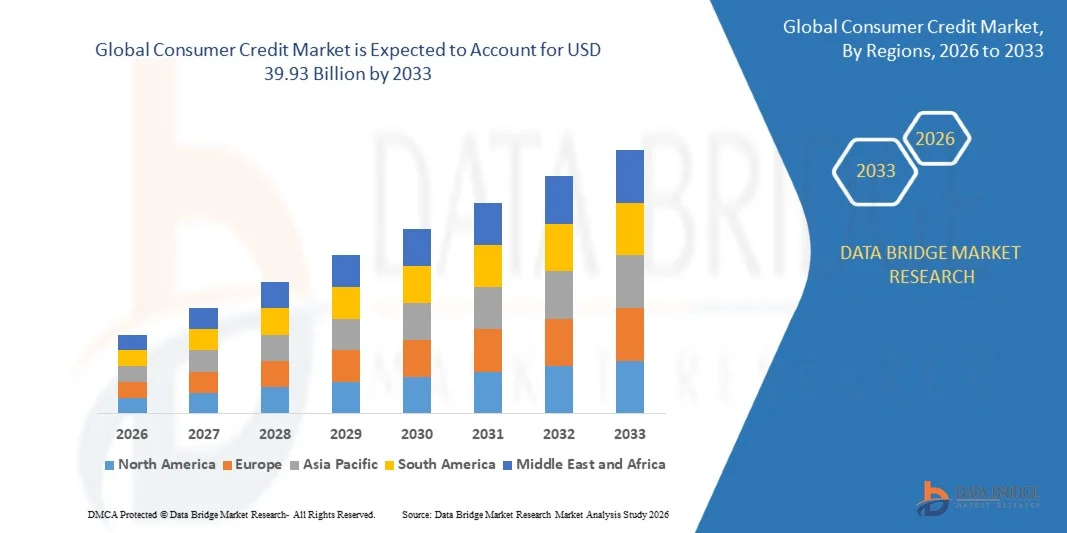
- As per Data Bridge Market Research analysis, the consumer credit market was valued at USD 14.50 billion in 2025 and is projected to reach USD 39.93 billion by 2033, growing at a CAGR of 13.50% from 2026 to 2033.
- The market is experiencing consistent growth driven by rising consumer spending, expanding access to digital financial services, increasing adoption of credit cards and installment-based purchases, and the growing availability of flexible lending products through banks, fintech companies, and other financial institutions.
- The increasing digitalization of banking and payments, combined with the rapid adoption of buy-now-pay-later services, alternative lending platforms, and AI-driven credit assessment, is encouraging consumers to access credit through faster and more convenient channels. Digital lending and broader financial inclusion are further expanding consumer access to personal loans, revolving credit, and other financing products across developed and emerging markets.
Market Size & Forecast
- Global Market Value (2025): USD 14.50 Billion
- Expected Market Value (2033): USD 39.93 Billion
- Forecast CAGR (2026–2033): 13.50%
- Leading Region in 2025: North America
- Fastest Growing Region: Asia Pacific
What are the Major Takeaways of the Consumer Credit Market?
- North America dominated the consumer credit market with the largest revenue share of 35.0% in 2025, supported by mature financial infrastructure, high credit-card penetration, strong consumer spending, and established lending institutions.
- Asia-Pacific is expected to be the fastest-growing region at a CAGR of 12.15% from 2026 to 2033, fueled by rising financial inclusion, increasing smartphone penetration, rapid adoption of digital wallets and embedded credit, and expanding consumer lending across emerging economies
- The non-revolving credit segment led the market with a 60.0% share in 2025, driven by the widespread use of personal loans, auto loans, education loans, and other installment-based financing products.
- Revolving credit are the fastest-growing type, projected to register a CAGR of 8.0%, reflecting the surge in adoption of credit cards, flexible lines of credit, and digital payment-linked borrowing solutions.
- The credit services segment dominated the service type category with a 56.0% revenue share in 2025, led by extensive demand for consumer lending, credit-card services, personal loans, and other financing solutions.
- Banks and finance companies accounted for 71.6% of the market share in 2025, preferred by extensive customer bases, established lending infrastructure, strong capital availability, and diversified consumer credit portfolios.
- The fintech companies segment is the fastest-growing provider category, with a CAGR of 10.1%, driven by rapid digitalization, alternative credit scoring, automated underwriting, and mobile-first lending platforms.
Report Scope and Consumer Credit Market Segmentation
|
Attributes |
Consumer Credit Key Market Insights |
|
Segments Covered |
|
|
Countries Covered |
North America
Europe
Asia-Pacific
Middle East and Africa
South America
|
|
Key Market Players |
|
|
Market Opportunities |
|
|
Value Added Data Infosets |
In addition to the market insights such as market value, growth rate, market segments, geographical coverage, market players, and market scenario, the market report curated by the Data Bridge Market Research team includes in-depth expert analysis, import/export analysis, pricing analysis, production consumption analysis, and pestle analysis. |
What is the Key Trend in the Consumer Credit Market?
- Consumer lenders are increasingly adopting digital-first credit origination and AI-driven underwriting to accelerate approvals, personalize offers, reduce processing costs, and expand access to borrowers with limited traditional credit histories.
- For instance, in November 2025, True Balance announced an AI-powered credit platform analyzing more than 90,000 alternative data sources, including SMS, bank statements, and behavioral signals, to support alternative credit scoring and financial inclusion.
- Alternative data from bank transactions, utility payments, mobile activity, and e-commerce transactions is increasingly being incorporated into credit-scoring models to evaluate borrowers beyond conventional bureau-based information.
- Buy Now, Pay Later (BNPL) and embedded credit are also expanding as consumers increasingly prefer flexible, point-of-sale financing integrated directly into e-commerce, payment, and digital-wallet platforms.
- For instance, in June 2026, the Federal Reserve estimated that BNPL providers originated nearly USD 160 billion in consumer credit products, with pay-in-four products accounting for approximately half of issuance, demonstrating the growing importance of flexible digital credit.
- As lenders increasingly combine artificial intelligence, alternative data, open banking, and embedded financing, digitalization is expected to remain a defining trend in consumer credit, improving convenience and expanding access while requiring stronger responsible-lending and consumer-protection frameworks.
What are the Key Drivers of the Consumer Credit Market?
- The rising consumer spending, increasing financial inclusion, expanding digital payments, and growing demand for personal financing are significantly increasing demand for consumer credit across developed and emerging economies.
- For instance, in May 2026, India’s Ministry of Finance reported that personal loans grew 16.2% in FY2025–26, accelerating from 11.7% in the previous year, supported by strong demand for vehicle, gold-backed, and housing-related credit.
- The rapid expansion of smartphones, digital banking, fintech platforms, and automated credit assessment is enabling lenders to provide faster approvals and reach consumers who may have limited access to traditional banking channels.
- Growing adoption of BNPL and other flexible financing products is further strengthening consumer credit demand by allowing consumers to spread payments and access financing directly during purchases.
- For instance, in January 2025, the CFPB reported that more than one-fifth of consumers with a U.S. credit record used BNPL in 2022, while more than three-fifths of BNPL borrowers held multiple simultaneous BNPL loans.
- With consumer spending, digital financial infrastructure, fintech adoption, and flexible financing options continuing to expand, these factors are expected to sustain consumer credit demand and support broader credit penetration across emerging and developed markets.
Which Factors are Challenging the Growth of the Consumer Credit Market?
- Rising borrower indebtedness, higher repayment burdens, and increasing credit delinquencies can constrain consumer credit growth by weakening repayment capacity and encouraging lenders to tighten underwriting standards.
- For instance, In August 2024, the CFPB reported that U.S. credit-card delinquency rates had risen above 2019 levels, with the sharpest increases among consumers aged 30–49, indicating increasing repayment pressure that can make lenders more cautious about extending consumer credit.
- Rapid BNPL adoption can also increase repayment and over-indebtedness risks when consumers hold multiple loans simultaneously, particularly among borrowers with weaker credit profiles and limited financial capacity.
- Regulatory requirements, responsible-lending obligations, fraud risks, and concerns surrounding alternative-data privacy can further increase compliance costs and complicate the expansion of digital consumer-credit products.
- For instance, In January 2025, the CFPB found that approximately 63% of BNPL borrowers originated multiple simultaneous loans, while 33% borrowed from multiple BNPL lenders, highlighting the risk of consumer overextension and repayment stress as flexible digital credit expands.
- As household debt pressures, delinquency risks, loan stacking, fraud concerns, and regulatory scrutiny continue to challenge lenders, stronger underwriting, transparent pricing, responsible lending, and effective credit-risk management will remain essential for sustainable consumer credit market growth.
How is the Consumer Credit Market Segmented?
The consumer credit market is segmented on the basis of type, service type, provider, and end user.
- By Type
On the basis of type, the consumer credit market is segmented into revolving credit and non-revolving credit. The non-revolving credit segment dominated the market with an estimated 60.0% share in 2025, owing to the widespread use of personal loans, auto loans, education loans, and other installment-based financing products. Non-revolving credit provides consumers with predictable repayment schedules and fixed borrowing terms, making it suitable for financing large purchases and planned expenditures. Banks and financial institutions extensively offer installment-based products because they provide structured repayment and clearer credit-risk assessment. Increasing consumer demand for vehicle financing, education, home-related expenses, and personal loans is supporting demand for this credit type.
The revolving credit segment is projected to register the fastest growth at a CAGR of 8.0% during the forecast period, driven by increasing adoption of credit cards, flexible lines of credit, and digital payment-linked borrowing solutions. Revolving credit allows consumers to repeatedly access available credit without applying for a new loan after every repayment. Growing e-commerce activity and digital payments are increasing the convenience and frequency of revolving credit usage. Financial institutions are also introducing rewards, personalized credit products, and flexible repayment options to encourage consumer adoption. Increasing integration of credit facilities with mobile banking and digital wallets is further improving accessibility. The expansion of embedded credit and flexible payment options is creating additional demand for revolving borrowing.
- By Service Type
On the basis of service type, the consumer credit market is segmented into credit services and software and IT support services. The credit services segment dominated the market with an estimated 56.0% share in 2025, supported by extensive demand for consumer lending, credit-card services, personal loans, and other financing solutions. Credit services form the core of the consumer credit ecosystem by enabling individuals to obtain financing for purchases, emergencies, education, automobiles, and other expenditures. Banks, finance companies, and fintech lenders are continuously expanding their consumer credit portfolios to capture borrowing demand. Increasing financial inclusion is bringing more individuals into formal credit systems. Digital application and approval processes are also making credit services faster and more accessible.
The software and IT support services segment is expected to witness the fastest growth at a CAGR of 13.5% during the forecast period, driven by increasing digitalization of credit origination, underwriting, servicing, and risk management. Lenders are investing in advanced software to automate credit scoring, fraud detection, loan processing, and customer onboarding. Artificial intelligence and machine learning are increasingly being incorporated into lending platforms to analyze large volumes of consumer data. Cloud-based infrastructure is enabling financial institutions to scale digital lending operations while reducing technology deployment complexity. Real-time analytics and automated decision-making are also improving the speed and accuracy of credit approvals. Growing regulatory requirements are encouraging lenders to strengthen technology-based compliance and risk management.
- By Provider
On the basis of provider, the consumer credit market is segmented into banks, finance companies, credit unions, and fintech companies. The banks and finance companies segment dominated the market with an estimated 71.6% share in 2025, supported by extensive customer bases, established lending infrastructure, strong capital availability, and diversified consumer credit portfolios. Banks and finance companies provide a wide range of products, including credit cards, personal loans, auto loans, and lines of credit. Their established relationships with consumers enable lenders to use existing financial information for credit assessment and personalized offers. Regulatory frameworks and established risk-management systems also strengthen consumer confidence in traditional lenders. The increasing adoption of digital banking is allowing established providers to deliver consumer credit through mobile and online channels.
The fintech companies segment is projected to register the fastest growth at a CAGR of 10.1% during the forecast period, driven by rapid digitalization, alternative credit scoring, automated underwriting, and mobile-first lending platforms. Fintech lenders can provide faster loan decisions by using artificial intelligence, machine learning, and alternative consumer data. Their digital-first models reduce dependence on physical branches and simplify the application process for consumers. Fintech companies are also expanding access to credit among younger consumers and individuals with limited traditional credit histories. Embedded lending and buy-now-pay-later solutions are creating additional opportunities for fintech providers across e-commerce and digital payment ecosystems. Partnerships between fintech companies and traditional financial institutions are further expanding distribution and funding capabilities.
- By End User
On the basis of end user, the consumer credit market is segmented into salaried employees and business owners. The salaried employees segment dominated the market in 2025 with a market share of 65.0%, supported by stable income streams that improve borrowers' repayment capacity and creditworthiness. Salaried consumers commonly use personal loans, credit cards, auto loans, and other financing products to meet household and lifestyle-related expenditures. Regular income also allows financial institutions to assess repayment ability more easily through salary and employment records. Increasing access to digital banking and payroll-linked financial services is further improving credit availability for salaried workers. Growing consumer spending on automobiles, education, housing-related expenses, travel, and consumer goods is supporting borrowing demand within this group
The business owners segment is expected to witness the fastest growth at a CAGR of 8.0% during the forecast period, supported by increasing demand for flexible financing among entrepreneurs and self-employed consumers. Business owners may use consumer credit products to manage personal liquidity, household expenditures, and short-term financial requirements alongside business-related cash-flow needs. The expansion of digital lenders is improving access to financing for entrepreneurs who may have limited access to conventional banking services. Alternative credit assessment using transaction history and digital financial data is also helping lenders evaluate self-employed borrowers. Growing entrepreneurship and the expansion of small and micro businesses are increasing the number of consumers requiring flexible financing solutions. Fintech platforms are introducing customized lending products and faster digital approvals to serve this customer group.
Which Region Holds the Largest Share of the Consumer Credit Market?
- North America dominated the consumer credit market with the largest revenue share of 35.0% in 2025, supported by mature financial infrastructure, high credit-card penetration, strong consumer spending, and established lending institutions.
- The region also benefits from widespread adoption of digital lending platforms, flexible credit products, and BNPL services, alongside continuous innovation in credit scoring and lending technologies. Strong participation from banks, fintech companies, and other financial institutions continues to reinforce North America’s leadership in the global consumer credit market.
U.S. Consumer Credit Market Insight
The U.S. consumer credit market is witnessing strong growth due to rising consumer spending, widespread credit card usage, and increasing adoption of digital lending platforms. The country’s mature banking ecosystem, along with growing availability of personal loans, BNPL services, and other flexible credit products, is driving demand across diverse consumer segments. In addition, increasing integration of AI-powered credit assessment, alternative data, and digital underwriting technologies is supporting faster credit decisions and expanding access to consumer financing.
Asia-Pacific Consumer Credit Market Insight
The Asia-Pacific consumer credit market is expected to witness rapid growth, driven by rising financial inclusion, expanding digital payment ecosystems, and increasing adoption of mobile-based lending across countries such as China, India, and Japan. Growing demand for personal loans, credit cards, BNPL services, and other digital credit products is supporting regional market expansion. In addition, the increasing use of fintech platforms, alternative credit scoring, and digital banking services is improving access to financing and accelerating consumer credit adoption across the region.
Japan Consumer Credit Market Insight
The Japan consumer credit market is witnessing consistent growth due to rising adoption of digital financial services, expanding cashless payment systems, and increasing demand for convenient consumer financing solutions. Banks, fintech companies, and other financial institutions are increasingly adopting digital lending platforms and advanced credit assessment technologies to improve customer access and lending efficiency. Moreover, growing integration of mobile payments, online banking, and data-driven credit evaluation is further contributing to the development of Japan’s consumer credit market.
China Consumer Credit Market Insight
The China consumer credit market is growing rapidly, driven by expanding digital financial services, rising consumer spending, and increasing adoption of online lending platforms. Growing use of mobile payments, digital wallets, and fintech-based credit solutions across retail and e-commerce applications is significantly boosting market demand. In addition, increasing integration of artificial intelligence, alternative data, and automated credit assessment is improving lending efficiency and expanding access to consumer financing, positioning China as one of the key growth markets for consumer credit globally.
U.K. Consumer Credit Market Insight
The U.K. consumer credit market is experiencing steady growth, supported by rising adoption of digital banking, credit cards, personal loans, and flexible payment solutions. Increasing investments in fintech infrastructure and growing demand for convenient, digitally accessible financing are contributing to market growth. Furthermore, integration of AI-driven credit assessment, automated underwriting, and open banking technologies is improving lending efficiency and customer access, positioning the U.K. as a key innovation hub in the consumer credit industry.
Germany Consumer Credit Market Insight
The Germany consumer credit market is expanding steadily due to the country’s well-developed banking infrastructure, growing adoption of digital financial services, and increasing demand for flexible consumer financing solutions. Banks, fintech companies, and financial service providers are increasingly utilizing digital lending platforms, automated credit assessment, and data-driven technologies to improve lending processes and customer experiences. Continuous advancements in digital payments, open banking, and AI-enabled credit evaluation, along with strong emphasis on secure financial services, are further driving market growth in Germany.
Which are the Top Companies in Consumer Credit Market?
The consumer credit industry is primarily led by well-established companies, including:
- JPMorgan Chase & Co. (U.S.)
- Bank of America Corporation (U.S.)
- Citigroup Inc. (U.S.)
- Wells Fargo & Company (U.S.)
- Capital One Services, LLC (U.S.)
- American Express Company (U.S.)
- U.S. Bank (U.S.)
- The PNC Financial Services Group, Inc. (U.S.)
- Truist Financial Corporation (U.S.)
- Synchrony Financial (U.S.)
- Ally Financial Inc. (U.S.)
- SoFi Technologies, Inc. (U.S.)
- Affirm Holdings, Inc. (U.S.)
- PayPal Holdings, Inc. (U.S.)
- LendingClub Corporation (U.S.)
- OneMain Holdings, Inc. (U.S.)
- Barclays (U.K.)
- HSBC Holdings plc (U.K.)
- Lloyds Banking Group plc (U.K.)
- Klarna Bank AB (Sweden)
What are Latest Developments in Consumer Credit Market?
- In September 2025, CRED announced the launch of a new co-branded credit card in partnership with IndusInd Bank and RuPay, including a premium 18-carat gold-plated card for select users. The launch demonstrates the growing integration of fintech platforms with established banks and card networks to develop differentiated consumer credit products.
- In June 2025, Citizens Financial Group launched a new suite of Mastercard credit cards designed to provide customers with greater choice across different spending and financial needs. The new portfolio was positioned around simplicity, financial stability, and customer-focused rewards, strengthening Citizens’ consumer credit-card offering and demonstrating continued innovation in traditional revolving credit product
- In August 2025, Bank of Maharashtra partnered with SBI Card to launch a new co-branded credit card portfolio comprising three variants designed to provide customers with differentiated rewards and shopping benefits. The launch expands the banks’ consumer credit-card offerings and strengthens the availability of co-branded credit products across multiple customer segments.
- In October 2024, Apple expanded Apple Pay by adding Klarna as a Buy Now, Pay Later option, allowing eligible consumers to split purchases into four interest-free installments. The development followed the addition of Affirm to Apple Pay and expanded access to BNPL-based consumer financing through a major digital payments ecosystem.
- In June 2022, Gap Inc. launched a new credit-card program in partnership with Barclays and Mastercard as part of its Gap Inc. Rewards program. The program introduced new consumer credit-card benefits linked to the retailer’s loyalty ecosystem and included a social-impact component allowing members to donate rewards points to selected causes.

- Interactive Data Analysis Dashboard
- Company Analysis Dashboard for high growth potential opportunities
- Research Analyst Access for customization & queries
- Competitor Analysis with Interactive dashboard
- Latest News, Updates & Trend analysis
- Harness the Power of Benchmark Analysis for Comprehensive Competitor Tracking
Data collection and base year analysis are done using data collection modules with large sample sizes. The stage includes obtaining market information or related data through various sources and strategies. It includes examining and planning all the data acquired from the past in advance. It likewise envelops the examination of information inconsistencies seen across different information sources. The market data is analysed and estimated using market statistical and coherent models. Also, market share analysis and key trend analysis are the major success factors in the market report. To know more, please request an analyst call or drop down your inquiry.
The key research methodology used by DBMR research team is data triangulation which involves data mining, analysis of the impact of data variables on the market and primary (industry expert) validation. Data models include Vendor Positioning Grid, Market Time Line Analysis, Market Overview and Guide, Company Positioning Grid, Patent Analysis, Pricing Analysis, Company Market Share Analysis, Standards of Measurement, Global versus Regional and Vendor Share Analysis. To know more about the research methodology, drop in an inquiry to speak to our industry experts.
Data Bridge Market Research is a leader in advanced formative research. We take pride in servicing our existing and new customers with data and analysis that match and suits their goal. The report can be customized to include price trend analysis of target brands understanding the market for additional countries (ask for the list of countries), clinical trial results data, literature review, refurbished market and product base analysis. Market analysis of target competitors can be analyzed from technology-based analysis to market portfolio strategies. We can add as many competitors that you require data about in the format and data style you are looking for. Our team of analysts can also provide you data in crude raw excel files pivot tables (Fact book) or can assist you in creating presentations from the data sets available in the report.













