


What is the Contactless Biometrics Technology Market Size and Growth Rate?
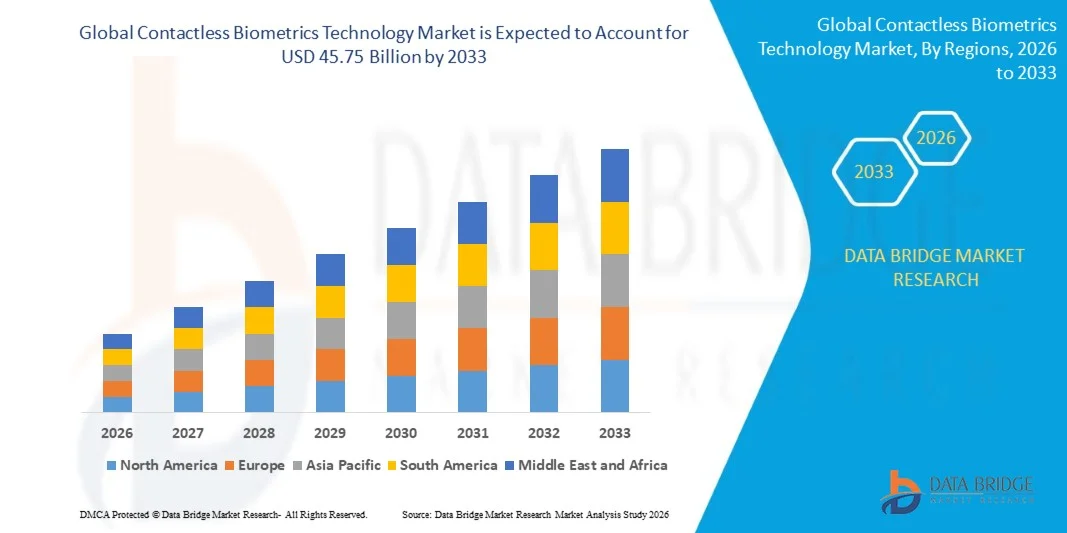
- As per Data Bridge Market Research analysis, the global contactless biometrics technology market is valued at USD 21.5 billion in 2025 and is projected to reach USD 45.75 billion by 2033, growing at a CAGR of 9.90% from 2026 to 2033.
- The market registers strong growth driven by rising security concerns, the need for convenient authentication methods, and expanding biometric adoption across government, healthcare, banking, and defense sectors.
- Facial recognition and iris scanning gain prominence in healthcare and access control applications, while rising penetration of smartphones and tablets, combined with manufacturer focus on facial recognition software, continues to expand the technology's addressable consumer base. Growing integration of artificial intelligence enhances contactless biometric accuracy, efficiency, and adaptability, minimizing false positives and negatives even in challenging scenarios such as low light or partial obstructions.
Market Size & Forecast
- Global Market Value (2025): USD 21.5 Billion
- Expected Market Value (2033): USD 45.75 Billion
- Forecast CAGR (2026–2033): 9.90%
- Leading Region in 2025: North America
- Fastest Growing Region: Asia-Pacific
What are the Major Takeaways of the Contactless Biometrics Technology Market?
- North America dominates the global contactless biometrics technology market with a 36.1% revenue share in 2025, driven by the presence of leading technology providers, including HID Global, M2SYS Technology, and BioConnect, alongside strong demand from payment solution providers and defense and government applications.
- Asia-Pacific registers the fastest growth at a 19.95% CAGR through 2031, fueled by rapid smartphone and tablet penetration, expanding government identity programs, and rising manufacturer investment in facial recognition software across the region.
- The facial recognition segment leads the technology category with a 37.65% share in 2025, driven by ubiquitous camera hardware and high user acceptance.
- The iris recognition segment registers the fastest CAGR of 20.75% among technology types, driven by liquid-lens optics enabling compact module integration.
- The access control segment leads the application category with a 41.12% revenue base, while the payments & transactions segment registers the fastest CAGR at 21.08%.
- The healthcare end-use segment records the highest projected growth among end-use industries, expanding at a 20.15% CAGR through 2031.
- The multimodal authentication segment registers accelerating adoption as systems fusing face and iris recognition push false-acceptance probabilities to 1 in 100 million.
Report Scope and Contactless Biometrics Technology Market Segmentation
|
Attributes |
Contactless Biometrics Technology Key Market Insights |
|
Segments Covered |
|
|
Countries Covered |
North America
Europe
Asia-Pacific
Middle East and Africa
South America
|
|
Key Market Players |
|
|
Market Opportunities |
|
|
Value Added Data Infosets |
In addition to the insights on market scenarios such as market value, growth rate, segmentation, geographical coverage, and major players, the market reports curated by the Data Bridge Market Research also include in-depth expert analysis, geographically represented company-wise production and capacity, network layouts of distributors and partners, detailed and updated price trend analysis and deficit analysis of supply chain and demand. |
What is the Key Trend in the Contactless Biometrics Technology Market?
- Leading biometric technology providers continue to form strategic alliances that integrate complementary hardware and software capabilities for public safety and government applications.
- In September 2025, NEC Corporation and HID Global announced a strategic alliance to integrate NEC's SmartScan software with HID's biometric capture hardware, targeting public safety agencies and biometric-based identity verification deployments.
- Contactless biometric providers continue to expand into small and medium-sized business markets through partnership-based identity verification platforms.
- In August 2025, Thales partnered with Goaco to provide biometric identity verification for Goidentity, an app enabling small and medium enterprises to securely onboard users, scanning global ID documents, matching face biometrics, and ensuring KYC and AML compliance with cloud-based real-time verification.
- Leading providers continue to expand digital identity partnerships into transportation and travel sector applications.
- In April 2025, NEC partnered with SITA, a Switzerland-based company, to join SITA's Digital Travel Ecosystem, accelerating the adoption of digital identity technologies across the travel sector.
As leading providers continue to form strategic alliances, expand into small and medium enterprise markets, and extend digital identity partnerships into travel and transportation, the global contactless biometrics technology market sustains strong growth across government, enterprise, and consumer applications.
What are the Key Drivers of the Contactless Biometrics Technology Market?
- Rising security concerns and demand for convenient, hygienic authentication methods continue to drive adoption of contactless biometric systems across government, healthcare, and enterprise sectors.
- In September 2025, the NEC Corporation and HID Global strategic alliance to integrate SmartScan software with biometric capture hardware illustrates the scale of continued technology provider investment in expanding public safety biometric capabilities.
- Rising penetration of smartphones and tablets, coupled with manufacturer focus on facial recognition software, continues to expand the addressable installed base for contactless biometric technology.
- In August 2025, Thales's partnership with Goaco to extend enterprise-grade biometric identity verification to small and medium enterprises reflects the broadening commercial reach of contactless biometric technology beyond large enterprise and government customers.
- Growing integration of artificial intelligence into biometric recognition systems continues to improve accuracy, efficiency, and adaptability, minimizing false positives and negatives across challenging real-world scenarios.
- With security concerns continuing to rise and leading providers continuing to expand strategic alliances and small and medium enterprise partnerships, the global contactless biometrics technology market remains a high-growth category within the broader identity verification and authentication landscape.
Which Factors are Challenging the Growth of the Contactless Biometrics Technology Market?
- Data privacy and biometric data protection regulations across different jurisdictions create compliance complexity for providers operating across multiple regional markets.
- The technical complexity of achieving reliable recognition accuracy in challenging real-world scenarios, including low light or partial facial obstructions, requires substantial ongoing research and development investment from technology providers.
- Intensifying competition among established global providers and emerging regional players continues to pressure pricing and margins across the industry.
- Public concern regarding surveillance and biometric data misuse in certain jurisdictions constrains broader adoption of facial recognition technology in specific consumer and public-sector applications.
- The combination of fragmented data privacy compliance requirements, the technical complexity of achieving reliable real-world recognition accuracy, and public concern regarding biometric data misuse continues to create headwinds for the contactless biometrics technology market, even as rising security concerns support long-term category growth.
How is the Contactless Biometrics Technology Market Segmented?
The global contactless biometrics technology market is segmented on the basis of technology, component, application, end-use industry, deployment mode, authentication type, and organization size.
- By Technology
On the basis of technology, the global contactless biometrics technology market is segmented into facial recognition, iris recognition, Speech and Voice Recognition , vein recognition, and gait recognition. The facial recognition segment leads the market with a 37.65% share in 2025, driven by ubiquitous camera hardware across smartphones, security systems, and access control infrastructure alongside high user acceptance of the technology.
The iris recognition segment registers the fastest CAGR of 20.75% from 2026 to 2033, driven by liquid-lens optics that shrink module depth to under 5 millimeters, enabling compact integration into a widening range of consumer and enterprise devices.
- By Component
On the basis of component, the global contactless biometrics technology market is segmented into hardware, software, and services. The hardware segment leads the market with the largest share of 42.08% in 2025, reflecting the foundational role of cameras, sensors, and scanning devices across all contactless biometric system deployments.
The software segment registers the fastest CAGR of 10.20% from 2026 to 2033, driven by rising demand for AI-powered matching algorithms and cloud-based biometric processing platforms.
- By Application
On the basis of application, the global contactless biometrics technology market is segmented into access control, payments & transactions, border control & immigration, law enforcement, and time & attendance. The access control segment leads the market with a 41.12% revenue base in 2025, reflecting the established role of contactless biometrics in securing physical facilities, devices, and digital systems across government, enterprise, and residential settings.
The payments & transactions segment registers a 21.08% CAGR from 2026 to 2033, outpacing access control's established revenue base and reflecting rapid growth in biometric authentication for point-of-sale and digital payment applications.
- By End-Use Industry
On the basis of end-use industry, the global contactless biometrics technology market is segmented into government & defense, banking & financial services, healthcare, retail, travel & hospitality, and IT & telecom. The government & defense segment leads the market with the largest share of 34.20% in 2025, driven by extensive deployment of contactless biometric systems in border control, national identity programs, and public safety applications.
The healthcare segment records the highest projected growth, expanding at a 20.15% CAGR through 2031, driven by rising adoption of contactless biometric patient identification to strengthen security while containing healthcare administrative expenses.
- By Deployment Mode
On the basis of deployment mode, the global contactless biometrics technology market is segmented into on-premises and cloud-based. The on-premises segment leads the market with the largest share of 68.20% in 2025, reflecting continued preference for localized data control among government and defense end users with stringent security requirements.
The cloud-based segment registers the fastest CAGR of 15.25% from 2026 to 2033, driven by rising enterprise adoption of scalable, centrally managed biometric authentication platforms.
- By Authentication Type
On the basis of authentication type, the global contactless biometrics technology market is segmented into single-modal and multimodal. The single-modal segment leads the market with the largest share of 68.92% in 2025, reflecting its lower implementation cost and widespread use across consumer-facing applications such as smartphone facial unlock.
The multimodal segment registers the fastest CAGR of 13.54% from 2026 to 2033, driven by the shift toward systems that fuse face and iris recognition to deliver false-acceptance probabilities of 1 in 100 million for high-security applications.
- By Organization Size
On the basis of organization size, the global contactless biometrics technology market is segmented into large enterprises and small & medium enterprises (SMEs). The large enterprises segment leads the market with the largest share 72.13% in 2025, reflecting greater capital availability for enterprise-wide biometric authentication infrastructure investment.
The small & medium enterprises (SMEs) segment registers the fastest CAGR of 11.93% from 2026 to 2033, driven by falling hardware costs and growing availability of cloud-based biometric authentication services tailored to smaller organizations.
Which Region Holds the Largest Share of the Contactless Biometrics Technology Market?
- North America dominates the global contactless biometrics technology market and accounts for a 36.1% revenue share in 2025, driven by the presence of leading technology providers, including HID Global, M2SYS Technology, nVIAsoft Corporation, and BioConnect, alongside strong regional demand from payment solution providers and defense and government applications.
- The region benefits from a robust supply chain, a large installed base of contactless biometric technology providers, and increasing adoption in defense and government applications. Continued strategic alliance activity among leading providers reinforces North America's leadership position in the global market.
U.K. Contactless Biometrics Technology Market Insight
The U.K. contactless biometrics technology market remains anchored by strong domestic technology provider presence, including HID Global, and continued strategic alliance activity, including the September 2025 partnership between NEC Corporation and HID Global targeting public safety agencies. Rising adoption of contactless biometric systems in defense and government applications continues to support sustained demand in the country.
Germany Contactless Biometrics Technology Market Insight
The Germany contactless biometrics technology market benefits from the domestic presence of BioConnect Inc., a leading contactless biometric technology provider, alongside growing enterprise and government adoption of contactless authentication systems across the country.
Asia-Pacific Contactless Biometrics Technology Market Insight
The Asia-Pacific contactless biometrics technology market registers the fastest growth globally through 2031, driven by rapid smartphone and tablet penetration, expanding government identity programs, and rising manufacturer investment in facial recognition software across China, Japan, and India.
Japan Contactless Biometrics Technology Market Insight
The Japan contactless biometrics technology market remains a global innovation hub, anchored by NEC Corporation's leadership in facial recognition and biometric middleware technology, reinforced by the company's September 2025 strategic alliance with HID Global and April 2025 partnership with SITA extending digital identity technology into the travel sector.
France Contactless Biometrics Technology Market Insight
The France contactless biometrics technology market benefits from the domestic presence of Thales and IDEMIA, two leading global biometric identity providers, reinforced by Thales's August 2025 partnership with Goaco extending biometric identity verification to small and medium enterprises.
Which are the Top Companies in the Contactless Biometrics Technology Market?
The global contactless biometrics technology industry is primarily led by well-established identity verification and biometric technology companies, including:
- HID Global Corporation (U.S.)
- NEC Corporation (Japan)
- Thales Group (France)
- IDEMIA (France)
- Fingerprint Cards AB (Sweden)
- Fujitsu Limited (Japan)
- M2SYS Technology (U.S.)
- BioConnect Inc. (Canada)
- Aware, Inc. (U.S.)
- Cognitec Systems GmbH (Germany)
- Innovatrics s.r.o. (Slovakia)
- Precise Biometrics AB (Sweden)
- Suprema Inc. (South Korea)
- Iris ID Systems, Inc. (U.S.)
- Daon, Inc. (U.S.)
- FaceFirst, Inc. (U.S.)
- GBG plc (U.K.)
- Entrust Corporation (U.S.)
- ZKTeco Co., Ltd. (China)
- Neurotechnology (Lithuania)
What are the Latest Developments in the Contactless Biometrics Technology Market?
- In September 2025, NEC Corporation and HID Global announced a strategic alliance to integrate NEC's SmartScan software with HID's biometric capture hardware, targeting public safety agencies and biometric-based identity verification deployments.
- In August 2025, Thales partnered with Goaco to provide biometric identity verification for Goidentity, extending enterprise-grade identity solutions to small and medium enterprises with cloud-based, GDPR-compliant verification.
- In July 2025, IDEMIA announced the launch of a library of 68 classical and post-quantum cryptographic algorithms, strengthening the security foundation underpinning its biometric identity solutions.
- In April 2025, NEC partnered with SITA to join SITA's Digital Travel Ecosystem, accelerating adoption of digital identity technologies across the travel sector.
- In November 2024, Thales Group introduced advanced biometric identity solutions and powered one in every three secure civil IDs issued globally, reinforcing its leadership position within the digital identity and biometrics landscape.

- Interactive Data Analysis Dashboard
- Company Analysis Dashboard for high growth potential opportunities
- Research Analyst Access for customization & queries
- Competitor Analysis with Interactive dashboard
- Latest News, Updates & Trend analysis
- Harness the Power of Benchmark Analysis for Comprehensive Competitor Tracking
Global Contactless Biometrics Technology Market, Supply Chain Analysis and Ecosystem Framework
To support market growth and help clients navigate the impact of geopolitical shifts, DBMR has integrated in-depth supply chain analysis into its Global Contactless Biometrics Technology Market research reports. This addition empowers clients to respond effectively to global changes affecting their industries. The supply chain analysis section includes detailed insights such as Global Contactless Biometrics Technology Market consumption and production by country, price trend analysis, the impact of tariffs and geopolitical developments, and import and export trends by country and HSN code. It also highlights major suppliers with data on production capacity and company profiles, as well as key importers and exporters. In addition to research, DBMR offers specialized supply chain consulting services backed by over a decade of experience, providing solutions like supplier discovery, supplier risk assessment, price trend analysis, impact evaluation of inflation and trade route changes, and comprehensive market trend analysis.
Data collection and base year analysis are done using data collection modules with large sample sizes. The stage includes obtaining market information or related data through various sources and strategies. It includes examining and planning all the data acquired from the past in advance. It likewise envelops the examination of information inconsistencies seen across different information sources. The market data is analysed and estimated using market statistical and coherent models. Also, market share analysis and key trend analysis are the major success factors in the market report. To know more, please request an analyst call or drop down your inquiry.
The key research methodology used by DBMR research team is data triangulation which involves data mining, analysis of the impact of data variables on the market and primary (industry expert) validation. Data models include Vendor Positioning Grid, Market Time Line Analysis, Market Overview and Guide, Company Positioning Grid, Patent Analysis, Pricing Analysis, Company Market Share Analysis, Standards of Measurement, Global versus Regional and Vendor Share Analysis. To know more about the research methodology, drop in an inquiry to speak to our industry experts.
Data Bridge Market Research is a leader in advanced formative research. We take pride in servicing our existing and new customers with data and analysis that match and suits their goal. The report can be customized to include price trend analysis of target brands understanding the market for additional countries (ask for the list of countries), clinical trial results data, literature review, refurbished market and product base analysis. Market analysis of target competitors can be analyzed from technology-based analysis to market portfolio strategies. We can add as many competitors that you require data about in the format and data style you are looking for. Our team of analysts can also provide you data in crude raw excel files pivot tables (Fact book) or can assist you in creating presentations from the data sets available in the report.













