


Content Detection Market Size
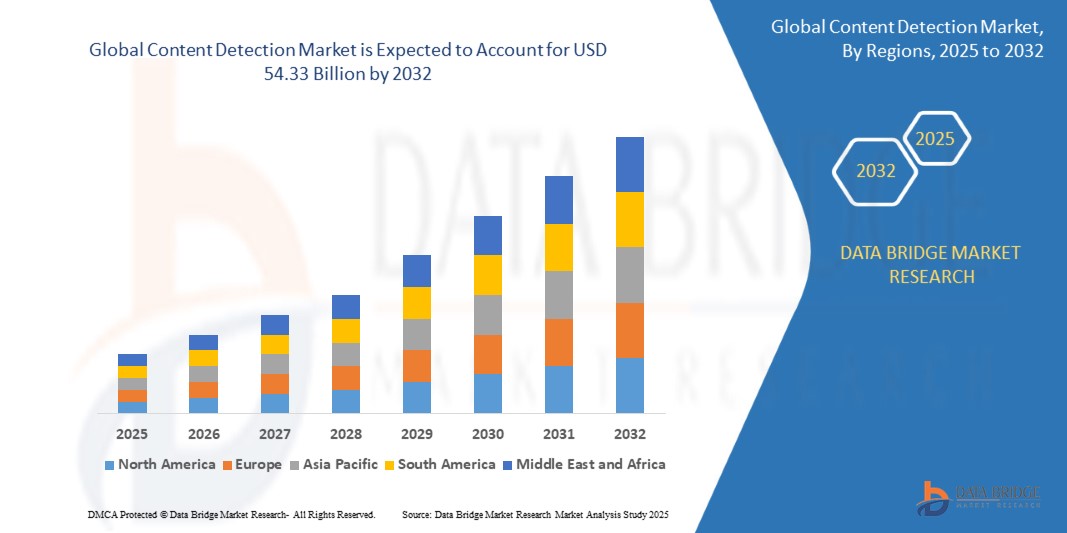
- The global content detection market size was valued at USD 16.92 billion in 2024 and is expected to reach USD 54.33 billion by 2032, at a CAGR of 15.70% during the forecast period
- The market growth is largely fueled by the exponential rise in digital content creation across social media, e-commerce, education, and enterprise platforms, driving the urgent need for authenticity, compliance, and brand safety solutions. The increasing prevalence of misinformation, plagiarism, and AI-generated deepfakes has made advanced detection technologies indispensable for safeguarding both businesses and consumers in the digital landscape
- Furthermore, rising regulatory pressures, coupled with growing demand for secure, trustworthy, and ethically aligned digital ecosystems, are accelerating the adoption of AI-powered content detection tools. These converging factors are significantly boosting investments in detection systems, establishing them as a core component of digital governance and cybersecurity strategies
Content Detection Market Analysis
- Content detection technologies encompass AI-powered solutions designed to analyze, verify, and moderate text, images, audio, and video to ensure originality, authenticity, and compliance. These tools are widely deployed across industries such as social media, publishing, academia, e-commerce, and gaming to detect plagiarism, identify manipulated media, and safeguard intellectual property
- The escalating demand for content detection solutions is primarily fueled by the rising penetration of generative AI, the increasing risk of misinformation, and the need for real-time content moderation. With enterprises, governments, and academic institutions placing higher emphasis on transparency and digital trust, the content detection market is witnessing robust growth across both developed and emerging economies
- North America dominated the content detection market with a share of 39.2% in 2024, due to the increasing spread of misinformation, rising digital content consumption, and the strong presence of leading AI technology providers
- Asia-Pacific is expected to be the fastest growing region in the content detection market during the forecast period due to surging digitalization, rising internet penetration, and rapid growth of social media and e-commerce platforms
- Content moderation segment dominated the market with a market share of 54.6% in 2024, due to the surge in user-generated content across social media platforms, forums, and streaming services. Businesses are investing heavily in moderation tools to filter harmful, violent, or offensive material, ensuring compliance with government guidelines and safeguarding brand reputation. AI-powered moderation solutions are increasingly being integrated with natural language processing and computer vision, enabling real-time scanning of large-scale text, image, and video uploads. Rising consumer demand for safer digital environments is expected to accelerate the expansion of this segment in the coming years
Report Scope and Content Detection Market Segmentation
|
Attributes |
Content Detection Key Market Insights |
|
Segments Covered |
|
|
Countries Covered |
North America
Europe
Asia-Pacific
Middle East and Africa
South America
|
|
Key Market Players |
|
|
Market Opportunities |
|
|
Value Added Data Infosets |
In addition to the market insights such as market value, growth rate, market segments, geographical coverage, market players, and market scenario, the market report curated by the Data Bridge Market Research team includes in-depth expert analysis, import/export analysis, pricing analysis, production consumption analysis, and pestle analysis. |
Content Detection Market Trends
Growing Use of AI and Machine Learning in Content Detection
- The increasing integration of artificial intelligence (AI) and machine learning (ML) into content detection systems is transforming the market by enhancing accuracy, scalability, and efficiency. As the volume of digital content continues to grow exponentially, advanced AI-powered solutions are becoming critical for identifying harmful, misleading, or inappropriate materials across platforms
- For instance, companies such as Microsoft and Google are deploying AI-driven detection tools that screen billions of pieces of content daily, flagging misinformation, hate speech, and copyright violations in real time. Similarly, startups such as Clarifai and Hive are leveraging computer vision and deep learning tools to identify manipulated media, including deepfakes and explicit visual content, with higher precision
- AI and ML models bring significant advantages by continuously learning and adapting to emerging content manipulation techniques. This adaptability improves the effectiveness of detection in environments where malicious actors frequently modify their tactics to bypass traditional manual and rule-based monitoring systems
- The growing use of AI-driven natural language processing (NLP) and computer vision technologies allows platforms to automate large-scale content reviews while reducing human workload. Moreover, predictive identification of suspicious content before it goes viral strengthens trust in digital platforms and mitigates reputational risks
- In summary, the growing deployment of AI and ML technologies is a key trend driving the evolution of the content detection market. These technologies are enabling faster detection of harmful content at scale while positioning the industry for long-term growth in an increasingly complex digital ecosystem
Content Detection Market Dynamics
Driver
Rising Incidents of Misinformation and Deepfakes
- The sharp rise in misinformation, disinformation, and deepfake content is a major driver for the content detection market. Social media, online news outlets, and digital platforms are increasingly under scrutiny for the spread of false narratives that influence public opinion, create political instability, and damage corporate reputations
- For instance, platforms such as Facebook and Twitter (now X) have adopted AI-based content detection frameworks to identify and remove misinformation related to elections, health crises, and social issues. Similarly, media organizations are collaborating with detection firms such as NewsGuard and Graphika to filter fabricated and manipulated news stories before they reach large audiences
- Deepfakes, generated using advanced AI and synthetic media technologies, present an even greater threat by creating highly realistic fake videos and audio recordings. This has raised concerns across industries from politics to finance, pushing demand for sophisticated detection mechanisms capable of identifying subtle digital manipulations
- Regulatory pressures and government initiatives are also reinforcing this driver. Governments in Europe, North America, and Asia are introducing stricter content regulation laws, compelling platforms to invest in advanced detection tools that ensure compliance and mitigate associated fines or legal exposure
- Overall, the rising volume of misinformation and the growing risks posed by deepfakes are significantly driving sustained demand for advanced content detection solutions globally, reinforcing their role as critical enablers of digital trust and security
Restraint/Challenge
High False Positive Rates in Automated Detection Systems
- One of the significant challenges facing the content detection market is the high rate of false positives generated by automated detection systems. While AI and ML algorithms have advanced significantly, distinguishing between harmful content and legitimate content remains difficult in many cases, especially in nuanced contexts such as satire, commentary, or cultural expression
- For instance, YouTube and TikTok have come under criticism for incorrectly flagging or removing legitimate videos as harmful content. Such errors disrupt user experience and also damage platform credibility and create friction with content creators and advertisers who rely on fair and transparent moderation systems
- False positive issues also carry operational implications. Over-blocking often increases administrative burdens as flagged content requires human review, offsetting the intended efficiencies of automated detection. This hybrid reliance increases costs while frustrating users affected by unwarranted restrictions
- Moreover, industries such as journalism, academia, and entertainment require contextual precision. Automated tools that fail to interpret context correctly risk stifling freedom of expression and generating reputational backlash for platforms
- As a result, high false positive rates remain a major restraint in the market. Addressing this challenge will require continuous refinement of AI/ML models, increased use of contextual analysis tools, and closer integration of human oversight with machine-driven detection systems to balance accuracy, fairness, and scalability
Content Detection Market Scope
The market is segmented on the basis of content detection approach, content type, and end use.
• By Content Detection Approach
On the basis of approach, the content detection market is segmented into AI content verification, content moderation, and plagiarism detection. The AI content moderation segment dominated the largest market revenue share of 54.6% in 2024, driven by the surge in user-generated content across social media platforms, forums, and streaming services. Businesses are investing heavily in moderation tools to filter harmful, violent, or offensive material, ensuring compliance with government guidelines and safeguarding brand reputation. AI-powered moderation solutions are increasingly being integrated with natural language processing and computer vision, enabling real-time scanning of large-scale text, image, and video uploads. Rising consumer demand for safer digital environments is expected to accelerate the expansion of this segment in the coming years.
The content verification segment is anticipated to witness the fastest growth rate from 2025 to 2032, fueled by the rising influx of AI-generated text, images, and videos across digital platforms. The need to authenticate originality and prevent misinformation has positioned AI verification tools as essential in publishing, advertising, and academic sectors. Their advanced ability to analyze context, detect manipulation, and validate authorship makes them highly effective against deepfakes and synthetic media proliferation. Increasing regulatory emphasis on maintaining content authenticity further strengthens the adoption of AI verification solutions.
• By Content Type
On the basis of content type, the content detection market is segmented into text, image, audio, and video. The text segment held the largest market revenue share in 2024, supported by the high volume of digital written material in academia, journalism, blogs, and corporate communications. Tools for plagiarism detection, grammar integrity, and contextual authenticity have become widely adopted to ensure originality and credibility of text-based content. Educational institutions, research publishers, and enterprises are consistently deploying advanced text detection platforms to minimize intellectual property risks and safeguard reputational value. The segment also benefits from growing integration with AI-driven linguistic models that enhance precision in identifying paraphrased or manipulated writing.
The video segment is expected to record the fastest CAGR from 2025 to 2032, fueled by the exponential rise in short-form video sharing, live streaming, and digital advertising. Detecting inappropriate, misleading, or AI-generated video content has become a critical priority for social media platforms, e-commerce, and news broadcasters. Video detection technologies leverage machine learning and deepfake identification models to flag manipulated visuals and prevent the spread of harmful or deceptive narratives. With video content consumption outpacing other formats globally, platforms are investing heavily in scalable detection systems capable of analyzing high-definition, real-time video uploads.
• By End Use
On the basis of end use, the content detection market is segmented into social media platforms, natural language processing (NLP), retail & e-commerce, gaming platforms, and others. Social media platforms dominated the largest market revenue share in 2024, as the massive flow of user-generated posts, images, and videos requires constant monitoring for misinformation, harmful content, and copyright violations. Platforms such as Facebook, Instagram, and TikTok have integrated sophisticated AI-powered detection systems to comply with regulatory demands and maintain trust with users and advertisers. The segment’s dominance is also strengthened by the rising global pressure to ensure safe online spaces and prevent the viral spread of manipulated content.
The NLP segment is projected to grow at the fastest rate from 2025 to 2032, driven by its expanding role in conversational AI, customer support, and enterprise communications. NLP-based detection tools are widely adopted for real-time analysis of textual interactions, enabling businesses to identify harmful speech, phishing attempts, or fraudulent communications instantly. Their application is rapidly extending into financial services, healthcare, and enterprise security, where the accuracy of contextual understanding is crucial. The segment is further supported by advancements in AI-driven linguistic analysis, which enhance the detection of nuanced language patterns, slang, and multilingual variations across global communication platforms.
Content Detection Market Regional Analysis
- North America dominated the content detection market with the largest revenue share of 39.2% in 2024, driven by the increasing spread of misinformation, rising digital content consumption, and the strong presence of leading AI technology providers
- Organizations across media, education, and enterprise sectors are heavily investing in advanced detection tools to ensure authenticity, compliance, and brand safety
- High disposable incomes, widespread internet penetration, and a mature digital ecosystem further accelerate the adoption of AI-powered detection systems, making North America the leading hub for innovation in this space
U.S. Content Detection Market Insight
The U.S. content detection market captured the largest revenue share in 2024 within North America, fueled by the rapid growth of social media platforms, online publishing, and e-commerce. The demand for AI verification, plagiarism detection, and real-time moderation is intensifying as consumers, businesses, and regulators push for greater transparency and content integrity. Strong adoption of cloud services, coupled with integration of NLP and computer vision in enterprise workflows, is further propelling market growth. Moreover, the rising challenge of AI-generated deepfakes and misinformation is significantly boosting investments in detection platforms across government, defense, and media sectors.
Europe Content Detection Market Insight
The Europe content detection market is projected to expand at a substantial CAGR throughout the forecast period, primarily driven by strict EU regulations around digital content authenticity and copyright compliance. Increasing cases of online fraud, academic plagiarism, and manipulated media are encouraging enterprises and educational institutions to adopt advanced detection systems. European consumers are also increasingly concerned about data integrity and misinformation, creating a strong demand for AI-based tools. The region is witnessing rapid integration of detection technologies into corporate, academic, and government workflows, strengthening the market outlook.
U.K. Content Detection Market Insight
The U.K. content detection market is anticipated to grow at a noteworthy CAGR during the forecast period, driven by the rising prevalence of digital media consumption and concerns about misinformation in both political and commercial contexts. The nation’s focus on academic integrity and regulatory frameworks to combat online harms are spurring adoption across universities, publishers, and tech platforms. The U.K.’s thriving digital economy and robust content creation sector further support the expansion of detection solutions.
Germany Content Detection Market Insight
The Germany content detection market is expected to expand at a considerable CAGR during the forecast period, fueled by the country’s strong emphasis on data security, regulatory compliance, and privacy. Demand for plagiarism detection in academic institutions and content verification in publishing is rising steadily. Germany’s innovation-driven ecosystem, coupled with its growing investments in AI and automation, promotes widespread adoption of content detection tools. The increasing focus on ethical AI and consumer protection further aligns with the demand for secure and accurate detection systems.
Asia-Pacific Content Detection Market Insight
The Asia-Pacific content detection market is poised to grow at the fastest CAGR during the forecast period of 2025 to 2032, driven by surging digitalization, rising internet penetration, and rapid growth of social media and e-commerce platforms. Countries such as China, Japan, and India are at the forefront of deploying AI-powered detection tools to manage misinformation, protect intellectual property, and ensure compliance. Government-led digital transformation initiatives and the presence of large content-generating populations are key growth enablers. The region is also emerging as a cost-efficient hub for developing and scaling advanced detection solutions.
Japan Content Detection Market Insight
The Japan content detection market is gaining traction due to its tech-savvy population, advanced internet infrastructure, and strong demand for trustworthy digital content. The rising adoption of AI in academic, corporate, and media sectors is fueling investments in plagiarism detection, content verification, and moderation tools. Japan’s emphasis on maintaining information credibility, combined with its integration of content detection into broader IoT and AI ecosystems, is accelerating growth. Moreover, the aging population’s reliance on secure digital solutions is further boosting adoption.
China Content Detection Market Insight
The China content detection market accounted for the largest revenue share in Asia-Pacific in 2024, supported by the country’s vast internet user base, rapid urbanization, and strong government focus on online content regulation. China is experiencing massive growth in social media, gaming, and e-commerce, all of which require robust content moderation and verification tools. Domestic AI companies are at the forefront of developing scalable detection technologies, making solutions more accessible and affordable. The national push towards digital governance and smart city initiatives is also propelling the widespread integration of detection systems across industries.
Content Detection Market Share
The content detection industry is primarily led by well-established companies, including:
- Microsoft (U.S.)
- Google (U.S.)
- Amazon (U.S.)
- Alibaba Cloud (China)
- IBM (U.S.)
- HCL Technologies (India)
- Huawei Cloud (China)
- Wipro (India)
- Accenture (Ireland)
- Clarifai (U.S.)
- Cogito Tech (U.S.)
- TaskUS (U.S.)
- Cognizant (U.S.)
- Proofpoint (U.S.)
- Concentrix (U.S.)
- SunTec.ai (U.S.)
- Besedo (Sweden)
- ActiveFence (U.S.)
- Sensity (Netherlands)
- Hive (U.S.)
- QuillBot (U.S.)
- Originality AI (Canada)
- iMerit Technology (U.S.)
- Dataloop (Israel)
- WebPurify (U.S.)
Latest Developments in Global Content Detection Market
- In November 2024, Clarifai joined the Berkeley AI Research (BAIR) Open Research Commons to accelerate advancements in large-scale AI models and multimodal learning. This collaboration strengthens Clarifai’s position in applied AI, with a direct impact on content detection by enhancing computer vision, content moderation, and ethical AI development. By combining research-driven innovation with commercial applications, the initiative is expected to push forward next-generation detection capabilities that improve accuracy in identifying manipulated or inappropriate content
- In September 2024, Microsoft introduced a new feature called Correction within its Azure AI Content Safety API, designed to counter AI hallucinations by automatically identifying and rectifying misleading or false text generated by large language models. This advancement directly benefits the content detection market by improving the reliability and factual grounding of generative AI outputs, particularly in sensitive sectors such as healthcare, finance, and legal services. The integration of multi-scale language models significantly enhances trust in AI-driven platforms, reinforcing Microsoft’s role in shaping safe and credible AI ecosystems
- In September 2024, Tata Consultancy Services (TCS) expanded its partnership with Google Cloud to launch two AI-powered cybersecurity solutions: TCS Managed Detection and Response (MDR) and TCS Secure Cloud Foundation. These offerings contribute to the content detection market by integrating detection technologies within enterprise cybersecurity frameworks, thereby improving resilience against evolving cyber threats. The collaboration expands TCS’s AI-driven detection portfolio and also strengthens adoption across enterprises seeking comprehensive digital trust solutions
- In August 2024, Meta expanded its licensing agreement with Universal Music Group to cover WhatsApp, extending content protection measures across its major communication platforms. The partnership emphasizes combating unauthorized AI-generated content, ensuring fair compensation for creators, and safeguarding human creativity. This move directly impacts the content detection market by driving the need for robust detection and moderation systems capable of distinguishing between human-created and AI-generated media across social messaging and entertainment ecosystems
- In March 2024, Huawei Cloud entered into a strategic partnership with YASH Technologies to deliver cloud computing and AI solutions across the MENA region. The partnership aims to leverage Huawei’s AI capabilities in machine learning and data analytics, potentially enhancing content detection technologies within enterprise workflows. By integrating advanced AI into regional business ecosystems, the collaboration is expected to expand market adoption of content detection tools, particularly in emerging economies with growing digital footprints

- Interactive Data Analysis Dashboard
- Company Analysis Dashboard for high growth potential opportunities
- Research Analyst Access for customization & queries
- Competitor Analysis with Interactive dashboard
- Latest News, Updates & Trend analysis
- Harness the Power of Benchmark Analysis for Comprehensive Competitor Tracking
Data collection and base year analysis are done using data collection modules with large sample sizes. The stage includes obtaining market information or related data through various sources and strategies. It includes examining and planning all the data acquired from the past in advance. It likewise envelops the examination of information inconsistencies seen across different information sources. The market data is analysed and estimated using market statistical and coherent models. Also, market share analysis and key trend analysis are the major success factors in the market report. To know more, please request an analyst call or drop down your inquiry.
The key research methodology used by DBMR research team is data triangulation which involves data mining, analysis of the impact of data variables on the market and primary (industry expert) validation. Data models include Vendor Positioning Grid, Market Time Line Analysis, Market Overview and Guide, Company Positioning Grid, Patent Analysis, Pricing Analysis, Company Market Share Analysis, Standards of Measurement, Global versus Regional and Vendor Share Analysis. To know more about the research methodology, drop in an inquiry to speak to our industry experts.
Data Bridge Market Research is a leader in advanced formative research. We take pride in servicing our existing and new customers with data and analysis that match and suits their goal. The report can be customized to include price trend analysis of target brands understanding the market for additional countries (ask for the list of countries), clinical trial results data, literature review, refurbished market and product base analysis. Market analysis of target competitors can be analyzed from technology-based analysis to market portfolio strategies. We can add as many competitors that you require data about in the format and data style you are looking for. Our team of analysts can also provide you data in crude raw excel files pivot tables (Fact book) or can assist you in creating presentations from the data sets available in the report.













