


Content Intelligence Market Size
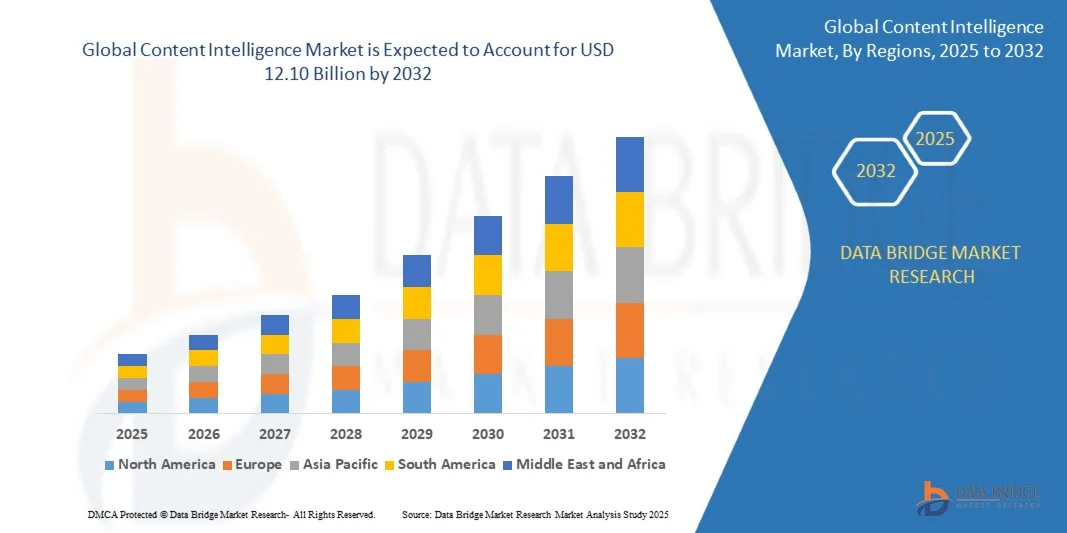
- The global content intelligence market size was valued at USD 1.51 billion in 2024 and is expected to reach USD 12.10 billion by 2032, at a CAGR of 29.72% during the forecast period
- The market growth is largely fueled by the growing adoption of AI-powered content analytics and automation solutions, leading to increased digitalization across enterprises and enhancing data-driven decision-making
- Furthermore, rising demand for personalized, optimized, and efficient content workflows is driving organizations to adopt content intelligence solutions for marketing, customer engagement, and operational efficiency. These factors are accelerating the uptake of AI-enabled content management tools, thereby significantly boosting the industry’s growth
Content Intelligence Market Analysis
- Content intelligence encompasses software and services that analyze, optimize, and automate content creation, management, and distribution. These solutions leverage AI, machine learning, and natural language processing to extract actionable insights, enhance personalization, and improve overall content effectiveness across industries
- The escalating demand for content intelligence is primarily fueled by enterprises seeking to streamline workflows, gain insights from structured and unstructured data, enhance customer engagement, and support digital transformation initiatives across marketing, sales, and operational processes
- North America dominated the content intelligence market with a share of 39.5%in 2024, due to growing adoption of AI-powered content analytics and enterprise digital transformation initiatives
- Asia-Pacific is expected to be the fastest growing region in the content intelligence market during the forecast period due to rising digitalization, increasing enterprise adoption of AI, and government initiatives promoting smart technologies
- Large enterprises segment dominated the market with a market share of 69.5% in 2024, due to their substantial budgets for AI and analytics, and the critical need to manage high volumes of content efficiently. Large organizations increasingly adopt content intelligence to enhance customer engagement, automate workflows, and ensure brand consistency across multiple channels. Integration with marketing, sales, and CRM platforms allows large enterprises to derive actionable insights and improve ROI on content investments. Growing demand for advanced analytics, predictive insights, and AI-powered personalization among global enterprises further strengthens this segment
Report Scope and Content Intelligence Market Segmentation
|
Attributes |
Content Intelligence Key Market Insights |
|
Segments Covered |
|
|
Countries Covered |
North America
Europe
Asia-Pacific
Middle East and Africa
South America
|
|
Key Market Players |
|
|
Market Opportunities |
|
|
Value Added Data Infosets |
In addition to the market insights such as market value, growth rate, market segments, geographical coverage, market players, and market scenario, the market report curated by the Data Bridge Market Research team includes in-depth expert analysis, import/export analysis, pricing analysis, production consumption analysis, and pestle analysis. |
Content Intelligence Market Trends
“Rising Use of AI-Driven Content Analytics”
- The content intelligence market is witnessing strong adoption of AI-driven analytics tools to enhance content performance and decision-making. Enterprises are increasingly leveraging AI algorithms to extract actionable insights from content engagement data, enabling personalized strategies and improved ROI across multiple channels
- For instance, Adobe has integrated AI-powered insights into its Experience Cloud platform, helping enterprises optimize content strategies based on user behavior, while IBM Watson provides content intelligence solutions that analyze audience interactions and recommend data-backed improvements. These offerings reflect how AI is shaping content value creation for businesses
- AI-driven content analytics assist enterprises in understanding consumer preferences, identifying emerging trends, and measuring content effectiveness. This allows precise targeting strategies that enhance customer experiences and boost brand loyalty across digital ecosystems
- In addition, natural language processing and machine learning are enabling businesses to assess the sentiment and contextual relevance of digital content. These technologies empower marketers to fine-tune messaging and adapt content dynamically based on evolving audience needs
- Enterprises are also using AI-driven analytics to automate workflows such as content tagging, categorization, and distribution. By improving efficiency while reducing human error, businesses ensure consistency and scalability of content strategies across multiple formats and regions
- The rising use of AI-driven content analytics signifies a fundamental transformation of digital marketing and enterprise communication. This trend is accelerating content optimization by aligning business objectives with consumer expectations and positioning AI-based intelligence as a core element of enterprise competitiveness
Content Intelligence Market Dynamics
Driver
“Growing Demand for Data-Driven Insights and Customer Engagement”
- The increasing emphasis on data-driven insights as a foundation for customer engagement strategies is a major driver of the content intelligence market. Businesses are prioritizing real-time data to maximize the impact of content initiatives across customer touchpoints
- For instance, Salesforce offers AI-powered data analytics within its Customer 360 platform, supporting brands in generating personalized recommendations and content journeys. Similarly, Oracle’s content analytics solutions help measure consumer engagement patterns and optimize campaigns at scale. These cases demonstrate how companies use data-driven insights to maximize engagement outcomes
- Organizations are investing in advanced analytics engines that measure customer interactions across websites, mobile apps, and social platforms. This enables brands to customize experiences, optimize messaging, and align content strategies with audience expectations
- In addition, the growth of omnichannel marketing requires actionable insights for consistent, personalized communication. Data-driven tools enable enterprises to understand customer behavior across multiple channels while ensuring relevance and accuracy of targeted campaigns
- The integration of advanced analytics into content workflows ensures enterprises can sustain engagement, refine audience strategies, and maximize ROI. The rise of real-time, data-driven customer engagement ensures expanding opportunities for the global content intelligence market in the years to come
Restraint/Challenge
“Integration with Existing Enterprise Systems”
- The integration of content intelligence platforms with existing enterprise systems poses a significant challenge. Many organizations struggle with aligning new AI-driven solutions with legacy IT infrastructure, content repositories, and CRM systems, which delays implementation and raises costs
- For instance, companies adopting AI-driven platforms from providers such as Cognizant and Accenture often face lengthy integration projects with existing ERP or content management frameworks. These integration workflows can cause disruptions and limit early ROI for enterprises
- Differences in data formats, legacy content systems, and siloed workflows add complexity to integration. Businesses must invest heavily in IT resources and expertise to ensure seamless interoperability between AI-driven content intelligence solutions and traditional systems
- In addition, enterprises often face hurdles related to data governance and security while merging multiple platforms. Misaligned standards across different tools and systems can impede data consistency and reduce the effectiveness of content analytics
- Overcoming integration challenges requires standardized APIs, cloud-based platforms, and scalable architectures that allow interoperability with minimal disruption. Ensuring seamless integration with legacy enterprise systems is imperative for unlocking the full potential of content intelligence and driving widespread adoption across industries
Content Intelligence Market Scope
The market is segmented on the basis of component, deployment type, organization size, and vertical.
• By Component
On the basis of component, the content intelligence market is segmented into solutions and services. The solutions segment dominated the largest market revenue share in 2024, driven by the increasing adoption of AI-powered content analytics, automation, and personalization tools across enterprises. Organizations leverage solutions to optimize content creation, enhance customer engagement, and improve decision-making by deriving actionable insights from structured and unstructured data. The growing need to streamline content workflows, maintain brand consistency, and integrate content intelligence with marketing and sales platforms also fuels demand for solutions. Vendors are continuously innovating with advanced analytics, natural language processing, and AI-driven content recommendations, further boosting adoption. Solutions are particularly favored for their ability to deliver measurable ROI, enhance operational efficiency, and support multi-channel content strategies.
The services segment is anticipated to witness the fastest growth from 2025 to 2032, fueled by increasing demand for managed content intelligence, consulting, and implementation services. Enterprises, especially those lacking in-house expertise, prefer services to deploy, integrate, and optimize content intelligence tools. Services provide continuous support, customization, and analytics guidance, helping organizations maximize the benefits of AI-driven content strategies. The complexity of modern content ecosystems and the need for data-driven content governance further contribute to growth in the services segment.
• By Deployment Type
On the basis of deployment type, the market is segmented into cloud, on-premises, and hybrid. The cloud segment dominated the largest market revenue share in 2024, driven by its scalability, cost-effectiveness, and easy accessibility across geographically distributed teams. Cloud-based content intelligence solutions allow enterprises to store, manage, and analyze massive volumes of content without heavy infrastructure investments. The ability to integrate with other SaaS applications, enable remote access, and provide real-time analytics enhances their appeal. Security protocols, automated backups, and seamless updates make cloud deployment the preferred choice for organizations of all sizes. Cloud deployment also supports collaboration, AI-driven insights, and predictive analytics, boosting operational efficiency and decision-making capabilities.
Hybrid deployment is expected to witness the fastest growth from 2025 to 2032, fueled by enterprises seeking the flexibility of cloud solutions while maintaining control over sensitive data on-premises. Hybrid models allow organizations to balance security, compliance, and scalability requirements. Growing adoption is driven by the increasing need to manage regulated content, integrate legacy systems with modern AI tools, and enable personalized content strategies without compromising data privacy.
• By Organization Size
On the basis of organization size, the content intelligence market is segmented into small and medium enterprises (SMEs) and large enterprises. Large enterprises dominated the largest market revenue share of 69.5% in 2024, driven by their substantial budgets for AI and analytics, and the critical need to manage high volumes of content efficiently. Large organizations increasingly adopt content intelligence to enhance customer engagement, automate workflows, and ensure brand consistency across multiple channels. Integration with marketing, sales, and CRM platforms allows large enterprises to derive actionable insights and improve ROI on content investments. Growing demand for advanced analytics, predictive insights, and AI-powered personalization among global enterprises further strengthens this segment.
The SME segment is anticipated to witness the fastest growth from 2025 to 2032, driven by rising awareness of content intelligence benefits and increasing availability of cost-effective, scalable solutions. SMEs are adopting AI-based tools to optimize content creation, improve marketing efficiency, and compete with larger players. Cloud-based solutions and managed services enable SMEs to deploy content intelligence without heavy infrastructure costs, while the need for digital transformation accelerates adoption.
• By Vertical
On the basis of vertical, the market is segmented into banking, financial services, and insurance (BFSI), government and public sector, healthcare and life sciences, IT and telecommunications, manufacturing, media and entertainment, retail and consumer goods, travel and hospitality, and others. The BFSI segment dominated the largest market revenue share in 2024, driven by the critical need to manage massive volumes of data, comply with stringent regulations, and deliver personalized customer experiences. Banks and insurance companies leverage content intelligence to enhance customer engagement, improve fraud detection, optimize communication, and support risk management. Advanced analytics, natural language processing, and AI-driven automation provide actionable insights, helping BFSI organizations reduce operational costs and enhance service quality. The growing emphasis on digital transformation, data governance, and intelligent content strategies further fuels adoption in this sector.
The IT and telecommunications vertical is expected to witness the fastest growth from 2025 to 2032, fueled by the increasing demand for AI-driven content optimization, customer engagement, and digital marketing solutions. Telecom and IT companies are leveraging content intelligence to streamline content workflows, enhance operational efficiency, and deliver personalized experiences across multiple channels. Rapid digitization, increasing data volumes, and growing competition push these organizations to adopt intelligent content strategies. Cloud deployment, AI-based analytics, and integration with enterprise platforms accelerate adoption in this vertical.
Content Intelligence Market Regional Analysis
- North America dominated the content intelligence market with the largest revenue share of 39.5% in 2024, driven by growing adoption of AI-powered content analytics and enterprise digital transformation initiatives
- Organizations in the region increasingly focus on leveraging content intelligence to enhance decision-making, optimize workflows, and improve customer engagement. High awareness of advanced analytics, widespread cloud adoption, and significant IT investments support market expansion
- Businesses are prioritizing tools that integrate with existing CRM, marketing, and collaboration platforms, enabling actionable insights from structured and unstructured data. The region’s strong technological infrastructure, skilled workforce, and high disposable incomes further propel adoption across enterprises
U.S. Content Intelligence Market Insight
The U.S. content intelligence market captured the largest share within North America in 2024, fueled by rapid digitalization and AI adoption. Enterprises are leveraging content intelligence to automate content creation, enhance personalization, and improve operational efficiency. The growing demand for analytics-driven decision-making, combined with cloud-based deployment preferences, strengthens market growth. Furthermore, U.S. organizations increasingly integrate content intelligence with marketing, sales, and IT systems, while adopting AI and machine learning tools to optimize content strategies and customer engagement.
Europe Content Intelligence Market Insight
The Europe content intelligence market is projected to expand steadily throughout the forecast period, driven by digital transformation across enterprises and increasing adoption of AI-enabled content solutions. The emphasis on data governance, compliance, and enhanced content efficiency fuels growth, particularly across BFSI, healthcare, and IT sectors. Organizations are deploying intelligent content solutions to improve operational efficiency, support multi-channel engagement, and extract actionable insights from large content repositories. Rising awareness of AI-based automation and integration of content intelligence with enterprise platforms further accelerates market adoption.
U.K. Content Intelligence Market Insight
The U.K. content intelligence market is expected to witness substantial growth during the forecast period, driven by enterprises’ need for improved content optimization and analytics-driven decision-making. Organizations are increasingly adopting AI-powered solutions to enhance productivity, streamline workflows, and support marketing and customer engagement strategies. The robust IT infrastructure, widespread cloud adoption, and digital initiatives across industries such as BFSI, retail, and media contribute to market growth.
Germany Content Intelligence Market Insight
The Germany content intelligence market is poised to grow steadily, fueled by increasing adoption of AI-driven content solutions and enterprise digitalization. German organizations emphasize operational efficiency, data-driven insights, and content governance to enhance productivity. Integration with enterprise software, cloud platforms, and marketing tools supports better content management and analytics. The focus on technological innovation, automation, and compliance with data regulations further encourages adoption in sectors such as BFSI, manufacturing, and healthcare.
Asia-Pacific Content Intelligence Market Insight
The Asia-Pacific content intelligence market is anticipated to grow at the fastest CAGR during the forecast period, driven by rising digitalization, increasing enterprise adoption of AI, and government initiatives promoting smart technologies. Countries such as China, Japan, and India are witnessing rapid enterprise digitization, accelerating demand for content intelligence solutions. The growing adoption of cloud-based deployment, rising IT investments, and the need for efficient content workflows across BFSI, IT, and retail sectors are key growth drivers. The expanding SME base in APAC further supports adoption of scalable and cost-effective content intelligence solutions.
Japan Content Intelligence Market Insight
The Japan content intelligence market is gaining momentum due to rapid digital transformation, high technological adoption, and demand for advanced AI-powered content solutions. Enterprises are increasingly deploying content intelligence tools to automate content workflows, enhance customer engagement, and optimize operational efficiency. The integration of content intelligence with cloud platforms and enterprise applications further supports growth.
China Content Intelligence Market Insight
The China content intelligence market accounted for the largest revenue share in Asia-Pacific in 2024, driven by rapid digitalization, growing enterprise adoption of AI, and increasing demand for efficient content management solutions. Large-scale enterprises and SMEs are leveraging content intelligence for analytics-driven decision-making, workflow automation, and customer engagement. Government initiatives supporting smart enterprise ecosystems and the availability of scalable solutions enhance market penetration across sectors including BFSI, IT, and retail.
Content Intelligence Market Share
The content intelligence industry is primarily led by well-established companies, including:
- Amazon Web Services, Inc. (U.S.)
- Adobe (U.S.)
- M-Files (Finland)
- Open Text Corporation. (Canada)
- Curata, Inc. (U.S.)
- Scoop.it (U.S.)
- Emplifi Czech Republic a.s. (Czech Republic)
- Atomic Reach (Canada)
- OneSpot. (U.S.)
- Vennli Company Inc. (U.S.)
- Episerver (U.S. and Sweden)
- ABBYY. (U.S.)
- Content Insights EAD (Serbia)
- Ceralytics (U.S.)
- Knotch, Inc. (U.S.)
- Smartlogic Semaphore Ltd (U.S.)
- Conductor (U.S.)
- CONCURED (U.K.)
- Salsify (U.S.)
- Hitachi Vantara Corporation (U.S.)
Latest Developments in Content Intelligence Market
- In January 2025, Perplexity AI proposed a USD 50 billion merger with TikTok’s U.S. operations, marking a significant move to integrate AI-driven content intelligence with one of the largest social media platforms. This development is poised to transform content creation, personalization, and distribution in the social media and digital marketing space, offering marketers enhanced targeting capabilities and deeper audience insights. The merger is expected to accelerate the adoption of AI-powered content analytics, driving innovation across content intelligence solutions for both enterprises and consumer-focused platforms
- In May 2025, IgniteTech acquired Khoros, strengthening its portfolio with AI-powered social engagement tools for over 2,000 corporate clients. This acquisition expands IgniteTech’s ability to provide advanced analytics and automated engagement solutions, enabling organizations to better understand customer sentiment, optimize social campaigns, and enhance real-time interaction. The integration of AI-driven capabilities into community and social platforms reinforces the role of content intelligence in improving customer experience and driving strategic decision-making
- In March 2025, Adobe launched the Experience Platform Agent Orchestrator, an AI-driven solution for customer experience management. By automating and orchestrating customer interactions across multiple touchpoints, this platform enables organizations to deliver more personalized and efficient experiences. The solution strengthens Adobe’s position in the content intelligence and digital experience market by providing actionable insights, enhancing workflow efficiency, and supporting enterprise adoption of AI-enabled customer engagement strategies
- In March 2023, IBM and Adobe partnered to optimize content supply chains for marketing and creative firms. By integrating people, processes, tools, and insights into a unified workflow, the collaboration enhances content creation, management, review, deployment, and analysis. This initiative improves transparency and efficiency across content operations, allowing organizations to leverage AI-driven analytics for better decision-making and enhanced audience targeting. The partnership represents a strategic step in advancing the content intelligence market through comprehensive, end-to-end workflow optimization
- In February 2023, Adobe Experience Cloud expanded its AI capabilities with Adobe Sensei GenAI, designed to assist marketers and customer experience teams in content creation and personalization throughout the customer journey. This enhancement empowers organizations to automate creative tasks, generate personalized assets, and extract actionable insights, significantly improving efficiency and engagement. The introduction of GenAI strengthens Adobe’s content intelligence offerings and reinforces the growing role of AI in optimizing digital experiences
- In September 2022, Messagepoint Inc. launched Semantex, a dedicated division focused on AI-driven content intelligence solutions. By providing cloud-based tools that analyze, optimize, and automate content workflows, Semantex enables enterprises to enhance personalization, improve operational efficiency, and gain actionable insights from large volumes of content. This launch positioned Messagepoint as a key player in the content intelligence market, addressing the rising demand for AI-powered content management solutions across multiple industries

- Interactive Data Analysis Dashboard
- Company Analysis Dashboard for high growth potential opportunities
- Research Analyst Access for customization & queries
- Competitor Analysis with Interactive dashboard
- Latest News, Updates & Trend analysis
- Harness the Power of Benchmark Analysis for Comprehensive Competitor Tracking
Data collection and base year analysis are done using data collection modules with large sample sizes. The stage includes obtaining market information or related data through various sources and strategies. It includes examining and planning all the data acquired from the past in advance. It likewise envelops the examination of information inconsistencies seen across different information sources. The market data is analysed and estimated using market statistical and coherent models. Also, market share analysis and key trend analysis are the major success factors in the market report. To know more, please request an analyst call or drop down your inquiry.
The key research methodology used by DBMR research team is data triangulation which involves data mining, analysis of the impact of data variables on the market and primary (industry expert) validation. Data models include Vendor Positioning Grid, Market Time Line Analysis, Market Overview and Guide, Company Positioning Grid, Patent Analysis, Pricing Analysis, Company Market Share Analysis, Standards of Measurement, Global versus Regional and Vendor Share Analysis. To know more about the research methodology, drop in an inquiry to speak to our industry experts.
Data Bridge Market Research is a leader in advanced formative research. We take pride in servicing our existing and new customers with data and analysis that match and suits their goal. The report can be customized to include price trend analysis of target brands understanding the market for additional countries (ask for the list of countries), clinical trial results data, literature review, refurbished market and product base analysis. Market analysis of target competitors can be analyzed from technology-based analysis to market portfolio strategies. We can add as many competitors that you require data about in the format and data style you are looking for. Our team of analysts can also provide you data in crude raw excel files pivot tables (Fact book) or can assist you in creating presentations from the data sets available in the report.













