


Continuous Tablet Manufacturing Systems Market Overview
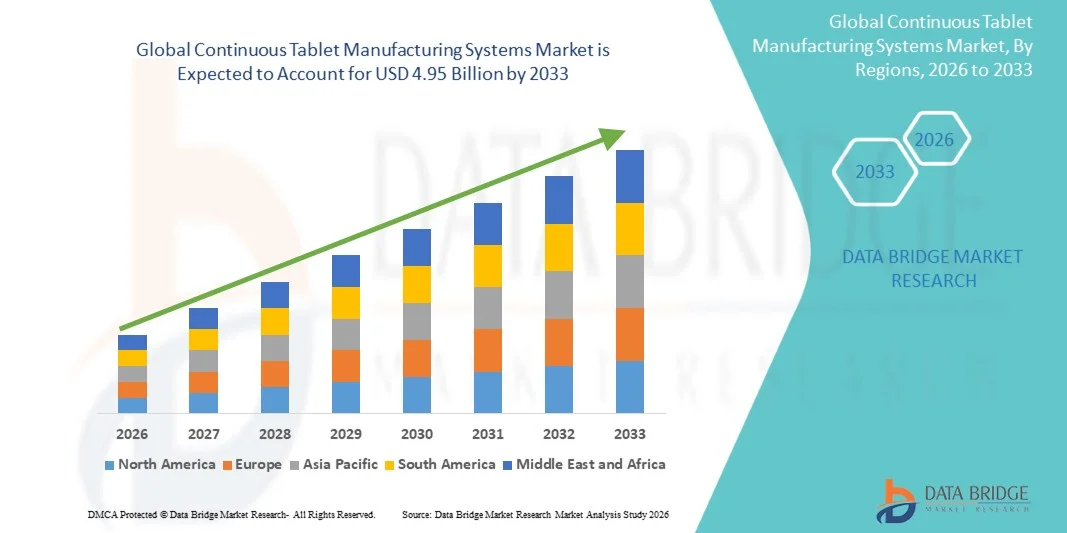
As per Data Bridge Market Research analysis The Continuous Tablet Manufacturing Systems Market was valued at USD 1.48 billion in 2025 and is projected to reach USD 4.95 billion by 2033, growing at a CAGR of 16.30% from 2026 to 2033. The market is experiencing steady growth driven by increasing adoption of continuous pharmaceutical manufacturing, rising demand for high-efficiency production processes, and growing emphasis on quality-by-design (QbD) and real-time process monitoring across the pharmaceutical industry.
The growing need to improve manufacturing efficiency, reduce production costs, and ensure consistent product quality is encouraging pharmaceutical companies and contract manufacturing organizations to transition from traditional batch processing to continuous tablet manufacturing systems. In addition, regulatory support from health authorities for advanced manufacturing technologies, coupled with increasing investments in process analytical technology (PAT), automation, and digitalized production facilities, is accelerating market adoption. Integrated continuous manufacturing platforms are gaining traction by enabling streamlined production, reduced waste generation, faster scale-up capabilities, and enhanced compliance with stringent pharmaceutical quality standards.
Key Market Trends & Insights
- North America dominated the Continuous Tablet Manufacturing Systems Market with the largest revenue share of 38.62% in 2025, supported by early adoption of continuous manufacturing technologies, strong pharmaceutical production capabilities, and favorable regulatory initiatives promoting advanced manufacturing
- The Integrated Continuous Tablet Manufacturing Systems segment led the market with a 44.18% share in 2025, driven by increasing demand for end-to-end automated pharmaceutical production and enhanced process efficiency.
- Asia-Pacific is expected to be the fastest-growing region at a CAGR of 8.1% from 2026 to 2033, fueled by expanding pharmaceutical manufacturing capacity, rising investments in process modernization, and growing adoption across China, India, and South Korea.
- Modular Continuous Tablet Manufacturing Systems are the fastest-growing system type, projected to register a CAGR of 8.4%, reflecting the surge in demand for flexible and customizable production platforms.
- The Direct Compression segment dominated the process type category with a 39.76% revenue share in 2025, led by its simple processing workflow, reduced equipment requirements, and lower manufacturing costs.
- Pharmaceutical Manufacturing accounted for 58.43% of the market, preferred by the widespread adoption of continuous production technologies for oral solid dosage forms.
- The Research & Development segment is the fastest-growing application category, with a CAGR of 8.7%, driven by increasing efforts to accelerate drug development and process optimization.
Market Size & Forecast
- Global Market Value (2025): USD 1.48 Billion
- Expected Market Value (2033): USD 4.95 Billion
- Forecast CAGR (2026–2033): 16.30%
- Leading Region in 2025: North America
- Fastest Growing Region: Asia Pacific
Report Scope and Continuous Tablet Manufacturing Systems Market Segmentation
|
Attributes |
Continuous Tablet Manufacturing Systems Key Market Insights |
|
Segments Covered |
|
|
Countries Covered |
North America · U.S. · Canada · Mexico Europe · Germany · France · U.K. · Netherlands · Switzerland · Belgium · Russia · Italy · Spain · Turkey · Rest of Europe Asia-Pacific · China · Japan · India · South Korea · Singapore · Malaysia · Australia · Thailand · Indonesia · Philippines · Rest of Asia-Pacific Middle East and Africa · Saudi Arabia · U.A.E. · South Africa · Egypt · Israel · Rest of Middle East and Africa South America · Brazil · Argentina · Rest of South America |
|
Key Market Players |
· GEA Group Aktiengesellschaft (Germany) · Syntegon Technology GmbH (Germany) · Glatt GmbH (Germany) · L.B. Bohle Maschinen und Verfahren GmbH (Germany) · Bruker Corporation (U.S.) · KORSCH AG (Germany) · Fette Compacting GmbH (Germany) · The Fitzpatrick Company (U.S.) · Gericke AG (Switzerland) · Hosokawa Micron Group (Japan) · Freund Corporation (Japan) · SaintyCo (China) · ACG Group (India) · Schaefer Technologies, Inc. (U.S.) · Perceptive Engineering Ltd (U.K.) · Siemens AG (Germany) · Emerson Electric Co. (U.S.) · Mettler-Toledo International Inc. (U.S.) · Thermo Fisher Scientific Inc. (U.S.) · Bruker Daltonics, Inc. (U.S.) |
|
Market Opportunities |
· Expansion of continuous manufacturing adoption for personalized and small-batch medicines · Growing regulatory support for advanced pharmaceutical manufacturing technologies · Increasing demand for high-potency and complex oral solid dosage formulations |
|
Value Added Data Infosets |
In addition to the insights on market scenarios such as market value, growth rate, segmentation, geographical coverage, and major players, the market reports curated by the Data Bridge Market Research also include in-depth expert analysis, patient epidemiology, pipeline analysis, pricing analysis, and regulatory framework. |
Continuous Tablet Manufacturing Systems Market Trends
Trend: Increasing Adoption of End-to-End Continuous Pharmaceutical Manufacturing
Pharmaceutical manufacturers are increasingly adopting continuous tablet manufacturing systems to improve production efficiency, reduce material waste, and achieve consistent product quality without the limitations of traditional batch processing. The integration of advanced process analytical technology enables real-time monitoring of critical quality attributes and supports continuous process verification throughout production. Contract manufacturers and drug developers are similarly leveraging continuous platforms to accelerate product commercialization through standardized, data-driven manufacturing approaches, while automation and digital technologies create highly efficient environments that closely align with modern pharmaceutical production requirements.
For instance, in June 2024, GEA Group expanded its continuous manufacturing solutions portfolio with advanced integrated processing technologies designed to improve efficiency, quality control, and scalability in oral solid dosage production.
Continuous Tablet Manufacturing Systems Market Dynamics
Key Market Driver: Growing Demand for Efficient and Flexible Pharmaceutical Production
The rapid expansion of pharmaceutical manufacturing and increasing demand for operational efficiency have created substantial demand for continuous tablet manufacturing systems that can optimize production throughput, improve product consistency, and support scalable commercial operations in ways difficult to achieve through conventional batch manufacturing. Pharmaceutical companies, contract manufacturers, and drug development organizations are deploying continuous systems as a core component of their manufacturing strategy, reducing costs, accelerating production cycles, and improving regulatory compliance across global markets.
For instance, in recent years, Eli Lilly and Company and other major pharmaceutical manufacturers have continued investing in advanced continuous manufacturing technologies to enhance production efficiency and strengthen supply chain resilience.
Key Restraint/Challenge: High Initial Investment Cost of Continuous Manufacturing Systems
A significant restraint in the Continuous Tablet Manufacturing Systems Market is the high upfront capital required for advanced manufacturing platforms. Modern systems integrate sophisticated feeders, granulators, tablet presses, process analytical technologies, and automated control architectures, demanding substantial investment in procurement, facility modifications, and ongoing validation activities. The total cost of ownership extends to software integration, workforce training, and regulatory qualification requirements, making adoption difficult for smaller pharmaceutical companies, contract manufacturers, and emerging-market organizations.
For instance, the implementation of fully integrated continuous manufacturing facilities by leading pharmaceutical companies often requires multimillion-dollar investments in equipment, automation infrastructure, and compliance programs, reflecting the broader challenge of adoption beyond well-funded organizations.
Key Market Opportunity: Expansion of Real-Time Release Testing and Digital Manufacturing
The integration of real-time release testing and digital manufacturing technologies in continuous tablet production presents a significant market opportunity. Advanced analytical platforms can provide continuous quality verification, generate real-time process intelligence, and support rapid product release without extensive end-product testing. The development of integrated automation architectures and data-driven manufacturing models is further improving operational efficiency, opening growth opportunities across pharmaceutical markets in Asia-Pacific, Latin America, and the Middle East.
For instance, in 2024, Siemens AG continued expanding digital manufacturing and pharmaceutical automation capabilities that support data-driven continuous production and advanced quality management systems.
Continuous Tablet Manufacturing Systems Market Scope
The continuous tablet manufacturing systems market is segmented on the basis of system type, process type, application, and end user.
- By System Type
On the basis of system type, the Continuous Tablet Manufacturing Systems Market is segmented into integrated continuous tablet manufacturing systems, modular continuous tablet manufacturing systems, and semi-continuous manufacturing systems. The Integrated Continuous Tablet Manufacturing Systems segment dominated the market with a 44.18% share in 2025, driven by increasing demand for end-to-end automated pharmaceutical production and enhanced process efficiency. These systems enable seamless integration of feeding, blending, granulation, compression, and coating operations within a single manufacturing line. Pharmaceutical manufacturers prefer integrated platforms because they reduce production downtime, minimize material losses, and improve product consistency. The ability to support real-time monitoring and process analytical technologies further strengthens their adoption. Regulatory agencies increasingly encourage advanced manufacturing approaches, supporting investment in integrated systems. Their capability to improve scalability, productivity, and compliance continues to position them as the leading segment globally.
The Modular Continuous Tablet Manufacturing Systems segment is projected to register the fastest growth at a CAGR of 8.4% from 2026 to 2033, driven by growing demand for flexible and customizable production platforms. These systems allow manufacturers to add, remove, or upgrade individual modules according to changing production requirements. Pharmaceutical companies increasingly favor modular solutions because they require lower initial capital investment and offer easier facility integration. Their flexibility supports both commercial manufacturing and product development activities. Rising demand for personalized medicines and small-batch production is further accelerating adoption. Continuous technological advancements in modular automation and control systems are also contributing to the segment’s rapid expansion.
- By Process Type
On the basis of process type, the Continuous Tablet Manufacturing Systems Market is segmented into direct compression, continuous wet granulation, continuous dry granulation, and hot melt extrusion. The Direct Compression segment dominated the market with a 39.76% share in 2025 owing to its simple processing workflow, reduced equipment requirements, and lower manufacturing costs. This process eliminates several intermediate steps, enabling faster production cycles and improved operational efficiency. Pharmaceutical manufacturers widely utilize direct compression for formulations with suitable flowability and compressibility characteristics. The process supports continuous production while maintaining high levels of product consistency and quality. Its reduced energy consumption and lower maintenance requirements further enhance adoption. The ability to streamline manufacturing operations makes direct compression the preferred process across many pharmaceutical facilities.
The Continuous Wet Granulation segment is expected to witness the fastest growth at a CAGR of 8.1% from 2026 to 2033, driven by increasing demand for enhanced content uniformity and improved formulation performance. This process offers superior control over granule characteristics, leading to consistent tablet quality and better production outcomes. Pharmaceutical companies are increasingly adopting continuous wet granulation for complex formulations that require precise process control. The technology supports efficient scale-up from development to commercial production. Growing regulatory emphasis on quality-by-design principles is encouraging wider implementation of wet granulation systems. Advancements in process monitoring and automation technologies are further accelerating segment growth.
- By Application
On the basis of application, the Continuous Tablet Manufacturing Systems Market is segmented into pharmaceutical manufacturing, nutraceutical manufacturing, research & development, and others. The Pharmaceutical Manufacturing segment led the market with a 58.43% share in 2025, driven by widespread adoption of continuous production technologies for oral solid dosage forms. Pharmaceutical companies increasingly utilize these systems to improve manufacturing efficiency, reduce costs, and enhance product quality. Continuous tablet manufacturing supports real-time process monitoring and facilitates compliance with stringent regulatory standards. The growing demand for high-volume drug production is further strengthening segment growth. Manufacturers are also leveraging these systems to shorten production timelines and improve supply chain responsiveness. Continuous investments in pharmaceutical facility modernization continue to support the segment’s dominant position.
The Research & Development segment is projected to experience the fastest growth at a CAGR of 8.7% from 2026 to 2033, fueled by increasing efforts to accelerate drug development and process optimization. Research organizations and pharmaceutical companies are utilizing continuous manufacturing platforms to evaluate formulations and streamline scale-up activities. These systems provide valuable process insights through real-time data collection and analysis. Growing interest in advanced manufacturing technologies is encouraging greater investment in pilot-scale continuous production facilities. The ability to rapidly test and optimize formulations supports faster product development cycles. Increasing collaboration between industry and academic institutions is also contributing to strong segment expansion.
- By End User
On the basis of end user, the Continuous Tablet Manufacturing Systems Market is segmented into pharmaceutical companies, biotechnology companies, contract development and manufacturing organizations (CDMOs), and research institutes & academic centers. The Pharmaceutical Companies segment dominated the market with a 47.25% share in 2025, driven by large-scale investments in advanced manufacturing technologies and production efficiency improvements. These organizations are actively transitioning from traditional batch processing to continuous manufacturing platforms to enhance competitiveness and operational performance. Continuous systems help pharmaceutical manufacturers reduce production costs while maintaining high product quality standards. The adoption of real-time release testing and process analytical technologies is further strengthening demand. Increasing pressure to improve supply chain resilience and manufacturing flexibility also supports market growth. Their substantial production volumes and capital resources make pharmaceutical companies the leading end-user segment.
The Contract Development and Manufacturing Organizations (CDMOs) segment is anticipated to register the fastest growth at a CAGR of 8.9% from 2026 to 2033, driven by rising outsourcing activities across the pharmaceutical industry. Drug developers increasingly rely on CDMOs for flexible manufacturing capacity and access to advanced production technologies. Continuous tablet manufacturing systems enable CDMOs to offer efficient, scalable, and cost-effective manufacturing services to multiple clients. Growing demand for specialized formulation expertise and accelerated commercialization timelines is supporting adoption. Investments in state-of-the-art continuous manufacturing facilities are expanding service capabilities across the sector. The increasing complexity of pharmaceutical products continues to create significant growth opportunities for CDMOs worldwide.
Continuous Tablet Manufacturing Systems Market Regional Analysis
North America dominated the Continuous Tablet Manufacturing Systems Market with the largest revenue share of 38.62% in 2025, supported by early adoption of continuous manufacturing technologies, strong pharmaceutical production capabilities, and favorable regulatory initiatives promoting advanced manufacturing. The region also benefits from favorable regulatory support for continuous manufacturing, high adoption of process analytical technology and automation platforms, and growing implementation of real-time quality monitoring across pharmaceutical production facilities. Increasing focus on manufacturing efficiency, supply chain resilience, and digitalized pharmaceutical operations continues to strengthen North America’s leadership position in the global market.
U.S. Continuous Tablet Manufacturing Systems Market Insight
The U.S. continuous tablet manufacturing systems market is witnessing strong growth due to rising investments in advanced pharmaceutical manufacturing facilities, process automation initiatives, and continuous production technologies. The country’s mature pharmaceutical industry, along with increasing adoption of process analytical technology, digital manufacturing platforms, and real-time release testing systems, is driving demand across commercial manufacturing and research applications. In addition, growing emphasis on improving production efficiency, ensuring product quality consistency, and strengthening domestic drug supply chains is accelerating continuous manufacturing system adoption across pharmaceutical companies and contract manufacturers.
Europe Continuous Tablet Manufacturing Systems Market Insight
The Europe continuous tablet manufacturing systems market remains a major contributor to global revenue, driven by strong regulatory support, technological innovation, and high demand for advanced pharmaceutical manufacturing solutions. The widespread use of continuous production platforms in commercial drug manufacturing, process development, and pharmaceutical research activities is supporting market expansion across the region. Increasing investments in automation technologies, coupled with stringent quality standards and a highly developed pharmaceutical sector, continue to enhance the adoption of continuous tablet manufacturing systems throughout Europe.
U.K. Continuous Tablet Manufacturing Systems Market Insight
The U.K. continuous tablet manufacturing systems market is experiencing steady growth, supported by rising adoption of advanced manufacturing technologies in pharmaceutical production and drug development applications. Increasing investments in modern production infrastructure and growing demand for efficient, scalable manufacturing solutions are contributing to market growth. Furthermore, integration of automation, data analytics, and process monitoring technologies is improving operational performance and manufacturing efficiency, positioning the U.K. as a key innovation hub in the continuous pharmaceutical manufacturing industry.
Germany Continuous Tablet Manufacturing Systems Market Insight
The Germany continuous tablet manufacturing systems market is expanding steadily due to the country’s strong pharmaceutical manufacturing base, advanced engineering capabilities, and increasing adoption of next-generation production technologies. Pharmaceutical companies, contract manufacturers, and research organizations are increasingly utilizing continuous systems for process optimization, quality improvement, and commercial-scale production activities. Continuous advancements in automation, process analytical technologies, and digital manufacturing solutions, along with strong government support for industrial innovation, are further driving market growth in Germany.
Asia-Pacific Continuous Tablet Manufacturing Systems Market Insight
The Asia-Pacific continuous tablet manufacturing systems market is expected to witness rapid growth, driven by expanding pharmaceutical production, increasing healthcare investments, and rising adoption of advanced manufacturing technologies across countries such as China, India, and Japan. Growing awareness regarding manufacturing efficiency, rising implementation of automation platforms, and increasing demand for scalable and cost-effective production solutions are supporting regional market expansion. In addition, the growing presence of pharmaceutical manufacturing hubs and contract development organizations is accelerating continuous manufacturing system adoption across commercial and research sectors.
Japan Continuous Tablet Manufacturing Systems Market Insight
The Japan continuous tablet manufacturing systems market is witnessing consistent growth due to rising investments in advanced pharmaceutical production technologies, manufacturing innovation, and quality assurance initiatives. Pharmaceutical manufacturers, research institutes, and technology providers are increasingly adopting continuous manufacturing platforms for process optimization, product consistency, and commercial production purposes. Moreover, increasing integration of automation technologies and the country’s focus on efficient, high-quality pharmaceutical manufacturing solutions are further contributing to market growth.
China Continuous Tablet Manufacturing Systems Market Insight
The China continuous tablet manufacturing systems market is growing rapidly, driven by expanding pharmaceutical manufacturing capacity, increasing healthcare expenditure, and rising government focus on advanced production technologies. Growing adoption of automated and data-driven manufacturing platforms across pharmaceutical and biotechnology sectors is significantly boosting market demand. In addition, rising investments in pharmaceutical R&D, increasing emphasis on product quality and regulatory compliance, and rapid technological advancements are positioning China as one of the fastest-growing markets for continuous tablet manufacturing systems globally.
Continuous Tablet Manufacturing Systems Market Share
The continuous tablet manufacturing systems industry is primarily led by well-established companies, including:
- GEA Group Aktiengesellschaft (Germany)
- Syntegon Technology GmbH (Germany)
- Glatt GmbH (Germany)
- B. Bohle Maschinen und Verfahren GmbH (Germany)
- Bruker Corporation (U.S.)
- KORSCH AG (Germany)
- Fette Compacting GmbH (Germany)
- The Fitzpatrick Company (U.S.)
- Gericke AG (Switzerland)
- Hosokawa Micron Group (Japan)
- Freund Corporation (Japan)
- SaintyCo (China)
- ACG Group (India)
- Schaefer Technologies, Inc. (U.S.)
- Perceptive Engineering Ltd (U.K.)
- Siemens AG (Germany)
- Emerson Electric Co. (U.S.)
- Mettler-Toledo International Inc. (U.S.)
- Thermo Fisher Scientific Inc. (U.S.)
- Bruker Daltonics, Inc. (U.S.)
Latest Developments in Continuous Tablet Manufacturing Systems Market
- In December 2025, GEA Group and Hovione announced the development of the ConsiGma® CDC Flex, a next-generation continuous direct compression platform designed to improve flexibility, simplicity, and cost-efficiency in continuous tablet manufacturing. The system enables pharmaceutical manufacturers to adopt continuous tableting with lower operational complexity while maintaining high product quality and production efficiency. This development highlights the industry's growing focus on scalable and flexible continuous manufacturing solutions
- In September 2023, industry experts and regulators at the PDA/FDA Joint Regulatory Conference 2023 emphasized the growing importance of continuous manufacturing in pharmaceutical production, highlighting increasing regulatory acceptance and broader industry adoption. Discussions focused on how continuous manufacturing supports enhanced product quality, process control, and operational efficiency, reinforcing its role in the future of tablet manufacturing
- In March 2023, the U.S. Food and Drug Administration published the final ICH Q13 Continuous Manufacturing Guidance, providing a globally harmonized framework for the development, implementation, operation, and lifecycle management of continuous manufacturing for drug substances and drug products. The guidance is expected to accelerate adoption of continuous tablet manufacturing technologies by improving regulatory clarity and reducing implementation barriers for pharmaceutical manufacturers
- In January 2023, WuXi STA announced the launch of its first continuous manufacturing line for oral solid dosage forms at its Wuxi facility in China. The new line incorporates continuous direct compression, blending, lubrication, tablet compression, and coating operations supported by Process Analytical Technology (PAT) for real-time monitoring and control. The launch strengthens the company's ability to provide faster and more efficient oral drug development and manufacturing services
- In January 2021, Continuus Pharmaceuticals announced plans to build the first U.S. GMP-certified facility utilizing Integrated Continuous Manufacturing (ICM) technology for end-to-end production of small-molecule drug products. Supported by a U.S. government contract, the facility was designed to commercialize continuous manufacturing technology and strengthen domestic pharmaceutical production capabilities. This development marked a significant milestone in advancing continuous tablet and oral solid dosage manufacturing infrastructure

- Interactive Data Analysis Dashboard
- Company Analysis Dashboard for high growth potential opportunities
- Research Analyst Access for customization & queries
- Competitor Analysis with Interactive dashboard
- Latest News, Updates & Trend analysis
- Harness the Power of Benchmark Analysis for Comprehensive Competitor Tracking
Data collection and base year analysis are done using data collection modules with large sample sizes. The stage includes obtaining market information or related data through various sources and strategies. It includes examining and planning all the data acquired from the past in advance. It likewise envelops the examination of information inconsistencies seen across different information sources. The market data is analysed and estimated using market statistical and coherent models. Also, market share analysis and key trend analysis are the major success factors in the market report. To know more, please request an analyst call or drop down your inquiry.
The key research methodology used by DBMR research team is data triangulation which involves data mining, analysis of the impact of data variables on the market and primary (industry expert) validation. Data models include Vendor Positioning Grid, Market Time Line Analysis, Market Overview and Guide, Company Positioning Grid, Patent Analysis, Pricing Analysis, Company Market Share Analysis, Standards of Measurement, Global versus Regional and Vendor Share Analysis. To know more about the research methodology, drop in an inquiry to speak to our industry experts.
Data Bridge Market Research is a leader in advanced formative research. We take pride in servicing our existing and new customers with data and analysis that match and suits their goal. The report can be customized to include price trend analysis of target brands understanding the market for additional countries (ask for the list of countries), clinical trial results data, literature review, refurbished market and product base analysis. Market analysis of target competitors can be analyzed from technology-based analysis to market portfolio strategies. We can add as many competitors that you require data about in the format and data style you are looking for. Our team of analysts can also provide you data in crude raw excel files pivot tables (Fact book) or can assist you in creating presentations from the data sets available in the report.













