Controlled Environment Agriculture (CEA) Systems Market Overview
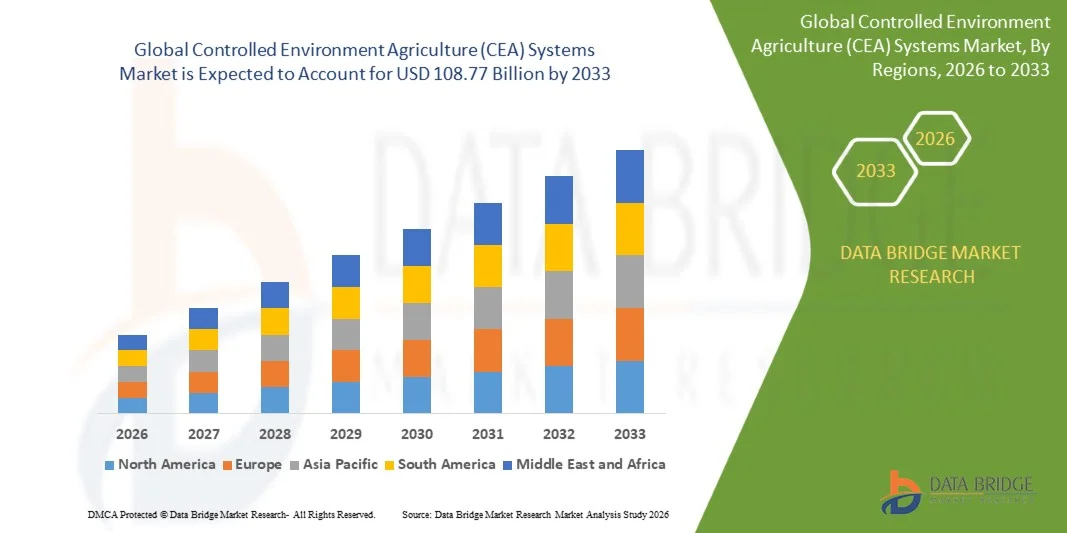
The Controlled Environment Agriculture (CEA) Systems Market was valued at USD 41.5 Billion in 2025 and is projected to reach USD 108.77 Billion by 2033, growing at a CAGR of 12.80% from 2026 to 2033. The market is experiencing consistent growth driven by increasing demand for sustainable food production, rising adoption of vertical farming and greenhouse technologies, and growing concerns regarding climate change and arable land scarcity. Expanding implementation of precision agriculture solutions and advancements in automation, LED lighting, and climate control technologies are further supporting market expansion across major agricultural regions.
The increasing global focus on food security and resource-efficient cultivation, combined with rising demand for year-round production of fresh and pesticide-free crops, is encouraging growers to adopt controlled environment agriculture systems. Advanced cultivation technologies are enabling higher yields with reduced water and land usage while improving crop quality and consistency. Growing investments in smart farming infrastructure and increasing government support for sustainable agriculture are further accelerating the adoption of controlled environment agriculture systems worldwide.
Key Market Trends & Insights
- North America dominated the Controlled Environment Agriculture (CEA) Systems Market with the largest revenue share of 36% in 2025, supported by strong adoption of vertical farming technologies, increasing investments in sustainable food production, and widespread implementation of precision agriculture solutions
- The vegetables segment led the market with a 60.7% share in 2025, driven by increasing consumer demand for fresh, pesticide-free, and locally produced leafy greens and specialty vegetables
- Asia-Pacific is expected to be the fastest-growing region at a CAGR of 13.2% from 2026 to 2033, fueled by rapid urbanization, declining arable land availability, and increasing demand for high-yield sustainable farming methods
- Aeroponics are the fastest-growing technology type, projected to register a CAGR of 15.5% from 2026 to 2033, supported by rising demand for highly efficient cultivation systems that minimize water consumption and maximize productivity
- The hardware segment dominated the component category with a 63.8% revenue share in 2025, led by the extensive deployment of climate control systems, LED lighting, sensors, irrigation equipment, and greenhouse structures across commercial facilities
- Hydroponics accounted for 56.4% of the market in 2025, preferred by its ability to deliver higher crop yields with efficient water and nutrient usage
- The software segment is the fastest-growing component category, with a CAGR of 14.2% from 2026 to 2033, driven by increasing integration of artificial intelligence, IoT platforms, and data analytics in indoor farming operations
Market Size & Forecast
- Global Market Value (2025): USD 41.5 Billion
- Expected Market Value (2033): USD 108.77 Billion
- Forecast CAGR (2026–2033): 12.80%
- Leading Region in 2025: North America
- Fastest Growing Region: Asia-Pacific
Report Scope and Controlled Environment Agriculture (CEA) Systems Market Segmentation
|
Attributes |
Controlled Environment Agriculture (CEA) Systems Key Market Insights |
|
Segments Covered |
|
|
Countries Covered |
North America · U.S. · Canada · Mexico Europe · Germany · France · U.K. · Netherlands · Switzerland · Belgium · Russia · Italy · Spain · Turkey · Rest of Europe Asia-Pacific · China · Japan · India · South Korea · Singapore · Malaysia · Australia · Thailand · Indonesia · Philippines · Rest of Asia-Pacific Middle East and Africa · Saudi Arabia · U.A.E. · South Africa · Egypt · Israel · Rest of Middle East and Africa South America · Brazil · Argentina · Rest of South America |
|
Key Market Players |
· Heliospectra AB (Sweden) · Signify N.V. (Netherlands) · Argus Control Systems Ltd. (Canada) · Priva Holding B.V. (Netherlands) · Netafim Ltd. (Israel) · Richel Group S.A.S. (France) · Certhon Group (Netherlands) · LumiGrow Inc. (U.S.) · Hydrofarm Holdings Group, Inc. (U.S.) · Freight Farms, Inc. (U.S.) · Bowery Farming Inc. (U.S.) · Gotham Greens Holdings, LLC (U.S.) · AeroFarms, Inc. (U.S.) · Plenty Unlimited Inc. (U.S.) · BrightFarms, Inc. (U.S.) · Kalera AS (Norway) · Village Farms International, Inc. (Canada) |
|
Market Opportunities |
· Expansion of Vertical Farming Projects in Urban Areas · Growing Adoption of Energy-Efficient LED Lighting Systems · Increasing Deployment of Automated Hydroponic Cultivation Solutions |
|
Value Added Data Infosets |
In addition to the insights on market scenarios such as market value, growth rate, segmentation, geographical coverage, and major players, the market reports curated by the Data Bridge Market Research also include import export analysis, production capacity overview, production consumption analysis, price trend analysis, climate change scenario, supply chain analysis, value chain analysis, raw material/consumables overview, vendor selection criteria, PESTLE Analysis, Porter Analysis, and regulatory framework. |
Controlled Environment Agriculture (CEA) Systems Market Trends
Trend: Integration of AI and IoT Technologies in Controlled Environment Farming
Controlled environment agriculture operators are increasingly integrating artificial intelligence, IoT sensors, and data analytics platforms to optimize crop production, improve resource efficiency, and enhance operational performance. Smart monitoring systems enable real-time control of temperature, humidity, lighting, nutrient delivery, and irrigation, allowing growers to maximize yields while reducing water and energy consumption. The growing adoption of automated vertical farming and greenhouse technologies is further accelerating digital transformation across the industry.
Companies such as Priva Holding B.V. are providing AI-enabled climate and crop management solutions that are widely deployed in commercial greenhouses worldwide. In addition, AeroFarms, Inc. utilizes machine learning and sensor-based technologies to optimize indoor farming operations and improve crop productivity.
Controlled Environment Agriculture (CEA) Systems Market Dynamics
Key Market Driver: Rising Demand for Sustainable and Year-Round Food Production
The increasing need for sustainable food production and year-round availability of fresh produce is significantly driving demand for controlled environment agriculture systems. Rising concerns regarding climate change, declining arable land, and water scarcity are encouraging growers to adopt resource-efficient cultivation technologies. Controlled environments enable higher crop yields while using substantially less water compared with conventional farming methods. Governments and investors are also supporting advanced agricultural technologies to strengthen food security and reduce dependence on seasonal production.
Major organizations such as FAO have emphasized the importance of resource-efficient agricultural practices for meeting future food demand. Companies including Gotham Greens Holdings, LLC and Plenty Unlimited Inc. are expanding greenhouse and indoor farming facilities to deliver fresh produce throughout the year and improve supply chain resilience.
Key Restraint/Challenge: High Initial Capital and Operating Costs of CEA Facilities
A major challenge in the Controlled Environment Agriculture systems market is the substantial capital investment required for establishing and operating advanced indoor farming facilities. Construction of greenhouses and vertical farms requires significant expenditure on LED lighting, HVAC systems, automation technologies, sensors, and irrigation infrastructure. High electricity consumption and maintenance costs further increase operating expenses and affect profitability. These factors create barriers for small and medium-sized growers and limit widespread adoption in cost-sensitive markets.
The financial difficulties experienced by Bowery Farming Inc., which ceased operations in 2024 despite raising substantial investment funding, highlighted the challenges associated with managing high infrastructure and energy costs in commercial indoor farming. The development underscored the importance of achieving operational efficiency and economic scalability in controlled environment agriculture.
Key Market Opportunity: Growing Adoption of Energy-Efficient LED Lighting Systems
The increasing use of energy-efficient LED lighting technologies is creating significant growth opportunities for the Controlled Environment Agriculture systems market. LED lighting enables precise control of light intensity and spectrum, improving crop quality while reducing electricity consumption compared with conventional lighting systems. Continuous advancements in smart lighting technologies are enhancing productivity and supporting commercial-scale cultivation of vegetables, fruits, and specialty crops. Growing emphasis on energy optimization is further encouraging adoption across greenhouses and vertical farms.
Companies such as Signify N.V. are expanding their horticultural LED portfolios through Philips GreenPower solutions, which are being adopted by greenhouse operators worldwide. In addition, Heliospectra AB provides intelligent LED lighting systems that help growers improve yields and lower energy consumption, supporting the expansion of advanced controlled environment agriculture facilities.
Controlled Environment Agriculture (CEA) Systems Market Scope
The Controlled Environment Agriculture (CEA) Systems market is segmented on the basis of component, technology, crop, and end use
- By Component
On the basis of component, the Controlled Environment Agriculture (CEA) Systems Market is segmented into hardware, software, and service. The Hardware segment dominated the market with the largest share of 63.8% in 2025, driven by the extensive deployment of climate control systems, LED lighting, sensors, irrigation equipment, and greenhouse structures across commercial facilities. Hardware components form the foundation of controlled cultivation environments and are essential for maintaining temperature, humidity, and nutrient levels. Growing investments in automated farming infrastructure and vertical farming projects are supporting segment expansion. Continuous upgrades in lighting and monitoring technologies further enhance operational efficiency. Rising adoption of precision agriculture solutions continues to reinforce the segment's leading position.
The Software segment is projected to register the fastest growth at a CAGR of 14.2% from 2026 to 2033, driven by increasing integration of artificial intelligence, IoT platforms, and data analytics in indoor farming operations. Software solutions enable real-time monitoring and optimization of crop growth parameters, improving productivity and resource utilization. Rising demand for predictive analytics and remote farm management systems is accelerating adoption among commercial growers. Advancements in cloud-based agricultural platforms are improving scalability and operational flexibility. Increasing focus on reducing labor costs and maximizing yields is expected to support rapid segment growth across developed and emerging markets.
- By Technology
On the basis of technology, the Controlled Environment Agriculture (CEA) Systems Market is segmented into hydroponics, aeroponics, aquaponics, and others. The Hydroponics segment dominated the market with a share of 56.4% in 2025, supported by its ability to deliver higher crop yields with efficient water and nutrient usage. Hydroponic systems are widely adopted across greenhouses and vertical farms due to their lower maintenance requirements and compatibility with a wide variety of crops. The technology offers better control over nutrient delivery, enabling consistent production throughout the year. Growing concerns regarding water scarcity and arable land limitations are further supporting adoption. Increasing commercial investments in sustainable farming infrastructure continue to strengthen segment dominance.
The Aeroponics segment is projected to register the fastest growth at a CAGR of 15.5% from 2026 to 2033, driven by rising demand for highly efficient cultivation systems that minimize water consumption and maximize productivity. Aeroponic systems provide enhanced oxygen exposure to plant roots, resulting in faster growth and improved crop quality. Technological advancements in misting systems and automated nutrient delivery are increasing commercial feasibility. Growing interest in space-efficient farming solutions and premium crop production is accelerating adoption. Expanding research activities and investments in advanced indoor farming technologies are expected to support strong segment growth.
- By Crop
On the basis of crop, the Controlled Environment Agriculture (CEA) Systems Market is segmented into vegetables, fruits, flowers and ornamentals, and others. The Vegetables segment dominated the market with the largest share of 60.7% in 2025, driven by increasing consumer demand for fresh, pesticide-free, and locally produced leafy greens and specialty vegetables. Controlled cultivation enables year-round production while ensuring consistent quality and higher yields. Vegetables are highly suitable for vertical farming and hydroponic systems due to their shorter growth cycles. Rising urbanization and increasing preference for sustainable food production are supporting segment expansion. Continuous demand from retail chains and food service industries further strengthens its leading position.
The Fruits segment is projected to register the fastest growth at a CAGR of 13.8% from 2026 to 2033, driven by growing adoption of advanced cultivation systems for berries, strawberries, and exotic fruits. Controlled environments help improve fruit quality, reduce seasonal limitations, and enhance productivity. Increasing consumer preference for premium and nutrient-rich fruits is supporting market demand. Advancements in climate control and pollination technologies are improving cultivation efficiency. Expanding investments in indoor fruit farming and greenhouse production are accelerating segment growth globally.
- By End Use
On the basis of end use, the Controlled Environment Agriculture (CEA) Systems Market is segmented into commercial, residential, and others. The Commercial segment dominated the market with a share of 40.1% in 2025, supported by large-scale investments in greenhouses, vertical farms, and indoor cultivation facilities. Commercial growers are increasingly adopting controlled environment systems to ensure consistent production and optimize resource utilization. Rising demand for high-quality produce from supermarkets, restaurants, and food processing companies is driving market expansion. Integration of automation and smart farming technologies is enhancing productivity and operational efficiency. Strong support from investors and government initiatives aimed at sustainable agriculture further reinforces segment dominance.
The Residential segment is projected to register the fastest growth at a CAGR of 12.9% from 2026 to 2033, driven by increasing consumer interest in home gardening and self-sustained food production. Compact indoor farming solutions and smart hydroponic kits are making controlled agriculture accessible to households. Growing awareness regarding food safety and healthy lifestyles is encouraging adoption among urban consumers. Advancements in user-friendly cultivation systems and connected monitoring technologies are improving convenience. Rising popularity of indoor gardening and smart home ecosystems is expected to support steady segment expansion.
Controlled Environment Agriculture (CEA) Systems Market Regional Analysis
North America dominated the Controlled Environment Agriculture (CEA) Systems market and accounted for the largest revenue share of 36% in 2025, driven by strong adoption of vertical farming technologies, increasing investments in sustainable food production, and widespread implementation of precision agriculture solutions. The region benefits from advanced greenhouse infrastructure, high awareness regarding food security, and growing demand for locally produced fresh crops. Commercial growers are increasingly utilizing automation, AI-based monitoring systems, and LED lighting technologies to improve productivity and resource efficiency. Rising concerns regarding climate variability and water conservation are further supporting market expansion. In addition, the presence of major technology providers and strong government support for controlled agriculture continue to reinforce North America's leadership position in the global market.
U.S. Controlled Environment Agriculture (CEA) Systems Market Insight
The U.S. Controlled Environment Agriculture (CEA) Systems market is experiencing strong growth driven by rising investments in indoor farming facilities, increasing adoption of smart agricultural technologies, and growing demand for pesticide-free produce. Commercial operators are focusing on advanced climate control systems and data-driven cultivation practices to maximize crop yields and optimize resource utilization. The country's strong technological ecosystem and availability of venture capital funding are accelerating the development of vertical farming projects. Increasing emphasis on food security and year-round crop production is further supporting market expansion. In addition, advancements in automation and artificial intelligence are enhancing operational efficiency across controlled farming environments in the U.S.
Canada Controlled Environment Agriculture (CEA) Systems Market Insight
The Canada Controlled Environment Agriculture (CEA) Systems market is witnessing steady growth supported by increasing greenhouse cultivation activities and rising demand for locally grown fresh produce. Producers are adopting advanced irrigation systems, climate management technologies, and hydroponic solutions to improve agricultural productivity. The country's cold climatic conditions are encouraging investments in indoor farming facilities that enable year-round cultivation. Government initiatives promoting sustainable agriculture and resource-efficient farming practices are further supporting adoption. In addition, growing awareness regarding food safety and environmental sustainability is contributing to market growth in Canada.
Europe Controlled Environment Agriculture (CEA) Systems Market Insight
The Europe Controlled Environment Agriculture (CEA) Systems market is expanding steadily due to increasing focus on sustainable food production, rising adoption of precision farming technologies, and strong government support for reducing agricultural carbon emissions. The region benefits from advanced greenhouse infrastructure and growing investments in resource-efficient cultivation methods. Commercial producers across horticulture and specialty crop sectors are increasingly adopting hydroponic and vertical farming systems to enhance productivity. Rising concerns regarding land scarcity and climate change are encouraging the use of controlled agricultural environments. Continuous technological advancements in lighting and environmental monitoring systems are supporting regional market growth.
U.K. Controlled Environment Agriculture (CEA) Systems Market Insight
The U.K. Controlled Environment Agriculture (CEA) Systems market is growing steadily, driven by increasing demand for locally sourced produce and rising investments in vertical farming projects. Agricultural producers are increasingly adopting automated climate control and smart irrigation technologies to improve crop quality and yield consistency. The country's focus on reducing dependence on imported produce is encouraging expansion of indoor farming infrastructure. Strong support for sustainable agricultural practices and technological innovation is further supporting market development. In addition, increasing consumer preference for fresh and chemical-free food products is strengthening demand in the U.K.
Germany Controlled Environment Agriculture (CEA) Systems Market Insight
The Germany Controlled Environment Agriculture (CEA) Systems market is expanding due to strong emphasis on sustainable agriculture, increasing integration of automation technologies, and rising demand for high-quality fresh produce. Producers are investing in energy-efficient greenhouses and advanced hydroponic systems to improve productivity and reduce resource consumption. The country's technological capabilities and focus on environmental sustainability are supporting adoption of smart farming solutions. Increasing investments in research and development activities are accelerating innovation across controlled cultivation systems. In addition, growing awareness regarding food security and climate-resilient farming practices is driving market growth in Germany.
Asia-Pacific Controlled Environment Agriculture (CEA) Systems Market Insight
The Asia-Pacific Controlled Environment Agriculture (CEA) Systems market is expected to register the fastest growth with a CAGR of 13.2% from 2026 to 2033, driven by rapid urbanization, declining arable land availability, and increasing demand for high-yield sustainable farming methods. Governments and private investors are increasingly supporting the development of vertical farms and technologically advanced greenhouse facilities. Countries such as China, Japan, India, and South Korea are witnessing rising adoption of hydroponics and automated cultivation systems. Growing population and rising food security concerns are significantly boosting investments in controlled farming technologies. In addition, advancements in IoT-enabled agricultural systems and LED lighting technologies are accelerating regional market expansion.
Japan Controlled Environment Agriculture (CEA) Systems Market Insight
The Japan Controlled Environment Agriculture (CEA) Systems market is witnessing steady growth supported by limited agricultural land availability, high technology adoption, and increasing focus on food security. Agricultural producers are increasingly utilizing automated cultivation systems and AI-driven environmental monitoring technologies to enhance productivity. The country's aging farming population is encouraging the adoption of labor-efficient indoor farming solutions. Strong emphasis on innovation and resource-efficient food production is supporting market expansion. In addition, growing demand for premium-quality vegetables and fruits is strengthening adoption of controlled agriculture systems in Japan.
China Controlled Environment Agriculture (CEA) Systems Market Insight
The China Controlled Environment Agriculture (CEA) Systems market is growing rapidly due to increasing investments in smart farming infrastructure, rising demand for safe and high-quality food products, and strong government support for agricultural modernization. Commercial growers are actively adopting greenhouse technologies, hydroponic systems, and automation solutions to improve crop productivity and optimize resource utilization. The country's large population and increasing pressure on arable land are accelerating the adoption of controlled cultivation practices. Rapid advancements in agricultural technologies and expanding investments by private companies are further supporting market growth. In addition, growing focus on sustainable food production and year-round cultivation is driving demand for CEA systems across China.
Controlled Environment Agriculture (CEA) Systems Market Share
The Controlled Environment Agriculture (CEA) Systems industry is primarily led by well-established companies, including
- Heliospectra AB (Sweden)
- Signify N.V. (Netherlands)
- Argus Control Systems Ltd. (Canada)
- Priva Holding B.V. (Netherlands)
- Netafim Ltd. (Israel)
- Richel Group S.A.S. (France)
- Certhon Group (Netherlands)
- LumiGrow Inc. (U.S.)
- Hydrofarm Holdings Group, Inc. (U.S.)
- Freight Farms, Inc. (U.S.)
- Bowery Farming Inc. (U.S.)
- Gotham Greens Holdings, LLC (U.S.)
- AeroFarms, Inc. (U.S.)
- Plenty Unlimited Inc. (U.S.)
- BrightFarms, Inc. (U.S.)
- Kalera AS (Norway)
- Village Farms International, Inc. (Canada)
Latest Developments in Controlled Environment Agriculture (CEA) Systems Market
- In April 2026, Premier Tech launched Premier Tech Controlled Culture following the acquisitions of Inno-3B and Artechno, expanding its presence in the controlled environment agriculture systems market. The move strengthened the availability of integrated greenhouse and vertical farming technologies and is expected to accelerate innovation and adoption of advanced CEA infrastructure across commercial farming operations
- In March 2026, Taylor Farms acquired Equinox Growers, one of the largest greenhouse operators in the Mid-Atlantic region, significantly expanding its controlled environment agriculture capabilities. The acquisition enhanced production capacity and reinforced the growing trend of large-scale investments aimed at improving year-round supply of fresh produce through protected cultivation systems
- In January 2026, Elevate Farms completed the acquisition of Fieldless Farms, strengthening its position in the indoor farming industry. The development increased the company’s cultivation footprint and supported broader commercialization of automated vertical farming technologies, contributing to the expansion of the CEA systems market in North America
- In December 2025, Eighty Acres Farms and Soli Organic announced a merger to establish one of the largest indoor farming networks in the U.S. The combination of their cultivation technologies and distribution capabilities enhanced operational scale and is expected to support wider adoption of controlled environment agriculture systems to meet rising demand for locally grown produce
- In October 2025, Dutch vertical farming company Growy acquired substrate developer FoamPlant, securing access to the GrowFoam biodegradable growing medium technology. This acquisition strengthened the development of sustainable cultivation solutions and supported innovation in resource-efficient growing systems, contributing to the advancement of the global controlled environment agriculture systems market

- Interactive Data Analysis Dashboard
- Company Analysis Dashboard for high growth potential opportunities
- Research Analyst Access for customization & queries
- Competitor Analysis with Interactive dashboard
- Latest News, Updates & Trend analysis
- Harness the Power of Benchmark Analysis for Comprehensive Competitor Tracking
Data collection and base year analysis are done using data collection modules with large sample sizes. The stage includes obtaining market information or related data through various sources and strategies. It includes examining and planning all the data acquired from the past in advance. It likewise envelops the examination of information inconsistencies seen across different information sources. The market data is analysed and estimated using market statistical and coherent models. Also, market share analysis and key trend analysis are the major success factors in the market report. To know more, please request an analyst call or drop down your inquiry.
The key research methodology used by DBMR research team is data triangulation which involves data mining, analysis of the impact of data variables on the market and primary (industry expert) validation. Data models include Vendor Positioning Grid, Market Time Line Analysis, Market Overview and Guide, Company Positioning Grid, Patent Analysis, Pricing Analysis, Company Market Share Analysis, Standards of Measurement, Global versus Regional and Vendor Share Analysis. To know more about the research methodology, drop in an inquiry to speak to our industry experts.
Data Bridge Market Research is a leader in advanced formative research. We take pride in servicing our existing and new customers with data and analysis that match and suits their goal. The report can be customized to include price trend analysis of target brands understanding the market for additional countries (ask for the list of countries), clinical trial results data, literature review, refurbished market and product base analysis. Market analysis of target competitors can be analyzed from technology-based analysis to market portfolio strategies. We can add as many competitors that you require data about in the format and data style you are looking for. Our team of analysts can also provide you data in crude raw excel files pivot tables (Fact book) or can assist you in creating presentations from the data sets available in the report.