What is the Controlled-Environment Agriculture Growing Substrates Market Size and Growth Rate?
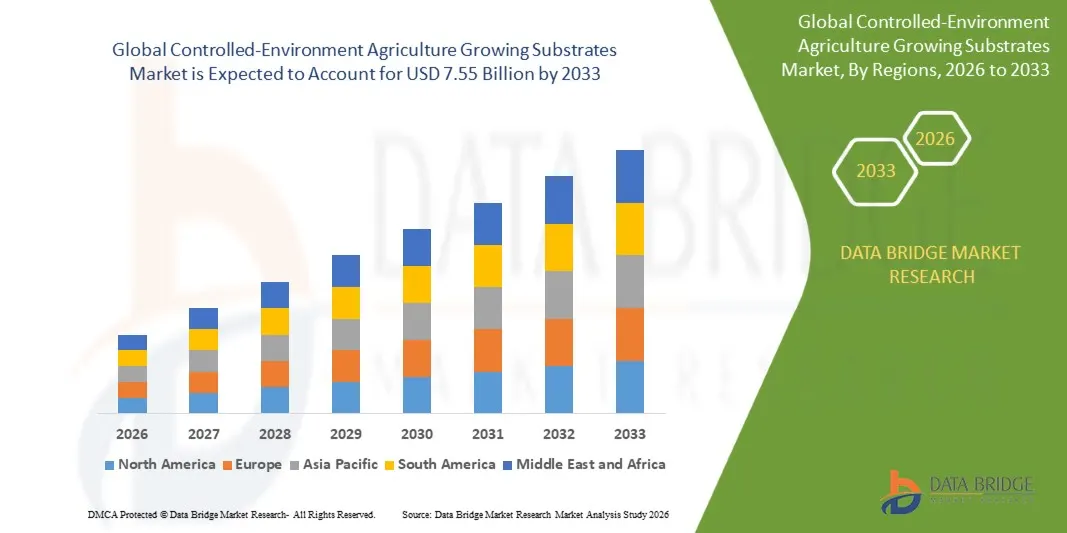
- As per Data Bridge Market Research analysis, the controlled-environment agriculture growing substrates market was valued at USD 3.60 billion in 2025 and is projected to reach USD 7.55 billion by 2033, growing at a CAGR of 9.7% from 2026 to 2033.
- The market is experiencing consistent growth driven by rising adoption of hydroponic and soilless cultivation, increasing peat-reduction initiatives, and expanding applications across greenhouse, vertical farming, nursery, research, and urban growing operations.
- The increasing shift toward water-efficient cultivation, year-round local production, and peat-reduced growing media, combined with growing investment in greenhouse and vertical farming capacity, is supporting market adoption. Growing substrates are being applied across commercial greenhouse vegetable production, hydroponic leafy greens, berries, propagation, and research facilities, offering growers precise water control, hygiene, and root-zone consistency across soilless cultivation systems.
Market Size & Forecast
- Global Market Value (2025): USD 3.60 Billion
- Expected Market Value (2033): USD 7.55 Billion
- Forecast CAGR (2026–2033): 9.7%
- Leading Region in 2025: Europe
- Fastest Growing Region: Asia-Pacific
What are the Major Takeaways of the Controlled-Environment Agriculture Growing Substrates Market?
- Europe dominated the controlled-environment agriculture growing substrates market with the largest revenue share of 38.20% in 2025, supported by extensive high-tech greenhouse production, established substrate suppliers, and strong peat-reduction initiatives across the region.
- Asia-Pacific is expected to be the fastest-growing region at a CAGR of 11.80% from 2026 to 2033, fueled by rapid greenhouse expansion, rising vertical farming investment, and strong government support for protected cultivation.
- The rockwool segment led the market with a 36.4% share in 2025, driven by extensive use in greenhouse tomato, cucumber, and pepper production.
- Coco coir is the fastest-growing product type, projected to register a CAGR of 12.1%, reflecting the surge in demand for renewable, peat-free substrates for hydroponic production.
- The slabs and mats segment dominated the form category with a 42.6% revenue share in 2025, led by extensive use in commercial greenhouse fruiting vegetable systems.
- Fruiting vegetables accounted for 44.8% of the market share in 2025, preferred by increasing greenhouse production of tomatoes, cucumbers, and peppers.
- The vertical farms segment is the fastest-growing end-user category, with a CAGR of 13.1%, driven by increasing urban indoor production.
Report Scope and Controlled-Environment Agriculture Growing Substrates Market Segmentation
|
Attributes |
Controlled-Environment Agriculture Growing Substrates Key Market Insights |
|
Segments Covered |
|
|
Countries Covered |
North America
Europe
Asia-Pacific
Middle East and Africa
South America
|
|
Key Market Players |
|
|
Market Opportunities |
|
|
Value Added Data Infosets |
In addition to the insights on market scenarios such as market value, growth rate, segmentation, geographical coverage, and major players, the market reports curated by the Data Bridge Market Research also include import export analysis, production capacity overview, production consumption analysis, price trend analysis, climate change scenario, supply chain analysis, value chain analysis, raw material/consumables overview, vendor selection criteria, PESTLE Analysis, Porter Analysis, and regulatory framework. |
What is the Key Trend in the Controlled-Environment Agriculture Growing Substrates Market?
- Growers and suppliers are increasingly shifting toward blended, peat-reduced substrates, combining coir, wood fiber, bark, compost, and newer renewable materials to balance performance, cost, hygiene, and supply security across controlled-environment production systems.
- For instance, in September 2025, according to Jiffy Group, blended substrates were becoming the new standard in professional horticulture, with growers combining peat, coir, wood fiber, and newer components, while the company worked on a renewable sugar-cane fibre raw material for future blends, noting that this approach offers flexibility across crops and reduces dependence on any single raw material.
- Circularity is gaining importance, with spent stone wool, coir, and peat-based media increasingly evaluated for reuse, composting, and soil amendment to reduce waste and disposal costs.
- Automation-ready propagation products, including plugs, blocks, and gel-based media, are being developed to support uniform rooting, hygiene, and food safety in vertical farms and greenhouses, while supporting compatibility with automated handling, irrigation, and fertigation systems.
- For instance, in August 2021, according to ILVO, Belgium imports about 800,000 cubic metres of peat per year, and Horti-BlueC trials showed a peat-free mixture could fully replace rockwool in tomato production without yield loss, while peat extraction is being restricted in more and more countries.
- As controlled-environment agriculture expands and peat availability tightens, growing substrates are expected to evolve beyond simple root-zone supports into engineered, circular, and data-driven inputs that enable sustainable, high-yield, year-round food production worldwide.
What are the Key Drivers of the Controlled-Environment Agriculture Growing Substrates Market?
- Rapid expansion of greenhouses, vertical farms, and hydroponic operations is increasing demand for clean, uniform substrates that improve water efficiency, disease control, and consistent crop yields.
- For instance, in August 2021, according to ILVO, global demand for cultivation substrates was expected to keep growing because good substrates improve water efficiency, help growers avoid plant diseases more precisely, and support vertical crops and urban cultivation systems, creating opportunities especially where sustainable raw materials are used.
- Restrictions on peat extraction and sustainability expectations are encouraging growers to adopt coir, wood fiber, compost, and other renewable alternatives, increasing demand for new substrate blends across greenhouse and indoor production.
- For instance, in July 2025, KRONEN Substrates introduced its K5 growing-media line using renewable raw materials, strengthening its sustainable substrate portfolio.
- With coir demand growing in hydroponic systems and soft fruit production, suppliers are expanding capacity and developing consistent, hygienic substrate formats for controlled-environment growers worldwide.
What Factors Are Challenging the Growth of the Controlled-Environment Agriculture Growing Substrates Market?
- Substrate supply depends on raw materials such as peat, coir, and stone wool, which face extraction limits, energy-intensive production, and logistics constraints that can affect availability and cost.
- For instance, in October 2025, according to Jiffy Group, tightening peat supply, fluctuating coir prices, and rising input costs were reshaping growing media decisions, with an industry report describing the ongoing historic peat shortage, while coir demand continued to rise in hydroponic systems and soft fruit production.
- Price volatility, uneven batch quality, and compatibility concerns when switching media can slow adoption, particularly among growers that need consistent irrigation, fertigation, and crop steering performance throughout long production cycles.
- End-of-life management of used substrates, including stone wool and mixed organic media, can increase operating costs and create regulatory and logistics challenges for greenhouse operators, especially when disposal is expensive and reuse options are limited.
- The combination of raw material shortages, volatile prices, disposal burdens, and the need for crop-specific testing can limit expansion among cost-sensitive growers, particularly where established substrates already meet production requirements or where crop-specific trials are costly.
How is the Controlled-Environment Agriculture Growing Substrates Market Segmented?
The controlled-environment agriculture growing substrates market is segmented on the basis of product, form, application, and end user.
- By Product
On the basis of product, the controlled-environment agriculture growing substrates market is segmented into rockwool, coco coir, peat-based, and others. The rockwool segment dominated the market with 36.4% share in 2025, supported by extensive use in greenhouse tomato, cucumber, and pepper production. Rockwool provides an inert, sterile, and uniform root zone that enables precise water and nutrient control. It is widely used across commercial greenhouses and propagation systems. Improvements in wetting behavior, density, and slab design are further strengthening demand. Integration with climate and irrigation systems also enables more precise crop steering across high-tech greenhouse operations.
The coco coir segment is projected to register the fastest growth at a CAGR of 12.1% from 2026 to 2033, driven by increasing demand for renewable, peat-free substrates. Coco coir offers good air-water balance, neutral pH, and strong suitability for hydroponic production. Its applications include berries, fruiting vegetables, herbs, and nursery crops. Increasing peat-reduction initiatives and demand for sustainable growing media are creating additional opportunities across growers, propagators, and retailers. Improvements in buffering, washing, and quality testing are enhancing consistency. Supply constraints and rising prices are also encouraging blended formulations. Coir demand is growing in hydroponic systems, soft fruit production, and peat-reduced blends, while growers increasingly evaluate cost-to-performance ratios and long-term availability when selecting products.
- By Form
On the basis of form, the controlled-environment agriculture growing substrates market is segmented into slabs & mats, blocks & plugs, and loose fill & granules. The slabs and mats segment dominated the market with 42.6% share in 2025, supported by extensive use in commercial greenhouse fruiting vegetable and berry systems. These formats offer a balanced combination of water holding capacity, drainage, and handling convenience for high-volume production. Their availability across multiple materials and suppliers expands the potential customer base. Greenhouse growers use slabs and mats to maintain uniform root-zone conditions across long crop cycles. The segment also benefits from established irrigation layouts and planting practices.
The blocks & plugs segment is projected to register the fastest growth at a CAGR of 11.4% from 2026 to 2033, supported by increasing adoption of automated propagation, vertical farming, and high-density seedling production. Uniform plugs and blocks improve germination, rooting consistency, and handling in mechanized systems. Propagators are increasingly specifying hygienic, ready-to-use formats for leafy greens, herbs, and transplants. Growers and suppliers are developing products that fit automated transplanting and ebb-and-flow or hydroponic lines. Improved material blends and shape designs further strengthen the segment’s attractiveness. Strict hygiene and quality requirements remain important considerations for expansion.
- By Application
On the basis of application, the controlled-environment agriculture growing substrates market is segmented into fruiting vegetables, berries, leafy greens & herbs, and others. The fruiting vegetables segment dominated the application category with 44.8% share in 2025, supported by increasing greenhouse production of tomatoes, cucumbers, and peppers. Substrates enable accurate irrigation, nutrient control, and long crop cycles. Efficiency and sustainability goals are increasing the use of improved substrate formats. Growth in high-tech greenhouse capacity further strengthens demand. Growers are also seeking materials that combine consistent hydration, hygiene, and compatibility with automation. Tomatoes, cucumbers, and peppers require stable root-zone conditions across long crop cycles, and improved slab and block formats are helping growers manage crop steering and plant health.
The leafy greens & herbs segment is projected to register the fastest growth at a CAGR of 11.6% from 2026 to 2033, driven by increasing indoor and vertical farm production, short crop cycles, and demand for locally grown produce. Compact substrates support rapid germination, uniform growth, and reliable harvest scheduling. Urban producers in Europe, Asia-Pacific, and North America are investing in hydroponic modules and propagation systems. Retail and foodservice demand for fresh herbs and salads is creating additional opportunities. Strict food safety requirements make clean, consistent substrates particularly important. Supportive policies for local food production can further improve project visibility across regions.
- By End User
On the basis of end user, the controlled-environment agriculture growing substrates market is segmented into commercial greenhouse growers, vertical farms, nurseries & propagators, research institutions, and others. The commercial greenhouse growers segment dominated the end-user category with 58.7% share in 2025, supported by increasing requirements for consistent, high-volume substrate supply. Greenhouse operators rely on substrates to improve water efficiency, hygiene, and crop uniformity. The segment uses rockwool, coir, and blended media for vegetables, berries, and flowers. Increasing investment in high-tech greenhouses and energy-efficient facilities is creating further opportunities. Long production cycles also make reliable substrate supply an important consideration in procurement decisions.
The vertical farms segment is projected to register the fastest growth at CAGR of 13.1% from 2026 to 2033, driven by increasing urban indoor production, rising demand for local produce, and expanding automation. Vertical farms require clean, lightweight, uniform substrates that support high-density cultivation and efficient water use. Operators and equipment suppliers are expanding hydroponic racks, propagation rooms, and automated handling lines. Closer collaboration with substrate suppliers is accelerating development of tailored plugs, mats, and gel-based products. Concerns about food safety are further supporting adoption. Cost competitiveness, energy use, and supply reliability remain important considerations for deployment.
Which Region Holds the Largest Share of the Controlled-Environment Agriculture Growing Substrates Market?
- Europe dominated the controlled-environment agriculture growing substrates market with the largest revenue share of 38.20% in 2025, supported by extensive high-tech greenhouse production, established substrate suppliers, and strong peat-reduction initiatives across the region.
- The region also benefits from advanced greenhouse technology, strong research institutions, and the presence of established substrate producers, along with growing demand for peat-reduced and circular growing media. Increasing investment in energy-efficient greenhouses, sustainability programs, and local food production continues to strengthen Europe’s position in the global market, supported by strong grower knowledge and technical advisory networks.
Germany Controlled-Environment Agriculture Growing Substrates Market Insight
Germany’s controlled-environment agriculture growing substrates market is expanding as greenhouse cultivation, vertical farming, and hydroponic production gain momentum. Demand for sustainable, high-performance substrates, including coco coir, peat alternatives, rockwool, and organic growing media, is increasing. Growers prioritize water efficiency, nutrient management, consistent crop yields, and reduced environmental impact. Government sustainability initiatives and technological advancements support market development, while rising input costs, peat-reduction policies, and resource constraints encourage innovation and adoption of alternative substrate solutions.
France Controlled-Environment Agriculture Growing Substrates Market Insight
France’s controlled-environment agriculture growing substrates market is gaining traction as greenhouse horticulture, vertical farming, and hydroponic cultivation expand. Demand for rockwool, coco coir, peat-based media, and sustainable alternatives is rising as growers seek improved water efficiency, nutrient delivery, and crop productivity. Environmental regulations and peat-reduction initiatives encourage the adoption of renewable substrates. Technological advancements, urban farming investments, and increasing demand for locally grown produce are expected to support market growth, despite cost pressures and resource constraints.
Asia-Pacific Controlled-Environment Agriculture Growing Substrates Market Insight
The Asia-Pacific controlled-environment agriculture growing substrates market is expected to witness rapid growth, driven by expanding greenhouse capacity, rising vertical farming investment, and increasing government support for protected cultivation across countries such as China, Japan, South Korea, and India. Growing demand for fresh produce, water-efficient farming, and local food security is supporting regional market expansion. In addition, the region’s strong access to coir and rice-based by-products and increasing adoption of hydroponics are accelerating demand for substrates across commercial and research facilities.
China Controlled-Environment Agriculture Growing Substrates Market Insight
The China controlled-environment agriculture growing substrates market is experiencing steady growth, supported by increasing greenhouse construction, plant factory development, and modernization of vegetable production. Greenhouse operators, research institutes, and agricultural technology firms are increasingly seeking reliable substrate supply. Furthermore, growing investment in protected agriculture, local food security, and efficient resource use is supporting wider adoption of soilless substrates in China, supported by rising consumer demand for safe, fresh produce and stronger agricultural technology capabilities across provinces.
Japan Controlled-Environment Agriculture Growing Substrates Market Insight
The Japan controlled-environment agriculture growing substrates market is expanding steadily due to the country’s advanced plant factory sector, labor constraints, and strong demand for consistent, high-quality produce. Plant factories, greenhouse growers, and food companies are increasingly utilizing hydroponic systems that rely on clean, uniform substrates. Continuous advancements in automation, indoor cultivation, and propagation technologies, along with Japan’s focus on food safety and quality, are further driving market growth in the country, supported by strong technology partnerships.
Which are the Top Companies in Controlled-Environment Agriculture Growing Substrates Market?
The controlled-environment agriculture growing substrates industry is primarily led by well-established companies, including:
- ROCKWOOL A/S (Grodan) (Denmark)
- Jiffy Group (Netherlands)
- Klasmann-Deilmann GmbH (Germany)
- Sun Gro Horticulture (Canada)
- The Scotts Miracle-Gro Company (U.S.)
- Hydrofarm Holdings Group, Inc. (U.S.)
- Saint-Gobain Cultilene (Netherlands)
- Kekkilä-BVB (Finland)
- Berger (Canada)
- Premier Tech Horticulture (Canada)
- Pindstrup Mosebrug A/S (Denmark)
- Imerys S.A. (France)
- Dicalite Management Group (U.S.)
- Smithers-Oasis Company (U.S.)
- CANNA (Netherlands)
- Plagron (Netherlands)
- Lambert Peat Moss Inc. (Canada)
- FoxFarm Soil & Fertilizer Company (U.S.)
- Biolan Oy (Finland)
- TREF Group (Netherlands)
What are Latest Developments in Controlled-Environment Agriculture Growing Substrates Market?
- In October 2026, Grodan invited growers, researchers, and industry experts to a workshop at Vineland Research and Innovation Centre on 5 October 2026 to discuss reuse pathways for spent greenhouse growing media in field production, including active trials evaluating spent stone wool as a soil amendment, as part of efforts to build circular solutions for greenhouse substrate waste.
- In July 2025, KRONEN Substrates introduced its K5 growing-media line using renewable raw materials, strengthening its sustainable substrate portfolio.
- In October 2025, Jiffy Group highlighted new materials for controlled-environment agriculture, including Jiffy Gel for clean, consistent rooting in automated propagation systems, a renewable raw material derived from sugar-cane fibre for future substrate blends, and research with Concert Bio on beneficial microbes in soilless growing systems, aimed at improving hygiene, food safety, and compatibility with high-tech propagation workflows.
- In February 2026, Klasmann-Deilmann advanced peat-reduced growing substrates incorporating wood fiber and TerraCoal biochar to improve water retention and nutrient management.
- In September 2025, Jiffy Group reported that an industry report from the Dutch Association of Potting Soil and Substrate Producers described the historic peat shortage as ongoing, creating supply chain uncertainty and pushing growers to evaluate coir, wood fiber, and other peat alternatives in blended substrates, with peat expected to remain in the mix at reduced levels.
- In August 2021, the Horti-BlueC project led by ILVO and Proefcentrum Hoogstraten reported that tomato and strawberry yields were maintained when rockwool and part of the peat were replaced with mixtures containing coconut fibre, wood fibre, bark, green compost, biochar, and chitin, with partners concluding that circular alternatives can replace rockwool and part of the peat without loss of tomatoes or strawberries.

- Interactive Data Analysis Dashboard
- Company Analysis Dashboard for high growth potential opportunities
- Research Analyst Access for customization & queries
- Competitor Analysis with Interactive dashboard
- Latest News, Updates & Trend analysis
- Harness the Power of Benchmark Analysis for Comprehensive Competitor Tracking
Data collection and base year analysis are done using data collection modules with large sample sizes. The stage includes obtaining market information or related data through various sources and strategies. It includes examining and planning all the data acquired from the past in advance. It likewise envelops the examination of information inconsistencies seen across different information sources. The market data is analysed and estimated using market statistical and coherent models. Also, market share analysis and key trend analysis are the major success factors in the market report. To know more, please request an analyst call or drop down your inquiry.
The key research methodology used by DBMR research team is data triangulation which involves data mining, analysis of the impact of data variables on the market and primary (industry expert) validation. Data models include Vendor Positioning Grid, Market Time Line Analysis, Market Overview and Guide, Company Positioning Grid, Patent Analysis, Pricing Analysis, Company Market Share Analysis, Standards of Measurement, Global versus Regional and Vendor Share Analysis. To know more about the research methodology, drop in an inquiry to speak to our industry experts.
Data Bridge Market Research is a leader in advanced formative research. We take pride in servicing our existing and new customers with data and analysis that match and suits their goal. The report can be customized to include price trend analysis of target brands understanding the market for additional countries (ask for the list of countries), clinical trial results data, literature review, refurbished market and product base analysis. Market analysis of target competitors can be analyzed from technology-based analysis to market portfolio strategies. We can add as many competitors that you require data about in the format and data style you are looking for. Our team of analysts can also provide you data in crude raw excel files pivot tables (Fact book) or can assist you in creating presentations from the data sets available in the report.