What is the Controlled Food Packaging Technology Market Size and Growth Rate?
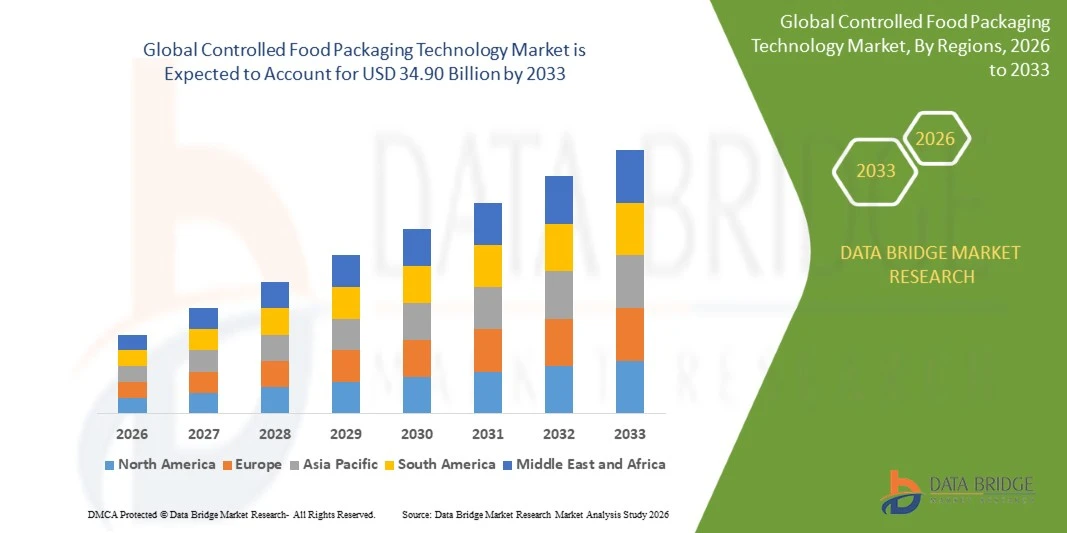
- As per Data Bridge Market Research analysis, the controlled food packaging technology market was valued at USD 18.17 billion in 2025 and is projected to reach USD 34.90 billion by 2033, growing at a CAGR of 8.50% from 2026 to 2033.
- The market is experiencing consistent growth driven by rising demand for fresh and minimally processed foods, increasing focus on food waste reduction, and expanding adoption of modified atmosphere, vacuum, and active packaging across retail and foodservice channels.
- The increasing shift toward longer shelf life without preservatives, safer food-contact materials, and recyclable packaging formats, combined with growing investment in automated packaging lines and traceability, is supporting market adoption. Controlled packaging is being applied across meat, dairy, bakery, and fresh produce, offering producers greater control over oxygen, carbon dioxide, and moisture through controlled food packaging, food packaging equipment, and active and intelligent packaging solutions.
Market Size & Forecast
- Global Market Value (2025): USD 18.17 Billion
- Expected Market Value (2033): USD 34.90 Billion
- Forecast CAGR (2026–2033): 8.50%
What are the Major Takeaways of the Controlled Food Packaging Technology Market?
- North America dominated the controlled food packaging technology market with the largest revenue share of 34.80% in 2025, supported by a large processed and fresh meat industry, advanced retail cold chains, and strong food safety standards.
- Asia-Pacific is expected to be the fastest-growing region at a CAGR of 10.20% from 2026 to 2033, fueled by rising packaged food consumption, expanding modern retail, and growing investment in food processing and cold chains.
- The plastics segment led the market with a 56.40% share in 2025, driven by excellent gas barrier performance, flexibility, and low cost across films, trays, and pouches.
- Paper & paperboard is the fastest-growing material, projected to register a CAGR of 9.60%, reflecting rising demand for recyclable, fiber-based, and PFAS-free food packaging.
- The form-fill-seal segment dominated the equipment category with a 31.80% revenue share in 2025, led by high-speed automation and compatibility with modified atmosphere systems.
- Meat, poultry & seafood accounted for 37.50% of the market share in 2025, preferred for strict shelf life, color retention, and contamination control needs.
- The fruits & vegetables segment is the fastest-growing application, with a CAGR of 10.40%, driven by fresh-cut produce demand, food waste reduction, and respiration-controlled film technologies.
Report Scope and Controlled Food Packaging Technology Market Segmentation
|
Attributes |
Controlled Food Packaging Technology Key Market Insights |
|
Segments Covered |
|
|
Countries Covered |
North America
Europe
Asia-Pacific
Middle East and Africa
South America
|
|
Key Market Players |
|
|
Market Opportunities |
|
|
Value Added Data Infosets |
In addition to the insights on market scenarios such as market value, growth rate, segmentation, geographical coverage, and major players, the market reports curated by the Data Bridge Market Research also include in-depth expert analysis, pricing analysis, brand share analysis, consumer survey, demography analysis, supply chain analysis, value chain analysis, raw material/consumables overview, vendor selection criteria, PESTLE Analysis, Porter Analysis, and regulatory framework. |
What is the Key Trend in the Controlled Food Packaging Technology Market?
- Controlled food packaging is increasingly evolving from simple gas flushing into integrated freshness systems, combining modified atmosphere, active absorbers, intelligent indicators, and recyclable mono-material structures that protect quality across longer supply chains.
- For instance, in March 2025, Freshr Technologies received funding support from the Atlantic Canada Opportunities Agency to scale its naturally derived antibacterial coating for compostable food packaging films, targeting longer shelf life and reduced food waste, particularly in seafood packaging.
- Sustainability is reshaping material choices, as brands move from multilayer laminates to mono-material films and fiber-based trays that keep gas barrier performance while meeting recyclability goals and chemical safety rules.
- Packers are increasingly investing in automated lines and inspection systems, as buyers compare technologies on seal integrity, line speed, gas consumption, traceability, and compatibility with recyclable materials across fresh and processed food categories.
- For instance, in April 2023, SUPAC Innovation Corp., a Vancouver-based company, develops oxygen-scavenger and ethylene-absorber sachets to protect packaged food and fresh produce from quality deterioration, supporting freshness preservation and food-waste reduction.
- As food waste reduction, recyclability rules, automation, and digital traceability continue to advance, controlled food packaging technology is expected to expand beyond meat and produce into ready meals, bakery, dairy, and e-commerce food delivery.
What are the Key Drivers of the Controlled Food Packaging Technology Market?
- The rapid growth of fresh, chilled, and ready-to-eat foods has significantly increased demand for packaging that preserves quality and safety over longer distribution times without adding preservatives.
- For instance, in February 2025, according to the German Federal Ministry for the Environment, the EU Packaging and Packaging Waste Regulation entered into force on 11 February 2025, requiring packaging to be recyclable and plastic packaging to contain recycled content, which is pushing producers toward redesigned, compliant packaging systems.
- Meat processors, dairy producers, bakeries, produce packers, and retailers are adopting controlled packaging to reduce spoilage, extend sell-by dates, support centralized distribution, and meet customer expectations for freshness.
- For instance, in October 2024, Amcor launched a new line of recyclable active packaging films for fresh produce with enhanced oxygen barrier and moisture control, illustrating the link between preservation performance and sustainability and the demand from retailers for recyclable solutions.
- With retailers expanding centralized packing, e-commerce grocery, and private-label fresh ranges, controlled food packaging technology can gain wider visibility, adoption, and repeat equipment and material orders across the food supply chain.
What Factors Are Challenging the Growth of the Controlled Food Packaging Technology Market?
- Controlled packaging systems require specialized equipment, high-barrier materials, and gas supply, which raise capital and operating costs, especially for small food producers.
- These costs can slow adoption among small and mid-sized processors, while the need for trained operators, line changeovers, and ongoing quality testing may limit return on investment in low-margin food categories.
- Complex regulations on active agents, migration limits, and recyclability further restrict growth, requiring suppliers to invest in testing, redesign, and certification that may increase development and compliance costs.
- For instance, in August 2026, according to the European Commission, food-contact packaging containing PFAS above set limits can no longer be placed on the EU market from 12 August 2026, and industry guidance notes that there is no general stock-exhaustion period, forcing rapid reformulation, testing, and supply chain changes for coated papers and barrier materials.
- The combination of high equipment and material costs, regulatory change, sustainability trade-offs between barrier performance and recyclability, and limited technical skills can constrain adoption among cost-sensitive producers and smaller brands.
How is the Controlled Food Packaging Technology Market Segmented?
The controlled food packaging technology market is segmented on the basis of material, equipment, application, and technology.
- By Material
On the basis of material, the controlled food packaging technology market is segmented into plastics, paper & paperboard, metal, glass, and others. The plastics segment dominated the market with 56.40% share in 2025, supported by excellent gas barrier performance, flexibility, and low cost across films, trays, and pouches. Multilayer and coextruded films allow precise control of oxygen and moisture transmission. Plastics are lightweight and easy to seal on high-speed machines. Their compatibility with modified atmosphere and vacuum systems strengthens demand. Growing mono-material and recycled-content options are helping the segment address sustainability concerns while maintaining its leadership.
The paper & paperboard segment is projected to register the fastest growth at a CAGR of 9.60% from 2026 to 2033, driven by increasing demand for recyclable, fiber-based, and PFAS-free food packaging. Retailers and brands are replacing plastic trays and wraps with paper-based alternatives that include thin barrier coatings. Regulatory pressure on chemicals in food-contact materials is encouraging safer designs. Paper-based trays with sealed lidding films are gaining use for fresh and chilled foods. Improvements in barrier coatings and forming technology are enhancing performance, while consumer preference for natural materials supports adoption. Investments by paper producers in food-grade barrier lines are also widening supply.
- By Equipment
On the basis of equipment, the controlled food packaging technology market is segmented into form-fill-seal, filling & dosing, cartoning & case packaging, wrapping & bundling, and labelling & coding. The form-fill-seal segment dominated the market with 31.80% share in 2025, supported by high-speed automation, flexible format changes, and compatibility with gas flushing and vacuum systems. Machines form pouches or trays, fill the product, and seal under controlled atmosphere in one line. They reduce labor and improve hygiene. Integration with inspection and leak detection supports quality assurance. Continuous improvements in speed, energy use, and film handling further strengthen its leadership.
The labelling & coding segment is projected to register the fastest growth at a CAGR of 9.80% from 2026 to 2033, driven by rising traceability, date marking, and regulatory labeling requirements. Digital printing, laser coding, and vision inspection support accurate lot tracking and recalls. Retailers increasingly demand barcodes, QR codes, and time-temperature information. Intelligent labels and freshness indicators are creating additional opportunities. Integration with factory software and cloud platforms is improving data use. Rapid growth of private-label and e-commerce food lines also increases the number of packaging formats that must be coded accurately and reliably.
- By Application
On the basis of application, the controlled food packaging technology market is segmented into dairy products, bakery & confectionery, meat, poultry & seafood, fruits & vegetables, and others. The meat, poultry & seafood segment dominated the application category with 37.50% share in 2025, supported by strict shelf life needs, color retention, and contamination control. Modified atmosphere and vacuum packs extend chilled life and reduce waste. Centralized processing and long distribution routes require reliable protection. Established use by large meat packers and retailers continues to reinforce this segment's leadership, while growth in case-ready meat adds volume.
The fruits & vegetables segment is projected to register the fastest growth at a CAGR of 10.40% from 2026 to 2033, driven by growing demand for fresh-cut produce, salads, and ready-to-eat vegetable products. Respiration-controlled films and microperforated packs help balance oxygen and carbon dioxide. Food waste reduction goals are encouraging retailers to adopt shelf life extension. Active sachets and absorbers manage ethylene and moisture. Recyclable mono-material films are increasingly used for produce packs. Growers and packers are also investing in controlled packing for export routes where transit times are long and quality losses are costly.
- By Technology
On the basis of technology, the controlled food packaging technology market is segmented into modified atmosphere packaging, vacuum packaging, and active & intelligent packaging. The modified atmosphere packaging segment dominated the market with 45.20% share in 2025, supported by its ability to extend chilled shelf life without preservatives. Gas mixtures of oxygen, carbon dioxide, and nitrogen slow spoilage and maintain color and texture. The technology is widely used for meat, poultry, seafood, fresh produce, and bakery. Compatibility with standard trays and films keeps costs manageable. Established supply of gases and equipment continues to reinforce this segment's leadership.
The active & intelligent packaging segment is projected to register the fastest growth at a CAGR of 11.30% from 2026 to 2033, supported by rising demand for oxygen scavengers, antimicrobial films, freshness indicators, and time-temperature labels. These systems actively regulate or monitor conditions inside the pack. Retailers and brands use them to reduce waste and improve safety. Advances in sensors and printed electronics are lowering costs. Regulatory approvals and consumer acceptance remain important considerations for wider adoption. Pilot programs with large retailers are testing connected labels that share freshness data across the cold chain.
Which Region Holds the Largest Share of the Controlled Food Packaging Technology Market?
- North America dominated the controlled food packaging technology market with the largest revenue share of 34.80% in 2025, supported by a large processed and fresh meat industry, advanced retail cold chains, and strong food safety standards.
- The region also benefits from a mature retail landscape, high consumption of packaged and chilled foods, and the presence of leading packaging materials and equipment suppliers. Increasing focus on food waste reduction, recyclable packaging, and automation continues to strengthen North America’s position in the global market.
U.S. Controlled Food Packaging Technology Market Insight
The U.S. controlled food packaging technology market is witnessing steady growth due to a large meat, poultry, and dairy industry, strong retail cold chains, and high demand for convenient fresh foods. The country’s major packaging manufacturers, along with increasing automation in food plants, are driving demand for modified atmosphere and vacuum systems. In addition, growing sustainability commitments, retailer requirements, labor shortages, and e-commerce grocery growth are accelerating adoption across processors and brands.
Canada Controlled Food Packaging Technology Market Insight
The Canada controlled food packaging technology market is experiencing growth driven by rising demand for food safety, extended shelf life, and reduced food waste. Increasing adoption of modified atmosphere packaging, active packaging, and intelligent monitoring systems is transforming food preservation practices. Stringent food safety regulations and growing consumer preference for fresh, minimally processed products further support market expansion. Technological advancements, sustainability initiatives, and investments in smart packaging solutions are creating significant opportunities for manufacturers across Canada.
Asia-Pacific Controlled Food Packaging Technology Market Insight
The Asia-Pacific controlled food packaging technology market is expected to witness rapid growth, driven by rising packaged food consumption, expanding modern retail, and increasing investment in food processing across countries such as China, India, and Japan. Growing demand for fresh meat, seafood, and ready meals is supporting regional market expansion. In addition, the region’s growing cold chain infrastructure, rising food safety awareness, large packaging manufacturing base, and expanding middle class are accelerating availability and adoption.
Japan Controlled Food Packaging Technology Market Insight
The Japan controlled food packaging technology market is witnessing consistent growth due to high food quality expectations, strong convenience store culture, and advanced packaging engineering. Food manufacturers and retailers are increasingly adopting oxygen absorbers, gas-flush packs, and precise sealing technology. Moreover, strong demand for freshness, portion packs, and innovative packaging materials, along with efforts to reduce food loss, is further contributing to market growth in Japan.
China Controlled Food Packaging Technology Market Insight
The China controlled food packaging technology market is growing rapidly, driven by expanding food processing, rising e-commerce food sales, and increasing demand for fresh and chilled products. Growing investment in cold chain logistics is significantly boosting market demand. In addition, strong domestic packaging machinery makers, rising food safety regulation, large retail chains, and growing demand for premium packaged foods are positioning China as a key growth market for controlled packaging across Asia-Pacific.
Which are the Top Companies in Controlled Food Packaging Technology Market?
The controlled food packaging technology industry is primarily led by well-established companies, including:
- Amcor plc (Switzerland)
- Sealed Air Corporation (U.S.)
- Mondi Group (U.K.)
- Tetra Pak International S.A. (Switzerland)
- Huhtamäki Oyj (Finland)
- Sonoco Products Company (U.S.)
- Constantia Flexibles Group GmbH (Austria)
- Coveris Holdings S.A. (Austria)
- MULTIVAC Group (Germany)
- Winpak Ltd. (Canada)
- ProAmpac LLC (U.S.)
- StePac Ltd. (Israel)
- Multisorb Technologies, Inc. (U.S.)
- Toyo Seikan Group Holdings, Ltd. (Japan)
- Crown Holdings, Inc. (U.S.)
- Graphic Packaging International, LLC (U.S.)
- Smurfit Westrock plc (Ireland)
- Bosch Packaging Technology (Germany)
- Coesia S.p.A. (Italy)
- GEA Group AG (Germany)
What are Latest Developments in Controlled Food Packaging Technology Market?
- In August 2026, the EU Packaging and Packaging Waste Regulation started to apply across all member states, introducing limits on PFAS in food-contact packaging, mandatory conformity declarations, and recyclability requirements. The rules are prompting food producers and packaging suppliers to redesign barrier materials and coatings used in controlled packaging, and to review testing and documentation.
- In April 2025, Amcor completed its merger with Berry Global, creating a larger global packaging group with a broader portfolio of flexible and rigid food packaging solutions. The combination is expected to support innovation in barrier films, recyclable structures, and preservation technologies for fresh and processed food, while expanding the group’s scale in modified atmosphere and vacuum packaging.
- In February 2025, the EU Packaging and Packaging Waste Regulation, Regulation (EU) 2025/40, entered into force, replacing the earlier packaging directive with directly applicable rules. The regulation sets requirements for recyclability, recycled content, labelling, and chemical safety that affect controlled food packaging materials and equipment, and gives companies until August 2026 to prepare for the first obligations.
- In October 2024, Amcor launched a new line of recyclable active packaging films for fresh produce, featuring enhanced oxygen barrier properties and moisture control. The films are designed to extend freshness while meeting retailer recyclability goals, supporting the shift to sustainable preservation technologies, and responding to demand from produce suppliers for lower food waste.
- In December 2022, Mondi collaborated with FRESH!PACKING to launch the Fresh!Bag, a recyclable kraft paper cooler bag made from renewable materials. The product addresses growing demand for sustainable food packaging for chilled and fresh delivery, and reflects the move toward fiber-based solutions, particularly for meal kits and online grocery.
- Interactive Data Analysis Dashboard
- Company Analysis Dashboard for high growth potential opportunities
- Research Analyst Access for customization & queries
- Competitor Analysis with Interactive dashboard
- Latest News, Updates & Trend analysis
- Harness the Power of Benchmark Analysis for Comprehensive Competitor Tracking
Global Controlled Food Packaging Technology Market, Supply Chain Analysis and Ecosystem Framework
To support market growth and help clients navigate the impact of geopolitical shifts, DBMR has integrated in-depth supply chain analysis into its Global Controlled Food Packaging Technology Market research reports. This addition empowers clients to respond effectively to global changes affecting their industries. The supply chain analysis section includes detailed insights such as Global Controlled Food Packaging Technology Market consumption and production by country, price trend analysis, the impact of tariffs and geopolitical developments, and import and export trends by country and HSN code. It also highlights major suppliers with data on production capacity and company profiles, as well as key importers and exporters. In addition to research, DBMR offers specialized supply chain consulting services backed by over a decade of experience, providing solutions like supplier discovery, supplier risk assessment, price trend analysis, impact evaluation of inflation and trade route changes, and comprehensive market trend analysis.
Data collection and base year analysis are done using data collection modules with large sample sizes. The stage includes obtaining market information or related data through various sources and strategies. It includes examining and planning all the data acquired from the past in advance. It likewise envelops the examination of information inconsistencies seen across different information sources. The market data is analysed and estimated using market statistical and coherent models. Also, market share analysis and key trend analysis are the major success factors in the market report. To know more, please request an analyst call or drop down your inquiry.
The key research methodology used by DBMR research team is data triangulation which involves data mining, analysis of the impact of data variables on the market and primary (industry expert) validation. Data models include Vendor Positioning Grid, Market Time Line Analysis, Market Overview and Guide, Company Positioning Grid, Patent Analysis, Pricing Analysis, Company Market Share Analysis, Standards of Measurement, Global versus Regional and Vendor Share Analysis. To know more about the research methodology, drop in an inquiry to speak to our industry experts.
Data Bridge Market Research is a leader in advanced formative research. We take pride in servicing our existing and new customers with data and analysis that match and suits their goal. The report can be customized to include price trend analysis of target brands understanding the market for additional countries (ask for the list of countries), clinical trial results data, literature review, refurbished market and product base analysis. Market analysis of target competitors can be analyzed from technology-based analysis to market portfolio strategies. We can add as many competitors that you require data about in the format and data style you are looking for. Our team of analysts can also provide you data in crude raw excel files pivot tables (Fact book) or can assist you in creating presentations from the data sets available in the report.