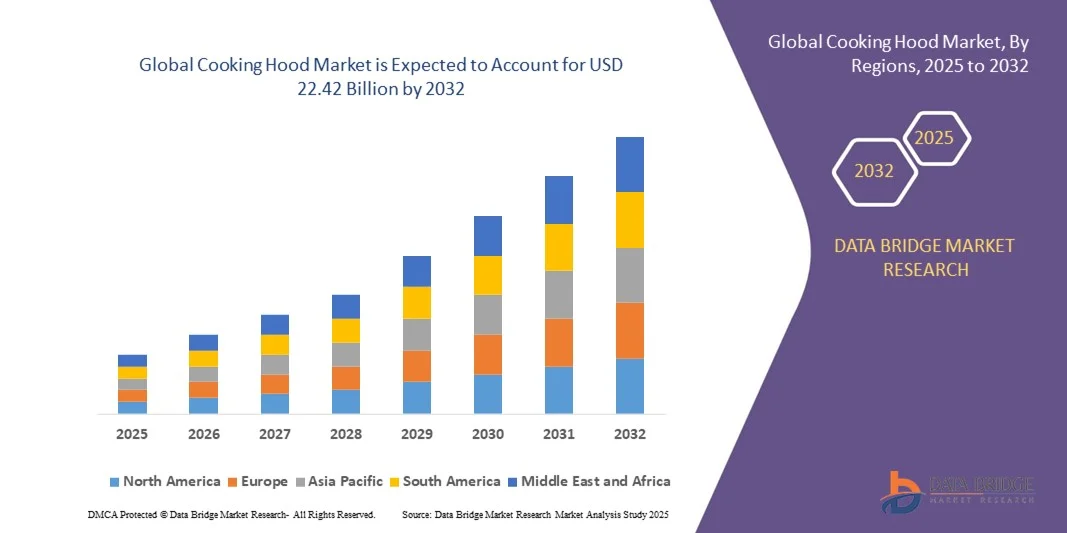
Cooking Hood Market Size
- The global cooking hood market size was valued at USD 13.03 billion in 2024 and is expected to reach USD 22.42 billion by 2032, at a CAGR of 8.7% during the forecast period
- The market growth is largely fueled by the increasing focus on modern kitchen designs, rising awareness of indoor air quality, and the adoption of energy-efficient and smart kitchen appliances in both residential and commercial settings
- Furthermore, growing consumer demand for low-noise, aesthetically appealing, and technologically advanced cooking hoods is establishing them as essential kitchen appliances. These converging factors are accelerating the adoption of high-performance and smart-enabled hoods, thereby significantly boosting the industry's growth
Cooking Hood Market Analysis
- Cooking hoods are kitchen appliances designed to remove smoke, grease, odors, and airborne particles from cooking areas. They come in various types such as wall-mounted, ceiling-mounted, under-cabinet, and downdraft, with features ranging from high suction power to low noise operation and smart connectivity
- The escalating demand for cooking hoods is primarily fueled by increasing urbanization, rising disposable incomes, the growing trend of modular and smart kitchens, and heightened consumer awareness of health, hygiene, and indoor air quality
- North America dominated cooking hood market with a share of 35.7% in 2024, due to rising demand for modern kitchens, home renovation activities, and increasing awareness of kitchen ventilation solutions
- Asia-Pacific is expected to be the fastest growing region in the cooking hood market during the forecast period due to rapid urbanization, rising disposable incomes, and increased awareness of indoor air quality in countries such as China, Japan, and India
- Wall mounted hoods segment dominated the market with a market share of 45.5% in 2024, due to its widespread adoption in residential kitchens and ease of installation against walls. These hoods are highly preferred for their efficient extraction of smoke and cooking fumes, as well as compatibility with most kitchen layouts. In addition, the segment benefits from technological advancements such as touch controls, LED lighting, and smart connectivity options that enhance user convenience and kitchen aesthetics. Manufacturers are increasingly focusing on energy-efficient and low-noise wall-mounted hoods, further driving their market dominance
Report Scope and Cooking Hood Market Segmentation
|
Attributes |
Cooking Hood Key Market Insights |
|
Segments Covered |
|
|
Countries Covered |
North America
Europe
Asia-Pacific
Middle East and Africa
South America
|
|
Key Market Players |
|
|
Market Opportunities |
|
|
Value Added Data Infosets |
In addition to the insights on market scenarios such as market value, growth rate, segmentation, geographical coverage, and major players, the market reports curated by the Data Bridge Market Research also include in-depth expert analysis, pricing analysis, brand share analysis, consumer survey, demography analysis, supply chain analysis, value chain analysis, raw material/consumables overview, vendor selection criteria, PESTLE Analysis, Porter Analysis, and regulatory framework. |
Cooking Hood Market Trends
Adoption of Smart, IoT-Enabled Cooking Hoods
- The cooking hood market is experiencing a growing trend toward smart and IoT-enabled models as modern consumers demand connectivity, automation, and convenience in kitchen appliances. These advanced cooking hoods integrate with smart ecosystems to improve air quality monitoring, reduce manual operation, and enhance user experience
- For instance, Bosch has introduced smart cooking hoods compatible with its Home Connect platform, allowing users to control ventilation via smartphones, while Samsung offers IoT-enabled hoods that synchronize automatically with cooktops to adjust suction levels. These innovations highlight the industry’s shift toward connectivity-driven appliances
- IoT-enabled cooking hoods provide real-time air quality insights, helping users maintain healthy indoor environments by monitoring smoke, grease, and particulate levels. Automated functions such as auto-start, self-adjusting suction, and remote operation enable precision performance with minimal user intervention
- In addition, integration with voice assistants such as Amazon Alexa and Google Assistant allows users to control cooking hoods hands-free, offering greater convenience in busy kitchen environments. This reflects consumer preference for multifunctional appliances that blend connectivity with practicality
- Smart hoods also align with broader sustainability and energy management initiatives by offering optimized ventilation settings and reduced energy consumption. These capabilities make them attractive to eco-conscious households and spur adoption in modern urban kitchens
- The adoption of smart, IoT-enabled hoods represents a turning point in the appliance market. By combining technology with functionality, manufacturers are setting new standards for convenience, efficiency, and design, ensuring connected cooking hoods become central to future smart kitchen ecosystems
Cooking Hood Market Dynamics
Driver
Demand for Energy-Efficient, Low-Noise, Stylish Hoods
- The rising demand for energy-efficient, low-noise, and stylish cooking hoods is a major driver shaping market growth as consumers value both performance and aesthetics in kitchen appliances. With energy savings and comfort becoming household priorities, modern cooking hoods are being designed to address these needs effectively
- For instance, Electrolux has developed energy-efficient hoods equipped with noise reduction technology, while Elica’s designer range of stylish hoods integrates energy efficiency with aesthetic appeal. These product launches showcase how companies are combining design, performance, and sustainability to capture consumer demand
- Energy-efficient cooking hoods consume less power while delivering superior suction, allowing households to manage electricity consumption without compromising ventilation quality. Noise reduction technologies further improve consumer comfort, making hoods suitable for open kitchens and compact apartments
- In addition, stylish hood designs that use premium finishes, sleek profiles, and integrated lighting systems contribute to kitchen aesthetics. This dual functionality addresses both performance and interior design, positioning hoods as lifestyle products rather than basic kitchen devices
- The convergence of efficiency, quiet operation, and style ensures greater acceptance of cooking hoods across multiple consumer segments. As the industry continues to promote eco-friendly, functional, and aesthetically appealing appliances, these factors will remain pivotal in driving long-term market growth
Restraint/Challenge
High Cost Limiting Adoption
- The high upfront cost of advanced cooking hoods poses a significant challenge to market adoption, particularly in price-sensitive households and emerging regions. Smart, energy-efficient, or designer models often demand premium pricing compared to conventional ventilation units, restricting accessibility
- For instance, premium hoods from brands such as Faber and Miele offer advanced IoT features, designer finishes, and high suction capacity but are priced considerably higher, limiting their adoption in developing markets. This cost disparity creates a challenge in reaching a broader consumer base
- The incorporation of smart technologies, advanced filters, and noise-control systems adds to production expenses, raising final product prices for consumers. High costs deter price-conscious buyers from substituting traditional exhaust fans with advanced cooking hoods
- In addition, the cost of installation and maintenance further restricts adoption, as specialized fittings and replacement parts for advanced models add financial burden for households. These expenses create hesitation in markets without strong disposable income growth
- To overcome this restraint, manufacturers must focus on scaling affordability by introducing mid-range smart models and cost-optimized manufacturing processes. Balancing advanced features with accessible pricing will be critical to expanding consumer reach and supporting broader adoption of cooking hoods globally
Cooking Hood Market Scope
The market is segmented on the basis of product, suction power, structure, decibel, application, and distribution channel.
- By Product
On the basis of product, the cooking hood market is segmented into wall-mounted hoods, ceiling-mounted hoods, under-cabinet type hoods, down draft, and others. The wall-mounted hoods segment dominated the largest market revenue share of 45.5% in 2024, owing to its widespread adoption in residential kitchens and ease of installation against walls. These hoods are highly preferred for their efficient extraction of smoke and cooking fumes, as well as compatibility with most kitchen layouts. In addition, the segment benefits from technological advancements such as touch controls, LED lighting, and smart connectivity options that enhance user convenience and kitchen aesthetics. Manufacturers are increasingly focusing on energy-efficient and low-noise wall-mounted hoods, further driving their market dominance.
The ceiling-mounted hoods segment is expected to witness the fastest growth rate from 2025 to 2032, driven by rising demand in luxury kitchens, commercial spaces, and open kitchen designs. Their superior suction coverage and modern design appeal make them popular among high-end residential users and hospitality setups. Integration with smart home systems, customizable lighting, and enhanced filtration technologies are contributing to the increasing adoption of ceiling-mounted hoods.
- By Suction Power
On the basis of suction power, the cooking hood market is segmented into less than 800 m³/h, 800–1200 m³/h, and more than 1200 m³/h. The 800–1200 m³/h segment dominated the largest market revenue share in 2024, as it provides an optimal balance between power and energy efficiency for most residential kitchens. Consumers prefer this range for its ability to remove smoke, odors, and grease effectively without excessive noise or high electricity consumption. Manufacturers are also offering advanced filters and energy-saving motors in this category, strengthening its market position.
The segment with suction power above 1200 m³/h is projected to witness the fastest growth during 2025–2032, driven by demand in commercial kitchens and large-scale residential setups. These high-capacity hoods are valued for their efficiency in handling intense cooking fumes and continuous usage. Enhanced durability, robust airflow, and smart features such as automatic fan speed adjustment are fueling adoption in professional and premium cooking environments.
- By Structure
On the basis of structure, the cooking hood market is segmented into convertible, ducted, and ductless types. The ducted segment dominated the market revenue share in 2024, supported by its high efficiency in venting smoke and odors directly outside. This type is widely preferred in modern kitchens where external ducting is feasible, as it ensures cleaner indoor air quality and long-term performance. The ducted hoods often come with advanced filtration systems and low-noise motors, further enhancing their appeal among residential and commercial users.
The convertible segment is expected to register the fastest growth from 2025 to 2032, driven by its flexibility to function in both ducted and ductless modes. This adaptability makes it suitable for urban apartments and commercial kitchens with space constraints. Manufacturers are promoting convertible hoods with smart controls, energy-efficient motors, and easy maintenance, which is boosting their adoption globally.
- By Decibel
On the basis of decibel level, the cooking hood market is segmented into less than 40 decibels, 40–60 decibels, and more than 60 decibels. The 40–60 decibels segment dominated the largest market revenue share in 2024, as it provides a comfortable balance between performance and noise for residential use. Consumers prefer this range for daily cooking without causing disturbances while maintaining strong suction efficiency. Advances in motor design, vibration reduction, and acoustic insulation have strengthened the dominance of this segment in modern kitchens.
The less than 40 decibels segment is anticipated to witness the fastest growth from 2025 to 2032, driven by increasing demand for ultra-quiet kitchens in premium homes and high-end commercial environments. Innovations in low-noise fan technology, streamlined airflow designs, and smart noise reduction features are attracting consumers seeking a silent cooking experience without compromising extraction efficiency.
- By Application
On the basis of application, the cooking hood market is segmented into residential and commercial. The residential segment dominated the largest market revenue share in 2024, due to the increasing focus on home cooking, smart kitchens, and health-conscious ventilation solutions. Homeowners are investing in advanced cooking hoods to maintain indoor air quality and modern kitchen aesthetics. The proliferation of urban apartments and renovation trends further supports the dominance of the residential segment.
The commercial segment is expected to witness the fastest growth from 2025 to 2032, driven by expanding restaurants, hotels, and institutional kitchens requiring high-capacity, durable, and efficient extraction systems. Commercial establishments prefer hoods with advanced filtration, easy maintenance, and smart integration features to meet regulatory standards and optimize kitchen workflows.
- By Distribution Channel
On the basis of distribution channel, the cooking hood market is segmented into online and retail stores. The retail stores segment dominated the largest market revenue share in 2024, owing to consumer preference for physically inspecting product quality, design, and features before purchase. Retail outlets also provide installation services and immediate after-sales support, making them the primary choice for many buyers. The presence of established kitchen appliance chains and multi-brand showrooms further strengthens the retail segment’s market position.
The online segment is anticipated to witness the fastest growth from 2025 to 2032, driven by the increasing e-commerce penetration, attractive discounts, and wide product availability. Consumers increasingly prefer online platforms for convenience, product variety, and easy comparison of features, specifications, and customer reviews. Integration of AR/VR tools for virtual kitchen setup visualization is also boosting online sales adoption.
Cooking Hood Market Regional Analysis
- North America dominated the cooking hood market with the largest revenue share of 35.7% in 2024, driven by rising demand for modern kitchens, home renovation activities, and increasing awareness of kitchen ventilation solutions
- Consumers in the region highly value efficiency, low-noise operation, and aesthetic design, as well as smart-enabled and energy-efficient cooking hoods
- This widespread adoption is further supported by high disposable incomes, technologically advanced households, and a growing preference for premium and customizable kitchen appliances, establishing cooking hoods as a key kitchen upgrade in both residential and commercial settings
U.S. Cooking Hood Market Insight
The U.S. cooking hood market captured the largest revenue share in North America in 2024, fueled by increasing focus on indoor air quality, smart kitchen solutions, and advanced home ventilation. Consumers are prioritizing modern, low-noise, and energy-efficient hoods with integrated features such as LED lighting, touch controls, and IoT connectivity. The rising trend of kitchen remodeling, coupled with growing adoption of smart appliances and e-commerce platforms for purchase, further propels market growth. Moreover, awareness of health and hygiene, alongside the demand for high-capacity and aesthetically appealing hoods, significantly contributes to market expansion.
Europe Cooking Hood Market Insight
The Europe cooking hood market is projected to expand at a significant CAGR throughout the forecast period, driven by stringent indoor air quality regulations and increasing focus on energy-efficient kitchen solutions. Urbanization and growing adoption of modular and smart kitchens are fostering demand across residential and commercial segments. European consumers are also influenced by the aesthetic appeal, low noise levels, and advanced features offered by modern cooking hoods. The market is witnessing substantial growth across new constructions and renovation projects, with hoods integrated into premium and smart kitchen setups.
U.K. Cooking Hood Market Insight
The U.K. cooking hood market is anticipated to grow at a noteworthy CAGR during the forecast period, driven by increasing interest in modern kitchens, home renovation trends, and energy-efficient solutions. Rising awareness of indoor air quality and kitchen hygiene is encouraging homeowners and commercial establishments to adopt advanced ventilation systems. The U.K.’s strong retail and e-commerce infrastructure, combined with growing adoption of smart appliances and modular kitchen designs, is expected to continue driving market growth.
Germany Cooking Hood Market Insight
The Germany cooking hood market is expected to expand at a considerable CAGR during the forecast period, fueled by a focus on energy efficiency, low-noise operations, and technologically advanced kitchen appliances. Germany’s well-established infrastructure, coupled with consumer preference for eco-friendly and innovative products, supports the adoption of high-performance cooking hoods. The integration of smart and IoT-enabled kitchen devices, along with rising demand in residential and commercial kitchens, is contributing to market expansion.
Asia-Pacific Cooking Hood Market Insight
The Asia-Pacific cooking hood market is poised to grow at the fastest CAGR during 2025–2032, driven by rapid urbanization, rising disposable incomes, and increased awareness of indoor air quality in countries such as China, Japan, and India. The growing adoption of modular and smart kitchens, coupled with government initiatives promoting clean and healthy living environments, is propelling market demand. Moreover, APAC is emerging as a hub for manufacturing cost-effective, high-quality cooking hoods, improving affordability and accessibility for a wider consumer base.
Japan Cooking Hood Market Insight
The Japan cooking hood market is gaining traction due to the country’s high-tech culture, urbanized population, and increasing focus on convenience and kitchen hygiene. Consumers prefer compact, low-noise, and energy-efficient hoods with smart and IoT-enabled features. The adoption is further driven by a growing number of smart homes and connected kitchen devices. Japan’s aging population is also likely to increase demand for easy-to-use, reliable, and safe cooking hood solutions in both residential and commercial kitchens.
China Cooking Hood Market Insight
The China cooking hood market accounted for the largest revenue share in Asia-Pacific in 2024, driven by rapid urbanization, rising middle-class households, and growing awareness of indoor air quality. High adoption of modular and smart kitchens, along with strong domestic manufacturing capabilities, ensures availability of affordable, feature-rich cooking hoods. Government initiatives promoting clean and healthy living environments, coupled with increasing commercial and residential construction, are further accelerating market growth in China.
Cooking Hood Market Share
The cooking hood industry is primarily led by well-established companies, including:
- Asko Appliances (Sweden)
- BSH Home Appliances Group (Germany)
- FABER S.p.A. (Italy)
- SAMSUNG (South Korea)
- Miele & Cie. KG (Germany)
- Broan, Inc. (U.S.)
- Elica S.p.A. (Italy)
- Falmec Spa. (Italy)
- Panasonic Corporation (Japan)
- Whirlpool (U.S.)
- Electrolux (Sweden)
- Beko (Turkey)
- IFB Home Appliances (India)
- Guangdong Vanward New Electric CO., LTD (China)
- Systemair AB (Sweden)
- Gorenje (Slovenia)
- Haier Inc. (China)
- Zhongshan Vantage Gas Appliance Stock Co., Ltd. (China)
- W.S.Westin Ltd. (U.K.)
- Luxair Cooker Hoods Limited (U.K.)
- Vent-A-Hood (U.S.)
- Novy (Belgium)
- Zephyr Ventilation (U.S.)
- KOBE Range Hoods (U.S.)
Latest Developments in Global Cooking Hood Market
- In September 2025, Samsung introduced the Extractor Induction Hob at IFA 2025, a groundbreaking appliance that integrates a powerful hood with a turbo slim fan directly into the cooktop surface. This design eliminates the need for traditional overhead range hoods, aligning with the growing trend of open-concept kitchens. The hob offers both ducted and recirculating extraction options, providing flexibility for various kitchen layouts. With a matte finish and anti-fingerprint coating, it combines aesthetics with functionality, catering to the European market's preference for minimalist designs
- In August 2025, BSH Home Appliances launched over 25 new cooking products, many focusing on advanced induction technologies. The company has also filed over 200 patents for "induction downdraft" systems, signaling a clear direction towards integrating ventilation directly into cooktops. This innovation addresses the demand for sleek, space-saving kitchen solutions and is reflected in the recognition of three new cooktops with integrated ventilation at the 2024 Architectural Digest Great Design Awards
- In August 2025, BSH Home Appliances launched over 25 new cooking products, with a significant focus on advanced induction technologies. The company has also filed over 200 patents for "induction downdraft" systems, signaling a clear direction towards integrating ventilation directly into cooktops. This innovation addresses the demand for sleek, space-saving kitchen solutions and is reflected in the recognition of three new cooktops with integrated ventilation at the 2024 Architectural Digest Great Design Awards
- In March 2025, Falmec's Jolie range hood was honored with the prestigious iF Design Award 2025. The award recognized the hood's innovation, functionality, aesthetic impact, and sustainability. This accolade underscores the industry's emphasis on combining performance with design excellence, positioning Falmec as a leader in the premium kitchen appliance segment
- In March 2025, Falmec's Jolie range hood was honored with the prestigious iF Design Award 2025. The award recognized the hood's innovation, functionality, aesthetic impact, and sustainability. This accolade underscores the industry's emphasis on combining performance with design excellence, positioning Falmec as a leader in the premium kitchen appliance segment

- Interactive Data Analysis Dashboard
- Company Analysis Dashboard for high growth potential opportunities
- Research Analyst Access for customization & queries
- Competitor Analysis with Interactive dashboard
- Latest News, Updates & Trend analysis
- Harness the Power of Benchmark Analysis for Comprehensive Competitor Tracking
Data collection and base year analysis are done using data collection modules with large sample sizes. The stage includes obtaining market information or related data through various sources and strategies. It includes examining and planning all the data acquired from the past in advance. It likewise envelops the examination of information inconsistencies seen across different information sources. The market data is analysed and estimated using market statistical and coherent models. Also, market share analysis and key trend analysis are the major success factors in the market report. To know more, please request an analyst call or drop down your inquiry.
The key research methodology used by DBMR research team is data triangulation which involves data mining, analysis of the impact of data variables on the market and primary (industry expert) validation. Data models include Vendor Positioning Grid, Market Time Line Analysis, Market Overview and Guide, Company Positioning Grid, Patent Analysis, Pricing Analysis, Company Market Share Analysis, Standards of Measurement, Global versus Regional and Vendor Share Analysis. To know more about the research methodology, drop in an inquiry to speak to our industry experts.
Data Bridge Market Research is a leader in advanced formative research. We take pride in servicing our existing and new customers with data and analysis that match and suits their goal. The report can be customized to include price trend analysis of target brands understanding the market for additional countries (ask for the list of countries), clinical trial results data, literature review, refurbished market and product base analysis. Market analysis of target competitors can be analyzed from technology-based analysis to market portfolio strategies. We can add as many competitors that you require data about in the format and data style you are looking for. Our team of analysts can also provide you data in crude raw excel files pivot tables (Fact book) or can assist you in creating presentations from the data sets available in the report.