


What is the Cooled Infrared Detector Thermal Camera Detector Market Size and Growth Rate?
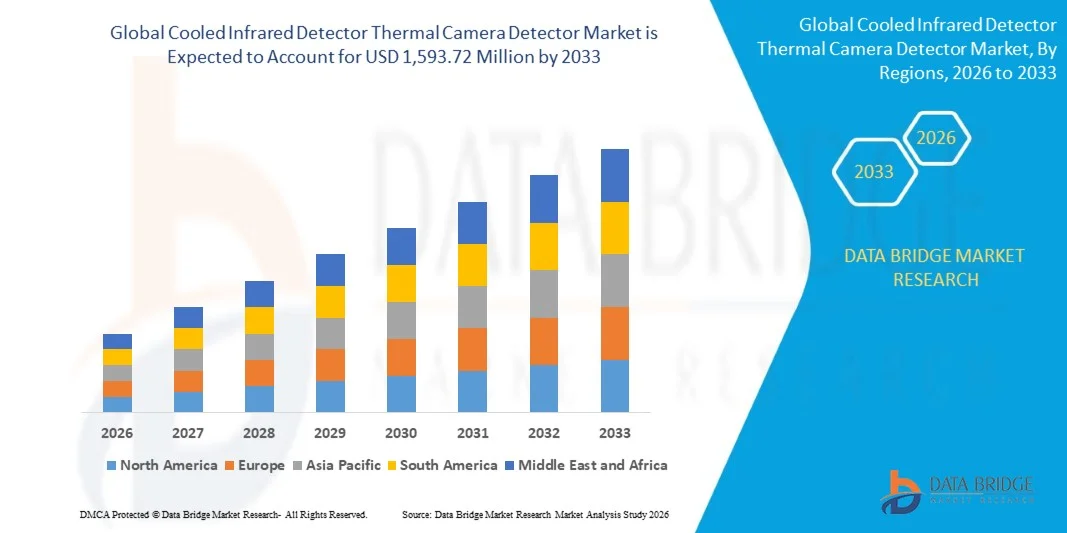
- As per Data Bridge Market Research analysis the cooled infrared detector thermal camera detector market was valued at USD 738.10 million in 2025 and is projected to reach USD 1,593.72 million by 2033, growing at a CAGR of 10.10% from 2026 to 2033.
- The market is experiencing consistent growth driven by increasing demand for high-performance thermal imaging systems, advancements in cooled infrared detector technologies, and expanding applications across defense, aerospace, surveillance, and industrial inspection.
- The growing need for long-range detection and high-resolution thermal imaging, combined with increasing investments in advanced defense and security systems, is compelling military organizations, aerospace companies, and industrial users to adopt cooled infrared detector-based thermal camera technologies.
Market Size & Forecast
- Market Value (2025): USD 738.10 Million
- Expected Market Value (2033): USD 1,593.72 Million
- Forecast CAGR (2026–2033): 10.10%
- Leading Region in 2025: North America
- Fastest Growing Region: Asia-Pacific
What are the Major Takeaways of the Cooled Infrared Detector Thermal Camera Detector Market?
- North America dominated the cooled infrared detector thermal camera detector market with the largest revenue share in 2025, supported by strong defense spending, aerospace programs, border surveillance requirements, and advanced industrial imaging applications.
- Asia-Pacific cooled infrared detector thermal camera detector market is expected to witness the fastest growth rate from 2026 to 2033, supported by increasing defense modernization, expanding electronics manufacturing, and rising industrial demand for advanced sensing technologies.
- The fixed/mounted segment held the largest market revenue share in 2025, driven by its widespread deployment in continuous surveillance, defense systems, industrial monitoring, and perimeter security applications. Fixed/mounted thermal cameras are preferred due to their stable positioning, integration with monitoring infrastructure, and suitability for long-duration observation.
- The handheld segment is projected to register the fastest growth from 2026 to 2033, driven by increasing demand for portable thermal imaging solutions in law enforcement, building inspection, fault detection, and field-based industrial applications. Growing requirements for rapid on-site inspection and mobile surveillance are accelerating segment expansion.
- The MWIR segment held the largest market revenue share in 2025, driven by its extensive use in defense, aerospace, surveillance, and industrial applications requiring high sensitivity and long-range thermal imaging. MWIR detectors are preferred for their strong performance in low-light and challenging atmospheric conditions.
- The LWIR segment is projected to register the fastest growth from 2026 to 2033, driven by increasing adoption in building inspection, industrial process monitoring, security, and fault detection applications. Rising demand for reliable thermal imaging across diverse operating environments is supporting segment expansion.
Report Scope and Cooled Infrared Detector Thermal Camera Detector Market Segmentation
|
Attributes |
Cooled Infrared Detector Thermal Camera Detector Key Market Insights |
|
Segments Covered |
|
|
Countries Covered |
North America
Europe
Asia-Pacific
Middle East and Africa
South America
|
|
Key Market Players |
|
|
Market Opportunities |
|
|
Value Added Data Infosets |
In addition to the insights on market scenarios such as market value, growth rate, segmentation, geographical coverage, and major players, the market reports curated by the Data Bridge Market Research also include in-depth expert analysis, geographically represented company-wise production and capacity, network layouts of distributors and partners, detailed and updated price trend analysis and deficit analysis of supply chain and demand. |
What is the Key Trend in the Cooled Infrared Detector Thermal Camera Detector Market?
- Thermal camera manufacturers are increasingly developing long-life cooled MWIR systems with higher sensitivity, faster imaging, and automation-ready interfaces to expand the use of cooled detectors beyond defense and surveillance into continuous industrial monitoring and process control.
- For instance, in February 2026, Teledyne FLIR launched the A6450 Long-Life Cooled MWIR Cameras for industrial automation, process control, and non-destructive testing, combining long-life cooling with high-speed MWIR performance for continuous 24/7 operations.
- Cooled infrared detectors provide higher sensitivity, faster frame rates, and improved imaging of low-energy and transient thermal events compared with conventional uncooled detectors, making them suitable for high-performance imaging applications.
- Advanced cooled detector modules are also being developed for hyperspectral imaging, remote sensing, surveillance, and targeting applications requiring high spatial resolution and sensitivity.
- For instance, AIM Infrarot-Module offers cooled MCT SWIR detector modules with resolutions up to 1024 × 256, frame rates of up to 250 Hz, and long-life integrated coolers for continuous remote-sensing applications.
- As manufacturers continue improving cooler lifetime, detector sensitivity, integration, and automation capabilities, cooled thermal imaging is expected to gain wider adoption across industrial inspection, aerospace, defense, and scientific applications.
What are the Key Drivers of the Cooled Infrared Detector Thermal Camera Detector Market?
- Increasing demand for long-range detection, high-resolution imaging, and reliable thermal sensing across defense, aerospace, surveillance, industrial inspection, and scientific applications is driving adoption of cooled infrared detector technologies.
- For instance, AIM Infrarot-Module's HuntIR Mk2 uses high-resolution cooled infrared detector technology to support long-range targeting and observation, with a stated precise engagement range of up to 1,500 meters across day and night conditions.
- Cooled detectors offer superior sensitivity and reduced thermal noise, enabling users to detect small temperature differences and capture fast-moving or transient thermal events with greater clarity.
- For instance, Teledyne FLIR's cooled A6301 thermal camera uses a highly sensitive cooled MWIR sensor with thermal sensitivity of ≤15 mK and a 27,000-hour cryocooler lifetime, supporting accurate defect detection and continuous production monitoring.
- With defense agencies, industrial manufacturers, and research organizations increasingly requiring precise thermal measurement and long-range detection, demand for cooled infrared detector-based thermal cameras is expected to continue expanding across high-performance imaging applications.
Which Factors are Challenging the Growth of the Cooled Infrared Detector Thermal Camera Detector Market?
- Cooled infrared thermal cameras require sophisticated cryogenic cooling systems, increasing system complexity, power consumption, maintenance requirements, and overall acquisition costs compared with uncooled thermal cameras.
- These factors can limit adoption in cost-sensitive applications where standard uncooled detectors provide adequate thermal imaging performance.
- For instance, Teledyne FLIR explains that cooled detectors require cryogenic operating temperatures and incorporate detector arrays, readout circuits, cold filters, and cooling systems, making their architecture more complex than conventional uncooled solutions.
- The requirement for specialized cooling technology can also increase maintenance considerations, particularly for applications requiring continuous operation and high reliability.
- For instance, Teledyne FLIR's development of long-life cooled MWIR cameras specifically addresses historical barriers related to the timing and cost of maintaining cooled thermal cameras in production environments.
- The high equipment cost, cooling-system complexity, and maintenance requirements therefore continue to restrict widespread adoption of cooled infrared detector thermal cameras, particularly in price-sensitive commercial and industrial applications.
How is the Cooled Infrared Detector Thermal Camera Detector Market Segmented?
The market is segmented on the basis of mobility, spectral range, technology, and application.
- By Mobility
On the basis of mobility, the cooled infrared detector thermal camera detector market is segmented into handheld and fixed/mounted. The fixed/mounted segment held the largest market revenue share in 2025, driven by its widespread deployment in continuous surveillance, defense systems, industrial monitoring, and perimeter security applications. Fixed/mounted thermal cameras are preferred due to their stable positioning, integration with monitoring infrastructure, and suitability for long-duration observation.
The handheld segment is projected to register the fastest growth from 2026 to 2033, driven by increasing demand for portable thermal imaging solutions in law enforcement, building inspection, fault detection, and field-based industrial applications. Growing requirements for rapid on-site inspection and mobile surveillance are accelerating segment expansion.
- By Spectral Range
On the basis of spectral range, the market is segmented into short wave infrared detectors (SWIR), mid wave infrared detectors (MWIR), and long wave infrared detectors (LWIR). The MWIR segment held the largest market revenue share in 2025, driven by its extensive use in defense, aerospace, surveillance, and industrial applications requiring high sensitivity and long-range thermal imaging. MWIR detectors are preferred for their strong performance in low-light and challenging atmospheric conditions.
The LWIR segment is projected to register the fastest growth from 2026 to 2033, driven by increasing adoption in building inspection, industrial process monitoring, security, and fault detection applications. Rising demand for reliable thermal imaging across diverse operating environments is supporting segment expansion.
- By Technology
On the basis of technology, the market is segmented into InGaAs, mercury cadmium telluride (MCT), micro bolometers, pyroelectric, and thermopile. The mercury cadmium telluride (MCT) segment held the largest market revenue share in 2025, driven by its high sensitivity, fast response, and broad spectral detection capabilities across defense, aerospace, and scientific imaging applications. MCT detectors are preferred for high-performance thermal imaging requiring precise detection of low-intensity infrared signals.
The InGaAs segment is projected to register the fastest growth from 2026 to 2033, driven by increasing demand for SWIR imaging in industrial inspection, surveillance, semiconductor inspection, and scientific applications. Growing adoption of high-speed and high-resolution infrared sensing technologies is accelerating segment expansion.
- By Application
On the basis of application, the market is segmented into building inspection, fault detection, law enforcement, medical, industrial process, astronomy, meteorology, and others. The industrial process segment held the largest market revenue share in 2025, driven by increasing use of thermal imaging for equipment monitoring, predictive maintenance, process optimization, and temperature measurement. The ability to identify thermal abnormalities without interrupting operations is supporting widespread adoption across industrial facilities.
The fault detection segment is projected to register the fastest growth from 2026 to 2033, driven by rising demand for early identification of electrical, mechanical, and structural defects. Increasing emphasis on predictive maintenance, operational safety, and reduced equipment downtime is accelerating the adoption of thermal camera detector solutions.
Which Region Holds the Largest Share of the Cooled Infrared Detector Thermal Camera Detector Market?
- North America dominated the cooled infrared detector thermal camera detector market with the largest revenue share in 2025, supported by strong defense spending, aerospace programs, border surveillance requirements, and advanced industrial imaging applications.
- The region benefits from a well-established ecosystem of infrared detector manufacturers and defense contractors, particularly in the U.S. The increasing deployment of high-performance cooled MWIR and LWIR systems for long-range surveillance, targeting, and advanced thermal imaging is further supporting regional market growth.
U.S. Cooled Infrared Detector Thermal Camera Detector Market Insight
U.S. cooled infrared detector thermal camera detector market captured the largest revenue share in 2025 within North America, fueled by substantial defense investments, aerospace applications, and increasing demand for high-performance surveillance and targeting systems. The country has a strong technological base involving major infrared imaging and defense companies, supporting continued development of advanced cooled detector technologies. Moreover, growing requirements for long-range detection, missile warning, border security, and military thermal imaging are contributing to market expansion.
Europe Cooled Infrared Detector Thermal Camera Detector Market Insight
Europe cooled infrared detector thermal camera detector market is expected to witness strong growth from 2026 to 2033, primarily driven by increasing defense modernization, aerospace applications, and industrial demand for high-precision thermal imaging. The region accounted for approximately 29% of the cooled IR camera market in 2024, supported by demand from the U.K., Germany, and France. Increasing adoption of cooled infrared systems for border surveillance, research imaging, industrial inspection, and defense applications is further supporting regional expansion.
U.K. Cooled Infrared Detector Thermal Camera Detector Market Insight
U.K. cooled infrared detector thermal camera detector market is expected to witness steady growth from 2026 to 2033, driven by increasing defense modernization, border surveillance requirements, and demand for advanced thermal imaging systems. The country's aerospace and defense ecosystem is supporting the deployment of high-performance infrared technologies for surveillance and security applications. In addition, growing adoption of thermal imaging in industrial inspection, research, and predictive maintenance is expected to stimulate market growth.
Germany Cooled Infrared Detector Thermal Camera Detector Market Insight
Germany cooled infrared detector thermal camera detector market is expected to witness strong growth from 2026 to 2033, fueled by increasing defense expenditure, advanced industrial manufacturing, and demand for precision thermal inspection technologies. Germany's established photonics and infrared technology base supports applications across aerospace, defense, industrial process monitoring, and research. Moreover, growing emphasis on predictive maintenance and energy-efficient industrial operations is contributing to the adoption of advanced infrared imaging systems.
Asia-Pacific Cooled Infrared Detector Thermal Camera Detector Market Insight
The Asia-Pacific cooled infrared detector thermal camera detector market is expected to witness the fastest growth rate from 2026 to 2033, supported by increasing defense modernization, expanding electronics manufacturing, and rising industrial demand for advanced sensing technologies. The region accounted for approximately 29.6% of the worldwide medium-wave cooled infrared detector market in 2025, while broader infrared detector demand is supported by China's industrial base and Japan's advanced component ecosystem. Increasing investments in surveillance, aerospace, semiconductor inspection, and industrial automation are further driving regional adoption.
Japan Cooled Infrared Detector Thermal Camera Detector Market Insight
Japan cooled infrared detector thermal camera detector market is expected to witness strong growth from 2026 to 2033 due to the country's advanced electronics and photonics industries, sophisticated manufacturing capabilities, and increasing adoption of high-performance infrared imaging. Japan plays an important role in the infrared detector supply chain, particularly through advanced semiconductor and optical technologies. Growing applications in industrial inspection, scientific research, aerospace, and defense are expected to support continued market development.
China Cooled Infrared Detector Thermal Camera Detector Market Insight
China cooled infrared detector thermal camera detector market accounted for a significant market revenue share in Asia Pacific in 2025, attributed to rapid industrialization, expanding electronics manufacturing, and increasing investments in defense and surveillance technologies. The country's growing semiconductor and infrared imaging capabilities are supporting domestic production and adoption of thermal sensing solutions. Furthermore, increasing demand for advanced surveillance, industrial inspection, aerospace, and security applications is expected to accelerate market growth.
Which are the Top Companies in Cooled Infrared Detector Thermal Camera Detector Market?
The cooled infrared detector thermal camera detector industry is primarily led by well-established companies, including:
- Teledyne FLIR LLC (U.S.)
- Fluke Corporation (U.S.)
- InfraTec GmbH (Germany)
- Axis Communications AB (Sweden)
- Opgal Optronic Industries Ltd. (Israel)
- JENOPTIK AG (Germany)
- PCE Instruments (Germany)
- MOBOTIX AG (Germany)
- Spectris plc (U.K.)
- Optris GmbH (Germany)
- DIAS Infrared GmbH (Germany)
- Zhejiang ULIRVISION Technology Co., Ltd. (China)
- Hangzhou Hikvision Digital Technology Co., Ltd. (China)
- MICRO-EPSILON Messtechnik GmbH and Co. KG (Germany)
- 3M Company (U.S.)

- Interactive Data Analysis Dashboard
- Company Analysis Dashboard for high growth potential opportunities
- Research Analyst Access for customization & queries
- Competitor Analysis with Interactive dashboard
- Latest News, Updates & Trend analysis
- Harness the Power of Benchmark Analysis for Comprehensive Competitor Tracking
Global Cooled Infrared Detector Thermal Camera Detector Market, Supply Chain Analysis and Ecosystem Framework
To support market growth and help clients navigate the impact of geopolitical shifts, DBMR has integrated in-depth supply chain analysis into its Global Cooled Infrared Detector Thermal Camera Detector Market research reports. This addition empowers clients to respond effectively to global changes affecting their industries. The supply chain analysis section includes detailed insights such as Global Cooled Infrared Detector Thermal Camera Detector Market consumption and production by country, price trend analysis, the impact of tariffs and geopolitical developments, and import and export trends by country and HSN code. It also highlights major suppliers with data on production capacity and company profiles, as well as key importers and exporters. In addition to research, DBMR offers specialized supply chain consulting services backed by over a decade of experience, providing solutions like supplier discovery, supplier risk assessment, price trend analysis, impact evaluation of inflation and trade route changes, and comprehensive market trend analysis.
Data collection and base year analysis are done using data collection modules with large sample sizes. The stage includes obtaining market information or related data through various sources and strategies. It includes examining and planning all the data acquired from the past in advance. It likewise envelops the examination of information inconsistencies seen across different information sources. The market data is analysed and estimated using market statistical and coherent models. Also, market share analysis and key trend analysis are the major success factors in the market report. To know more, please request an analyst call or drop down your inquiry.
The key research methodology used by DBMR research team is data triangulation which involves data mining, analysis of the impact of data variables on the market and primary (industry expert) validation. Data models include Vendor Positioning Grid, Market Time Line Analysis, Market Overview and Guide, Company Positioning Grid, Patent Analysis, Pricing Analysis, Company Market Share Analysis, Standards of Measurement, Global versus Regional and Vendor Share Analysis. To know more about the research methodology, drop in an inquiry to speak to our industry experts.
Data Bridge Market Research is a leader in advanced formative research. We take pride in servicing our existing and new customers with data and analysis that match and suits their goal. The report can be customized to include price trend analysis of target brands understanding the market for additional countries (ask for the list of countries), clinical trial results data, literature review, refurbished market and product base analysis. Market analysis of target competitors can be analyzed from technology-based analysis to market portfolio strategies. We can add as many competitors that you require data about in the format and data style you are looking for. Our team of analysts can also provide you data in crude raw excel files pivot tables (Fact book) or can assist you in creating presentations from the data sets available in the report.













