


What is the Uncooled Infrared Detector Camera Detector Market Size and Growth Rate?
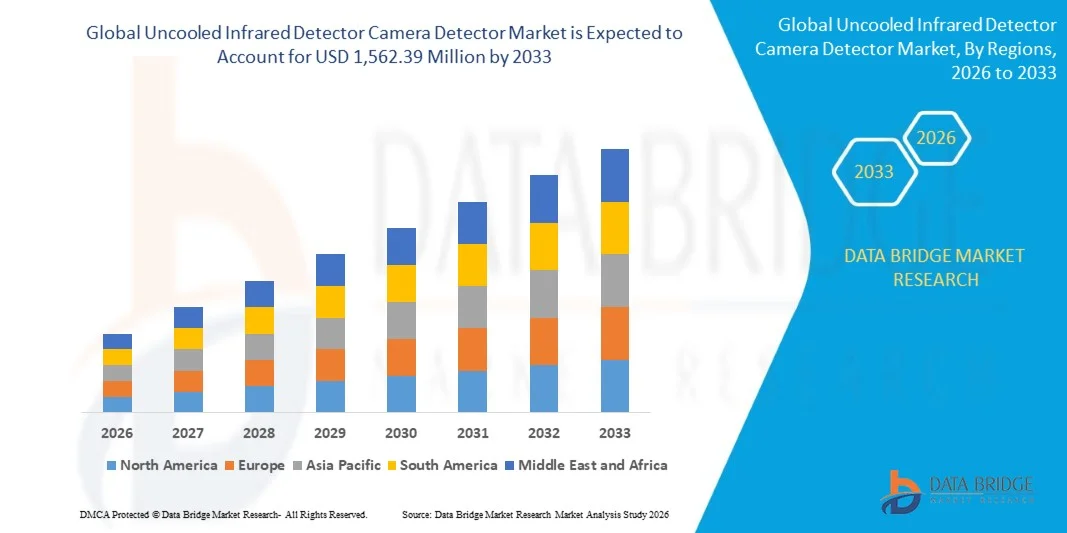
- As per Data Bridge Market Research analysis, the uncooled infrared detector camera detector market was valued at USD 673.10 million in 2025 and is projected to reach USD 1,562.39 million by 2033, growing at a CAGR of 11.10% from 2026 to 2033.
- The market is experiencing consistent growth driven by the increasing adoption of infrared detectors in security and surveillance systems, growing demand for thermal imaging technologies, and expanding applications across automotive, defense, healthcare, and industrial sectors.
- The growing demand for advanced surveillance and security systems, combined with increasing applications of thermal imaging for automotive night vision, industrial inspection, firefighting, and defense applications, is supporting the adoption of uncooled infrared detector camera technologies. Uncooled detectors offer advantages including compact size, low power consumption, and cost-effectiveness, making them suitable for a wide range of commercial and industrial applications.
Market Size & Forecast
- Global Market Value (2025): USD 673.10 Million
- Expected Market Value (2033): USD 1,562.39 Million
- Forecast CAGR (2026–2033): 11.10%
- Leading Region in 2025: North America
- Fastest Growing Region: Asia Pacific
What are the Major Takeaways of the Uncooled Infrared Detector Camera Detector Market?
- North America dominated the uncooled infrared detector camera detector market with the largest revenue share of 36.5% in 2025, supported by early technology adoption, substantial government funding for defense modernization, and advanced automotive sectors focused on safety enhancements.
- Asia-Pacific is expected to be the fastest-growing region at a CAGR of 10.5% from 2026 to 2033, fueled by increasing adoption of infrared detectors across security, healthcare, industrial inspection, automotive, and smart-city applications.
- The microbolometer segment led the market with a 60% share in 2025, driven by its extensive adoption in uncooled thermal imaging cameras and infrared focal plane arrays.
- InGaAs are the fastest-growing type, projected to register a CAGR of 8%, reflecting the surge in demand for high-performance infrared detection in the NIR and SWIR ranges.
- The long-wave infrared (LWIR) segment dominated the wavelength category with a 65% revenue share in 2025, led by its extensive use in thermal imaging and temperature-detection applications.
- Fixed accounted for 45% of the market share in 2025, preferred by its widespread deployment in continuous thermal surveillance and monitoring applications
- The linear arrays segment is the fastest-growing detector format category, with a CAGR of 7.5%, driven by increasing adoption of infrared detection in industrial scanning, machine vision, process monitoring, and automated inspection.
Report Scope and Uncooled Infrared Detector Camera Detector Market Segmentation
|
Attributes |
Uncooled Infrared Detector Camera Detector Key Market Insights |
|
Segments Covered |
|
|
Countries Covered |
North America
Europe
Asia-Pacific
Middle East and Africa
South America
|
|
Key Market Players |
|
|
Market Opportunities |
|
|
Value Added Data Infosets |
In addition to the insights on market scenarios such as market value, growth rate, segmentation, geographical coverage, and major players, the market reports curated by the Data Bridge Market Research also include in-depth expert analysis, geographically represented company-wise production and capacity, network layouts of distributors and partners, detailed and updated price trend analysis and deficit analysis of supply chain and demand. |
What is the Key Trend in the Uncooled Infrared Detector Camera Detector Market?
- Artificial intelligence integration is increasingly transforming uncooled infrared detector technology, improving thermal image resolution, reducing noise, and enhancing target detection accuracy across security surveillance, autonomous vehicles, and industrial automation applications.
- For instance, in April 2025, SkyWater Technology unveiled its ThermaView thermal-imaging solutions, including hybridized focal-plane arrays and monolithically fabricated microbolometer FPAs for uncooled imaging, targeting aerospace, defense, industrial automation, automotive, and medical applications.
- Compact and low-power thermal cameras are gaining adoption in automotive night vision and driver assistance, as advances in microbolometer performance expand thermal sensing capabilities beyond traditional defense and surveillance applications.
- For instance, in May 2025, Telops demonstrated its Radia V60 uncooled microbolometer camera for automotive parts inspection, using infrared thermography to identify anomalies and defects in components such as seals, brake pads, and gaskets without physical contact.
- Industrial organizations are increasingly deploying uncooled infrared detectors for predictive maintenance, condition monitoring, and automated inspection, because room-temperature operation enables compact thermal sensing for continuous equipment monitoring across manufacturing environments.
What are the Key Drivers of the Uncooled Infrared Detector Camera Detector Market?
- The rising demand for military and defense applications is driving adoption of uncooled infrared detectors, particularly for night vision, surveillance, targeting, and portable thermal imaging systems that provide operational advantages without requiring cryogenic cooling.
- For instance, in July 2024, Teledyne FLIR upgraded its Boson+ thermal camera module, delivering improved thermal sensitivity of ≤20 mK and enhanced image processing for defense, firefighting, automotive, security, and surveillance applications, supporting the growing adoption of compact uncooled infrared imaging solutions.
- Growing industrial adoption of thermal imaging for predictive maintenance is supporting market expansion, as uncooled detectors enable continuous monitoring of equipment and help identify thermal abnormalities before failures occur.
- Increasing automotive applications are accelerating demand for uncooled infrared cameras, particularly for night vision, driver assistance, collision avoidance, and autonomous driving systems requiring enhanced detection capabilities in low-visibility conditions.
- For instance, in September 2025, Teledyne FLIR launched the Boson+ IQ Thermal Imaging Development Kit, combining uncooled thermal sensing with edge AI capabilities for defense, security, industrial automation, drones, and ground-based robotics, expanding the use of uncooled infrared cameras in autonomous and intelligent sensing applications
- Advancements in microbolometer technology are expanding commercial applications, improving detector performance while retaining the compact size, low power consumption, and cost advantages associated with uncooled infrared imaging systems.
Which Factors are Challenging the Growth of the Uncooled Infrared Detector Camera Detector Market?
- Performance limitations compared with cooled infrared detectors remain a significant challenge, particularly because uncooled technologies generally provide lower sensitivity and detection range for high-precision military, scientific, and long-distance thermal imaging applications.
- For instance, in May 2025, Teledyne FLIR highlighted that uncooled infrared detectors generally provide lower sensitivity and resolution than cooled detectors, making them less suitable for applications requiring detection of low-energy or transient thermal events and highly detailed thermal imagery.
- High manufacturing complexity and capital requirements can restrict production scalability, as microbolometer-based detector arrays require specialized MEMS fabrication, advanced lithography, etching, and vacuum packaging processes.
- Supply-chain vulnerabilities involving specialized materials and components create additional market risks, particularly for vanadium oxide, amorphous silicon, and customized readout integrated circuits used in detector-array manufacturing.
- For instance, in April 2025, an article published in Communications Physics showing that uncooled thermal infrared detectors remain constrained by noise from electronic readout and photothermal effects, which limits their sensitivity at room temperature.
- Intense price competition from manufacturers in Asia-Pacific can pressure industry margins, requiring established manufacturers to continuously improve production efficiency, achieve economies of scale, and invest in next-generation detector technologies.
How is the Uncooled Infrared Detector Camera Detector Market Segmented?
The uncooled infrared detector camera detector market is segmented on the basis of type, wavelength, product, detector format, and application.
- By Type
On the basis of type, the uncooled infrared detector camera detector market is segmented into MCT, InGaAs, pyroelectric, thermopile, microbolometer, and others. The microbolometer segment dominated the market with an estimated share of 60% in 2025, owing to its extensive adoption in uncooled thermal imaging cameras and infrared focal plane arrays. Microbolometers operate at room temperature without requiring cryogenic cooling, making them compact, energy-efficient, and cost-effective. They are widely used in surveillance, automotive night vision, firefighting, industrial inspection, and government and defense applications. Increasing demand for portable and embedded thermal imaging systems is further supporting segment growth. Advancements in pixel density, thermal sensitivity, and image-processing capabilities are improving the performance of microbolometer-based cameras.
The InGaAs segment is projected to register the fastest growth at an estimated CAGR of 8% from 2026 to 2033, driven by increasing demand for high-performance infrared detection in the NIR and SWIR ranges. InGaAs detectors provide high sensitivity beyond the visible spectrum and are particularly suitable for low-light imaging applications. They are increasingly used in semiconductor inspection, industrial machine vision, surveillance, agriculture, and quality-control applications. The ability of SWIR cameras to identify materials and defects that are difficult to detect using visible cameras is creating new opportunities. Continuous advancements in InGaAs detector technology are improving sensitivity, resolution, and operational efficiency. Increasing demand for compact SWIR cameras in industrial and defense applications is further supporting adoption.
- By Wavelength
On the basis of wavelength, the market is segmented into near infrared (NIR) and short-wave infrared (SWIR), mid-wave infrared (MWIR), and long-wave infrared (LWIR). The long-wave infrared (LWIR) segment dominated the market with an estimated share of 65% in 2025, owing to its extensive use in thermal imaging and temperature-detection applications. LWIR detectors can detect thermal radiation emitted by objects and operate effectively in darkness and challenging visibility conditions. They are widely used in security surveillance, firefighting, automotive night vision, industrial monitoring, and defense applications. The ability to detect temperature differences makes LWIR cameras particularly valuable for predictive maintenance and thermal inspection. Uncooled LWIR cameras based on microbolometer technology also offer a more compact and cost-effective solution compared with cooled systems.
The near infrared (NIR) and short-wave infrared (SWIR) segment is projected to register the fastest growth at an estimated CAGR of 9% from 2026 to 2033, driven by increasing adoption of infrared imaging across industrial inspection, semiconductor manufacturing, agriculture, and security applications. SWIR cameras can capture images under low-light conditions and identify materials that cannot be effectively distinguished using visible-light cameras. Increasing automation and machine-vision adoption are creating significant demand for SWIR-based inspection systems. The technology is increasingly used for sorting, quality control, moisture detection, and semiconductor inspection. Advancements in InGaAs detector technology are improving sensitivity and reducing the size and cost of SWIR imaging systems. Growing use of SWIR cameras in defense and surveillance is further creating growth opportunities.
- By Product
On the basis of product, the market is segmented into fixed, handheld, and pan-tilt-zoom (PTZ). The fixed segment dominated the market with an estimated share of 45% in 2025, owing to its widespread deployment in continuous thermal surveillance and monitoring applications. Fixed infrared cameras are extensively installed at industrial facilities, commercial buildings, critical infrastructure, borders, and defense installations. These systems provide continuous monitoring and can identify abnormal heat signatures, unauthorized activity, and potential security threats. Their integration with video management systems, alarms, and artificial intelligence-based analytics further enhances their effectiveness. Increasing investments in physical security and critical infrastructure protection are supporting demand for fixed thermal cameras. Their relatively simple installation and reliable operation make them suitable for long-term monitoring applications.
The pan-tilt-zoom (PTZ) segment is projected to register the fastest growth at an estimated CAGR of 8% from 2026 to 2033, driven by increasing demand for wide-area surveillance and remotely controlled thermal imaging. PTZ thermal cameras can rotate horizontally, tilt vertically, and zoom into distant objects, enabling broader monitoring coverage than conventional fixed cameras. They are increasingly deployed for border security, critical infrastructure, maritime surveillance, airports, and large industrial facilities. Integration with intelligent video analytics and automated target-tracking technologies is further enhancing PTZ camera capabilities. These cameras can monitor large areas while reducing the number of individual camera installations required. Increasing security investments and growing demand for advanced perimeter monitoring are supporting segment growth.
- By Detector Format
On the basis of detector format, the market is segmented into single element detectors, linear arrays, and two-dimensional focal plane arrays (FPAs). The two-dimensional focal plane arrays (FPAs) segment dominated the market with an estimated share of 70% in 2025, owing to their ability to capture complete thermal images with high spatial information. Two-dimensional FPAs are extensively incorporated into thermal cameras used for surveillance, defense, automotive, firefighting, and industrial inspection. They provide detailed temperature distribution across an entire scene and support real-time thermal imaging. Increasing demand for high-resolution thermal cameras is strengthening their adoption across commercial and government applications. Improvements in detector sensitivity, pixel density, and image-processing technologies are further enhancing FPA performance. Growing deployment of thermal imaging in autonomous systems and intelligent surveillance is also supporting segment expansion.
The linear arrays segment is projected to register the fastest growth at an estimated CAGR of 7.5% from 2026 to 2033, driven by increasing adoption of infrared detection in industrial scanning, machine vision, process monitoring, and automated inspection. Linear arrays contain multiple detector elements arranged in a single line and can generate images as the sensor or inspected object moves. This configuration is particularly suitable for high-speed industrial inspection and continuous production-line monitoring. Increasing manufacturing automation is creating demand for non-contact infrared sensing technologies that can monitor products and processes in real time. Linear arrays also provide a compact sensing solution for applications where a complete two-dimensional FPA may not be required. Improvements in detector sensitivity and readout electronics are increasing their suitability for demanding industrial applications.
- By Application
On the basis of application, the market is segmented into automotive, BFSI, commercial, government & defence, healthcare, industrial, and residential. The government & defence segment dominated the market with an estimated share of 30% in 2025, driven by extensive deployment of infrared cameras for surveillance, border monitoring, reconnaissance, target detection, and situational awareness. Thermal imaging enables personnel to detect people, vehicles, and objects during nighttime and under challenging conditions such as smoke, fog, and low visibility. Increasing government investments in border security and advanced surveillance infrastructure are supporting demand for infrared detection systems. Defense forces are also deploying thermal cameras in vehicle-mounted systems, unmanned platforms, night-vision systems, and targeting applications. Growing adoption of unmanned aerial and ground systems is creating additional demand for lightweight and compact infrared detectors.
The automotive segment is projected to register the fastest growth at an estimated CAGR of 10% from 2026 to 2033, driven by increasing integration of thermal sensing technologies into advanced driver-assistance systems and vehicle safety applications. Infrared cameras can improve nighttime visibility and assist in detecting pedestrians, cyclists, animals, and other obstacles beyond the effective range of conventional headlights. Increasing focus on road safety and accident prevention is encouraging automakers to incorporate additional sensing technologies into vehicles. The development of autonomous and semi-autonomous vehicles is further increasing demand for sensors capable of operating under poor visibility conditions. Advancements in compact uncooled infrared detectors are making thermal cameras increasingly suitable for automotive integration. Declining sensor costs and improvements in image processing are also supporting adoption.
Which Region Holds the Largest Share of the Uncooled Infrared Detector Camera Detector Market?
- North America dominated the uncooled infrared detector camera detector market with the largest revenue share of 36.5% in 2025, supported by early technology adoption, substantial government funding for defense modernization, and advanced automotive sectors focused on safety enhancements.
- The region also benefits from increasing adoption of uncooled infrared detectors in security, industrial monitoring, automotive night vision, and defense applications, where compact size, low power consumption, and room-temperature operation provide important advantages. Growing investments in border surveillance, critical infrastructure protection, and advanced driver-assistance technologies are creating additional opportunities for infrared detector cameras. The increasing integration of thermal imaging with artificial intelligence and advanced analytics is further strengthening demand across North America.
U.S. Uncooled Infrared Detector Camera Detector Market Insight
The U.S. uncooled infrared detector camera detector market is witnessing strong growth due to rising investments in defense modernization, thermal imaging, autonomous vehicles, and industrial applications. The country has a strong defense and aerospace ecosystem, supporting demand for advanced infrared detection and thermal imaging technologies. In January 2025, Teledyne FLIR introduced the Hadron 640R+, an uncooled thermal camera module designed for integration into unmanned systems, including drones and ground vehicles. The module combines a high-resolution thermal sensor with visible imaging and is designed for applications such as defense, security, and autonomous systems. In addition, increasing adoption of thermal imaging for vehicle perception, surveillance, and industrial monitoring is accelerating demand for compact uncooled infrared detectors. These developments are strengthening the U.S. position in advanced infrared sensing technologies.
Asia-Pacific Uncooled Infrared Detector Camera Detector Market Insight
The Asia-Pacific uncooled infrared detector camera detector market is expected to witness rapid growth, driven by increasing defense expenditure, industrial automation, electronics manufacturing, and expanding thermal imaging applications across China, Japan, South Korea, and India. The region has a strong semiconductor and electronics manufacturing ecosystem, supporting the development and deployment of infrared detector technologies. Sony Semiconductor Solutions announced the development of a SWIR image sensor using a newly developed material technology, supporting high-performance imaging in wavelengths beyond visible light. Increasing adoption of infrared imaging in industrial inspection, security, automotive systems, and smart infrastructure is further supporting regional expansion. The growing presence of electronics manufacturers and expanding investments in advanced sensing technologies are creating additional opportunities.
Japan Uncooled Infrared Detector Camera Detector Market Insight
The Japan uncooled infrared detector camera detector market is witnessing consistent growth due to investments in advanced sensing technologies, automotive safety, defense applications, and industrial monitoring. Japan has a well-established electronics and semiconductor industry that supports innovation in infrared and image-sensing technologies. In June 2025, Sony Semiconductor Solutions announced the development of a new SWIR image sensor, using advanced material technology to enable imaging in the short-wave infrared region. The technology expands imaging capabilities beyond visible light and can support industrial inspection and sensing applications. Japan’s automotive and electronics industries are also increasingly incorporating advanced image sensors into next-generation systems. These developments are strengthening the country’s position in infrared and advanced image-sensing technologies.
China Uncooled Infrared Detector Camera Detector Market Insight
The China uncooled infrared detector camera detector market is growing rapidly, driven by expanding surveillance infrastructure, industrial automation, defense applications, and domestic infrared technology development. China has developed a significant infrared imaging industry supporting applications across security, firefighting, industrial inspection, automotive, and defense sectors. In October 2024, Guide Infrared launched a new generation of thermal imaging products at Security China 2024, highlighting applications in security, intelligent transportation, industrial inspection, and other thermal imaging fields. Increasing demand for intelligent surveillance and advanced sensing systems is further supporting adoption. In addition, the expansion of domestic infrared detector manufacturing is improving the availability of compact and cost-effective thermal imaging solutions. These developments are supporting China's rapid expansion in infrared imaging technologies.
U.K. Uncooled Infrared Detector Camera Detector Market Insight
The U.K. uncooled infrared detector camera detector market is experiencing steady growth, supported by defense modernization, advanced sensing research, surveillance, and emergency-response applications. The country has established capabilities in infrared imaging research through organizations such as the Defence Science and Technology Laboratory (Dstl). In May 2025, the U.K. Ministry of Defence conducted its largest-ever defense AI trial, using visual infrared and radar data collected from Royal Navy vessels, ground vehicles, and manned and unmanned aircraft to improve automatic target detection and recognition. The trial demonstrates growing integration of infrared sensing with artificial intelligence and autonomous defense systems. Increasing deployment of thermal imaging for security and situational awareness is further supporting demand. These developments are strengthening the U.K.'s role in advanced infrared sensing and defense technologies.
Germany Uncooled Infrared Detector Camera Detector Market Insight
The Germany uncooled infrared detector camera detector market is expanding steadily due to strong automotive research, industrial monitoring, photonics innovation, and increasing demand for advanced vehicle safety technologies. Germany has a highly developed automotive industry and research ecosystem supporting the integration of infrared sensing into next-generation vehicles. In September 2025, Fraunhofer IOF presented a novel infrared thermal imaging camera at IAA MOBILITY 2025, specifically designed for road-traffic applications and autonomous driving. The camera operates in the 8–14 micrometer wavelength range and is designed to detect people even under difficult visibility conditions during day and night. The development demonstrates the increasing application of infrared imaging for automotive safety and autonomous mobility. Growing research into cost-effective thermal imaging is further supporting demand for uncooled infrared technologies in Germany.
Which are the Top Companies in Uncooled Infrared Detector Camera Detector Market?
The uncooled infrared detector camera detector industry is primarily led by well-established companies, including:
- Teledyne Technologies Incorporated, (U.S.)
- Yantai Ruichuang Micro-Nano Technology Co., Ltd. (China)
- Guide outdoor Tech Co., Ltd. (China)
- ROCIR (China)
- SensorMicro (China)
- Global Sensor Technology (China)
- Leonardo DRS, Inc. (U.S.)
- Seek Thermal Inc. (U.S.)
- Thermoteknix Systems Ltd. (U.K.)
- MikroSens Elektronik San. ve Tic. A.Ş. (Turkey)
- Thermal Expert (South Korea)
- InfraTec GmbH (Germany)
- Hamamatsu Photonics K.K. (Japan)
- TOSHIBA CORPORATION (Japan)
- Tamron Co., Ltd. (Japan)
- Excelitas Technologies Corp. (U.S.)
- Fluke Corporation (U.S.)
- SATIR Ltd. (China)
What are Latest Developments in Uncooled Infrared Detector Camera Detector Market?
- In September 2025, Teledyne FLIR OEM launched the Boson+ IQ Thermal Imaging Development Kit, combining the Boson+ uncooled thermal camera with Prism software and edge-AI processing to help developers integrate thermal sensing and artificial intelligence into defense, security, and industrial platforms. The development kit supports advanced functions including object detection, image enhancement, and AI processing at the edge, demonstrating the increasing integration of uncooled infrared cameras with intelligent sensing technologies.
- In July 2024, Teledyne FLIR upgraded the Boson+ uncooled thermal camera module with new embedded software capabilities, improving thermal image quality, scene contrast, and overall performance for defense, firefighting, automotive, security, and surveillance applications. The upgrade strengthened the capabilities of the Boson+ platform while retaining its compact size, weight, and power advantages. The development demonstrates continued technological advancement in high-performance uncooled LWIR camera modules.
- In October 2023, Teledyne FLIR expanded its Lepton thermal camera series with the Lepton UW ultra-wide-field-of-view thermal camera module, providing a 120 × 120 thermal resolution and a scene dynamic range of up to 400°C. The module retained the Lepton family's uncooled thermal imaging architecture and sensitivity of less than 50 mK. The product was designed to expand thermal imaging capabilities into applications requiring a wider field of view and compact camera integration.
- In August 2023, Teledyne FLIR introduced the Lepton 3.1R radiometric thermal camera module, expanding its uncooled micro-thermal camera portfolio with radiometric capabilities. The module provides temperature measurements for every pixel in a scene and incorporates a compact, low-power design suitable for integration into a wide range of products. The launch expanded the application of uncooled infrared sensing into products requiring quantitative temperature measurement and thermal analysis.
- In April 2022, Teledyne FLIR launched the Boson+ uncooled long-wave infrared thermal camera module, offering thermal sensitivity of 20 millikelvin or less. The product was designed to provide high-performance thermal imaging while maintaining the size, weight, and power advantages of the Boson platform. The Boson+ was positioned for applications requiring compact infrared imaging, including defense, surveillance, firefighting, and other demanding thermal sensing applications.

- Interactive Data Analysis Dashboard
- Company Analysis Dashboard for high growth potential opportunities
- Research Analyst Access for customization & queries
- Competitor Analysis with Interactive dashboard
- Latest News, Updates & Trend analysis
- Harness the Power of Benchmark Analysis for Comprehensive Competitor Tracking
Global Uncooled Infrared Detector Camera Detector Market, Supply Chain Analysis and Ecosystem Framework
To support market growth and help clients navigate the impact of geopolitical shifts, DBMR has integrated in-depth supply chain analysis into its Global Uncooled Infrared Detector Camera Detector Market research reports. This addition empowers clients to respond effectively to global changes affecting their industries. The supply chain analysis section includes detailed insights such as Global Uncooled Infrared Detector Camera Detector Market consumption and production by country, price trend analysis, the impact of tariffs and geopolitical developments, and import and export trends by country and HSN code. It also highlights major suppliers with data on production capacity and company profiles, as well as key importers and exporters. In addition to research, DBMR offers specialized supply chain consulting services backed by over a decade of experience, providing solutions like supplier discovery, supplier risk assessment, price trend analysis, impact evaluation of inflation and trade route changes, and comprehensive market trend analysis.
Data collection and base year analysis are done using data collection modules with large sample sizes. The stage includes obtaining market information or related data through various sources and strategies. It includes examining and planning all the data acquired from the past in advance. It likewise envelops the examination of information inconsistencies seen across different information sources. The market data is analysed and estimated using market statistical and coherent models. Also, market share analysis and key trend analysis are the major success factors in the market report. To know more, please request an analyst call or drop down your inquiry.
The key research methodology used by DBMR research team is data triangulation which involves data mining, analysis of the impact of data variables on the market and primary (industry expert) validation. Data models include Vendor Positioning Grid, Market Time Line Analysis, Market Overview and Guide, Company Positioning Grid, Patent Analysis, Pricing Analysis, Company Market Share Analysis, Standards of Measurement, Global versus Regional and Vendor Share Analysis. To know more about the research methodology, drop in an inquiry to speak to our industry experts.
Data Bridge Market Research is a leader in advanced formative research. We take pride in servicing our existing and new customers with data and analysis that match and suits their goal. The report can be customized to include price trend analysis of target brands understanding the market for additional countries (ask for the list of countries), clinical trial results data, literature review, refurbished market and product base analysis. Market analysis of target competitors can be analyzed from technology-based analysis to market portfolio strategies. We can add as many competitors that you require data about in the format and data style you are looking for. Our team of analysts can also provide you data in crude raw excel files pivot tables (Fact book) or can assist you in creating presentations from the data sets available in the report.













