


Corn Wet-Milling Market Size
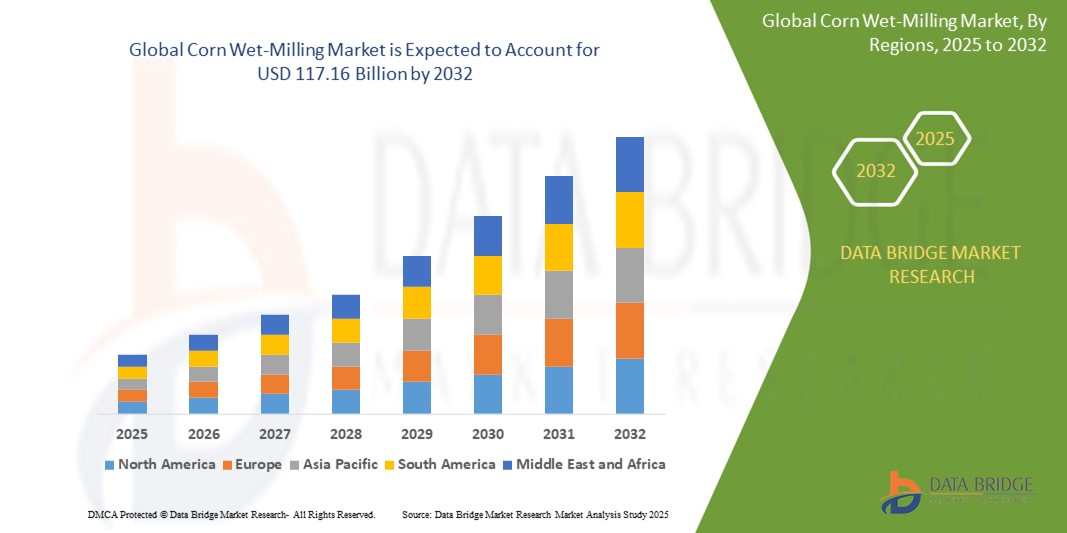
- The global corn wet-milling market size was valued at USD 82.83 billion in 2024 and is expected to reach USD 117.16 billion by 2032, at a CAGR of 4.43% during the forecast period
- The market growth is largely fuelled by the increasing demand for corn-based sweeteners, starches, and ethanol across food, beverage, pharmaceutical, and industrial sectors due to their versatile applications and rising consumer preferences for plant-based ingredients
- Technological advancements in wet-milling processes and growing investments in bio-based product development are also contributing to the market’s expansion by enhancing efficiency and product yield
Corn Wet-Milling Market Analysis
- The corn wet-milling market is experiencing steady growth as manufacturers expand the use of starch, sweeteners, and oil across food, textile, and paper industries
- The versatility of corn derivatives and their growing demand in processed foods and industrial applications are shaping market expansion
- North America dominated the corn wet-milling market with the largest revenue share of 37.8% in 2024, driven by strong demand for starch-based products and ethanol, particularly in the U.S.
- Asia-Pacific region is expected to witness the highest growth rate in the global corn wet-milling market, driven by demand for processed food, increasing industrial applications of corn derivatives, and supportive government policies for bioethanol production in countries such as China, India, and Japan
- The starch segment dominated the market with the largest revenue share in 2024, supported by its extensive use across food, paper, and pharmaceutical industries. Starch extracted through wet-milling is preferred for its purity and versatility, making it a critical component in food thickening, adhesives, and biodegradable materials
Report Scope and Corn Wet-Milling Market Segmentation
|
Attributes |
Corn Wet-Milling Key Market Insights |
|
Segments Covered |
|
|
Countries Covered |
North America
Europe
Asia-Pacific
Middle East and Africa
South America
|
|
Key Market Players |
|
|
Market Opportunities |
• Rising Demand for Bio-Based Sustainable Products • Expansion in Emerging Markets |
|
Value Added Data Infosets |
In addition to the insights on market scenarios such as market value, growth rate, segmentation, geographical coverage, and major players, the market reports curated by the Data Bridge Market Research also include in-depth expert analysis, pricing analysis, brand share analysis, consumer survey, demography analysis, supply chain analysis, value chain analysis, raw material/consumables overview, vendor selection criteria, PESTLE Analysis, Porter Analysis, and regulatory framework. |
Corn Wet-Milling Market Trends
“Rising Shift toward Bio-Based and Sustainable Products in Corn Wet-Milling”
- There is a growing trend in the corn wet-milling market toward producing bio-based and sustainable alternatives to petroleum-derived products
- Manufacturers are leveraging corn-derived starches and ethanol for applications in biodegradable plastics, biofuels, and eco-friendly solvents
- For instance, Cargill has invested in bio-industrial solutions using corn-based inputs to produce sustainable packaging materials
- This trend is driven by increasing environmental concerns, government regulations supporting green chemistry, and consumer preference for sustainable products across global markets
Corn Wet-Milling Market Dynamics
Driver
“Expanding Applications across Food and Industrial Sectors”
- The corn wet-milling market is expanding due to its wide applications in both food and industrial sectors, including the production of high-fructose corn syrup, starch, corn oil, and gluten meal used in processed foods and beverages
- These corn-derived ingredients function as thickeners, sweeteners, and stabilizers, helping improve texture, shelf life, and product consistency across bakery, confectionery, and soft drink segments
- In the industrial sector, corn starch and ethanol are increasingly used in biodegradable plastics, textiles, paper, adhesives, and biofuels, aligning with the growing push for sustainable materials
- Government incentives and environmental policies supporting clean energy are bolstering demand for bioethanol
- For instance, ADM has scaled up its ethanol operations to meet sustainability goals
- Companies such as Ingredion are investing in integrated processing technologies to enhance efficiency and reduce waste, especially as emerging markets in Asia-Pacific and South America witness rising demand for corn-based exports
Restraint/Challenge
“High Capital Investment and Energy-Intensive Operations”
- The corn wet-milling process requires heavy capital investment in infrastructure such as steeping tanks, mills, dryers, and separation systems, making market entry challenging for small and medium enterprises
- High energy and water consumption during processing increases operational costs and raises sustainability concerns for manufacturers and regulators alike
- Compliance with strict environmental regulations on emissions, wastewater discharge, and waste management adds complexity and financial strain on operations
- Volatility in corn prices due to climate change or supply chain disruptions—such as droughts in the U.S. Midwest or Brazil, can directly impact production costs and profit margins
- The industry also faces a shortage of skilled labor and growing pressure to invest in R&D for improving extraction efficiency and energy-saving technologies, further increasing the financial burden
Corn Wet-Milling Market Scope
The corn wet-milling market is segmented on the basis of end-product, application, source, and equipment.
• By End-Product
On the basis of end-product, the corn wet-milling market is segmented into starch, sweetener, ethanol, corn gluten MEAI, gluten feed, and others. The starch segment dominated the market with the largest revenue share in 2024, supported by its extensive use across food, paper, and pharmaceutical industries. Starch extracted through wet-milling is preferred for its purity and versatility, making it a critical component in food thickening, adhesives, and biodegradable materials.
The ethanol segment is expected to witness the fastest growth rate from 2025 to 2032, driven by rising global demand for biofuels and the push for renewable energy sources. Ethanol derived from corn is gaining traction as a cleaner alternative to fossil fuels, especially in transportation. Government mandates and incentives promoting ethanol blending in countries such as the U.S. and Brazil further bolster this segment’s expansion.
• By Application
On the basis of application, the corn wet-milling market is segmented into feed, food, steepwater, mill, refinery, ethanol production, starch modification, and industrial applications. The food segment held the largest revenue share in 2024, owing to increasing demand for corn-based ingredients in processed food products. From syrups to starch derivatives, wet-milled corn plays a vital role in enhancing food texture, shelf life, and sweetness.
The ethanol production segment is expected to witness the fastest growth rate from 2025 to 2032, due to the expanding use of corn ethanol as a sustainable fuel. This trend is largely supported by cleaner energy policies and the growing demand for eco-friendly transportation solutions.
• By Source
On the basis of source, the corn wet-milling market is segmented into dent corn and waxy corn. The dent corn segment dominated the market in 2024 due to its high starch content and widespread cultivation, particularly in North America. Dent corn is the most preferred raw material in wet-milling owing to its cost-efficiency and versatility in producing multiple end-products.
The waxy corn segment is expected to witness the fastest growth rate from 2025 to 2032, fueled by increasing demand for specialty starches in food and industrial applications. Waxy corn's unique composition makes it ideal for producing modified starches used in sauces, adhesives, and biodegradable films.
• By Equipment
On the basis of equipment, the corn wet-milling market is segmented into milling equipment, steeping equipment, centrifuge systems, washing and filtration systems, and others. The milling equipment segment held the largest revenue share in 2024, driven by its essential role in separating kernel components with precision and efficiency. Upgrades in milling machinery, such as high-capacity wet mills, are further enhancing processing capabilities and product yield.
The centrifuge systems segment is expected to witness the fastest growth rate from 2025 to 2032, supported by advancements in continuous separation technologies. These systems are crucial for isolating gluten and starch fractions efficiently, meeting quality standards in both food-grade and industrial-grade outputs.
Corn Wet-Milling Market Regional Analysis
• North America dominated the corn wet-milling market with the largest revenue share of 37.8% in 2024, driven by strong demand for starch-based products and ethanol, particularly in the U.S.
• The region benefits from a well-established corn supply chain, advanced milling infrastructure, and robust investments in biofuel production.
• In addition, favorable government policies promoting ethanol blending and sustainable practices support steady market expansion.
• The abundance of dent corn, technological adoption in milling processes, and growing demand for processed food ingredients further reinforce the region’s leadership in the global market.
U.S. Corn Wet-Milling Market Insight
The U.S. corn wet-milling market captured the largest revenue share of over 80% in 2024 within North America, underpinned by extensive ethanol production and industrial demand for starch. The U.S. remains a top corn producer globally, offering an abundant raw material base for wet-milling. The growing usage of corn-based sweeteners in beverages and packaged foods, along with government mandates for biofuel content, further bolsters growth. Continuous R&D initiatives to improve extraction efficiency and sustainability are also helping market players gain competitive advantages.
Europe Corn Wet-Milling Market Insight
The Europe corn wet-milling market is expected to witness the fastest growth rate from 2025 to 2032, supported by the growing consumption of corn-derived ingredients in food, pharmaceuticals, and personal care industries. Increasing health awareness and demand for gluten-free products are accelerating the use of corn starch and derivatives. Countries such as Germany and France are witnessing rising investments in eco-friendly and efficient milling operations, while stringent environmental regulations push for sustainable water and energy usage in processing plants.
U.K. Corn Wet-Milling Market Insight
The U.K. corn wet-milling market is expected to witness the fastest growth rate from 2025 to 2032, due to rising demand for functional food ingredients and clean-label sweeteners. The country is seeing an uptick in consumer preference for plant-based and allergen-free products, boosting the application of corn starch and gluten meal. In addition, the region’s developed food and beverage sector and commitment to sustainable sourcing practices contribute to long-term growth potential in corn wet-milling applications.
Germany Corn Wet-Milling Market Insight
The Germany corn wet-milling market is expected to witness the fastest growth rate from 2025 to 2032, driven by demand for bio-based industrial products and increasing use of modified starch in packaging and paper industries. Germany's emphasis on circular economy principles and energy-efficient manufacturing supports the modernization of milling plants. The strong presence of food and chemical processing industries also accelerates the consumption of wet-milled corn derivatives in value-added applications.
Asia-Pacific Corn Wet-Milling Market Insight
The Asia-Pacific corn wet-milling market is expected to witness the fastest growth rate from 2025 to 2032, led by increasing industrialization, rising processed food demand, and expanding bioethanol initiatives in countries such as China, India, and Japan. The availability of low-cost labor, improving agricultural yields, and rising investments in wet-milling infrastructure are contributing to the region’s rapid growth. In addition, government support for renewable energy and food security is encouraging the expansion of wet-milling capacity across APAC.
Japan Corn Wet-Milling Market Insight
The Japan corn wet-milling market is expected to witness the fastest growth rate from 2025 to 2032, propelled by demand for high-purity starches and specialty corn products in food processing and pharmaceutical sectors. Japan’s emphasis on innovation, food quality, and technological integration enables manufacturers to optimize yields and cater to premium product segments. The country's strict food safety standards and growing use of functional ingredients are also favoring the adoption of advanced wet-milling practices.
China Corn Wet-Milling Market Insight
The China corn wet-milling market held the largest revenue share in Asia Pacific in 2024, owing to high corn production, government-backed ethanol blending programs, and growing industrial use of corn-based derivatives. As the country continues to scale up production for both domestic consumption and exports, manufacturers are expanding their capacities and upgrading technologies. China’s role as a leading supplier of starch, sweeteners, and bio-products strengthens its position in the global corn wet-milling market.
Corn Wet-Milling Market Share
The Corn Wet-Milling industry is primarily led by well-established companies, including:
- Eastern Resources, Inc. (U.S.)
- Tate & Lyle (U.K.)
- ADM (U.S.)
- Cargill, Incorporated (U.S.)
- AGRANA Beteiligungs-AG (Austria)
- Bunge Limited (U.S.)
- Global Bio-chem Technology Group Company Limited (China)
- Grain Processing Corporation (U.S.)
- Roquette Frères (France)
- ANDRITZ (Austria)
- Sanstar Bio-Polymers Ltd. (India)
- Jäckering Gruppe (Germany)
- Jupiter (India)
- The Nisshin OilliO Group, Ltd. (Japan)
- LifeLine Foods (U.S.)
- SDC Nutrition Inc (U.S.)
- Didion Inc. (U.S.)
Latest Developments in Global Corn Wet-Milling Market
- In September 2022, Cargill launched a USD 100 million corn wet mill plant in Indonesia to address increasing demand in the Asian market for sweeteners, starch, and feeds. This investment underscores Cargill's commitment to meeting regional needs, strengthening its position, and seizing opportunities in the corn wet-milling market
- In January 2022, Ambuja Exports' share price surged by 4.96% following the announcement of a new corn wet-milling plant construction in Gujarat, India. This investment reflects the company's strategic move to capitalize on the growing demand in the corn wet-milling market, driving investor confidence and stock appreciation

- Interactive Data Analysis Dashboard
- Company Analysis Dashboard for high growth potential opportunities
- Research Analyst Access for customization & queries
- Competitor Analysis with Interactive dashboard
- Latest News, Updates & Trend analysis
- Harness the Power of Benchmark Analysis for Comprehensive Competitor Tracking
Global Corn Wet Milling Market, Supply Chain Analysis and Ecosystem Framework
To support market growth and help clients navigate the impact of geopolitical shifts, DBMR has integrated in-depth supply chain analysis into its Global Corn Wet Milling Market research reports. This addition empowers clients to respond effectively to global changes affecting their industries. The supply chain analysis section includes detailed insights such as Global Corn Wet Milling Market consumption and production by country, price trend analysis, the impact of tariffs and geopolitical developments, and import and export trends by country and HSN code. It also highlights major suppliers with data on production capacity and company profiles, as well as key importers and exporters. In addition to research, DBMR offers specialized supply chain consulting services backed by over a decade of experience, providing solutions like supplier discovery, supplier risk assessment, price trend analysis, impact evaluation of inflation and trade route changes, and comprehensive market trend analysis.
Data collection and base year analysis are done using data collection modules with large sample sizes. The stage includes obtaining market information or related data through various sources and strategies. It includes examining and planning all the data acquired from the past in advance. It likewise envelops the examination of information inconsistencies seen across different information sources. The market data is analysed and estimated using market statistical and coherent models. Also, market share analysis and key trend analysis are the major success factors in the market report. To know more, please request an analyst call or drop down your inquiry.
The key research methodology used by DBMR research team is data triangulation which involves data mining, analysis of the impact of data variables on the market and primary (industry expert) validation. Data models include Vendor Positioning Grid, Market Time Line Analysis, Market Overview and Guide, Company Positioning Grid, Patent Analysis, Pricing Analysis, Company Market Share Analysis, Standards of Measurement, Global versus Regional and Vendor Share Analysis. To know more about the research methodology, drop in an inquiry to speak to our industry experts.
Data Bridge Market Research is a leader in advanced formative research. We take pride in servicing our existing and new customers with data and analysis that match and suits their goal. The report can be customized to include price trend analysis of target brands understanding the market for additional countries (ask for the list of countries), clinical trial results data, literature review, refurbished market and product base analysis. Market analysis of target competitors can be analyzed from technology-based analysis to market portfolio strategies. We can add as many competitors that you require data about in the format and data style you are looking for. Our team of analysts can also provide you data in crude raw excel files pivot tables (Fact book) or can assist you in creating presentations from the data sets available in the report.













