


Corneal Analyzer Market Size
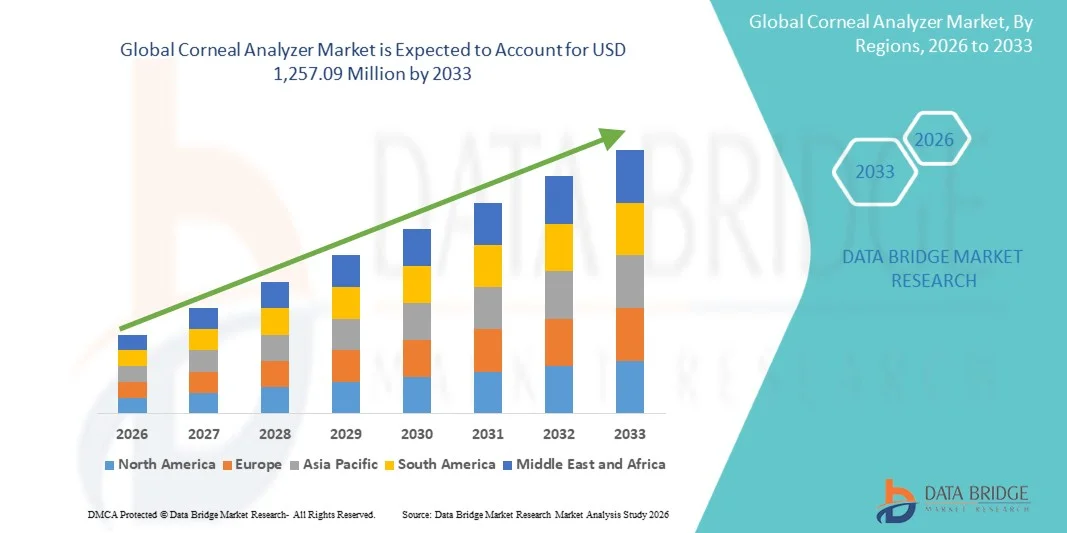
- The global corneal analyzer market size was valued at USD 850.85 million in 2025and is expected to reach USD 1,257.09 million by 2033, at a CAGR of 5.00% during the forecast period
- The market growth is largely fueled by the increasing prevalence of corneal disorders, refractive errors, and dry eye diseases, along with rising demand for advanced ophthalmic diagnostic technologies in hospitals, eye clinics, and specialty centers
- Furthermore, growing adoption of precision-based eye examination systems, expanding ophthalmology infrastructure, and technological advancements in imaging accuracy and automation are strengthening the role of corneal analyzers as essential diagnostic tools, thereby significantly accelerating market expansion
Corneal Analyzer Market Analysis
- Corneal analyzers, used for detailed assessment of corneal curvature, topography, and refractive properties, are essential ophthalmic diagnostic devices in hospitals and eye clinics due to their ability to enable early detection and precise evaluation of corneal disorders, refractive errors, and surgical outcomes in vision correction procedures
- The rising demand for corneal analyzers is primarily driven by the increasing prevalence of vision-related disorders such as astigmatism, keratoconus, and dry eye disease, along with growing adoption of advanced ophthalmic diagnostic technologies and expanding access to specialized eye care services globally
- North America dominated the corneal analyzer market with the largest revenue share of 42.9% in 2025, supported by advanced healthcare infrastructure, high adoption of ophthalmic diagnostic innovations, and strong presence of leading eye care equipment manufacturers, with widespread usage across hospitals and specialty eye centers
- Asia-Pacific is expected to be the fastest growing region in the corneal analyzer market during the forecast period due to rising healthcare investments, increasing awareness of early eye disease diagnosis, growing geriatric population, and expanding ophthalmology service networks in emerging economies
- The bench-top segment dominated the corneal analyzer market with a market share of 58.6% in 2025, driven by its high accuracy, advanced imaging capabilities, and widespread adoption in hospitals and ophthalmic diagnostic centers for comprehensive corneal assessment and surgical planning
Report Scope and Corneal Analyzer Market Segmentation
|
Attributes |
Corneal Analyzer Key Market Insights |
|
Segments Covered |
|
|
Countries Covered |
North America · U.S. · Canada · Mexico Europe · Germany · France · U.K. · Netherlands · Switzerland · Belgium · Russia · Italy · Spain · Turkey · Rest of Europe Asia-Pacific · China · Japan · India · South Korea · Singapore · Malaysia · Australia · Thailand · Indonesia · Philippines · Rest of Asia-Pacific Middle East and Africa · Saudi Arabia · U.A.E. · South Africa · Egypt · Israel · Rest of Middle East and Africa South America · Brazil · Argentina · Rest of South America |
|
Key Market Players |
|
|
Market Opportunities |
· Integration of corneal analyzers with AI-powered diagnostic platforms · Growing demand for portable and handheld corneal analyzers in ambulatory and remote eye care settings |
|
Value Added Data Infosets |
In addition to the insights on market scenarios such as market value, growth rate, segmentation, geographical coverage, and major players, the market reports curated by the Data Bridge Market Research also include in-depth expert analysis, patient epidemiology, pipeline analysis, pricing analysis, and regulatory framework |
Corneal Analyzer Market Trends
“AI-Driven Imaging and Enhanced Diagnostic Precision”
- A significant and accelerating trend in the global corneal analyzer market is the integration of artificial intelligence (AI) and advanced imaging analytics to improve diagnostic accuracy and automate interpretation of corneal data in ophthalmic examinations
- For instance, modern corneal analyzers are incorporating AI-based algorithms that assist in detecting early signs of keratoconus and refractive irregularities by analyzing corneal curvature and elevation maps with higher precision
- AI integration in corneal analyzers enables automated pattern recognition, improved repeatability of measurements, and faster clinical decision-making, helping ophthalmologists reduce diagnostic errors and enhance patient outcomes in refractive and corneal disease management
- The seamless integration of corneal analyzers with electronic medical records (EMR) systems and ophthalmic diagnostic platforms is enabling centralized data access, streamlined workflow, and better long-term monitoring of patient eye health conditions
- Another emerging trend is the growing use of portable and compact corneal analyzers in outpatient and mobile eye care units, expanding access to advanced diagnostics in remote and underserved regions
- This trend toward intelligent, high-precision, and digitally connected diagnostic systems is reshaping expectations in ophthalmology practices, with companies developing next-generation corneal analyzers featuring enhanced imaging speed, 3D mapping, and AI-assisted diagnostics
- The demand for advanced corneal analyzers with AI-enabled analysis and high-resolution imaging capabilities is growing rapidly across hospitals and specialty eye clinics, as clinicians increasingly prioritize accuracy, efficiency, and early disease detection
Corneal Analyzer Market Dynamics
Driver
“Rising Prevalence of Corneal Disorders and Expanding Ophthalmic Diagnostics Demand”
- The increasing prevalence of corneal disorders, refractive errors, and age-related vision impairment is a major driver for the growing demand for corneal analyzers in both developed and emerging healthcare markets
- For instance, rising cases of keratoconus and astigmatism are prompting greater use of advanced corneal diagnostic systems in pre-surgical planning and contact lens fitting procedures across ophthalmology centers
- As patient awareness regarding early eye disease detection increases, corneal analyzers provide critical benefits such as precise corneal mapping, early diagnosis, and improved treatment planning for vision correction procedures
- Furthermore, the expansion of ophthalmic healthcare infrastructure and increasing adoption of advanced diagnostic equipment in hospitals and eye clinics are supporting broader utilization of corneal analyzers globally
- The growing number of refractive surgeries such as LASIK and cataract procedures is also driving demand for accurate corneal assessment tools, strengthening the role of corneal analyzers in clinical decision-making workflows
- In addition, rising geriatric population globally is contributing to higher incidence of corneal degeneration and vision-related complications, further increasing reliance on advanced diagnostic devices
- Moreover, increasing integration of corneal analysis in preoperative screening protocols is improving surgical outcomes and reinforcing the importance of corneal analyzers in modern ophthalmic practice
Restraint/Challenge
“High Equipment Cost and Limited Accessibility in Emerging Regions”
- The high cost of advanced corneal analyzer systems and associated maintenance expenses poses a significant challenge to widespread adoption, particularly in cost-sensitive healthcare markets and smaller clinical setting
- For instance, premium corneal analyzers with high-resolution imaging and AI-based diagnostic capabilities require substantial capital investment, limiting their deployment in low-resource hospitals and standalone eye clinics
- In addition, the need for skilled ophthalmic professionals to operate and interpret results from advanced corneal diagnostic systems can restrict adoption in regions with limited trained healthcare workforce
- Limited reimbursement frameworks for advanced ophthalmic diagnostic procedures in some developing countries further reduce affordability and slow down market penetration of corneal analyzers
- Moreover, lack of standardized diagnostic protocols across different ophthalmology practices can create variability in test interpretation, affecting consistent clinical adoption
- Furthermore, slow procurement cycles in public healthcare systems can delay the integration of advanced corneal diagnostic equipment despite rising clinical demand
- Overcoming these challenges through development of cost-effective models, improved training programs, standardization of diagnostic guidelines, and wider healthcare funding support will be essential for sustained global market expansion
Corneal Analyzer Market Scope
The market is segmented on the basis of product type and end user.
- By Product Type
On the basis of product type, the corneal analyzer market is segmented into handheld and bench-top systems. The bench-top segment dominated the market with the largest revenue share of 58.6% in 2025, driven by its superior diagnostic accuracy, advanced imaging capabilities, and widespread adoption in hospitals and specialty ophthalmic centers. Bench-top corneal analyzers provide highly detailed corneal topography and tomography, making them essential for refractive surgery planning and complex corneal disorder diagnosis. These systems are preferred in clinical settings due to their ability to deliver comprehensive, high-resolution measurements that support precise treatment decisions. In addition, their integration with advanced ophthalmic diagnostic platforms and compatibility with multiple testing modules further strengthens their dominance. The strong presence of established healthcare infrastructure in developed regions also contributes significantly to the high utilization of bench-top systems. Furthermore, continuous technological advancements such as 3D corneal mapping and AI-assisted analysis are reinforcing their position as the standard diagnostic tool in ophthalmology clinics.
The handheld segment is anticipated to witness the fastest growth rate of 22.4% from 2026 to 2033, fueled by increasing demand for portable, point-of-care diagnostic solutions in ophthalmology. Handheld corneal analyzers are gaining traction due to their ease of use, mobility, and ability to perform rapid screenings in outpatient and remote care settings. These devices are particularly valuable in rural healthcare environments where access to full-scale ophthalmic equipment is limited. Growing adoption in mobile eye clinics and community screening programs is further accelerating segment growth. In addition, advancements in miniaturization and wireless connectivity are improving device functionality and enabling real-time data transfer to hospital systems. Rising focus on early detection of corneal diseases and expanding outreach eye care initiatives are also contributing to increased adoption of handheld systems globally.
- By End User
On the basis of end user, the corneal analyzer market is segmented into hospitals, eye clinics, and others. The hospitals segment dominated the market with the largest revenue share of 62.3% in 2025, driven by high patient inflow, availability of advanced ophthalmic infrastructure, and strong adoption of sophisticated diagnostic technologies. Hospitals are primary centers for complex eye disease diagnosis and surgical procedures, requiring precise corneal analysis for treatment planning. The availability of trained ophthalmologists and integration of corneal analyzers into multi-specialty diagnostic systems further supports hospital dominance. In addition, hospitals frequently invest in high-end bench-top analyzers, enhancing diagnostic accuracy and workflow efficiency. The rising number of refractive surgeries and cataract procedures performed in hospital settings also contributes significantly to segment growth. Furthermore, government and private healthcare funding for advanced ophthalmic equipment is strengthening adoption in hospital environments globally.
The eye clinics segment is expected to witness the fastest growth rate of 23.1% from 2026 to 2033, driven by increasing preference for specialized and outpatient ophthalmic care services. Eye clinics are rapidly adopting corneal analyzers to provide focused, efficient, and cost-effective diagnostic services for refractive errors and corneal disorders. The growing trend of standalone ophthalmic centers and chain eye care clinics is boosting demand for compact and user-friendly diagnostic devices. These settings benefit from faster patient turnaround and high-volume screening capabilities enabled by modern corneal analyzers. In addition, rising awareness of preventive eye care and early diagnosis is encouraging more patients to seek treatment in specialized clinics rather than hospitals. Technological advancements in portable and automated corneal analyzers are further supporting adoption in these facilities. Expanding private healthcare investments in ophthalmology clinics, particularly in emerging economies, is also accelerating segment growth globally.
Corneal Analyzer Market Regional Analysis
- North America dominated the corneal analyzer market with the largest revenue share of 42.9% in 2025, supported by advanced healthcare infrastructure, high adoption of ophthalmic diagnostic innovations, and strong presence of leading eye care equipment manufacturers, with widespread usage across hospitals and specialty eye centers
- Healthcare providers in the region highly value the precision, early disease detection capabilities, and advanced imaging accuracy offered by corneal analyzers for managing refractive errors and corneal disorders in clinical and surgical settings
- This widespread adoption is further supported by a high prevalence of vision-related disorders, strong reimbursement frameworks for ophthalmic procedures, and the presence of leading eye care device manufacturers, establishing corneal analyzers as a standard diagnostic tool across hospitals and specialty eye clinics
U.S. Corneal Analyzer Market Insight
The U.S. corneal analyzer market captured the largest revenue share of 80.6% in 2025 within North America, driven by the strong presence of advanced ophthalmic healthcare infrastructure and rapid adoption of cutting-edge diagnostic imaging technologies. Healthcare providers are increasingly prioritizing early detection and precise evaluation of corneal disorders such as keratoconus, astigmatism, and refractive errors through advanced corneal analysis systems. The growing number of refractive surgeries and laser-assisted vision correction procedures is further boosting demand for high-accuracy diagnostic devices. Moreover, the integration of AI-enabled ophthalmic platforms and electronic medical record systems is significantly contributing to workflow efficiency and market expansion.
Europe Corneal Analyzer Market Insight
The Europe corneal analyzer market is projected to expand at a substantial CAGR throughout the forecast period, primarily driven by rising prevalence of eye disorders and increasing demand for advanced diagnostic ophthalmic equipment. The region’s strong regulatory focus on healthcare quality and early disease detection is encouraging widespread adoption of corneal analyzers in hospitals and specialty eye clinics. Growing aging population and increasing cases of refractive vision disorders are further supporting market growth. In addition, expansion of outpatient ophthalmology centers and increasing investment in healthcare modernization are fostering greater penetration of advanced corneal diagnostic technologies across the region.
U.K. Corneal Analyzer Market Insight
The U.K. corneal analyzer market is anticipated to grow at a noteworthy CAGR during the forecast period, driven by increasing awareness of preventive eye care and rising demand for advanced ophthalmic diagnostics in both public and private healthcare systems. Concerns related to vision impairment and corneal diseases are encouraging early diagnostic testing using high-precision corneal analyzers. The country’s strong adoption of digital healthcare solutions and integration of diagnostic devices with hospital information systems are further accelerating market growth. In addition, expanding private eye care clinics and increasing refractive surgery procedures are supporting sustained demand for advanced corneal imaging systems.
Germany Corneal Analyzer Market Insight
The Germany corneal analyzer market is expected to expand at a considerable CAGR during the forecast period, fueled by growing emphasis on precision diagnostics and technologically advanced ophthalmic equipment. Germany’s well-established healthcare infrastructure and strong focus on medical innovation are promoting the adoption of high-end corneal analyzers in clinical practice. Increasing prevalence of age-related eye disorders and rising demand for refractive surgery planning are further driving market growth. Moreover, integration of corneal analyzers with digital health platforms and emphasis on high-quality, data-driven diagnosis are aligning with local healthcare standards and supporting wider adoption.
Asia-Pacific Corneal Analyzer Market Insight
The Asia-Pacific corneal analyzer market is poised to grow at the fastest CAGR of 23.8% during the forecast period of 2026 to 2033, driven by rapid urbanization, rising healthcare expenditure, and increasing prevalence of vision disorders in countries such as China, India, and Japan. Growing awareness of early eye disease detection and expanding access to ophthalmic care services are significantly boosting demand for advanced diagnostic devices. Furthermore, increasing investments in eye care infrastructure and expansion of specialty ophthalmology clinics are supporting market penetration. The region’s growing medical device manufacturing capabilities are also improving affordability and accessibility of corneal analyzers across emerging economies.
Japan Corneal Analyzer Market Insight
The Japan corneal analyzer market is gaining momentum due to the country’s advanced healthcare system, aging population, and strong emphasis on precision medical diagnostics. Rising prevalence of age-related corneal and refractive disorders is increasing demand for high-accuracy diagnostic imaging systems in hospitals and eye clinics. The integration of corneal analyzers with digital ophthalmic platforms and AI-assisted diagnostic tools is further enhancing clinical efficiency. Moreover, Japan’s focus on technologically advanced and minimally invasive diagnostic procedures is supporting steady adoption of corneal analyzers in both public and private healthcare settings.
India Corneal Analyzer Market Insight
The India corneal analyzer market accounted for the largest market revenue share in Asia-Pacific in 2025, attributed to the rapidly expanding patient pool with vision disorders and increasing investments in ophthalmic healthcare infrastructure. Growing awareness of eye health and rising demand for early diagnosis of corneal diseases are driving adoption of advanced diagnostic devices in urban and semi-urban areas. Expansion of eye care chains and specialty ophthalmology clinics is further strengthening market growth. In addition, improving affordability of medical devices and government initiatives supporting healthcare modernization and preventive eye care are key factors propelling market expansion in the country.
Corneal Analyzer Market Share
The Corneal Analyzer industry is primarily led by well-established companies, including:
- Carl Zeiss Meditec AG (Germany)
- OCULUS Optikgeräte GmbH (Germany)
- NIDEK CO., LTD. (Japan)
- Topcon Corporation (Japan)
- Tomey Corporation (Japan)
- Haag-Streit AG (Switzerland)
- Alcon Inc. (Switzerland)
- Bausch + Lomb Incorporated (U.S.)
- Essilor Instruments (France)
- Canon Inc. (Japan)
- Ziemer Ophthalmic Systems AG (Switzerland)
- Medmont International Pty Ltd (Australia)
- Optovue, Inc. (U.S.)
- Tracey Technologies Corp. (U.S.)
- EyeSys Vision (U.S.)
- Heidelberg Engineering GmbH (Germany)
- SCHWIND eye-tech-solutions GmbH (Germany)
- CSO Srl (Italy)
- Visionix Ltd (Israel)
- Reichert Technologies (U.S.)
What are the Recent Developments in Global Corneal Analyzer Market?
- In October 2025, Topcon Healthcare, a leading ophthalmic diagnostic solutions provider, announced the advancement of its AI-enabled ophthalmic imaging ecosystem designed to integrate large-scale ocular data and enhance corneal and eye disease diagnostics. The solution focuses on improving corneal assessment accuracy through multimodal imaging, AI-driven analytics, and connected clinical workflows, supporting earlier detection and better management of corneal disorders in clinical practice
- In September 2025, ophthalmology researchers and clinical innovators demonstrated the use of portable and handheld corneal topography devices for community-based screening of keratoconus and other corneal abnormalities. These innovations enable rapid, non-invasive corneal assessments in outreach programs, improving early diagnosis rates in remote and underserved populations while expanding access to advanced eye care diagnostics
- In September 2025, Topcon Healthcare introduced an advanced non-invasive ocular surface imaging solution designed to enhance corneal and tear film evaluation within a single integrated platform. The system supports comprehensive analysis of corneal conditions and dry eye disease, enabling clinicians to improve diagnostic precision and streamline ophthalmic examination workflows in clinical environments
- In May 2025, clinical research advancements highlighted the application of deep learning algorithms for automated interpretation of corneal topography maps, significantly improving diagnostic accuracy for conditions such as keratoconus and irregular astigmatism. These AI-based systems are increasingly being validated for clinical use, enabling faster, more consistent, and objective evaluation of corneal structures compared to traditional manual analysis methods
- In March 2025, academic and medical imaging research introduced large-scale multimodal corneal topography datasets designed to support artificial intelligence model development for automated corneal disease detection. These datasets improve machine learning training for identifying keratoconus and other corneal abnormalities, accelerating innovation in AI-based ophthalmic diagnostic systems and enhancing future corneal analyzer capabilities

- Interactive Data Analysis Dashboard
- Company Analysis Dashboard for high growth potential opportunities
- Research Analyst Access for customization & queries
- Competitor Analysis with Interactive dashboard
- Latest News, Updates & Trend analysis
- Harness the Power of Benchmark Analysis for Comprehensive Competitor Tracking
Data collection and base year analysis are done using data collection modules with large sample sizes. The stage includes obtaining market information or related data through various sources and strategies. It includes examining and planning all the data acquired from the past in advance. It likewise envelops the examination of information inconsistencies seen across different information sources. The market data is analysed and estimated using market statistical and coherent models. Also, market share analysis and key trend analysis are the major success factors in the market report. To know more, please request an analyst call or drop down your inquiry.
The key research methodology used by DBMR research team is data triangulation which involves data mining, analysis of the impact of data variables on the market and primary (industry expert) validation. Data models include Vendor Positioning Grid, Market Time Line Analysis, Market Overview and Guide, Company Positioning Grid, Patent Analysis, Pricing Analysis, Company Market Share Analysis, Standards of Measurement, Global versus Regional and Vendor Share Analysis. To know more about the research methodology, drop in an inquiry to speak to our industry experts.
Data Bridge Market Research is a leader in advanced formative research. We take pride in servicing our existing and new customers with data and analysis that match and suits their goal. The report can be customized to include price trend analysis of target brands understanding the market for additional countries (ask for the list of countries), clinical trial results data, literature review, refurbished market and product base analysis. Market analysis of target competitors can be analyzed from technology-based analysis to market portfolio strategies. We can add as many competitors that you require data about in the format and data style you are looking for. Our team of analysts can also provide you data in crude raw excel files pivot tables (Fact book) or can assist you in creating presentations from the data sets available in the report.













