


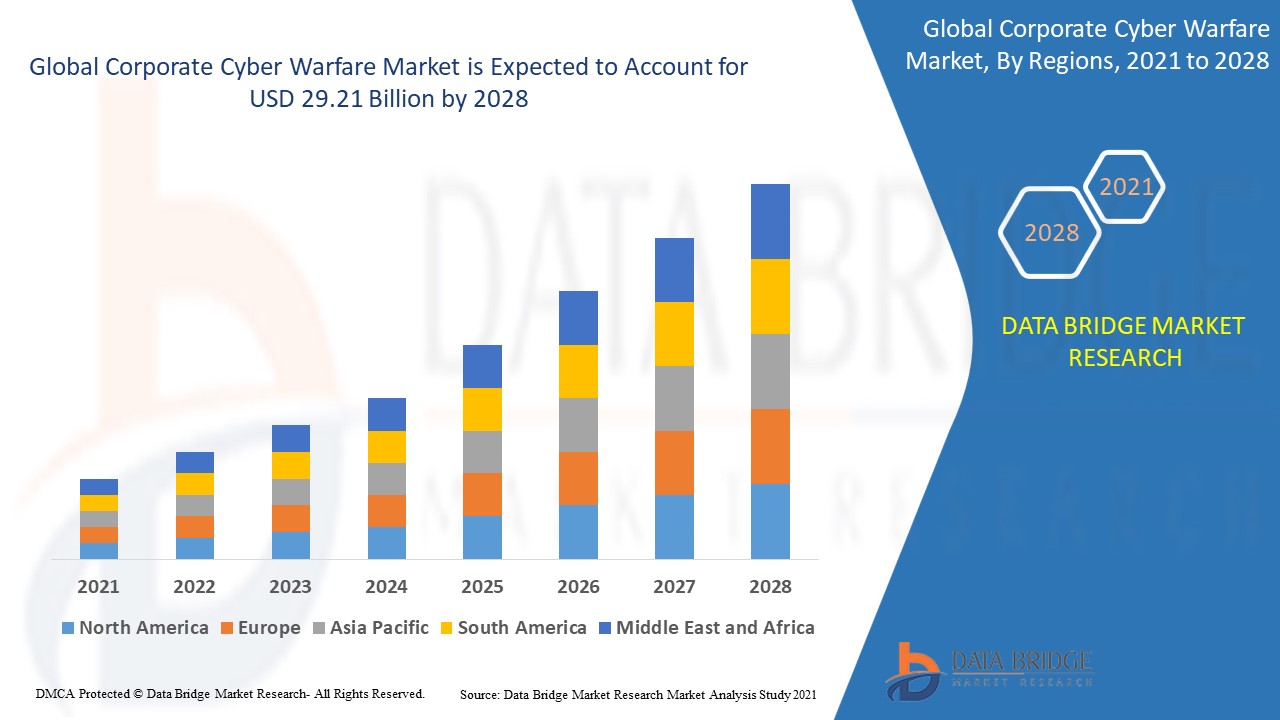
Corporate Cyber Warfare Market Analysis
The global corporate cyber warfare market is driven by the rising threat of cyberattacks targeting corporations and the increasing adoption of advanced security solutions. Cyber warfare involves malicious activities, such as data breaches, ransomware, and espionage, aimed at disrupting corporate operations. The market is expanding as businesses invest in robust cybersecurity frameworks to protect sensitive data, intellectual property, and digital infrastructure. Key players are focusing on integrating artificial intelligence, machine learning, and blockchain technologies into cybersecurity solutions. Recent developments include enhanced threat intelligence platforms and collaboration between governments and enterprises for better cyber defense strategies. With the growing digitization of industries and an evolving threat landscape, the corporate cyber warfare market is expected to witness significant growth. Companies such as IBM, Proofpoint, and Zscaler are introducing innovative solutions, driving competition and technological advancements. The market plays a crucial role in safeguarding corporate ecosystems from emerging cyber threats globally.
Corporate Cyber Warfare Market Size
The global corporate cyber warfare market size was valued at USD 15.04 billion in 2024 and is projected to reach USD 56.73 billion by 2032, with a CAGR of 18.05% during the forecast period of 2025 to 2032. In addition to the market insights such as market value, growth rate, market segments, geographical coverage, market players, and market scenario, the market report curated by the Data Bridge Market Research team includes in-depth expert analysis, import/export analysis, pricing analysis, production consumption analysis, and pestle analysis.
Corporate Cyber Warfare Market Trends
“Adopting of Cutting-Edge Technologies”
The global corporate cyber warfare market is experiencing rapid growth as businesses combat escalating cyber threats with advanced security measures. As cyberattacks become more sophisticated, corporations are adopting cutting-edge technologies such as artificial intelligence and blockchain to enhance cybersecurity frameworks. A notable trend is the integration of predictive analytics and machine learning, enabling organizations to identify and neutralize threats proactively. Innovations such as zero-trust security models and automated threat detection systems are transforming the market landscape. Companies are increasingly collaborating with governments and security firms to fortify defenses against cyber warfare. This market plays a pivotal role in safeguarding corporate assets and operations, driven by the urgent need for robust solutions in an evolving and complex threat environment.
Report Scope and Corporate Cyber Warfare Market Segmentation
|
Attributes |
Corporate Cyber Warfare Key Market Insights |
|
Segments Covered |
|
|
Countries Covered |
U.S., Canada and Mexico in North America, Germany, France, U.K., Netherlands, Switzerland, Belgium, Russia, Italy, Spain, Turkey, Rest of Europe in Europe, China, Japan, India, South Korea, Singapore, Malaysia, Australia, Thailand, Indonesia, Philippines, Rest of Asia-Pacific (APAC) in the Asia-Pacific (APAC), Saudi Arabia, U.A.E, South Africa, Egypt, Israel, Rest of Middle East and Africa (MEA) as a part of Middle East and Africa (MEA), Brazil, Argentina and Rest of South America as part of South America |
|
Key Market Players |
Airbus (Netherlands), BAE Systems (U.K.), DXC Technology Company (U.S.), General Dynamics Corporation (U.S.), IBM (U.S.), Intel Corporation (U.S.), Lockheed Martin Corporation (U.S.), Proofpoint Inc (U.S.), RTX (U.S.), Zscaler, Inc. (U.S.) |
|
Market Opportunities |
|
|
Value Added Data Infosets |
In addition to the market insights such as market value, growth rate, market segments, geographical coverage, market players, and market scenario, the market report curated by the Data Bridge Market Research team includes in-depth expert analysis, import/export analysis, pricing analysis, production consumption analysis, and pestle analysis. |
Corporate Cyber Warfare Market Definition
Global corporate cyber warfare refers to malicious activities and strategic cyberattacks directed at corporations by individuals, groups, or nation-states, aiming to disrupt operations, steal sensitive data, or damage digital infrastructure. These attacks leverage advanced techniques, such as ransomware, phishing, distributed denial-of-service (DDoS), and espionage, targeting businesses' critical assets. The term encompasses both offensive and defensive strategies employed to combat such threats, with corporations increasingly investing in cybersecurity frameworks, artificial intelligence, and collaborative defense mechanisms to mitigate risks.
Corporate Cyber Warfare Market Dynamics
Drivers
- Rise in Remote Work
The shift toward remote work has significantly expanded the attack surface for cybercriminals, as employees access corporate networks and systems from various devices and locations. This increased vulnerability exposes businesses to a broader range of cyber threats, such as phishing, malware, and ransomware attacks, which are commonly used in corporate cyber warfare. With the growing reliance on digital communication and cloud-based services, businesses are becoming more susceptible to data breaches and espionage. As a result, organizations are prioritizing the implementation of advanced cybersecurity measures to protect sensitive information and maintain operational continuity. This heightened need for secure remote work environments is a key driver for the growth of the global corporate cyber warfare market.
- Rise in Corporate Espionage
The rise in corporate espionage, where competitors or state-sponsored actors employ cyber tactics to steal intellectual property, trade secrets, or sensitive data, has become a significant concern for businesses worldwide. These malicious activities result in financial losses and damage a company's reputation and competitive edge. As a result, companies are increasingly investing in advanced cybersecurity solutions to safeguard critical assets from these covert attacks. Enhanced security measures, including encryption, access controls, and threat intelligence platforms, are becoming essential in defending against corporate espionage. This growing threat is a major driver in the expansion of the global corporate cyber warfare market.
Opportunities
- Cloud Security Solutions
As businesses increasingly migrate their operations to the cloud, the need for robust cloud security solutions has become more critical. Cloud environments, while offering flexibility and scalability, present unique vulnerabilities such as data breaches, unauthorized access, and insufficient data control. To mitigate these risks, companies are seeking advanced cloud security solutions that provide secure access, encryption, and real-time threat monitoring. This growing demand for comprehensive cloud security frameworks presents a significant opportunity for cybersecurity providers to develop specialized solutions tailored to cloud infrastructure. The shift toward cloud adoption continues to drive the expansion of the global corporate cyber warfare market, positioning cloud security as a key growth opportunity.
- Rise in Cybersecurity Awareness
As businesses become more aware of the potentially devastating consequences of cyber warfare, including financial losses, reputational damage, and intellectual property theft, there is a growing demand for proactive cybersecurity solutions. Companies are shifting from reactive measures to more strategic, preventative approaches, such as continuous monitoring, threat intelligence, and advanced risk management tools. This heightened focus on cybersecurity innovation fosters the development of next-generation security technologies, such as AI-powered threat detection and automated response systems. As a result, this demand for proactive security solutions presents a significant market opportunity, driving the growth and expansion of the global corporate cyber warfare market.
Restraints/Challenges
- Shortage of Skilled Cybersecurity Professionals
The growing demand for qualified cybersecurity experts significantly exceeds the available supply, creating a substantial talent gap in the industry. This shortage of skilled professionals hinders organizations' ability to effectively combat cyber threats, as businesses struggle to recruit and retain talent capable of managing complex security environments. With the increasing sophistication of cyberattacks, companies require highly trained experts to develop, implement, and maintain advanced defense strategies. This talent shortage is particularly challenging for small to medium-sized enterprises, which may not have the resources to attract top-tier cybersecurity professionals. This gap in expertise is a major challenge affecting the global corporate cyber warfare market.
- High Costs of Cybersecurity Implementation
Investing in advanced cybersecurity measures, such as AI-driven tools, threat detection systems, and secure cloud infrastructures, can be a significant financial burden, particularly for small to medium-sized enterprises (SMEs). These businesses often have limited budgets and may find it difficult to justify or allocate funds for sophisticated security solutions that require ongoing updates and maintenance. The high costs of implementing comprehensive cybersecurity frameworks can deter SMEs from adopting necessary protections, leaving them vulnerable to cyber threats. As a result, the financial constraints faced by smaller organizations act as a major restraint on the growth of the global corporate cyber warfare market.
This market report provides details of new recent developments, trade regulations, import-export analysis, production analysis, value chain optimization, market share, impact of domestic and localized market players, analyses opportunities in terms of emerging revenue pockets, changes in market regulations, strategic market growth analysis, market size, category market growths, application niches and dominance, product approvals, product launches, geographic expansions, technological innovations in the market. To gain more info on the market contact Data Bridge Market Research for an analyst brief, our team will help you take an informed market decision to achieve market growth.
Corporate Cyber Warfare Market Scope
The market is segmented on the basis of type and application. The growth amongst these segments will help you analyze meagre growth segments in the industries and provide the users with a valuable market overview and market insights to help them make strategic decisions for identifying core market applications.
Type
- Solutions
- Services
Application
- Aerospace
- Corporate
- Government
- Homeland
- Defense
Corporate Cyber Warfare Market Regional Analysis
The market is analyzed and market size insights and trends are provided by country, type, and application as referenced above.
The countries covered in the market report are U.S., Canada, Mexico in North America, Germany, Sweden, Poland, Denmark, Italy, U.K., France, Spain, Netherland, Belgium, Switzerland, Turkey, Russia, Rest of Europe in Europe, Japan, China, India, South Korea, New Zealand, Vietnam, Australia, Singapore, Malaysia, Thailand, Indonesia, Philippines, Rest of Asia-Pacific (APAC) in Asia-Pacific (APAC), Brazil, Argentina, Rest of South America as a part of South America, U.A.E, Saudi Arabia, Oman, Qatar, Kuwait, South Africa, Rest of Middle East and Africa (MEA) as a part of Middle East and Africa (MEA).
North America dominate the corporate cyber warfare market, driven by the widespread availability of advanced IT infrastructure and the growing trend of hyperconnectivity. This interconnected environment necessitates continuous monitoring and management of potential cyber threats across organizational systems. As a result, businesses in the region are increasingly investing in robust cybersecurity solutions to safeguard their digital assets.
The country section of the report also provides individual market impacting factors and changes in market regulation that impact the current and future trends of the market. Data points such as down-stream and upstream value chain analysis, technical trends and porter's five forces analysis, case studies are some of the pointers used to forecast the market scenario for individual countries. Also, the presence and availability of global brands and their challenges faced due to large or scarce competition from local and domestic brands, impact of domestic tariffs and trade routes are considered while providing forecast analysis of the country data.
Corporate Cyber Warfare Market Share
The market competitive landscape provides details by competitor. Details included are company overview, company financials, revenue generated, market potential, investment in research and development, new market initiatives, global presence, production sites and facilities, production capacities, company strengths and weaknesses, product launch, product width and breadth, application dominance. The above data points provided are only related to the companies' focus related to market.
Corporate Cyber Warfare Market Leaders Operating in the Market Are:
- Airbus (Netherlands)
- BAE Systems (U.K.)
- DXC Technology Company (U.S.)
- General Dynamics Corporation (U.S.)
- IBM (U.S.)
- Intel Corporation (U.S.)
- Lockheed Martin Corporation (U.S.)
- Proofpoint Inc (U.S.)
- RTX (U.S.)
- Zscaler, Inc. (U.S.)
Latest Developments in Global Corporate Cyber Warfare Market
- In November 2023, BAE Systems Detica introduced CyberReveal, its defense-grade cybersecurity product, to the commercial sector, allowing companies to use it in-house for the first time. CyberReveal is an advanced analytics and investigation tool designed to help organizations safeguard their valuable assets and sensitive commercial data from cyber threats. The product provides real-time intelligence, empowering companies to proactively protect themselves from potential cybercriminal activities
- In May 2023, Mosaic, an agricultural firm, partnered with U.S.-based Safe Security to launch a new cyber coverage model, integrating real-time cyber-risk data into Mosaic's underwriting process. The collaboration leverages Safe Security’s cyber-risk platform to evaluate organizational cybersecurity and provides premium-rate incentives for companies investing in stronger security measures
- In August 2022, SynSaber, a cybersecurity and asset monitoring company, raised USD 13 million in Series A funding. This investment is fueling the growth of SynSaber’s industrial asset and network monitoring solutions, expanding its global footprint, and enhancing its sales, marketing, and development efforts, while advancing customer engagement and research
- In February 2022, IBM made a multi-million-dollar investment in its Asia Pacific operations, opening a new Security Operations Center (SOC) as part of its effort to boost cyber resiliency for businesses in the region. The center aims to improve cybersecurity capabilities for organizations across the area
- In July 2021, Leonardo, an aerospace company, joined forces with Italian utility A2A to integrate its advanced cybersecurity technologies into A2A's plants and networks. The partnership, supported by Leonardo’s cybersecurity research center, aims to enhance security during digital transformation processes and develop products that protect energy infrastructures from cyber threats

- Interactive Data Analysis Dashboard
- Company Analysis Dashboard for high growth potential opportunities
- Research Analyst Access for customization & queries
- Competitor Analysis with Interactive dashboard
- Latest News, Updates & Trend analysis
- Harness the Power of Benchmark Analysis for Comprehensive Competitor Tracking
Data collection and base year analysis are done using data collection modules with large sample sizes. The stage includes obtaining market information or related data through various sources and strategies. It includes examining and planning all the data acquired from the past in advance. It likewise envelops the examination of information inconsistencies seen across different information sources. The market data is analysed and estimated using market statistical and coherent models. Also, market share analysis and key trend analysis are the major success factors in the market report. To know more, please request an analyst call or drop down your inquiry.
The key research methodology used by DBMR research team is data triangulation which involves data mining, analysis of the impact of data variables on the market and primary (industry expert) validation. Data models include Vendor Positioning Grid, Market Time Line Analysis, Market Overview and Guide, Company Positioning Grid, Patent Analysis, Pricing Analysis, Company Market Share Analysis, Standards of Measurement, Global versus Regional and Vendor Share Analysis. To know more about the research methodology, drop in an inquiry to speak to our industry experts.
Data Bridge Market Research is a leader in advanced formative research. We take pride in servicing our existing and new customers with data and analysis that match and suits their goal. The report can be customized to include price trend analysis of target brands understanding the market for additional countries (ask for the list of countries), clinical trial results data, literature review, refurbished market and product base analysis. Market analysis of target competitors can be analyzed from technology-based analysis to market portfolio strategies. We can add as many competitors that you require data about in the format and data style you are looking for. Our team of analysts can also provide you data in crude raw excel files pivot tables (Fact book) or can assist you in creating presentations from the data sets available in the report.













