What is the Corporate Social Responsibility Software Market Size and Overview?
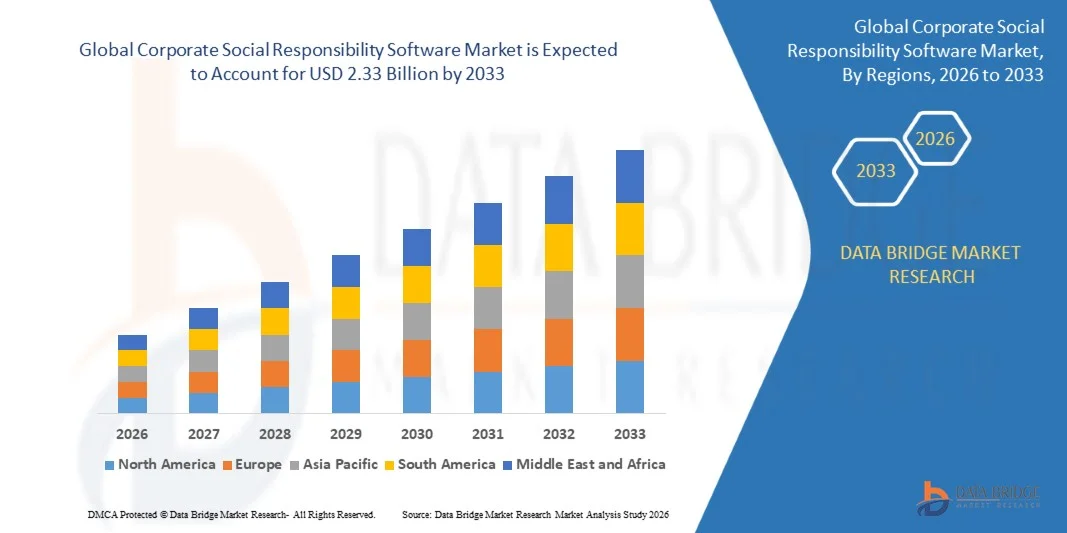
As per Data Bridge Market Research analysis, the corporate social responsibility software market was valued at USD 1.05 billion in 2025 and is projected to reach USD 2.33 billion by 2033, growing at a CAGR of 10.48% from 2026 to 2033. The market is experiencing significant growth driven by increasing corporate focus on environmental, social, and governance (ESG) performance, rising regulatory requirements for sustainability reporting, and growing demand for centralized platforms to manage CSR initiatives, stakeholder engagement, and impact measurement.
The growing emphasis on transparency and corporate accountability, combined with evolving sustainability standards and investor expectations, is compelling organizations across industries to adopt advanced CSR software solutions. Cloud-based and AI-enabled platforms are increasingly replacing manual reporting and fragmented tracking systems, enabling businesses to streamline ESG disclosures, monitor sustainability metrics in real time, and improve compliance with international reporting frameworks. Furthermore, the expanding adoption of CSR software across large enterprises, government organizations, and small and medium-sized businesses is supporting market growth by facilitating data-driven decision-making and strengthening corporate sustainability strategies.
Market Size & Forecast
- Market Value (2025): USD 1.05 Billion
- Expected Market Value (2033): USD 2.33 Billion
- Forecast CAGR (2026–2033): 10.48%
- Leading Region in 2025: North America
- Fastest Growing Region: Asia-Pacific
Key Market Trends & Insights
- North America dominated the corporate social responsibility software market with the largest revenue share of 45.5% in 2025, supported by increasing regulatory requirements for ESG disclosures, a strong corporate sustainability culture, and widespread adoption of digital transformation technologies.
- Asia-Pacific corporate social responsibility software market is expected to witness the fastest growth rate from 2026 to 2033, holding approximately 20.5% of the market share, supported by increasing digitalization, rising corporate sustainability initiatives, and expanding regulatory frameworks in countries such as China, Japan, India, and Australia.
- The cloud-based segment held the largest market share in 2025 driven by its scalability, lower upfront costs, and ability to support real-time ESG reporting across geographically dispersed operations. Cloud-based CSR platforms are increasingly preferred by organizations due to their ease of deployment, seamless integration capabilities, and support for remote collaboration across sustainability teams.
- The on-premise segment is projected to witness steady growth from 2026 to 2033, supported by demand from organizations operating in highly regulated industries that require greater control over sensitive sustainability and compliance data. Growing concerns regarding data privacy and internal governance are continuing to support adoption among select enterprise customers.
- The large enterprises segment accounted for the largest market share in 2025 owing to significant investments in ESG initiatives, greater regulatory exposure, and the need for comprehensive sustainability reporting capabilities. Large organizations continue to adopt CSR software to manage complex reporting requirements and improve stakeholder engagement across operations.
- The SMEs segment is expected to register the fastest growth during the forecast period, driven by increasing affordability of cloud-based solutions and growing awareness of the business benefits associated with sustainability initiatives. Rising investor and customer expectations are encouraging SMEs to formalize their CSR programs and adopt dedicated software platforms.
Report Scope and Corporate Social Responsibility Software Market Segmentation
|
Attributes |
Corporate Social Responsibility Software Key Market Insights |
|
Segments Covered |
|
|
Countries Covered |
North America
Europe
Asia-Pacific
Middle East and Africa
South America
|
|
Key Market Players |
|
|
Market Opportunities |
|
|
Value Added Data Infosets |
In addition to the market insights such as market value, growth rate, market segments, geographical coverage, market players, and market scenario, the market report curated by the Data Bridge Market Research team includes in-depth expert analysis, import/export analysis, pricing analysis, production consumption analysis, and pestle analysis. |
What is the Key Trend in the Corporate Social Responsibility Software Market?
Trend: Rising Adoption Of AI-Enabled ESG And Sustainability Reporting Platforms
Growing corporate emphasis on sustainability, transparency, and stakeholder accountability is accelerating the adoption of corporate social responsibility (CSR) software across industries worldwide. Organizations are increasingly deploying AI-enabled and cloud-based CSR platforms to streamline ESG reporting, monitor sustainability performance, and improve compliance with evolving disclosure frameworks. The increasing alignment of CSR initiatives with broader business strategies is further strengthening demand for integrated software solutions.
The rapid expansion of sustainability regulations and investor scrutiny is creating sustained demand for CSR software capable of automating data collection, impact assessment, and regulatory reporting. For instance, in September 2025, Workiva introduced new Sustainability Reporting capabilities, including ESRS Intelligence powered by Workiva AI, enabling enterprises to simplify compliance with European Sustainability Reporting Standards (ESRS), identify applicable disclosure requirements, and improve reporting efficiency. This development reflects increasing industry investment in intelligent CSR and ESG management solutions that directly support organizational sustainability objectives.
The growing shift toward digital sustainability management and continued investments in AI-powered reporting technologies are expected to reinforce long-term demand for CSR software, positioning providers to benefit from increasing corporate commitments to environmental and social responsibility initiatives.
Corporate Social Responsibility Software Market Dynamics
Key Market Driver: Increasing Regulatory Requirements For ESG And Sustainability Reporting
The business environment continues to experience increasing demand for ESG transparency due to stricter disclosure requirements, investor expectations, and stakeholder scrutiny. Organizations are increasingly adopting CSR software to centralize sustainability data, improve reporting accuracy, and enhance accountability across environmental and social initiatives.
Major software providers continue investing in ESG management capabilities to address growing market demand. According to Workiva's 2025 Executive Benchmark Report on Integrated Reporting, 97% of executives believe sustainability reporting will provide a business advantage within the next two years, while 93% report increased investor requests for ESG-related information. This growing emphasis on transparency is directly increasing demand for CSR software across large enterprises, financial institutions, and multinational organizations.
As sustainability regulations and reporting requirements continue to expand, CSR software providers are expected to benefit from sustained demand driven by compliance needs, improved stakeholder engagement, and increasing investments in digital sustainability infrastructure.
Key Restraint/Challenge: Data Integration Complexity And Evolving Regulatory Standards
Corporate social responsibility software providers remain challenged by the complexity of integrating sustainability data across multiple enterprise systems, exposing organizations to implementation delays and increased operational costs. Variability in reporting frameworks, changing regulatory requirements, and fragmented data sources continue to affect software deployment and long-term adoption, particularly among organizations operating across multiple jurisdictions.
In addition, enterprises must manage data quality and interoperability challenges while maintaining compliance with evolving sustainability standards. For instance, July 2026 the European Union's Corporate Sustainability Reporting Directive (CSRD) significantly expanded reporting obligations for thousands of companies across Europe, requiring substantial investments in sustainability data management and reporting capabilities. These market conditions continue to create implementation challenges across the CSR software ecosystem.
Despite robust market demand, data integration complexities and ongoing regulatory uncertainties are expected to remain significant restraints, increasing implementation costs, pressuring IT resources, and limiting seamless adoption throughout the forecast period.
Key Market Opportunity: Expansion Of AI-Driven Sustainability Analytics And ESG Automation
Governments, investors, and enterprises are accelerating investments in digital sustainability initiatives to improve reporting efficiency and enhance strategic decision-making. AI-powered analytics and automated ESG reporting capabilities are creating significant long-term opportunities for CSR software providers supplying intelligent sustainability management solutions to organizations worldwide.
Leading companies are strengthening their offerings through advanced analytics and automation technologies. For instance, June 2026, Workiva continues to expand its AI capabilities through Disclosure Creator and IFRS Sustainability Intelligence tools, enabling enterprises to draft disclosures, identify reporting gaps, and improve compliance with IFRS Sustainability Disclosure Standards. These innovations are supporting increased adoption of digital CSR solutions across enterprises.
As governments tighten sustainability regulations and businesses accelerate ESG initiatives, increasing use of AI-enabled analytics and automated reporting solutions is expected to create substantial long-term growth opportunities for the corporate social responsibility software market.
How is the Corporate Social Responsibility Software Market Segmented?
The market is segmented on the basis of deployment model, organization size, industry vertical, specific functionality, and type of organization.
- By Deployment Model
On the basis of deployment model, the corporate social responsibility software market is segmented into cloud-based and on-premise. The cloud-based segment held the largest market share in 2025 driven by its scalability, lower upfront costs, and ability to support real-time ESG reporting across geographically dispersed operations. Cloud-based CSR platforms are increasingly preferred by organizations due to their ease of deployment, seamless integration capabilities, and support for remote collaboration across sustainability teams.
The on-premise segment is projected to witness steady growth from 2026 to 2033, supported by demand from organizations operating in highly regulated industries that require greater control over sensitive sustainability and compliance data. Growing concerns regarding data privacy and internal governance are continuing to support adoption among select enterprise customers.
- By Organization Size
On the basis of organization size, the market is segmented into small and medium-sized enterprises (SMEs) and large enterprises. The large enterprises segment accounted for the largest market share in 2025 owing to significant investments in ESG initiatives, greater regulatory exposure, and the need for comprehensive sustainability reporting capabilities. Large organizations continue to adopt CSR software to manage complex reporting requirements and improve stakeholder engagement across operations.
The SMEs segment is expected to register the fastest growth during the forecast period, driven by increasing affordability of cloud-based solutions and growing awareness of the business benefits associated with sustainability initiatives. Rising investor and customer expectations are encouraging SMEs to formalize their CSR programs and adopt dedicated software platforms.
- By Industry Vertical
On the basis of industry vertical, the market is segmented into manufacturing, retail and consumer goods, healthcare, financial services, IT and telecommunications, government, education, and non-profit. The manufacturing segment held the largest market share in 2025 driven by increasing pressure to reduce environmental impact, improve supply chain transparency, and comply with sustainability regulations. Manufacturers are leveraging CSR software to monitor emissions, track resource utilization, and support corporate sustainability objectives.
The IT and telecommunications segment is projected to witness the fastest growth from 2026 to 2033 due to rising investments in digital sustainability initiatives and increasing emphasis on transparent ESG reporting. Growing adoption of AI-enabled sustainability platforms is further contributing to segment expansion.
- By Specific Functionality
On the basis of specific functionality, the market is segmented into carbon emissions reporting, supply chain management, social impact tracking, employee engagement, and data analytics. The carbon emissions reporting segment accounted for the largest market share in 2025 owing to increasing focus on decarbonization, net-zero commitments, and mandatory emissions disclosure requirements. Organizations are increasingly prioritizing emissions monitoring to align with international sustainability standards and investor expectations.
The data analytics segment is expected to witness the fastest growth during the forecast period, supported by growing demand for actionable sustainability insights, predictive analytics, and automated reporting capabilities. Advances in artificial intelligence and machine learning are enabling organizations to derive greater value from CSR-related data.
- By Type Of Organization
On the basis of type of organization, the market is segmented into for-profit, non-profit, and government. The for-profit segment held the largest market share in 2025 driven by increasing emphasis on ESG performance, stakeholder transparency, and long-term value creation. Businesses across industries are utilizing CSR software to enhance brand reputation, strengthen investor confidence, and improve regulatory compliance.
The government segment is anticipated to register the fastest growth from 2026 to 2033, supported by increasing public-sector sustainability initiatives and expanding adoption of digital tools for monitoring social and environmental programs. Rising government commitments toward transparency and accountability are expected to further accelerate segment growth throughout the forecast period.
Which Region Holds the Largest Share of the Corporate Social Responsibility Software Market?
North America Corporate Social Responsibility Software Market Insight
North America dominated the corporate social responsibility software market with the largest revenue share of 45.5% in 2025, supported by increasing regulatory requirements for ESG disclosures, a strong corporate sustainability culture, and widespread adoption of digital transformation technologies. Organizations across the region highly value the ability of CSR software to centralize sustainability data, automate reporting processes, and improve stakeholder engagement. This widespread adoption is further supported by the presence of leading software providers, high IT spending, and growing investor demand for transparent ESG performance, establishing CSR software as a critical tool for both public and private sector organizations.
U.S. Corporate Social Responsibility Software Market Insight
The U.S. corporate social responsibility software market captured the largest revenue share in 2025 within North America, fueled by the rapid adoption of ESG reporting platforms and the increasing emphasis on corporate transparency. Organizations are increasingly prioritizing sustainability initiatives to meet investor expectations and regulatory obligations. The growing preference for cloud-based software solutions, combined with robust demand for AI-powered analytics and automated reporting capabilities, further propels the market. Moreover, the increasing adoption of sustainability frameworks and integrated reporting standards is significantly contributing to market expansion.
Europe Corporate Social Responsibility Software Market Insight
The Europe corporate social responsibility software market is expected to witness the fastest growth rate from 2026 to 2033, accounting for approximately 30.5% of the market share, primarily driven by stringent sustainability regulations and the implementation of the Corporate Sustainability Reporting Directive (CSRD). The increase in corporate sustainability commitments, coupled with growing demand for ESG transparency, is fostering the adoption of CSR software. European organizations are also drawn to the compliance and efficiency benefits these platforms offer. The region is experiencing significant growth across manufacturing, financial services, and government applications, with CSR software being incorporated into broader digital transformation strategies.
U.K. Corporate Social Responsibility Software Market Insight
The U.K. corporate social responsibility software market is expected to witness the fastest growth rate from 2026 to 2033, driven by increasing corporate focus on sustainability and a desire for enhanced ESG reporting capabilities. In addition, growing investor scrutiny and evolving disclosure requirements are encouraging businesses to adopt dedicated CSR software platforms. The U.K.'s mature technology ecosystem, alongside its strong financial services sector, is expected to continue stimulating market growth throughout the forecast period.
Germany Corporate Social Responsibility Software Market Insight
The Germany corporate social responsibility software market is expected to witness the fastest growth rate from 2026 to 2033, fueled by increasing awareness of environmental sustainability and the demand for technologically advanced compliance solutions. Germany's well-developed industrial base, combined with its emphasis on sustainability and innovation, promotes the adoption of CSR software, particularly among manufacturing and automotive companies. The integration of sustainability management platforms with enterprise systems is also becoming increasingly prevalent, aligning with local corporate governance priorities.
Asia-Pacific Corporate Social Responsibility Software Market Insight
The Asia-Pacific corporate social responsibility software market is expected to witness the fastest growth rate from 2026 to 2033, holding approximately 20.5% of the market share, supported by increasing digitalization, rising corporate sustainability initiatives, and expanding regulatory frameworks in countries such as China, Japan, India, and Australia. The region's growing inclination toward ESG adoption, supported by government initiatives promoting sustainable development, is driving demand for CSR software. Furthermore, as APAC continues to emerge as a major business and technology hub, the accessibility and adoption of cloud-based CSR platforms are expanding to a wider organizational base.
Japan Corporate Social Responsibility Software Market Insight
The Japan corporate social responsibility software market is expected to witness the fastest growth rate from 2026 to 2033 due to the country's strong emphasis on corporate governance, sustainability, and technological innovation. Japanese organizations place significant importance on stakeholder trust and environmental responsibility, driving the adoption of CSR software across multiple industries. The integration of CSR platforms with broader enterprise management systems is fueling growth. Moreover, Japan's commitment to achieving carbon neutrality is expected to spur demand for advanced sustainability reporting and emissions management solutions.
China Corporate Social Responsibility Software Market Insight
The China corporate social responsibility software market accounted for the largest market revenue share in Asia-Pacific in 2025, attributed to the country's expanding digital economy, increasing ESG awareness, and strong government emphasis on sustainable development. China has emerged as one of the largest markets for enterprise software solutions, with CSR platforms becoming increasingly popular among large corporations, financial institutions, and state-owned enterprises. The push toward sustainable business practices, alongside increasing investments in digital transformation initiatives, are key factors propelling the market in China.
Which are the Top Companies in Corporate Social Responsibility Software Market?
The corporate social responsibility software industry is primarily led by well-established companies, including:
- Salesforce, Inc. (U.S.)
- International Business Machines Corporation (IBM) (U.S.)
- Microsoft Corporation (U.S.)
- Oracle Corporation (U.S.)
- SAP SE (Germany)
- Wolters Kluwer N.V. (Enablon) (Netherlands)
- EcoVadis SAS (France)
- Sphera Solutions, Inc. (U.S.)
- Benchmark ESG (U.S.)
- Cority Software Inc. (Canada)
- Diligent Corporation (U.S.)
- NAVEX Global, Inc. (U.S.)
- Workiva Inc. (U.S.)
- Intelex Technologies ULC (Canada)
- Gensuite LLC (U.S.)
What are Latest Developments in Corporate Social Responsibility Software Market?
- In May 2024, Tennaxia, a leading sustainability software provider, announced the acquisition of Traace as part of its strategic acquisition initiative. The acquisition integrates Traace's advanced carbon footprint management capabilities with Tennaxia's ESG and EHS expertise to deliver a comprehensive sustainable performance management platform. The development enables enterprises to gain a unified view of emissions, improve decarbonization strategies, and strengthen compliance with evolving regulations such as the Corporate Sustainability Reporting Directive (CSRD). This move is expected to accelerate innovation in the CSR software market and strengthen demand for integrated sustainability management solutions.
- In December 2021, Benevity, Inc. announced the acquisition of Alaya, a Switzerland-based employee engagement SaaS platform, to expand its international footprint and enhance its corporate purpose software portfolio. The acquisition combines Benevity's ESG and social impact solutions with Alaya's expertise in employee volunteering and engagement. This development enables organizations worldwide to access a more comprehensive suite of CSR solutions while strengthening Benevity's presence across Europe and Asia. The transaction is expected to support growing enterprise demand for integrated employee engagement and social impact platforms within the CSR software market.

- Interactive Data Analysis Dashboard
- Company Analysis Dashboard for high growth potential opportunities
- Research Analyst Access for customization & queries
- Competitor Analysis with Interactive dashboard
- Latest News, Updates & Trend analysis
- Harness the Power of Benchmark Analysis for Comprehensive Competitor Tracking
Data collection and base year analysis are done using data collection modules with large sample sizes. The stage includes obtaining market information or related data through various sources and strategies. It includes examining and planning all the data acquired from the past in advance. It likewise envelops the examination of information inconsistencies seen across different information sources. The market data is analysed and estimated using market statistical and coherent models. Also, market share analysis and key trend analysis are the major success factors in the market report. To know more, please request an analyst call or drop down your inquiry.
The key research methodology used by DBMR research team is data triangulation which involves data mining, analysis of the impact of data variables on the market and primary (industry expert) validation. Data models include Vendor Positioning Grid, Market Time Line Analysis, Market Overview and Guide, Company Positioning Grid, Patent Analysis, Pricing Analysis, Company Market Share Analysis, Standards of Measurement, Global versus Regional and Vendor Share Analysis. To know more about the research methodology, drop in an inquiry to speak to our industry experts.
Data Bridge Market Research is a leader in advanced formative research. We take pride in servicing our existing and new customers with data and analysis that match and suits their goal. The report can be customized to include price trend analysis of target brands understanding the market for additional countries (ask for the list of countries), clinical trial results data, literature review, refurbished market and product base analysis. Market analysis of target competitors can be analyzed from technology-based analysis to market portfolio strategies. We can add as many competitors that you require data about in the format and data style you are looking for. Our team of analysts can also provide you data in crude raw excel files pivot tables (Fact book) or can assist you in creating presentations from the data sets available in the report.