


What is Corrosion Inhibitors Market Size & Growth Rate?
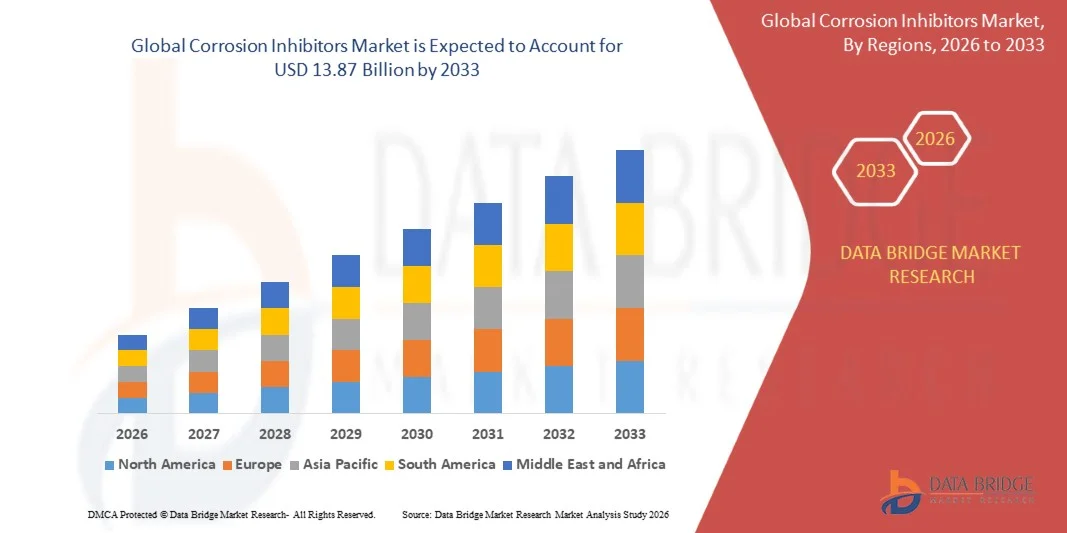
- As per Data Bridge Market Research Analysis the global corrosion inhibitors market size was valued at USD 9.76 billion in 2025 and is expected to reach USD 13.87 billion by 2033, at a CAGR of 4.50% during the forecast period
- The market growth is largely fueled by increasing demand for asset protection and operational efficiency across industries such as oil and gas, power generation, and chemical processing, where corrosion leads to significant financial losses and safety risks
- Furthermore, rising investments in infrastructure development, aging industrial equipment, and the need to minimize maintenance costs are establishing corrosion inhibitors as essential solutions for extending equipment lifespan and ensuring process reliability. These converging factors are accelerating the adoption of corrosion inhibitors, thereby significantly boosting the market growth
Market Size and Forecast:
- Global Market Value (2025): USD 9.76 billion
- Expected Market Value (2033): USD 13.87 billion
- Forecast CAGR (2026–2033): 4.50%
How Corrosion Inhibitors Market Analysed?
- Corrosion inhibitors are chemical substances that, when added in small concentrations, effectively reduce or prevent the corrosion of metals by forming protective films or altering electrochemical reactions in aggressive environments. These inhibitors are widely used in water treatment systems, pipelines, boilers, cooling systems, and industrial processing units to enhance durability and performance
- The escalating demand for corrosion inhibitors is primarily driven by rapid industrialization, increasing exposure of metal infrastructure to harsh environments, and stringent regulations aimed at ensuring safety and environmental compliance, leading industries to adopt advanced corrosion protection solutions
- Asia-Pacific dominated the corrosion inhibitors market with a share of 37.7% in 2025, due to rapid industrialization, expanding oil and gas infrastructure, and growing power generation and metal processing activities
- North America is expected to be the fastest growing region in the corrosion inhibitors market during the forecast period due to rising demand for corrosion inhibitors in oil and gas pipelines, power generation, and chemical processing industries
- Organic segment dominated the market with a market share of 76.1% in 2025, due to its effectiveness in forming protective films on metal surfaces and compatibility with water-based and oil-based systems. Organic inhibitors are widely preferred due to their ability to minimize environmental impact, provide long-term corrosion protection, and enhance operational efficiency in industrial applications
How Corrosion Inhibitors Market Segmented?
|
Attributes |
Corrosion Inhibitors Key Market Insights |
|
Segments Covered |
|
|
Countries Covered |
North America
Europe
Asia-Pacific
Middle East and Africa
South America
|
|
Key Market Players |
|
|
Market Opportunities |
|
|
Value Added Data Infosets |
In addition to the insights on market scenarios such as market value, growth rate, segmentation, geographical coverage, and major players, the market reports curated by the Data Bridge Market Research also include import export analysis, production capacity overview, production consumption analysis, price trend analysis, climate change scenario, supply chain analysis, value chain analysis, raw material/consumables overview, vendor selection criteria, PESTLE Analysis, Porter Analysis, and regulatory framework. |
What are Corrosion Inhibitors Market Trends?
“Growing Shift Toward Eco-Friendly and Green Corrosion Inhibitors”
- A significant trend in the corrosion inhibitors market is the increasing shift toward environmentally friendly and green inhibitor formulations, driven by stringent environmental regulations and growing industrial focus on sustainability. This transition is elevating the role of bio-based and low-toxicity inhibitors as essential solutions for reducing environmental impact while maintaining effective corrosion protection across industries
- For instance, BASF SE and Akzo Nobel N.V. are developing eco-friendly corrosion inhibitors and coatings that comply with global environmental standards while ensuring high performance in industrial applications. These solutions support industries in achieving regulatory compliance and minimizing hazardous chemical discharge
- Industries such as oil and gas and water treatment are increasingly adopting green inhibitors to reduce the ecological footprint of operations while maintaining equipment integrity. This trend is strengthening demand for sustainable formulations that offer both performance efficiency and environmental safety
- The growing emphasis on wastewater treatment and discharge regulations is encouraging the use of biodegradable and non-toxic corrosion inhibitors in industrial processes. This is accelerating innovation in green chemistry and expanding the application scope of eco-friendly inhibitors
- Manufacturers are investing in research and development to create high-performance green inhibitors that can compete with traditional chemical formulations in harsh operating conditions. This is fostering advancements in formulation technologies and enhancing product competitiveness
- The rising awareness regarding environmental impact and long-term sustainability is reinforcing the adoption of green corrosion inhibitors across global industries. This trend is shaping the market toward cleaner technologies and driving continuous innovation in sustainable corrosion protection solutions
What are Corrosion Inhibitors Market Dynamics?
Driver
“Rising Demand for Corrosion Protection Across Industrial Infrastructure”
- The increasing need to protect critical industrial infrastructure such as pipelines, storage tanks, and processing equipment from corrosion is a major driver for the corrosion inhibitors market. Corrosion leads to significant financial losses, operational downtime, and safety risks, prompting industries to invest in effective prevention solutions
- For instance, Ecolab through its Nalco Water division provides corrosion inhibitor solutions for oil and gas pipelines and industrial water systems, helping reduce maintenance costs and improve operational efficiency. These solutions enable industries to extend asset lifespan and ensure uninterrupted operations
- Rapid industrialization and expansion of sectors such as oil and gas, power generation, and chemical processing are increasing exposure of metal infrastructure to harsh environments. This is driving demand for advanced corrosion inhibitors that can withstand extreme temperatures, pressures, and chemical conditions
- The aging infrastructure in developed economies is further boosting the need for corrosion protection solutions to prevent failures and costly replacements. Industries are prioritizing preventive maintenance strategies supported by efficient inhibitor technologies
- The continuous need to enhance operational reliability, reduce maintenance costs, and ensure safety compliance is reinforcing this driver. This sustained demand for effective corrosion protection solutions is significantly contributing to overall market growth
Restraint/Challenge
“Fluctuating Raw Material Prices and Environmental Compliance Constraints”
- The corrosion inhibitors market faces challenges due to fluctuations in raw material prices, particularly for specialty chemicals and feedstocks used in inhibitor formulations. These variations impact production costs and create pricing uncertainties for manufacturers operating in competitive markets
- For instance, Solvay and Kemira encounter cost pressures due to volatility in chemical feedstocks required for producing corrosion inhibitors, affecting overall profitability and supply chain stability. These fluctuations make it difficult to maintain consistent pricing strategies
- Stringent environmental regulations governing the use and disposal of chemical inhibitors are increasing compliance requirements for manufacturers. Companies must invest in reformulating products to meet regulatory standards, which adds to operational complexity and cost
- The transition from conventional inhibitors to environmentally friendly alternatives requires significant research and development investments. This shift can slow down product commercialization and create barriers for smaller market players
- The combined impact of cost volatility and regulatory pressures is creating significant challenges for market participants. These constraints are compelling companies to innovate while managing costs effectively to sustain competitiveness in the corrosion inhibitors market
What is Corrosion Inhibitors Market Scope?
The market is segmented on the basis of product, application, end-use industry, corrosive agent, corrosion type, and inhibitor type.
• By Product
On the basis of product, the corrosion inhibitors market is segmented into organic and inorganic inhibitors. The organic segment dominated the largest market revenue share of 76.1% in 2025, driven by its effectiveness in forming protective films on metal surfaces and compatibility with water-based and oil-based systems. Organic inhibitors are widely preferred due to their ability to minimize environmental impact, provide long-term corrosion protection, and enhance operational efficiency in industrial applications. Industries often select organic types for critical equipment in chemical processing and oil and gas operations because of their proven performance and regulatory compliance. The versatility of organic inhibitors across multiple corrosive environments further strengthens their market presence.
The inorganic segment is anticipated to witness the fastest growth rate from 2026 to 2033, fueled by technological advancements and rising demand in heavy industrial applications. For instance, companies such as BASF leverage inorganic inhibitors for high-temperature and high-pressure environments in power generation and metal processing. Inorganic types are favored for their cost-effectiveness, stability, and strong performance against specific corrosive agents such as oxygen and carbon dioxide. Increased research into eco-friendly inorganic formulations is further accelerating adoption across emerging markets.
• By Application
On the basis of application, the corrosion inhibitors market is segmented into water-based and solvent/oil-based inhibitors. The water-based segment held the largest market revenue share in 2025, driven by the rising preference for environmentally friendly and low-toxicity solutions across industrial sectors. Water-based inhibitors offer effective protection in pipelines, cooling systems, and process water circuits while ensuring regulatory compliance and reducing environmental impact. They are widely adopted in power generation and chemical processing industries due to their ease of use, safe handling, and compatibility with various metallic substrates. The growing focus on sustainable industrial operations is reinforcing demand for water-based corrosion inhibitors globally.
The solvent/oil-based segment is expected to witness the fastest growth rate from 2026 to 2033, propelled by its superior performance in extreme conditions. For instance, AkzoNobel provides oil-based inhibitors for high-pressure oil and gas pipelines where water-based systems are less effective. Solvent/oil-based inhibitors are particularly valued for their ability to penetrate metal surfaces, form durable protective films, and resist high-temperature corrosion. Rising industrialization and expanding oil and gas operations in emerging economies contribute to the growth of this segment.
• By End-Use Industry
On the basis of end-use industry, the market is segmented into power generation, oil and gas, chemical processing, metal processing, and others. The oil and gas segment dominated the largest market revenue share in 2025, driven by the critical need to protect pipelines, storage tanks, and offshore infrastructure from corrosive agents such as hydrogen sulfide and carbon dioxide. Companies prioritize corrosion inhibitors in oil and gas operations to reduce downtime, minimize maintenance costs, and extend asset life. The growing focus on deepwater and offshore exploration further strengthens the demand for high-performance inhibitors in this sector.
The power generation segment is anticipated to witness the fastest growth rate from 2026 to 2033, fueled by increasing investments in thermal and nuclear power plants. For instance, ChemTreat supplies inhibitors that enhance boiler and cooling water system longevity in power plants. Power generation applications require inhibitors capable of withstanding high temperatures, high pressures, and various water chemistries, driving adoption of advanced corrosion protection solutions. Rising electricity demand and modernization of aging plants reinforce the growth of this segment.
• By Corrosive Agent
On the basis of corrosive agent, the market is segmented into oxygen, hydrogen sulfide, and carbon dioxide. The oxygen segment dominated the largest market revenue share in 2025, due to oxygen’s widespread occurrence in industrial processes and its high reactivity with metals, leading to rust and scaling. Oxygen corrosion is particularly critical in water and steam systems, making inhibitors against oxygen essential for minimizing operational disruptions. The segment’s strong demand is driven by end-use industries seeking to reduce maintenance costs and enhance equipment life.
The hydrogen sulfide segment is expected to witness the fastest growth rate from 2026 to 2033, driven by its corrosive impact in oil and gas and chemical processing industries. For instance, Schlumberger provides inhibitors targeting hydrogen sulfide corrosion in sour gas pipelines and refining units. Hydrogen sulfide accelerates localized and pitting corrosion, making specialized inhibitors necessary for safety and asset protection. Expanding oilfield exploration in regions with high sulfide content supports growth in this segment.
• By Corrosion Type
On the basis of corrosion type, the market is segmented into uniform or general corrosion, galvanic corrosion, localized corrosion, stress corrosion cracking (SCC), and erosion corrosion. The uniform or general corrosion segment dominated the largest market revenue share in 2025, as it occurs in most industrial processes and affects a wide range of metals. Inhibitors for uniform corrosion are critical for pipelines, tanks, and process equipment to prevent gradual material loss and maintain operational efficiency. Strong demand arises from industries seeking reliable, broad-spectrum corrosion protection solutions.
The stress corrosion cracking (SCC) segment is anticipated to witness the fastest growth rate from 2026 to 2033, driven by the rising need to protect high-strength alloys and critical infrastructure. For instance, NACE International highlights inhibitors for SCC in nuclear and chemical processing equipment. SCC is highly dangerous as it can lead to sudden catastrophic failures, increasing the adoption of advanced inhibitors. Growth in high-performance industrial applications and stringent safety regulations further accelerate this segment.
• By Inhibitor Type
On the basis of inhibitor type, the market is segmented into passivating inhibitors, volatile inhibitors, cathodic inhibitors, anodic inhibitors, mixed inhibitors, synergistic inhibitors, precipitation inhibitors, green corrosion inhibitors, and adsorption action inhibitors. The mixed inhibitors segment dominated the largest market revenue share in 2025, due to their dual mechanism providing both anodic and cathodic protection, making them highly effective across diverse applications. Industries favor mixed inhibitors for critical infrastructure and process systems requiring reliable, broad-spectrum protection. Their ability to minimize maintenance costs and extend equipment life reinforces market adoption globally.
The green corrosion inhibitors segment is expected to witness the fastest growth rate from 2026 to 2033, fueled by increasing regulatory focus on eco-friendly solutions and sustainability goals. For instance, AkzoNobel and BASF have introduced bio-based green inhibitors for water treatment and industrial processes. Green inhibitors reduce environmental impact, comply with stringent discharge norms, and are gaining preference in emerging economies. Rising awareness of sustainable practices and technological advancements drive rapid adoption of this segment.
Which Region Holds the Largest Share of the Corrosion Inhibitors Market?
- Asia-Pacific dominated the corrosion inhibitors market with the largest revenue share of 37.7% in 2025, driven by rapid industrialization, expanding oil and gas infrastructure, and growing power generation and metal processing activities
- The region’s cost-effective manufacturing base, increasing investments in chemical processing, and strong presence of inhibitor production facilities are accelerating market expansion
- Availability of skilled labor, favorable government regulations, and rising adoption of advanced corrosion protection solutions across industrial sectors are contributing to increased consumption of corrosion inhibitors
China Corrosion Inhibitors Market Insight
China held the largest share in the Asia-Pacific corrosion inhibitors market in 2025, owing to its extensive industrial base, high-volume oil and gas operations, and strong manufacturing capabilities in chemical processing. The country’s supportive government policies for industrial growth, combined with rising demand for corrosion protection in pipelines, power plants, and metal processing, are major growth drivers. Demand is further bolstered by exports of corrosion inhibitor products and ongoing investment in high-performance industrial chemicals.
India Corrosion Inhibitors Market Insight
India is witnessing the fastest growth in the Asia-Pacific region, fueled by expanding oil and gas infrastructure, increasing power generation capacity, and rising industrial modernization initiatives. Government initiatives promoting Make in India and self-reliance in chemical and industrial manufacturing are strengthening the demand for corrosion inhibitors. In addition, growth in chemical processing, metal fabrication, and downstream industrial applications is driving robust market expansion.
Europe Corrosion Inhibitors Market Insight
The Europe corrosion inhibitors market is expanding steadily, supported by stringent regulatory frameworks, emphasis on sustainability, and growing adoption of high-performance industrial chemicals. The region places strong focus on environmental compliance, safety standards, and advanced chemical formulations, particularly in oil and gas, power generation, and metal processing sectors. Increasing use of corrosion inhibitors in protective coatings and industrial water treatment applications is further enhancing market growth.
Germany Corrosion Inhibitors Market Insight
Germany’s market is driven by its leadership in chemical processing, high-precision manufacturing, and export-oriented industrial infrastructure. The country has well-established R&D networks and partnerships between academic institutions and industrial players, fostering continuous innovation in corrosion protection technologies. Demand is particularly strong for inhibitors used in power plants, chemical refineries, and high-value metal processing applications.
U.K. Corrosion Inhibitors Market Insight
The U.K. market is supported by a mature industrial sector, increasing emphasis on sustainability and environmental regulations, and growing adoption of advanced corrosion protection solutions. With rising focus on research, industrial-academic collaboration, and localized production of specialty inhibitors, the U.K. continues to play a significant role in high-value industrial chemical markets.
North America Corrosion Inhibitors Market Insight
North America is projected to grow at the fastest CAGR from 2026 to 2033, driven by rising demand for corrosion inhibitors in oil and gas pipelines, power generation, and chemical processing industries. A strong focus on industrial safety, technological advancements in protective chemicals, and increasing adoption of eco-friendly inhibitors are boosting demand. In addition, reshoring of chemical manufacturing and collaboration between industrial and chemical players are supporting market expansion.
U.S. Corrosion Inhibitors Market Insight
The U.S. accounted for the largest share in the North America market in 2025, underpinned by its expansive oil and gas infrastructure, strong R&D capabilities, and advanced chemical manufacturing facilities. The country’s emphasis on industrial safety, sustainability, and regulatory compliance is encouraging adoption of high-performance corrosion inhibitors. Presence of major players and a well-established distribution network further solidify the U.S.'s leading position in the region.
What is Corrosion Inhibitors Market Share?
The corrosion inhibitors industry is primarily led by well-established companies, including:
- Advance Products & Systems, LLC. (U.S.)
- Akzo Nobel N.V. (The Netherlands)
- Air Products and Chemicals, Inc. (U.S.)
- Champion Technology Services, Inc. (U.S.)
- ICL (Israel)
- SUEZ (France)
- Daubert Cromwell, Inc. (U.S.)
- Dai-ichi India Pvt Ltd (India)
- Solvay (Belgium)
- ChemTreat, Inc. (U.S.)
- Aegion Corporation (U.S.)
- Kurita Water Industries Ltd. (Japan)
- Kemira (Finland)
- The Lubrizol Corporation (U.S.)
- Milacron (U.S.)
- Ecolab (U.S.)
- QED Chemicals Ltd (U.K.)
- Eastman Chemical Company (U.S.)
- SHAWCOR (Canada)
- Ashland (U.S.)
- Corrosion Technologies (U.S.)
- BASF SE (Germany)
Which are Latest Developments in Global Corrosion Inhibitors Market?
- In January 2025, BASF SE introduced an advanced range of bio-based corrosion inhibitors designed for industrial water treatment and oilfield applications, focusing on reducing environmental impact while maintaining high performance. This development is accelerating the transition toward sustainable corrosion protection solutions as industries increasingly prioritize eco-friendly chemicals to meet tightening regulatory standards. It is also enabling end users to achieve longer equipment life cycles and improved system efficiency while lowering environmental footprint, thereby strengthening BASF’s position in the green inhibitor segment
- In October 2024, Ecolab Inc. expanded its digital water management solutions integrated with corrosion inhibitor technologies to optimize industrial system performance. This advancement is enhancing real-time monitoring, predictive maintenance, and precise chemical dosing, which significantly reduces operational inefficiencies and chemical wastage. As industries move toward digitalization and smart infrastructure, this innovation is driving wider adoption of integrated corrosion management systems, improving cost efficiency and operational reliability across sectors such as power generation and manufacturing
- In August 2024, PPG Industries introduced PPG PRIMERON Optimal, a powder primer incorporating optimized zinc technology to enhance corrosion resistance and coating durability. This innovation is significantly improving the longevity of coated surfaces, particularly in harsh industrial environments where corrosion risks are high. By reducing maintenance frequency and extending asset life, it is driving cost savings for end users while increasing demand for advanced coating systems integrated with effective corrosion inhibitors
- In June 2024, Henkel AG & Co. KGaA launched a new series of high-efficiency corrosion inhibitors tailored for automotive and metal processing industries, emphasizing improved surface protection and compatibility with advanced coatings. This development is supporting manufacturers in achieving higher durability and performance standards while minimizing maintenance downtime and operational disruptions. It is also contributing to the growing demand for multifunctional inhibitors that can enhance coating adhesion and corrosion resistance simultaneously, strengthening product innovation within industrial manufacturing environments
- In March 2023, Cortec Corporation launched VpCI-649 HP, a corrosion inhibitor certified under ANSI/NSF Standard 61 for hydro-testing drinking water systems. This product is expanding the application scope of corrosion inhibitors into potable water infrastructure, addressing critical safety and compliance requirements. Its low dosage requirement and minimal environmental impact are improving operational efficiency while setting higher industry benchmarks for safe corrosion prevention solutions in sensitive applications

- Interactive Data Analysis Dashboard
- Company Analysis Dashboard for high growth potential opportunities
- Research Analyst Access for customization & queries
- Competitor Analysis with Interactive dashboard
- Latest News, Updates & Trend analysis
- Harness the Power of Benchmark Analysis for Comprehensive Competitor Tracking
Global Corrosion Inhibitor Market, Supply Chain Analysis and Ecosystem Framework
To support market growth and help clients navigate the impact of geopolitical shifts, DBMR has integrated in-depth supply chain analysis into its Global Corrosion Inhibitor Market research reports. This addition empowers clients to respond effectively to global changes affecting their industries. The supply chain analysis section includes detailed insights such as Global Corrosion Inhibitor Market consumption and production by country, price trend analysis, the impact of tariffs and geopolitical developments, and import and export trends by country and HSN code. It also highlights major suppliers with data on production capacity and company profiles, as well as key importers and exporters. In addition to research, DBMR offers specialized supply chain consulting services backed by over a decade of experience, providing solutions like supplier discovery, supplier risk assessment, price trend analysis, impact evaluation of inflation and trade route changes, and comprehensive market trend analysis.
Data collection and base year analysis are done using data collection modules with large sample sizes. The stage includes obtaining market information or related data through various sources and strategies. It includes examining and planning all the data acquired from the past in advance. It likewise envelops the examination of information inconsistencies seen across different information sources. The market data is analysed and estimated using market statistical and coherent models. Also, market share analysis and key trend analysis are the major success factors in the market report. To know more, please request an analyst call or drop down your inquiry.
The key research methodology used by DBMR research team is data triangulation which involves data mining, analysis of the impact of data variables on the market and primary (industry expert) validation. Data models include Vendor Positioning Grid, Market Time Line Analysis, Market Overview and Guide, Company Positioning Grid, Patent Analysis, Pricing Analysis, Company Market Share Analysis, Standards of Measurement, Global versus Regional and Vendor Share Analysis. To know more about the research methodology, drop in an inquiry to speak to our industry experts.
Data Bridge Market Research is a leader in advanced formative research. We take pride in servicing our existing and new customers with data and analysis that match and suits their goal. The report can be customized to include price trend analysis of target brands understanding the market for additional countries (ask for the list of countries), clinical trial results data, literature review, refurbished market and product base analysis. Market analysis of target competitors can be analyzed from technology-based analysis to market portfolio strategies. We can add as many competitors that you require data about in the format and data style you are looking for. Our team of analysts can also provide you data in crude raw excel files pivot tables (Fact book) or can assist you in creating presentations from the data sets available in the report.













