Cotton Processing Market Overview
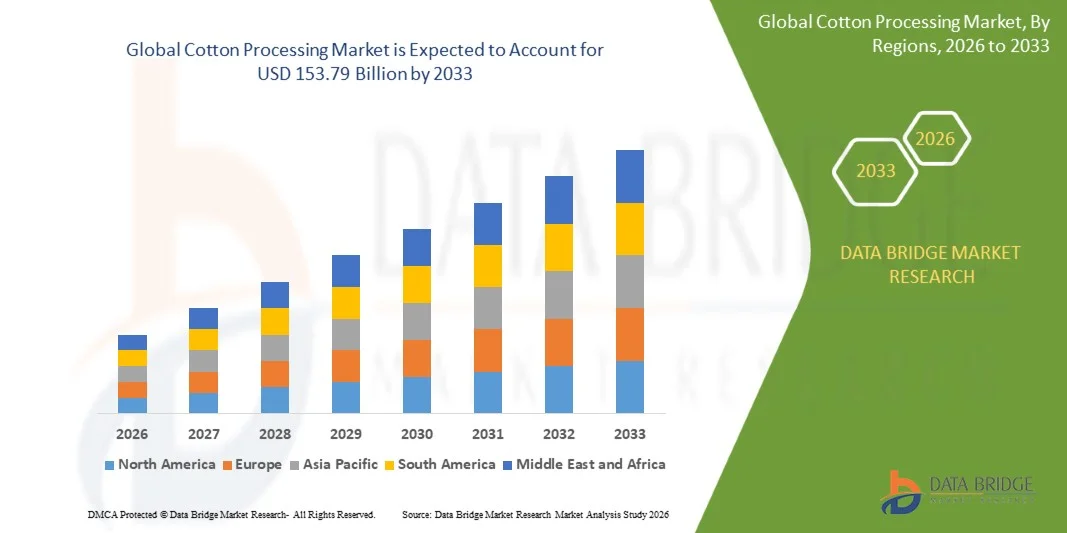
As per Data Bridge Market Research Analysis the cotton processing market was valued at USD 96.49 billion in 2025 and is projected to reach USD 153.79 billion by 2033, growing at a CAGR of 6.00 % from 2026 to 2033. The market is witnessing steady growth driven by increasing global demand for cotton-based textiles, expanding apparel manufacturing, and rising consumption of natural fibre products. Growing investments in modern ginning and spinning technologies, coupled with the adoption of automated processing equipment, are enhancing operational efficiency, fibre quality, and production capacity across cotton processing facilities. Furthermore, supportive government initiatives aimed at strengthening the textile sector and improving cotton value chains are contributing to market expansion.
The growing preference for sustainable and biodegradable fibres over synthetic alternatives is further accelerating demand for processed cotton across textile, medical, consumer goods, and animal feed applications. Cottonseed, a key by-product of cotton processing, is witnessing increased utilization in livestock feed and edible oil production, creating additional revenue opportunities for processors. Rapid industrialization, expanding textile exports from countries such as India, China, Bangladesh, and Vietnam, and continuous technological advancements in cotton ginning and spinning machinery are strengthening the competitive landscape. As manufacturers focus on automation, energy-efficient processing systems, and improved fibre recovery, the global cotton processing market is expected to experience sustained growth throughout the forecast period.
Market Size & Forecast
- Market Value (2025): USD 96.49 Billion
- Expected Market Value (2033): USD 153.79 Billion
- Forecast CAGR (2026–2033): 6.00%
- Leading Region in 2025: Asia-Pacific
- Fastest Growing Region: North America
Key Market Trends & Insights
- Asia-Pacific dominated the cotton processing market with the largest revenue share in 2025 and supported by the regional market during the forecast period. The region's leadership is supported by its extensive textile manufacturing base, abundant cotton production, and strong export activities in countries such as China, India, Pakistan, Bangladesh, and Vietnam.
- North America is expected to witness the fastest growth rate from 2026 to 2033, primarily driven by rising investments in automated cotton ginning and spinning technologies, increasing adoption of precision agriculture, growing demand for sustainably sourced cotton, and continuous modernization of textile manufacturing facilities.
- The lint segment held the largest market revenue share in 2025, driven by its extensive utilization in textile and apparel manufacturing, home furnishings, medical textiles, and industrial fabrics. Cotton lint serves as the primary raw material for yarn production, making it an essential component of the global textile value chain. Growing consumer preference for natural and biodegradable fibers, coupled with increasing textile exports from major manufacturing countries such as China, India, Bangladesh, and Vietnam, continues to strengthen the segment's market position.
- The cottonseed segment is expected to witness the fastest growth during the forecast period from 2026 to 2033, driven by its expanding utilization in edible oil production, animal feed, and other value-added industrial applications. Rising efforts to maximize by-product utilization, improve processing profitability, and meet growing demand for protein-rich livestock feed are expected to further support the growth of this segment.
- The ginning segment held the largest market revenue share in 2025, driven by its critical role in separating cotton fibers from seeds while improving fiber quality for downstream textile applications. Increasing adoption of automated and high-capacity ginning machines, along with investments in modern processing facilities, is enhancing operational efficiency, minimizing contamination, and supporting higher-quality lint production.
- The spinning segment is expected to witness the fastest growth during the forecast period from 2026 to 2033, driven by rising global demand for cotton yarn from the textile and apparel industries. Continuous advancements in spinning technologies, increasing automation, and expanding textile manufacturing capacities across Asia-Pacific are expected to improve production efficiency, yarn quality, and overall processing capabilities.
Report Scope and Cotton Processing Market Segmentation
|
Attributes |
Cotton Processing Key Market Segments |
|
Segments Covered |
|
|
Countries Covered |
North America
Europe
Asia-Pacific
Middle East and Africa
South America
|
|
Key Market Players |
|
|
Market Opportunities |
|
|
Value Added Data Infosets |
In addition to the insights on market scenarios such as market value, growth rate, segmentation, geographical coverage, and major players, the market reports curated by the Data Bridge Market Research also include import export analysis, production capacity overview, production consumption analysis, price trend analysis, climate change scenario, supply chain analysis, value chain analysis, raw material/consumables overview, vendor selection criteria, PESTLE Analysis, Porter Analysis, and regulatory framework. |
Cotton Processing Market Trends
Trend: Rising Adoption of Automated and Intelligent Cotton Processing Technologie
The cotton processing market is witnessing a significant shift toward automated ginning and spinning technologies as manufacturers focus on improving fiber quality, reducing contamination, and increasing production efficiency. Modern cotton processing facilities are increasingly integrating intelligent machinery, real-time monitoring systems, and energy-efficient equipment to enhance operational performance while lowering production costs.
Growing investments in textile manufacturing, increasing labor costs, and rising demand for premium-quality cotton products are encouraging processors to modernize existing facilities. The expansion of textile production across Asia-Pacific and the adoption of Industry 4.0 technologies are further accelerating automation throughout the cotton value chain.
For instance, in April 2026, Rieter Holding AG showcased its latest intelligent spinning technologies at ITM 2026, including automated spinning solutions, digital mill management systems, and energy-efficient machinery designed to improve yarn quality, production efficiency, and mill automation for cotton processors.
The increasing adoption of intelligent processing technologies is expected to improve operational efficiency, enhance fiber quality, and support the long-term growth of the cotton processing market.
Cotton Processing Market Dynamics
Key Market Driver: Rising Modernization and Automation of Cotton Processing Facilities
The cotton processing market is being driven by increasing investments in modern ginning and spinning infrastructure aimed at improving productivity, reducing operational costs, and producing higher-quality cotton fibers. Cotton processors are replacing conventional machinery with automated systems that enable better contamination control, optimized raw material utilization, and consistent processing performance.
Expanding textile manufacturing, rising exports of cotton yarn and fabrics, and growing demand for premium cotton products are encouraging processors to upgrade existing processing facilities. Government support for textile modernization in major cotton-producing countries is further accelerating technology adoption.
For instance, in March 2025, Trützschler Group reported that its TC 30i card achieved up to 30% higher productivity in commercial cotton spinning mills while maintaining or improving yarn quality through intelligent automation and optimized carding technology.
Growing investments in automated cotton processing technologies are expected to improve processing efficiency, reduce production costs, and strengthen the market's long-term growth.
Key Restraint/Challenge: Climate-Driven Raw Cotton Supply Volatility
The cotton processing market faces significant challenges due to fluctuations in raw cotton availability caused by climate change, droughts, erratic rainfall, pest infestations, and other extreme weather events. Unstable raw material supply directly impacts processing volumes, fiber quality, procurement planning, and operating costs.
Increasing climate variability, water scarcity, and changing agricultural conditions are affecting cotton cultivation across major producing countries. Rising volatility in cotton prices is further creating uncertainty for processors and textile manufacturers relying on stable raw material supplies.
For instance, in October 2022, Olam Agri highlighted that around 40% of global cotton-producing regions could experience shorter growing seasons by 2040, while drought could affect nearly half of global cotton production, emphasizing the need for climate-resilient cotton supply chains.
Climate-related production risks and raw cotton supply volatility are expected to remain key challenges, increasing procurement uncertainty and operational costs for cotton processors.
Key Market Opportunity: Growing Demand for Traceable and High-Quality Cotton Processing
Increasing consumer demand for sustainably sourced and traceable cotton is creating new growth opportunities for the cotton processing market. Textile manufacturers and global apparel brands are placing greater emphasis on transparency, quality assurance, and responsible sourcing throughout the cotton value chain.
Growing sustainability regulations, corporate ESG commitments, and increasing adoption of digital traceability solutions are encouraging cotton processors to invest in advanced fiber testing, contamination control, and quality management systems that improve market access and customer confidence.
For instance, in November 2023, Better Cotton launched its Traceability Solution, enabling cotton to be digitally traced back to its country of origin through a dedicated platform, improving supply chain transparency and supporting responsible cotton sourcing.
The growing adoption of traceability technologies and sustainable cotton sourcing practices is expected to create significant long-term growth opportunities for cotton processors by improving product quality, transparency, and global market competitiveness.
Cotton Processing Market Scope
The cotton processing market is segmented based on product type, equipment, operation, and application.
- By Product Type
On the basis of product type, the cotton processing market is segmented into lint, cottonseed, and others. The lint segment held the largest market revenue share in 2025, driven by its extensive utilization in textile and apparel manufacturing, home furnishings, medical textiles, and industrial fabrics. Cotton lint serves as the primary raw material for yarn production, making it an essential component of the global textile value chain. Growing consumer preference for natural and biodegradable fibers, coupled with increasing textile exports from major manufacturing countries such as China, India, Bangladesh, and Vietnam, continues to strengthen the segment's market position.
The cottonseed segment is expected to witness the fastest growth during the forecast period from 2026 to 2033, driven by its expanding utilization in edible oil production, animal feed, and other value-added industrial applications. Rising efforts to maximize by-product utilization, improve processing profitability, and meet growing demand for protein-rich livestock feed are expected to further support the growth of this segment.
- By Equipment
On the basis of equipment, the cotton processing market is segmented into ginning and spinning. The ginning segment held the largest market revenue share in 2025, driven by its critical role in separating cotton fibers from seeds while improving fiber quality for downstream textile applications. Increasing adoption of automated and high-capacity ginning machines, along with investments in modern processing facilities, is enhancing operational efficiency, minimizing contamination, and supporting higher-quality lint production.
The spinning segment is expected to witness the fastest growth during the forecast period from 2026 to 2033, driven by rising global demand for cotton yarn from the textile and apparel industries. Continuous advancements in spinning technologies, increasing automation, and expanding textile manufacturing capacities across Asia-Pacific are expected to improve production efficiency, yarn quality, and overall processing capabilities.
- By Operation
On the basis of operation, the cotton processing market is segmented into automatic and semi-automatic. The automatic segment held the largest market revenue share in 2025, driven by the increasing adoption of advanced cotton processing equipment that improves productivity, reduces labor dependency, and enhances fiber quality. Automatic ginning and spinning systems provide greater processing efficiency, real-time monitoring, lower contamination levels, and reduced operating costs, making them the preferred choice for large-scale processing facilities.
The semi-automatic segment is expected to witness the fastest growth during the forecast period from 2026 to 2033, driven by the ongoing modernization of small- and medium-sized cotton processing facilities, particularly across developing economies. Semi-automatic equipment offers a cost-effective solution for processors seeking improved operational efficiency while requiring lower capital investment than fully automated systems, supporting broader adoption across emerging markets.
- By Application
On the basis of application, the cotton processing market is segmented into textiles, medical and surgical, feed, consumer goods, and others. The textiles segment held the largest market revenue share in 2025, driven by the extensive utilization of processed cotton in apparel, home textiles, technical textiles, and industrial fabrics. Rising global demand for sustainable and natural fibers, coupled with expanding textile manufacturing capacities and increasing investments in modern spinning and weaving technologies, continues to reinforce the segment's leadership.
The medical and surgical segment is expected to witness the fastest growth during the forecast period from 2026 to 2033, driven by increasing demand for absorbent cotton, surgical dressings, gauze, bandages, and other healthcare products. Growing healthcare expenditure, expanding medical infrastructure, and rising utilization of cotton-based medical textiles are expected to further accelerate the growth of this segment.
Cotton Processing Market Analysis
Asia-Pacific Cotton Processing Market Insight
Asia-Pacific dominated the cotton processing market with the largest revenue share in 2025, supported by its large-scale cotton production, well-established textile manufacturing industry, and expanding investments in modern ginning and spinning infrastructure. Major cotton-producing and textile-exporting countries such as China, India, Pakistan, Bangladesh, and Vietnam continue to strengthen regional demand through increasing yarn and fabric production. Supportive government initiatives, abundant raw material availability, and rising textile and apparel exports further reinforce the region's market leadership. Continuous modernization of cotton processing facilities and the presence of an integrated cotton value chain are expected to sustain Asia-Pacific's dominance throughout the forecast period.
China Cotton Processing Market Insight
China dominated the cotton processing market with the largest revenue share in 2025, supported by its extensive textile manufacturing base, advanced spinning infrastructure, and strong domestic demand for cotton products. The country's cotton processing industry is heavily concentrated in Xinjiang, which accounts for more than 80% of China's total cotton production, providing a stable supply of raw material for ginning, spinning, and textile manufacturing. Continuous investments in automation, mechanized harvesting, and modern processing technologies have significantly improved fiber quality, production efficiency, and global competitiveness.
Japan Cotton Processing Market Insight
Japan is expected to witness the fastest growth rate from 2026 to 2033, supported by its advanced textile machinery industry, high-value textile manufacturing, and strong focus on automation. Although the country imports most of its raw cotton, it has developed a highly efficient spinning and textile processing sector backed by leading machinery manufacturers such as Toyota Industries Corporation and Murata Machinery, Ltd. (Muratec). Continuous investments in intelligent spinning technologies, energy-efficient production systems, and premium textile manufacturing continue to strengthen Japan's cotton processing market.
North America Cotton Processing Market Insight
North America is expected to witness the fastest growth rate in the cotton processing market from 2026 to 2033, primarily driven by rising investments in automated ginning and spinning technologies, increasing adoption of precision agriculture, and growing demand for high-quality and sustainably sourced cotton. The region benefits from a well-established cotton production ecosystem led by the United States, which is one of the world's largest cotton producers and exporters. Advanced ginning infrastructure, stringent cotton grading and quality assessment systems, and continuous modernization of textile manufacturing facilities are further improving processing efficiency and fiber quality. In addition, increasing adoption of digital technologies and smart manufacturing solutions is expected to strengthen the region's competitiveness and support sustained market growth throughout the forecast period.
U.S. Cotton Processing Market Insight
The U.S. is expected to witness the fastest growth rate from 2026 to 2033, supported by its large-scale cotton production, advanced ginning infrastructure, and well-established textile value chain. The country is one of the world's largest cotton exporters, with Texas accounting for approximately 40% of total U.S. cotton production, ensuring a stable supply of raw materials for cotton processing. Continuous investments in automated ginning technologies, precision agriculture, and modern processing equipment continue to improve fiber quality, operational efficiency, and global competitiveness.
Europe Cotton Processing Market Insight
Europe is expected to witness the fastest growth rate from 2026 to 2033, driven by its well-established textile manufacturing industry, increasing demand for sustainably sourced cotton, and advanced spinning and textile processing technologies. Although cotton cultivation in Europe is limited, countries such as Türkiye, Greece, and Spain play an important role in cotton production and processing, while Italy, Germany, Portugal, and France serve as major textile manufacturing and value-added processing hubs. The region's emphasis on high-quality textile production and sustainable manufacturing practices continues to drive investments in modern cotton processing equipment and digitalized spinning technologies. According to the European Commission, the European Union produces approximately 1 million tonnes of raw cotton annually, with Greece accounting for nearly 80% and Spain around 20% of EU cotton production, ensuring a reliable raw material supply for regional processors.
Germany Cotton Processing Market Insight
Germany is expected to witness the fastest growth rate from 2026 to 2033, supported by its advanced textile machinery industry, high adoption of automated spinning technologies, and strong demand for premium technical textiles. The country's focus on Industry 4.0 manufacturing, sustainable textile production, and high-quality yarn processing continues to strengthen investments in modern cotton processing equipment, improving production efficiency and global competitiveness.
U.K. Cotton Processing Market Insight
The U.K. is expected to witness the fastest growth rate from 2026 to 2033 through its strong demand for high-value technical textiles, medical textiles, and sustainable cotton products. Increasing investments in advanced textile manufacturing, circular economy initiatives, and responsibly sourced cotton are supporting modernization across the textile value chain, while demand for premium processed cotton continues to drive market growth.
Cotton Processing Market Share
The cotton processing market analysis is primarily led by well-established companies, including:
- Lummus Corporation (U.S.)
- Bajaj Steel Industries Limited (India)
- Rieter (Switzerland)
- Trützschler Group SE (Germany)
- Shandong Swan Cotton Industrial Machinery Stock Co., Ltd. (China)
- Toyota Industries Corporation (Japan)
- Saurer Intelligent Technology AG (China)
- LMW Limited (India)
- Murata Machinery, Ltd. (Japan)
- Marzoli Machines Textile S.r.l. (Italy)
- Savio Macchine Tessili S.p.A. (Italy)
- Jingwei Textile Machinery Co., Ltd. (China)
- Roc Machine Electronics Co., Ltd. (China)
- Cherokee Fabrication (U.S.)
- Prashant Group (India)
- Electro-Jet S.L. (Spain)
- Olam Agri Holdings Pte. Ltd. (Singapore)
- Louis Dreyfus Company (Netherlands)
- Cargill, Incorporated (U.S.)
Latest Developments in Cotton Processing Market
- In May 2025, Saurer Group introduced advanced spinning automation and digital textile solutions at ITMA Asia + CITME 2025, showcasing next-generation technologies designed to improve yarn quality, increase production efficiency, reduce energy consumption, and enhance automation across cotton spinning mills. The innovations support manufacturers in optimizing mill performance while accelerating the adoption of smart textile manufacturing.
- In October 2023, The Cotton Corporation of India (CCI) launched the Bale Identification and Traceability System (BITS), a blockchain-enabled platform that assigns a unique QR code to every cotton bale. The system enables end-to-end traceability of cotton from origin to processing, storage, and quality assessment, improving transparency, product authentication, and quality assurance throughout the cotton processing value chain.
- In December 2022, The Cotton Corporation of India (CCI) and the Cotton Textiles Export Promotion Council (TEXPROCIL) signed a Memorandum of Understanding (MoU) to promote Kasturi Cotton Bharat, a premium Indian cotton brand. The collaboration aims to strengthen branding, encourage value-added cotton processing, improve international market recognition, and enhance exports of high-quality Indian cotton and textile products.
- In May 2022, The Government of Pakistan announced incentive measures encouraging farmers to shift from water-intensive sugarcane cultivation to cotton farming. The initiative aims to increase domestic cotton production, reduce dependence on imported cotton, strengthen the country's cotton processing and textile industries, and ensure a more reliable supply of raw materials for downstream textile manufacturing.

- Interactive Data Analysis Dashboard
- Company Analysis Dashboard for high growth potential opportunities
- Research Analyst Access for customization & queries
- Competitor Analysis with Interactive dashboard
- Latest News, Updates & Trend analysis
- Harness the Power of Benchmark Analysis for Comprehensive Competitor Tracking
Data collection and base year analysis are done using data collection modules with large sample sizes. The stage includes obtaining market information or related data through various sources and strategies. It includes examining and planning all the data acquired from the past in advance. It likewise envelops the examination of information inconsistencies seen across different information sources. The market data is analysed and estimated using market statistical and coherent models. Also, market share analysis and key trend analysis are the major success factors in the market report. To know more, please request an analyst call or drop down your inquiry.
The key research methodology used by DBMR research team is data triangulation which involves data mining, analysis of the impact of data variables on the market and primary (industry expert) validation. Data models include Vendor Positioning Grid, Market Time Line Analysis, Market Overview and Guide, Company Positioning Grid, Patent Analysis, Pricing Analysis, Company Market Share Analysis, Standards of Measurement, Global versus Regional and Vendor Share Analysis. To know more about the research methodology, drop in an inquiry to speak to our industry experts.
Data Bridge Market Research is a leader in advanced formative research. We take pride in servicing our existing and new customers with data and analysis that match and suits their goal. The report can be customized to include price trend analysis of target brands understanding the market for additional countries (ask for the list of countries), clinical trial results data, literature review, refurbished market and product base analysis. Market analysis of target competitors can be analyzed from technology-based analysis to market portfolio strategies. We can add as many competitors that you require data about in the format and data style you are looking for. Our team of analysts can also provide you data in crude raw excel files pivot tables (Fact book) or can assist you in creating presentations from the data sets available in the report.