Cottonseed Processing Market Size
- The global cottonseed processing market size was valued at USD 5.07 billion in 2025and is expected to reach USD 7.32 billion by 2033, at a CAGR of 4.70% during the forecast period
- The market growth is largely fuelled by increasing demand for edible oil and animal feed derived from cottonseed, driven by rising global population and food consumption patterns
- Growing utilization of cottonseed meal in livestock nutrition as a high-protein feed ingredient is further supporting market expansion
Cottonseed Processing Market Analysis
- The market is witnessing steady growth due to expanding applications of cottonseed oil in food processing, cosmetics, and industrial sectors
- Increasing focus on maximizing agricultural by-product utilization and reducing waste generation is also supporting industry development
- North America dominated the cottonseed processing market with the largest revenue share in 2025, driven by strong industrial processing infrastructure, high adoption of advanced agricultural technologies, and well-established textile and feed industries
- Asia-Pacific region is expected to witness the highest growth rate in the global cottonseed processing market, driven by rising cotton cultivation, growing population-driven demand for food and feed products, increasing industrialization, and expanding investments in modern processing facilities
- The automatic segment held the largest market revenue share in 2025 driven by higher processing efficiency, improved output consistency, and reduced dependence on manual labor. Automatic systems are widely adopted in large-scale processing facilities due to their ability to streamline operations and enhance productivity across the value chain
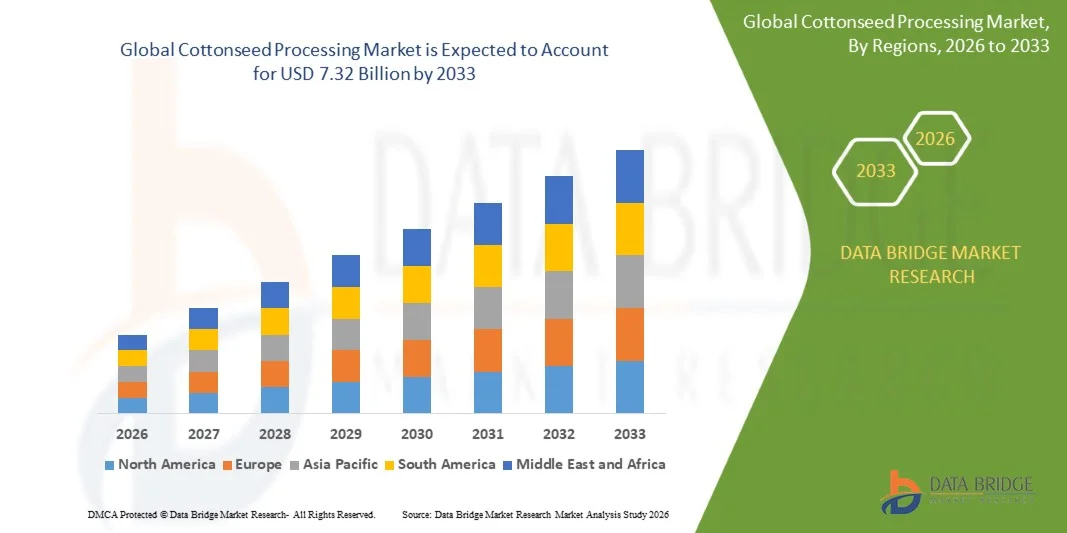
Report Scope and Cottonseed Processing Market Segmentation
|
Attributes |
Cottonseed Processing Key Market Insights |
|
Segments Covered |
· By Operation: Automatic and Semi-Automatic · By Equipment: Ginning, Spinning, and Others · By Application: Textiles, Medical and Surgical, Feed, and Consumer Goods |
|
Countries Covered |
North America · U.S. · Canada · Mexico Europe · Germany · France · U.K. · Netherlands · Switzerland · Belgium · Russia · Italy · Spain · Turkey · Rest of Europe Asia-Pacific · China · Japan · India · South Korea · Singapore · Malaysia · Australia · Thailand · Indonesia · Philippines · Rest of Asia-Pacific Middle East and Africa · Saudi Arabia · U.A.E. · South Africa · Egypt · Israel · Rest of Middle East and Africa South America · Brazil · Argentina · Rest of South America |
|
Key Market Players |
• Lummus Corp (U.S.) |
|
Market Opportunities |
• Expanding Demand For Plant-Based Oils |
|
Value Added Data Infosets |
In addition to the insights on market scenarios such as market value, growth rate, segmentation, geographical coverage, and major players, the market reports curated by the Data Bridge Market Research also include import export analysis, production capacity overview, production consumption analysis, price trend analysis, climate change scenario, supply chain analysis, value chain analysis, raw material/consumables overview, vendor selection criteria, PESTLE Analysis, Porter Analysis, and regulatory framework. |
Cottonseed Processing Market Trends
“Rising Demand For Edible Oil And Animal Feed By-Products”
- The growing utilization of cottonseed as a valuable source of edible oil and livestock feed is significantly shaping the cottonseed processing market, as industries increasingly focus on maximizing agricultural output and by-product utilization. Cottonseed processing enables efficient extraction of oil and production of protein-rich meal, strengthening its role in food and feed supply chains. This trend is encouraging manufacturers to adopt advanced processing technologies to improve yield and product quality
- Increasing awareness around sustainable agriculture and resource optimization has accelerated demand for cottonseed-based products in food processing and animal nutrition sectors. Cottonseed oil is widely used in cooking applications, while cottonseed meal is gaining traction as a cost-effective feed ingredient. This dual utilization is prompting processors to enhance operational efficiency and expand production capacities
- Industrial demand for cottonseed derivatives is also influenced by rising consumption of processed foods and expanding livestock farming activities. Manufacturers are focusing on improving extraction efficiency and reducing waste generation through modern processing techniques. This is helping improve profitability while supporting sustainable agricultural value chains
- For instance, in 2024, major agricultural processors in India and the U.S. expanded their cottonseed oil refining and meal production capacities to meet growing demand from food and feed industries. These developments were aimed at improving supply chain efficiency and strengthening product availability in both domestic and export markets
- While demand for cottonseed processing continues to grow, market expansion depends on raw material availability, technological advancements, and efficient supply chain management. Companies are also focusing on improving processing yield and developing value-added cottonseed-based products to enhance market competitiveness
Cottonseed Processing Market Dynamics
Driver
“Growing Demand For Edible Oil And Livestock Feed Ingredients”
- Rising global demand for edible oils and high-protein animal feed is a major driver for the cottonseed processing market. Cottonseed oil is increasingly used in cooking applications, while cottonseed meal serves as an important protein source in livestock nutrition. This dual application is supporting strong market growth
- Expanding livestock production and rising meat consumption are further influencing demand for cottonseed meal. Manufacturers are focusing on improving feed quality and nutritional value through efficient cottonseed processing techniques. This is enhancing its adoption in poultry, cattle, and aquaculture feed industries
- Agricultural processors are actively investing in advanced extraction and refining technologies to improve yield and product quality. These efforts are supported by rising demand for cost-effective feed ingredients and edible oils, encouraging collaboration between agricultural producers and processing companies
- For instance, in 2023, leading agribusiness companies in China and Brazil reported increased cottonseed crushing activities to support growing demand from edible oil refiners and livestock feed manufacturers. This expansion helped strengthen supply chains and improve product availability across regional markets
- Although demand growth supports market expansion, factors such as raw material price fluctuations, seasonal crop dependency, and processing efficiency challenges remain critical. Investment in modern processing infrastructure and supply chain optimization will be essential for sustained growth
Restraint/Challenge
“Fluctuating Raw Material Supply And Processing Inefficiencies”
- Variability in cotton production due to climatic conditions and agricultural dependency remains a key challenge for the cottonseed processing market. Fluctuating raw material availability directly impacts processing volumes and production stability, creating supply chain uncertainty
- Limited awareness and adoption of advanced processing technologies in developing regions further restrict market efficiency. Traditional processing methods often result in lower yield and reduced product quality, affecting overall profitability
- High operational costs associated with processing equipment, energy consumption, and maintenance also pose challenges for market expansion. In addition, storage and transportation of cottonseed and its derivatives require proper infrastructure to maintain quality standards
- For instance, in 2024, cottonseed processors in parts of Africa and Southeast Asia reported reduced output due to irregular cotton harvests and limited access to modern crushing facilities. This led to supply shortages for both edible oil and feed manufacturers, impacting downstream industries
- Overcoming these challenges will require investment in advanced processing technologies, improved agricultural practices, and stronger supply chain integration. Enhancing raw material stability and expanding processing infrastructure will be critical for long-term market development
Cottonseed Processing Market Scope
The market is segmented on the basis of type, operation, equipment, and application.
- By Operation
On the basis of operation, the cottonseed processing market is segmented into automatic and semi-automatic. The automatic segment held the largest market revenue share in 2025 driven by higher processing efficiency, improved output consistency, and reduced dependence on manual labor. Automatic systems are widely adopted in large-scale processing facilities due to their ability to streamline operations and enhance productivity across the value chain.
The semi-automatic segment is expected to witness the fastest growth rate from 2026 to 2033, driven by lower initial investment requirements and increasing adoption among small and medium-scale processors. Semi-automatic systems offer operational flexibility and are increasingly preferred in developing regions where gradual automation is being implemented.
- By Equipment
On the basis of equipment, the cottonseed processing market is segmented into ginning, spinning, and others. The ginning segment held the largest market revenue share in 2025 driven by its critical role in separating cotton fibers from seeds and enabling downstream processing. Ginning equipment remains a fundamental part of the cottonseed value chain, supporting large-scale textile and industrial applications.
The spinning segment is expected to witness the fastest growth rate from 2026 to 2033, driven by rising demand for value-added textile production and increased integration of cotton processing with yarn manufacturing. Advancements in spinning technologies are further enhancing fiber quality and production efficiency.
- By Application
On the basis of application, the cottonseed processing market is segmented into textiles, medical and surgical, feed, and consumer goods. The textiles segment held the largest market revenue share in 2025 driven by strong demand for cotton-based fabrics, apparel production, and expanding textile manufacturing industries globally. Cottonseed processing plays a vital role in ensuring consistent raw material supply for textile production.
The medical and surgical segment is expected to witness the fastest growth rate from 2026 to 2033, driven by increasing demand for absorbent cotton products, surgical materials, and hygiene-related applications. Rising healthcare awareness and expanding medical infrastructure are further supporting segment growth.
Cottonseed Processing Market Regional Analysis
- North America dominated the cottonseed processing market with the largest revenue share in 2025, driven by strong industrial processing infrastructure, high adoption of advanced agricultural technologies, and well-established textile and feed industries
- The region benefits from large-scale cotton production and efficient processing facilities, enabling higher recovery rates of cotton fiber, oil, and seed by-products
- Growing demand for cottonseed oil in food applications and cottonseed meal in animal feed further supports market expansion, along with continuous investments in automation and processing efficiency.
U.S. Cottonseed Processing Market Insight
The U.S. cottonseed processing market captured the largest revenue share in North America in 2025, supported by its strong cotton cultivation base and highly mechanized processing industry. Increasing demand for cottonseed oil in food processing and cottonseed meal in livestock feed is driving market growth. The presence of advanced processing technologies and large integrated agribusiness companies further strengthens production efficiency. In addition, rising focus on value-added by-products and sustainable processing practices is contributing to industry expansion in the country.
Europe Cottonseed Processing Market Insight
The Europe cottonseed processing market is expected to witness steady growth from 2026 to 2033, driven by increasing demand for plant-based oils and sustainable feed ingredients. Strict food safety and environmental regulations are encouraging the adoption of efficient and eco-friendly processing methods. Growing awareness regarding alternative protein sources and natural agricultural inputs is further supporting demand. The region is also experiencing expansion in food, pharmaceutical, and animal nutrition applications of cottonseed derivatives.
U.K. Cottonseed Processing Market Insight
The U.K. cottonseed processing market is expected to grow steadily from 2026 to 2033, driven by rising demand for vegetable oils and increasing use of cottonseed meal in livestock feed. Growing emphasis on sustainable sourcing and plant-based ingredients is supporting market development. In addition, advancements in food processing and rising imports of cottonseed raw materials are strengthening industry growth. The market is also benefiting from increasing interest in alternative agricultural by-products.
Germany Cottonseed Processing Market Insight
The Germany cottonseed processing market is expected to grow steadily from 2026 to 2033, supported by strong demand for high-quality feed ingredients and plant-based oil products. The country’s focus on sustainable agriculture and efficient resource utilization is encouraging advanced processing technologies. Increasing applications of cottonseed derivatives in food and animal nutrition sectors are further driving growth. Germany’s emphasis on eco-friendly industrial practices is also supporting market expansion.
Asia Pacific Cottonseed Processing Market Insight
The Asia-Pacific cottonseed processing market is expected to witness the fastest growth rate from 2026 to 2033, driven by rising cotton production, expanding textile industries, and growing demand for edible oils and animal feed. Rapid urbanization and population growth are increasing consumption of cottonseed-based products across food and agriculture sectors. Government support for agro-processing industries and rising investments in modern processing facilities are further accelerating market expansion.
Japan Cottonseed Processing Market Insight
The Japan cottonseed processing market is expected to grow steadily from 2026 to 2033 due to strong demand for high-quality edible oils and processed agricultural inputs. The country’s focus on advanced food processing technologies and precision agriculture supports efficient utilization of cottonseed by-products. Increasing demand for functional food ingredients and sustainable feed solutions is also driving growth. Japan’s emphasis on quality standards and innovation further strengthens market development.
China Cottonseed Processing Market Insight
The China cottonseed processing market accounted for the largest market revenue share in Asia-Pacific in 2025, supported by high cotton production, strong domestic processing capacity, and growing demand for cottonseed oil and meal. Rapid industrialization and expansion of the livestock sector are key growth drivers. Government initiatives promoting agricultural modernization and self-sufficiency are further boosting processing activities. The availability of cost-effective manufacturing infrastructure and strong domestic players continues to strengthen China’s dominant position in the global market.
Cottonseed Processing Market Share
The Cottonseed Processing industry is primarily led by well-established companies, including:
• Lummus Corp (U.S.)
• Bajaj Steel Industries Limited (India)
• Nipha Exports Private Limited (India)
• Shandong Swan Cottonseed Industrial Machinery Stock Co., Ltd. (China)
• Cherokee Fabrication (U.S.)
• Reiter (Germany)
• Toyota Industries Corporation (Japan)
• ShanDong Swan Cotton (China)
• Samuel Jackson (Unknown)
• Rieter (Switzerland)
• Mitsun Engineering (Japan)
Latest Developments in Global Cottonseed Processing Market
- In November 2025, Cargill (U.S.) announced a strategic partnership with a leading technology firm to develop AI-driven solutions for cottonseed processing, representing a digital transformation initiative. The development aims to optimize processing efficiency, improve operational accuracy, and reduce production costs. By integrating artificial intelligence into core operations, Cargill (U.S.) is expected to enhance yield quality and streamline supply chain processes. This advancement strengthens its competitive position in the global market. It also accelerates the adoption of smart technologies across the cottonseed processing industry, improving overall productivity standards
- In October 2025, Bunge (U.S.) expanded its cottonseed processing capacity in Brazil through a $50 million investment in a new facility, marking a significant capacity expansion initiative. The development is focused on increasing production output to meet rising regional and global demand for cottonseed products. This expansion is expected to improve supply reliability and operational scalability for Bunge (U.S.). It also strengthens the company’s presence in the South American market, which is witnessing growing industrial demand. The move enhances competitive positioning and supports long-term revenue growth in emerging markets
- In September 2025, Olam International (SG) launched a sustainability initiative aimed at reducing the carbon footprint of its cottonseed processing operations, reflecting an environmental responsibility program. The initiative includes the adoption of renewable energy sources and implementation of advanced waste reduction strategies. It is designed to improve environmental efficiency while maintaining production performance. This development enhances Olam International’s brand value among environmentally conscious stakeholders. It also supports global sustainability trends and encourages greener processing practices across the cottonseed industry

- Interactive Data Analysis Dashboard
- Company Analysis Dashboard for high growth potential opportunities
- Research Analyst Access for customization & queries
- Competitor Analysis with Interactive dashboard
- Latest News, Updates & Trend analysis
- Harness the Power of Benchmark Analysis for Comprehensive Competitor Tracking
Data collection and base year analysis are done using data collection modules with large sample sizes. The stage includes obtaining market information or related data through various sources and strategies. It includes examining and planning all the data acquired from the past in advance. It likewise envelops the examination of information inconsistencies seen across different information sources. The market data is analysed and estimated using market statistical and coherent models. Also, market share analysis and key trend analysis are the major success factors in the market report. To know more, please request an analyst call or drop down your inquiry.
The key research methodology used by DBMR research team is data triangulation which involves data mining, analysis of the impact of data variables on the market and primary (industry expert) validation. Data models include Vendor Positioning Grid, Market Time Line Analysis, Market Overview and Guide, Company Positioning Grid, Patent Analysis, Pricing Analysis, Company Market Share Analysis, Standards of Measurement, Global versus Regional and Vendor Share Analysis. To know more about the research methodology, drop in an inquiry to speak to our industry experts.
Data Bridge Market Research is a leader in advanced formative research. We take pride in servicing our existing and new customers with data and analysis that match and suits their goal. The report can be customized to include price trend analysis of target brands understanding the market for additional countries (ask for the list of countries), clinical trial results data, literature review, refurbished market and product base analysis. Market analysis of target competitors can be analyzed from technology-based analysis to market portfolio strategies. We can add as many competitors that you require data about in the format and data style you are looking for. Our team of analysts can also provide you data in crude raw excel files pivot tables (Fact book) or can assist you in creating presentations from the data sets available in the report.