


What is the Cranial Orthoses Market Size and Growth Rate?
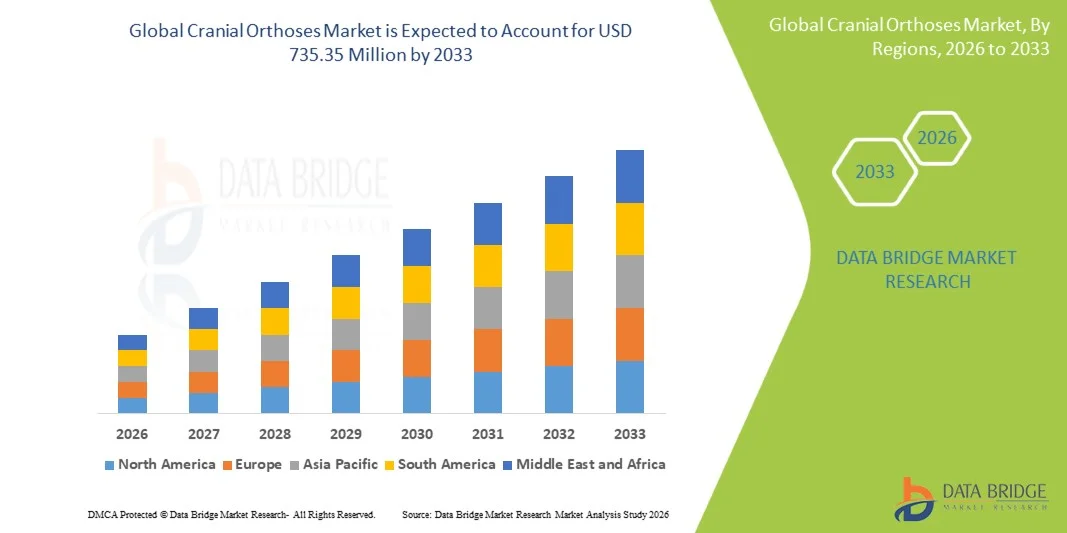
- As per Data Bridge Market Research analysis, the cranial orthoses market was valued at USD 321.40 million in 2025 and is projected to reach USD 735.35 million by 2033, growing at a CAGR of 10.90% from 2026 to 2033.
- The market is experiencing consistent growth driven by the rising incidence of infant cranial deformities such as plagiocephaly and brachycephaly, increasing awareness of early cranial shape correction, and advancements in customized orthotic solutions, including digital scanning and improved helmet designs.
- The growing emphasis on early diagnosis and intervention, combined with increasing collaboration among pediatricians, orthotists, and craniofacial specialists, is encouraging wider adoption of cranial orthoses. Active helmets remain a major product category, while hospitals and pediatric specialty centers are increasingly integrating digital scanning and customized fitting technologies to improve treatment outcomes and patient comfort.
Market Size & Forecast
- Global Market Value (2025): USD 321.40 Million
- Expected Market Value (2033): USD 735.35 Million
- Forecast CAGR (2026–2033): 10.90%
- Leading Region in 2025: North America
- Fastest Growing Region: Asia Pacific
What are the Major Takeaways of the Cranial Orthoses Market?
- North America dominated the cranial orthoses market with the largest revenue share of 43% in 2025, supported by advanced pediatric healthcare infrastructure, high awareness of cranial deformities, and strong adoption of specialized orthotic treatment.
- Asia-Pacific is expected to be the fastest-growing region at a CAGR of 10.5% from 2026 to 2033, fueled by increasing awareness of positional cranial deformities, improving pediatric healthcare infrastructure, and rising access to specialized cranial orthotic services.
- The active helmets segment led the market with a 56.45% share in 2025, driven by their widespread use in correcting positional cranial deformities through controlled pressure and growth guidance.
- Passive helmets are the fastest-growing product type, projected to register a CAGR of 12.87%, reflecting the surge in relatively simple construction, established clinical use, and growing demand for accessible cranial correction solutions.
- The polyethylene foam interfaces segment dominated the material category with a 45.88% revenue share in 2025, led by the material's lightweight characteristics, cushioning properties, and suitability for prolonged contact with sensitive infant skin.
- Plagiocephaly accounted for 54.34% of the market share in 2025, preferred by the high prevalence of positional plagiocephaly among infants and the established use of cranial orthoses for correcting cranial asymmetry.
- The brachycephaly segment is the fastest-growing application category, with a CAGR of 11.56%, driven by increasing recognition of posterior skull flattening and growing use of cranial orthoses for moderate-to-severe deformities.
Report Scope and Cranial Orthoses Market Segmentation
|
Attributes |
Cranial Orthoses Key Market Insights |
|
Segments Covered |
|
|
Countries Covered |
North America
Europe
Asia-Pacific
Middle East and Africa
South America
|
|
Key Market Players |
|
|
Market Opportunities |
|
|
Value Added Data Infosets |
|
What is the Key Trend in the Cranial Orthoses Market?
- Cranial orthosis manufacturers are increasingly adopting 3D scanning, computer-aided design, and additive manufacturing to produce customized helmets with improved anatomical fit, lighter weight, and greater patient comfort.
- For instance, in August 2023, the Springer Nature journal 3D Printing in Medicine published research on an individualized infant cranial helmet developed using handheld 3D scanning and additive manufacturing, with the scanning methodology validated on 15 infants aged 6–12 months to improve fitting accuracy, ventilation, and treatment comfort
- Digital scanning enables clinicians to capture the infant's cranial geometry without traditional plaster casting, allowing manufacturers to create highly personalized orthoses based on precise three-dimensional head measurements.
- Manufacturers are also focusing on lightweight, ventilated, and growth-adjustable helmet designs to improve infant tolerance and encourage consistent wear throughout the treatment period.
- For instance, in July 2025, the Frontiers in Pediatrics journal published a study evaluating customized 3D-printed cranial helmet therapy in 11 infants with deformational plagiocephaly, reporting a significant reduction in the cranial vault asymmetry index from 7.7% before treatment to 3.1% after treatment.
- As pediatric orthotic providers increasingly integrate digital workflows with personalized manufacturing, 3D-enabled cranial orthoses are expected to become an increasingly important component of modern cranial deformity management, supporting precision fitting and patient-specific treatment.
What are the Key Drivers of the Cranial Orthoses Market?
- The rising incidence and clinical recognition of positional plagiocephaly, brachycephaly, and other nonsynostotic cranial deformities are increasing demand for cranial orthoses, particularly among infants requiring correction after repositioning or physical therapy.
- For instance, in March 2025, NVIDIA announced through its Newsroom the release of Cosmos world foundation models and new Omniverse-powered blueprints for generating controllable synthetic data for autonomous vehicles, enabling developers to create large-scale virtual driving scenarios for AI training and vehicle validation
- Pediatricians, craniofacial specialists, and orthotists are increasingly emphasizing early assessment and intervention, as infant skull growth provides an important treatment window for correcting abnormal cranial shape.
- For instance, in November 2024, BMW Group reported through its official website that its Dingolfing plant had begun series production using Level 4+ driverless vehicle technology, with automated-driving findings being used for future autonomous-driving development and plans to accumulate several million test kilometres across its production network.
- With growing awareness of positional skull deformities and greater integration of pediatric craniofacial assessment into infant care, demand for customized cranial orthoses is expected to continue increasing, particularly for moderate-to-severe cases requiring specialized intervention.
Which Factors are Challenging the Growth of the Cranial Orthoses Market?
- Cranial orthosis treatment can impose a significant financial and practical burden on families, particularly because helmets require customized fabrication, professional fitting, repeated adjustments, and prolonged daily use during infancy.
- For instance, in June 2023, the American Society of Plastic Surgeons reported that children insured through Medicaid were less likely to receive helmet therapy for deformational plagiocephaly than children with commercial insurance, highlighting insurance-related disparities that can restrict access to cranial orthoses
- These costs and treatment requirements can limit adoption among families with inadequate insurance coverage or limited access to pediatric orthotic and craniofacial specialists, particularly in emerging and underserved healthcare markets.
- Treatment adherence can also be challenging because infants typically need to wear cranial orthoses for extended periods, while heat, perspiration, skin irritation, and discomfort can affect tolerance and consistent usage.
- For instance, in May 2022, the journal Plastic and Reconstructive Surgery Global Open published a cost analysis reporting that cranial orthotic treatment typically costs approximately USD 1,500–3,000, with expenses including the helmet and required follow-up visits, demonstrating the financial burden that can limit wider adoption of cranial orthoses.
- The combination of treatment costs, specialist availability, prolonged wear requirements, and selective clinical indications continues to constrain broader adoption, particularly in price-sensitive markets where access to customized pediatric orthotic services remains limited.
How is the Cranial Orthoses Market Segmented?
The cranial orthoses market is segmented on the basis of product type, material, application, and end user.
- By Product Type
On the basis of product type, the cranial orthoses market is segmented into active helmets, passive helmets, custom-molded orthoses, and prefabricated orthoses. The active helmets segment dominated the market with a 56.45% share in 2025, owing to their widespread use in correcting positional cranial deformities through controlled pressure and growth guidance. These helmets are extensively prescribed for moderate-to-severe plagiocephaly and brachycephaly when repositioning or other conservative treatments provide insufficient improvement. Increasing diagnosis of deformational skull abnormalities is supporting demand for active correction devices. Advances in helmet design are improving ventilation, weight distribution, and infant comfort during prolonged treatment. Growing awareness among parents and pediatric specialists regarding early intervention is further strengthening adoption.
The passive helmets segment is projected to register the fastest growth at a CAGR of 12.87% from 2026 to 2033, driven by their relatively simple construction, established clinical use, and growing demand for accessible cranial correction solutions. These helmets use sustained contact and controlled pressure differentials to guide natural skull growth without complex mechanical components. Their lower technological complexity can simplify manufacturing, fitting, and maintenance. Increasing availability of lightweight materials and improved helmet designs is also enhancing infant comfort. Growing diagnosis of positional cranial deformities is expanding the potential patient base for passive correction approaches.
- By Material
On the basis of material, the cranial orthoses market is segmented into thermoplastic outer shells, polyethylene foam interfaces, polyurethane foam interfaces, copolymer materials, and silicone and soft-interface materials. The polyethylene foam interfaces segment dominated the market with a 45.88% share in 2025, supported by the material's lightweight characteristics, cushioning properties, and suitability for prolonged contact with sensitive infant skin. Polyethylene foam provides an interface between the rigid helmet shell and the infant's head while helping distribute contact forces. Its flexibility and shock-absorbing characteristics make it suitable for customized cranial orthotic designs. The material can also be shaped and adjusted to accommodate changes in cranial growth during treatment. Increasing emphasis on comfort and pressure distribution is supporting its use in cranial orthoses.
The thermoplastic outer shells segment is projected to register the fastest growth at a CAGR of 10.55% from 2026 to 2033, driven by increasing demand for durable, lightweight, and precisely customized cranial orthoses. Thermoplastic materials can be molded into patient-specific shapes, making them suitable for both conventional and digitally manufactured helmets. Their compatibility with 3D scanning, computer-aided design, and advanced fabrication processes is further expanding their application. Improvements in shell design are helping manufacturers develop thinner and more comfortable orthoses without compromising structural integrity. Increasing adoption of digital workflows is also improving fitting precision and production efficiency.
- By Application
On the basis of application, the cranial orthoses market is segmented into plagiocephaly, brachycephaly, scaphocephaly, and post-surgical cranial deformity. The plagiocephaly segment dominated the market with a 54.34% share in 2025, owing to the high prevalence of positional plagiocephaly among infants and the established use of cranial orthoses for correcting cranial asymmetry. Increasing pediatric screening and parental awareness are contributing to earlier identification of abnormal head shape. Cranial helmets are commonly considered for moderate-to-severe cases that do not improve adequately through repositioning and conservative management. Improvements in customized helmet fitting are supporting more precise treatment of asymmetric skull shapes. Greater awareness among pediatricians and craniofacial specialists is also supporting referrals for orthotic intervention.
The brachycephaly segment is projected to register the fastest growth at a CAGR of 11.56% from 2026 to 2033, driven by increasing recognition of posterior skull flattening and growing use of cranial orthoses for moderate-to-severe deformities. Brachycephaly is increasingly identified through routine pediatric examinations and cranial-shape assessments during infancy. Rising awareness among parents is encouraging earlier consultation with pediatricians and orthotic specialists. Customized helmet designs can provide targeted space and controlled contact areas to accommodate abnormal posterior cranial growth. Advances in 3D scanning are also improving the ability to measure and monitor changes in cranial shape during treatment.
- By End User
On the basis of end user, the cranial orthoses market is segmented into hospitals, pediatric and craniofacial centers, orthotic and prosthetic clinics, neurosurgery and craniofacial surgery clinics, and home care settings. The hospitals segment dominated the market with a 55.67% share in 2025, supported by their role as major referral points for infants with suspected cranial deformities. Hospitals provide access to pediatricians, neonatologists, neurosurgeons, craniofacial specialists, and orthotic services within integrated care pathways. Their diagnostic infrastructure facilitates early assessment and identification of cranial abnormalities. Hospitals can also coordinate helmet fitting, clinical monitoring, and follow-up through multidisciplinary teams. Established relationships with insurers and healthcare networks can further facilitate treatment authorization and patient access.
The pediatric and craniofacial centers segment is expected to witness the fastest growth at a CAGR of 8.45% from 2026 to 2033, driven by increasing specialization in the diagnosis and treatment of infant cranial deformities. These centers provide dedicated multidisciplinary care involving pediatricians, craniofacial surgeons, neurosurgeons, and orthotists. Their specialized expertise can shorten the pathway from referral and cranial assessment to orthotic fitting and follow-up. Increasing parental preference for specialized pediatric services is also supporting patient volumes. Integration of 3D scanning and digitally customized helmet fabrication is improving treatment workflows and personalization.
Which Region Holds the Largest Share of the Cranial Orthoses Market?
- North America dominated the cranial orthoses market with the largest revenue share of 43% in 2025, supported by advanced pediatric healthcare infrastructure, high awareness of cranial deformities, and strong adoption of specialized orthotic treatment.
- The region also benefits from well-established pediatric screening practices, hospital-embedded 3D scanning services, specialist orthotic networks, and improving insurance coverage for cranial orthoses. The United States represents the major contributor to regional demand, while policy developments such as expanded Medicaid and CHIP coverage for cranial remolding orthoses are improving patient access. These factors continue to strengthen North America's leadership in the global cranial orthoses market.
U.S. Cranial Orthoses Market Insight
The U.S. cranial orthoses market is witnessing strong growth due to rising diagnosis of positional cranial deformities, increasing awareness of early intervention, and widespread availability of pediatric orthotic services. The country’s mature healthcare infrastructure, along with increasing adoption of customized cranial helmets and digital 3D scanning technologies, is driving demand across hospitals, pediatric centers, and orthotic clinics. In addition, growing emphasis on pediatric cranial screening and improving access to specialized craniofacial care is accelerating cranial orthosis adoption across the country.
Asia-Pacific Cranial Orthoses Market Insight
The Asia-Pacific cranial orthoses market is expected to witness rapid growth, driven by increasing awareness of infant cranial deformities, improving pediatric healthcare infrastructure, and rising investments in specialized craniofacial treatment across countries such as China, Japan, and India. Growing recognition of plagiocephaly and brachycephaly, rising adoption of customized orthotic solutions, and increasing availability of specialized pediatric services are supporting regional market expansion. In addition, growing healthcare expenditure and improving access to advanced diagnostic and digital scanning technologies are accelerating cranial orthosis adoption across the region.
Japan Cranial Orthoses Market Insight
The Japan cranial orthoses market is witnessing consistent growth due to rising investments in advanced pediatric healthcare, increasing awareness of infant cranial deformities, and improvements in specialized craniofacial treatment. Hospitals, pediatric centers, and orthotic providers are increasingly adopting customized cranial helmets for the management of positional plagiocephaly and brachycephaly. Moreover, increasing integration of 3D scanning and digital customization technologies, along with Japan’s advanced healthcare infrastructure and focus on pediatric care, is further contributing to market growth.
China Cranial Orthoses Market Insight
The China cranial orthoses market is growing rapidly, driven by increasing awareness of positional skull deformities, expanding pediatric healthcare infrastructure, and rising demand for specialized infant treatment. Growing adoption of customized and digitally manufactured cranial orthoses across hospitals and pediatric centers is significantly boosting market demand. In addition, rising healthcare expenditure, increasing availability of 3D scanning technologies, greater parental awareness regarding early intervention, and improvements in specialized craniofacial services are positioning China as one of the fastest-growing markets for cranial orthoses globally.
U.K. Cranial Orthoses Market Insight
The U.K. cranial orthoses market is experiencing steady growth, supported by rising awareness of positional cranial deformities, increasing adoption of helmet therapy, and improvements in specialized pediatric and craniofacial services. Increasing availability of customized cranial orthoses and growing use of digital assessment and 3D scanning technologies are contributing to market growth. Furthermore, integration of advanced fitting technologies and increasing emphasis on early diagnosis and multidisciplinary pediatric care are improving treatment accessibility, positioning the U.K. as an important market for cranial orthoses.
Germany Cranial Orthoses Market Insight
The Germany cranial orthoses market is expanding steadily due to the country’s strong healthcare infrastructure, advanced pediatric care capabilities, and increasing adoption of customized orthotic technologies. Pediatric hospitals, craniofacial centers, and orthotic clinics are increasingly utilizing cranial helmets for the assessment and management of positional cranial deformities. Continuous advancements in 3D scanning, digital helmet design, and customized manufacturing, along with growing emphasis on early pediatric intervention and specialized craniofacial treatment, are further driving market growth in Germany.
Which are the Top Companies in Cranial Orthoses Market?
The cranial orthoses industry is primarily led by well-established companies, including:
- ORTHOMERICA PRODUCTS, INC. (U.S.)
- Cranial Technologies (U.S.)
- Ottobock SE & Co. KGaA (Germany)
- Invent Medical (Czech Republic)
- Cranioform AG (Switzerland)
- Danmar Products, Inc. (U.S.)
- BioSculptor Corporation (U.S.)
- Krugener Orthotech Ltd (Cyprus)
- Orthotic Care Services LLP (U.S.)
- Custom Orthotic Design Group Ltd. (Canada)
- Braceworks Custom Orthotics (Canada)
- ORTHOPAEDIC APPLIANCES PTY. LTD. (Australia)
- Union Orthotics & Prosthetics Co. (U.S.)
- Summit Bracing and Orthotic Services (Canada)
- Gibson Orthotics (South Africa)
- Ktwo Healthcare Pvt. Ltd. (India)
- P-POD Orthotics, Inc. (U.S.)
- MedFac Orthotics (U.K.)
- OrthoPediatrics Corp. (U.S.)
What are Latest Developments in Cranial Orthoses Market?
- In March 2025, Surestep, part of Hanger, announced the launch of Sprout3D, a 3D-printed cranial remolding orthosis specifically designed for plagiocephaly and brachycephaly. The device uses more than 10,000 data points in its design and incorporates indication-specific trim lines, a lightweight structure, perforated foam for ventilation, and a single-side hinge opening. Surestep stated that the U.S.-manufactured device is designed to provide faster turnaround and reduce the need for in-clinic modifications, highlighting the market's shift toward digitally fabricated and customized cranial orthoses.
- In July 2024, Mary Free Bed introduced Orthomerica's STARband 3D cranial helmet as a new treatment option for infants with abnormal head shape. The 3D-printed design provides ventilation openings and a lightweight structure intended to improve comfort compared with conventional helmet designs. The product's introduction demonstrates the increasing use of additive manufacturing and patient-specific digital designs in cranial remolding therapy.
- In November 2022, Berry Inc. introduced its baby band2 cranial remolding helmet in Japan, using 3D printing to create individually customized helmets based on each infant’s cranial shape. The device was designed as a single-device treatment that accommodates anticipated skull growth, highlighting the industry's shift toward digitally customized and potentially more efficient cranial orthotic solutions.
- In July 2022, the London Orthotic Consultancy celebrated the first anniversary of its LOCband Lite cranial remolding helmet after the 250th baby completed treatment. The company describes LOCband Lite as a 3D-printed helmet that is approximately 40% lighter than its predecessor because of thinner walls, while its ventilated design is intended to improve comfort. The milestone demonstrated continued clinical adoption of lightweight, digitally manufactured cranial orthoses for plagiocephaly treatment.
- In March 2021, Ottobock expanded the use of digital manufacturing in cranial orthotics through its MyCRO Band, a 3D-printed cranial molding orthosis developed from digital head scans. The digitally designed device allows clinicians to create an individualized helmet based on the infant's cranial geometry, supporting precise fitting while reducing the need for traditional fabrication methods. The development represented a broader industry movement toward digital scanning, computer-aided design, and 3D printing in pediatric orthotic care.

- Interactive Data Analysis Dashboard
- Company Analysis Dashboard for high growth potential opportunities
- Research Analyst Access for customization & queries
- Competitor Analysis with Interactive dashboard
- Latest News, Updates & Trend analysis
- Harness the Power of Benchmark Analysis for Comprehensive Competitor Tracking
Data collection and base year analysis are done using data collection modules with large sample sizes. The stage includes obtaining market information or related data through various sources and strategies. It includes examining and planning all the data acquired from the past in advance. It likewise envelops the examination of information inconsistencies seen across different information sources. The market data is analysed and estimated using market statistical and coherent models. Also, market share analysis and key trend analysis are the major success factors in the market report. To know more, please request an analyst call or drop down your inquiry.
The key research methodology used by DBMR research team is data triangulation which involves data mining, analysis of the impact of data variables on the market and primary (industry expert) validation. Data models include Vendor Positioning Grid, Market Time Line Analysis, Market Overview and Guide, Company Positioning Grid, Patent Analysis, Pricing Analysis, Company Market Share Analysis, Standards of Measurement, Global versus Regional and Vendor Share Analysis. To know more about the research methodology, drop in an inquiry to speak to our industry experts.
Data Bridge Market Research is a leader in advanced formative research. We take pride in servicing our existing and new customers with data and analysis that match and suits their goal. The report can be customized to include price trend analysis of target brands understanding the market for additional countries (ask for the list of countries), clinical trial results data, literature review, refurbished market and product base analysis. Market analysis of target competitors can be analyzed from technology-based analysis to market portfolio strategies. We can add as many competitors that you require data about in the format and data style you are looking for. Our team of analysts can also provide you data in crude raw excel files pivot tables (Fact book) or can assist you in creating presentations from the data sets available in the report.













