


What is the Crank Case Ventilation Valve Market Size and Growth Rate?
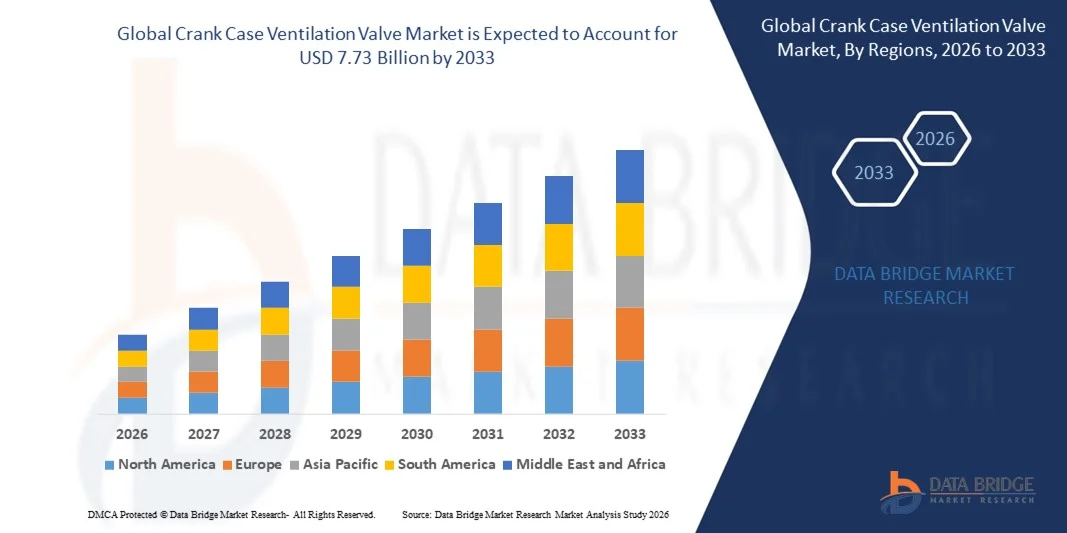
- As per Data Bridge Market Research Analysis the global crank case ventilation valve market size was valued at USD 5.56 billion in 2025 and is expected to reach USD 7.73 billion by 2033, at a CAGR of 4.20% during the forecast period
- The market growth is largely fuelled by the rising demand for efficient emission control systems in internal combustion engines to meet stringent environmental regulations
- Increasing production of passenger and commercial vehicles, coupled with the growing need for engine performance optimization, is further boosting market expansion
Market Size and Forecast:
- Global Market Value (2025): USD 5.56 billion
- Expected Market Value (2033):USD 7.73 billion
- Forecast CAGR (2026–2033): 4.20%
How Crank Case Ventilation Valve Market Analysed?
- The market is experiencing consistent growth due to the growing emphasis on reducing engine blow-by gases and improving overall engine efficiency across automotive and industrial applications
- In addition, the shift toward improved fuel economy, enhanced engine reliability, and compliance with global emission standards is driving manufacturers to adopt high-quality crank case ventilation solutions
- North America dominated the crank case ventilation valve market with the largest revenue share in 2025, driven by the high production of passenger and commercial vehicles, stringent emission regulations, and growing adoption of advanced engine technologies
- Asia-Pacific region is expected to witness the highest growth rate in the global crank case ventilation valve market, driven by rising vehicle production, government initiatives for cleaner engines, and expanding automotive manufacturing capabilities
- The Gasoline segment held the largest market revenue share in 2025, driven by the high production and sales of gasoline-powered passenger vehicles across North America and Europe. Gasoline engines typically require efficient ventilation systems to manage blow-by gases and ensure optimal engine performance, making these valves essential components
Report Scope and Crank Case Ventilation Valve Market Segmentation
|
Attributes |
Crank Case Ventilation Valve Key Market Insights |
|
Segments Covered |
|
|
Countries Covered |
North America
Europe
Asia-Pacific
Middle East and Africa
South America
|
|
Key Market Players |
|
|
Market Opportunities |
|
|
Value Added Data Infosets |
In addition to the market insights such as market value, growth rate, market segments, geographical coverage, market players, and market scenario, the market report curated by the Data Bridge Market Research team includes in-depth expert analysis, import/export analysis, pricing analysis, production consumption analysis, and pestle analysis. |
What are the Crank Case Ventilation Valve Market Trends?
Rising Emphasis on Emission Reduction and Engine Efficiency
- The growing focus on minimizing harmful engine emissions is driving the adoption of advanced crank case ventilation valves across passenger and commercial vehicles. These components help control blow-by gases more effectively, ensuring engines operate within regulatory emission limits and improving environmental compliance for manufacturers
- The demand for enhanced engine efficiency is accelerating the use of optimized ventilation systems that support smoother combustion and reduced oil contamination. Automotive OEMs are increasingly integrating high-performance valves to extend engine life, reduce maintenance cycles, and improve overall vehicle reliability
- The shift toward lightweight and durable materials in ventilation valve manufacturing is fostering improved performance, corrosion resistance, and longer service life. These innovations are helping automakers meet performance benchmarks while reducing production costs and enhancing component sustainability
- For instance, in 2024, several European automotive suppliers introduced composite-based ventilation valves that significantly reduced weight while maintaining operational integrity under high thermal stress. These advancements supported improved fuel efficiency and engine stability, particularly in turbocharged engines
- While ventilation valve technologies are steadily evolving, their long-term impact depends on continued R&D investment, cost-effective production strategies, and strong aftermarket support. Manufacturers must focus on innovation, durability enhancement, and compliance-driven designs to fully leverage emerging growth opportunities
What are the Crank Case Ventilation Valve Market Dynamics?
Driver
Growing Vehicle Production and Increasing Focus on Clean Engine Operation
- The steady rise in global vehicle production is creating sustained demand for crank case ventilation valves, as these components are essential for maintaining optimal engine airflow, controlling crankcase pressure, and preventing harmful blow-by emissions. Manufacturers are prioritizing ventilation systems to ensure smoother engine operation, reduce mechanical strain, and enhance overall vehicle reliability. This growth is further supported by rising demand for both passenger and commercial vehicles across emerging and developed markets
- Automakers are increasingly aware of the performance and durability benefits associated with efficient ventilation systems, such as improved fuel economy, reduced engine wear, and enhanced combustion stability. High-quality valves help optimize engine efficiency under varying operational conditions, which is critical for meeting customer expectations. This awareness is driving widespread integration of advanced ventilation components across mass-market, premium, and heavy-duty vehicle segments
- Regulatory bodies worldwide are implementing stricter emission norms, prompting OEMs to invest heavily in upgraded ventilation technologies. Compliance with Euro 7, BS-VI, and other global standards is accelerating adoption, encouraging the deployment of advanced crank case ventilation systems. These regulations not only ensure cleaner engine operation but also drive innovation in valve design and materials to meet environmental mandates
- For instance, in 2023, automotive authorities in the United States tightened emission standards for light-duty vehicles, prompting manufacturers to adopt advanced ventilation components to meet updated requirements. This regulatory push has led to rapid upgrades in OEM production lines, greater R&D investments, and increased aftermarket demand for compliant components. The trend highlights the importance of regulatory alignment in driving market expansion
- While automotive demand and environmental compliance are supporting market expansion, ongoing innovation, material enhancement, and system compatibility improvements remain essential to fully capitalize on growth potential. Manufacturers must focus on lightweight, corrosion-resistant materials, improved valve geometry, and seamless integration with modern engines to sustain long-term market growth
Restraint/Challenge
High Maintenance Requirements and Compatibility Issues with Advanced Engines
- The maintenance needs associated with crank case ventilation systems pose challenges for widespread adoption, particularly in regions with limited automotive service infrastructure. Valves can become clogged, worn, or fail under high thermal and pressure conditions, leading to reduced engine performance, higher repair costs, and potential engine damage. These issues make regular monitoring and proper servicing critical for long-term reliability
- Many automotive workshops lack skilled technicians trained to diagnose, repair, and service advanced ventilation components. The absence of standardized servicing procedures, insufficient training programs, and limited technical expertise can lead to improper installations, premature failures, and operational inefficiencies. This skill gap slows adoption in regions with emerging automotive markets and contributes to higher maintenance downtime
- Market growth is further constrained by compatibility challenges, especially in newer engine architectures with higher thermal loads, turbocharging, and variable valve timing systems. Manufacturers must continuously modify valve designs to ensure consistent performance under diverse operating conditions, which adds engineering complexity, production costs, and longer development cycles. Incompatibility issues can also affect warranty coverage and aftermarket adoption
- For instance, in 2024, automotive surveys across Southeast Asia indicated that more than 50% of independent garages faced difficulties in maintaining modern ventilation systems due to lack of specialized tools, inadequate training, and insufficient awareness of valve specifications. These challenges delayed maintenance schedules, reduced engine efficiency, and highlighted the need for accessible technical guidance and service support networks
- While ventilation technologies continue to progress, addressing maintenance barriers, enhancing product durability, and improving aftermarket training remain critical. Stakeholders must prioritize robust designs, cost-effective replacement solutions, and comprehensive service networks, while also developing awareness programs for technicians to ensure valves operate efficiently over the vehicle lifecycle
what is Crank Case Ventilation Valve Market Scope?
The market is segmented on the basis of fuel type, material type, engine type, vehicle type, and distribution channel
- By Fuel Type
On the basis of fuel type, the crank case ventilation valve market is segmented into Gasoline and Diesel. The Gasoline segment held the largest market revenue share in 2025, driven by the high production and sales of gasoline-powered passenger vehicles across North America and Europe. Gasoline engines typically require efficient ventilation systems to manage blow-by gases and ensure optimal engine performance, making these valves essential components.
The Diesel segment is expected to witness the fastest growth rate from 2026 to 2033, driven by increasing adoption of diesel-powered commercial vehicles and stringent emission norms targeting diesel engines. Diesel engines generate higher blow-by gases, increasing the demand for advanced ventilation valves to maintain engine efficiency and compliance with emission standards.
- By Material Type
On the basis of material type, the market is segmented into Stainless Steel and Aluminum. The Stainless Steel segment held the largest revenue share in 2025, owing to its high durability, corrosion resistance, and ability to withstand extreme engine temperatures. Stainless steel valves are widely preferred in commercial and heavy-duty vehicles for long-term reliability.
The Aluminum segment is expected to witness the fastest growth rate from 2026 to 2033, driven by the automotive industry’s focus on lightweight components to improve fuel efficiency and reduce overall vehicle weight. Aluminum valves offer cost-effective manufacturing advantages while maintaining adequate strength for modern engines.
- By Engine Type
On the basis of engine type, the market is segmented into 2 Stroke Engine and 4 Stroke Engine. The 4 Stroke Engine segment held the largest market revenue share in 2025 due to the widespread use of 4-stroke engines in passenger and commercial vehicles, which require effective crank case ventilation for efficient performance and reduced emissions.
The 2 Stroke Engine segment is expected to witness the fastest growth rate from 2026 to 2033, driven by emerging markets where 2-stroke engines are still common in motorcycles, scooters, and small commercial vehicles. Efficient ventilation valves improve engine longevity and reduce oil contamination in these applications.
- By Vehicle Type
On the basis of vehicle type, the market is segmented into Two-Wheeler, Passenger Vehicle, and Commercial Vehicle. The Passenger Vehicle segment held the largest revenue share in 2025, fueled by high production and sales of cars globally and the need for improved engine efficiency and emission control.
The Commercial Vehicle segment is expected to witness the fastest growth rate from 2026 to 2033, driven by rising logistics, transportation, and fleet modernization requirements. Commercial vehicles benefit from advanced ventilation systems to handle higher engine loads and extended operating hours.
- By Distribution Channel
On the basis of distribution channel, the market is segmented into OEM and Aftermarket. The OEM segment held the largest revenue share in 2025, as most vehicle manufacturers integrate crank case ventilation valves during engine assembly to ensure compliance with emission regulations and maintain engine performance.
The Aftermarket segment is expected to witness the fastest growth rate from 2026 to 2033, driven by increasing replacement demand, engine upgrades, and rising awareness about maintaining optimal engine efficiency in older vehicles. Aftermarket sales are supported by workshops, service centers, and e-commerce platforms offering high-quality valve components.
Which Region Holds the Largest Share of the Crank Case Ventilation Valve Market?
- North America dominated the crank case ventilation valve market with the largest revenue share in 2025, driven by the high production of passenger and commercial vehicles, stringent emission regulations, and growing adoption of advanced engine technologies
- Automotive manufacturers and consumers in the region are increasingly focusing on improved engine efficiency, reduced blow-by emissions, and long-term reliability, making high-performance ventilation valves essential for modern engines
- This widespread adoption is further supported by well-established automotive infrastructure, high vehicle ownership rates, and strong OEM presence, establishing crank case ventilation valves as a standard component in engines across the region
U.S. Crank Case Ventilation Valve Market Insight
The U.S. crank case ventilation valve market captured the largest revenue share in 2025 within North America, fueled by the increasing adoption of emission-compliant engines and advanced vehicle technologies. OEMs are prioritizing high-quality ventilation valves to enhance engine performance, meet regulatory requirements, and reduce maintenance costs. Growing demand for fuel-efficient vehicles, coupled with rising awareness about engine longevity, is further driving market growth. Moreover, U.S.-based automotive manufacturers are investing in R&D for lightweight and durable valve designs, supporting continuous innovation and expansion in the market.
Europe Crank Case Ventilation Valve Market Insight
The Europe crank case ventilation valve market is expected to witness the fastest growth rate from 2026 to 2033, primarily driven by stringent emission norms, rapid adoption of passenger and commercial vehicles, and emphasis on reducing environmental impact. The region’s focus on cleaner engines and sustainable automotive technologies is fostering the adoption of advanced ventilation valves. European automotive OEMs are increasingly integrating high-performance valves in both new vehicles and retrofitting programs for older engines to ensure compliance and improved engine efficiency.
U.K. Crank Case Ventilation Valve Market Insight
The U.K. crank case ventilation valve market is expected to witness significant growth from 2026 to 2033, driven by growing vehicle production, environmental regulations, and rising demand for fuel-efficient engines. Automakers are focusing on advanced ventilation solutions to enhance engine performance and comply with emission standards. In addition, the increasing popularity of high-performance passenger vehicles and commercial fleets is boosting the requirement for durable and efficient ventilation valves.
Germany Crank Case Ventilation Valve Market Insight
The Germany crank case ventilation valve market is expected to witness strong growth from 2026 to 2033, fueled by rising awareness of emission control, growing adoption of technologically advanced vehicles, and stringent environmental regulations. German OEMs are emphasizing the integration of high-quality valves in engines to maintain performance and comply with Euro 7 emission standards. The trend is further supported by Germany’s focus on innovation, sustainability, and high-quality manufacturing, driving demand across passenger, commercial, and industrial vehicles.
Asia-Pacific Crank Case Ventilation Valve Market Insight
The Asia-Pacific crank case ventilation valve market is expected to witness the fastest growth rate from 2026 to 2033, driven by increasing vehicle production, rapid industrialization, and rising demand for emission-compliant engines in countries such as China, India, and Japan. The region’s growing automotive manufacturing capabilities, government incentives for cleaner engines, and expanding aftermarket services are boosting the adoption of advanced ventilation valves. Furthermore, APAC’s emergence as a hub for automotive component production is improving affordability and accessibility of high-performance valves.
Japan Crank Case Ventilation Valve Market Insight
The Japan crank case ventilation valve market is expected to witness significant growth from 2026 to 2033, due to the country’s emphasis on technological advancement, fuel efficiency, and environmental sustainability. Japanese automakers are increasingly adopting advanced ventilation valves to optimize engine performance, reduce emissions, and enhance durability. Moreover, the demand for compact, lightweight, and efficient engines in both passenger and commercial vehicles is further propelling market expansion.
China Crank Case Ventilation Valve Market Insight
The China crank case ventilation valve market accounted for the largest market revenue share in Asia-Pacific in 2025, attributed to the country’s high vehicle production, rapid urbanization, and strict emission control policies. China is one of the largest automotive markets globally, and the adoption of advanced ventilation valves is increasing across passenger, commercial, and electric-assisted vehicles. The push for smart manufacturing, emission-compliant engines, and growing domestic production capabilities are key factors driving market growth in China.
Which are the Top Companies in Crank Case Ventilation Valve Market?
The Crank Case Ventilation Valve industry is primarily led by well-established companies, including:
- AISAN INDUSTRY CO. LTD. (Japan)
- Alfdex AB (Sweden)
- Continental AG (Germany)
- Volkswagen (Germany)
- Cummins Filtration (U.S.)
- ElringKlinger AG (Germany)
- MAHLE GmbH (Germany)
- Tenneco Inc. (U.S.)
- TPR CO., LTD. (Japan)
- RIKEN CORPORATION (Japan)
- NIPPON PISTON RING Co., Ltd (Japan)
- MANN+HUMMEL (Germany)
- DynoValve Technology (U.S.)
- Daytona (Japan)
- APA Industries, Inc. (U.S.)
- Ford Motor Company (U.S.)
- Metal Textiles Corporation (U.S.)
- Sankei Giken India Pvt. Ltd (India)
- PARKER HANNIFIN CORP (U.S.)
- Robert Bosch GmbH (Germany)

- Interactive Data Analysis Dashboard
- Company Analysis Dashboard for high growth potential opportunities
- Research Analyst Access for customization & queries
- Competitor Analysis with Interactive dashboard
- Latest News, Updates & Trend analysis
- Harness the Power of Benchmark Analysis for Comprehensive Competitor Tracking
Data collection and base year analysis are done using data collection modules with large sample sizes. The stage includes obtaining market information or related data through various sources and strategies. It includes examining and planning all the data acquired from the past in advance. It likewise envelops the examination of information inconsistencies seen across different information sources. The market data is analysed and estimated using market statistical and coherent models. Also, market share analysis and key trend analysis are the major success factors in the market report. To know more, please request an analyst call or drop down your inquiry.
The key research methodology used by DBMR research team is data triangulation which involves data mining, analysis of the impact of data variables on the market and primary (industry expert) validation. Data models include Vendor Positioning Grid, Market Time Line Analysis, Market Overview and Guide, Company Positioning Grid, Patent Analysis, Pricing Analysis, Company Market Share Analysis, Standards of Measurement, Global versus Regional and Vendor Share Analysis. To know more about the research methodology, drop in an inquiry to speak to our industry experts.
Data Bridge Market Research is a leader in advanced formative research. We take pride in servicing our existing and new customers with data and analysis that match and suits their goal. The report can be customized to include price trend analysis of target brands understanding the market for additional countries (ask for the list of countries), clinical trial results data, literature review, refurbished market and product base analysis. Market analysis of target competitors can be analyzed from technology-based analysis to market portfolio strategies. We can add as many competitors that you require data about in the format and data style you are looking for. Our team of analysts can also provide you data in crude raw excel files pivot tables (Fact book) or can assist you in creating presentations from the data sets available in the report.













