


Global Crew Management Systems Market Overview
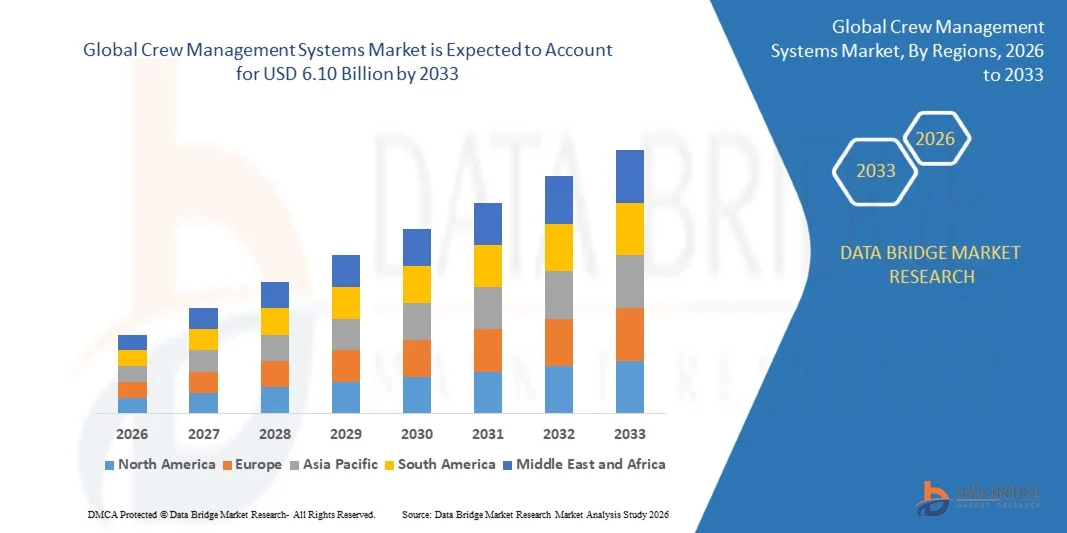
The global crew management systems market was valued at USD 2.95 billion in 2025 and is projected to reach USD 6.10 billion by 2033, growing at a CAGR of 9.52% from 2026 to 2033. The market is experiencing strong growth driven by increasing adoption of digital workforce optimization tools in aviation, maritime, and rail industries, alongside rising demand for automation in crew scheduling, compliance management, and operational efficiency.
The growing complexity of global transportation networks, combined with stricter regulatory requirements for crew safety, working hours, and certification tracking, is compelling airlines, shipping companies, and rail operators to adopt advanced crew management solutions. Cloud-based and AI-enabled platforms are replacing traditional manual scheduling systems, enabling real-time workforce allocation, reduced operational delays, and improved regulatory compliance across global transport operations.
Key Market Trends & Insights
- North America dominated the crew management systems market with the largest revenue share of 38.9% in 2025, supported by strong adoption of digital aviation solutions, advanced maritime fleet operations, and rapid deployment of cloud-based workforce management platforms across transportation industries.
- Asia-Pacific is expected to be the fastest-growing region, recording a CAGR of from 2026 to 2033. Growth is driven by rapid expansion of airline fleets, growing maritime trade activities, and increasing adoption of digital workforce management platforms in countries such as China, India, and Japan.
- The Smartphones segment held the largest market revenue share of approximately 46.3% in 2025 driven by increasing reliance on mobile workforce applications, real-time crew notifications, and cloud-based scheduling accessibility across aviation and maritime operations. Smartphones are widely preferred due to their portability, instant communication capabilities, and integration with enterprise crew management platforms for on-the-go operational control.
- The Tablets segment is projected to register the fastest growth at a CAGR of 11.2% from 2026 to 2033, driven by increasing adoption in cockpit operations, shipboard crew coordination, and rail workforce management where larger screens are required for detailed scheduling, documentation, and compliance monitoring. Rising deployment of ruggedized tablets in aviation and maritime environments is further accelerating segment expansion.
- The On-Cloud segment held the largest market revenue share of approximately 58.7% in 2025 driven by rapid digital transformation across airlines, shipping companies, and rail operators, along with growing demand for scalable, real-time, and remotely accessible workforce management solutions. Cloud-based systems enable seamless integration with enterprise resource planning and operational platforms, improving scheduling efficiency and regulatory compliance.
- The On-Cloud segment is also projected to register the fastest growth at a CAGR of 10.6% from 2026 to 2033, driven by increasing migration from legacy systems, reduced IT infrastructure costs, and enhanced data security and analytics capabilities offered by cloud deployment models across global transportation networks.
- The Crew Operations segment held the largest market revenue share of approximately 41.5% in 2025 driven by the critical need for real-time monitoring, scheduling optimization, and operational coordination across aviation, maritime, and rail industries. Efficient crew operations management is essential for minimizing delays, ensuring compliance, and maintaining service reliability.
- The Crew Planning segment is projected to register the fastest growth at a CAGR of 11.8% from 2026 to 2033, driven by increasing adoption of AI-based forecasting tools, predictive scheduling systems, and automated workforce allocation technologies that enhance efficiency, reduce operational conflicts, and improve resource utilization across global transportation networks.
Market Size & Forecast
- Global Market Value (2025): USD 2.95 Billion
- Expected Market Value (2033): USD 6.10 Billion
- Forecast CAGR (2026–2033): 9.52%
- Leading Region in 2025: North America
- Fastest Growing Region: Asia-Pacific
Report Scope and Crew Management Systems Market Segmentation
|
Attributes |
Crew Management Systems Key Market Insights |
|
Segments Covered |
|
|
Countries Covered |
North America
Europe
Asia-Pacific
Middle East and Africa
South America
|
|
Key Market Players |
• Yii (U.K.) |
|
Market Opportunities |
• Expansion Of Cloud-Based Crew Scheduling Platforms |
|
Value Added Data Infosets |
In addition to the market insights such as market value, growth rate, market segments, geographical coverage, market players, and market scenario, the market report curated by the Data Bridge Market Research team includes in-depth expert analysis, import/export analysis, pricing analysis, production consumption analysis, and pestle analysis. |
Global Crew Management Systems Market Trends
Trend: Growth In Digital Workforce Optimization And AI-Driven Crew Scheduling Systems
Increasing demand for automated, efficient, and compliant workforce management solutions across aviation, maritime, and rail industries is driving rapid adoption of advanced crew management systems. Traditional manual scheduling methods are increasingly being replaced due to rising operational complexity, regulatory compliance requirements, and the need for real-time workforce visibility across global transport networks.
In modern airline operations, crew management platforms are being integrated with AI and cloud-based systems to optimize pilot and cabin crew scheduling, reduce turnaround delays, and ensure compliance with flight duty time limitations. For instance, major airlines such as Delta Air Lines and Lufthansa Group have implemented advanced crew optimization tools that process thousands of crew assignments daily, significantly reducing scheduling conflicts and operational disruptions. In the maritime sector, shipping companies are deploying digital crew management systems to handle multinational workforce allocation and certification tracking in compliance with IMO regulations. The rapid expansion of global air passenger traffic, which surpassed pre-pandemic levels in 2024 according to IATA, is further increasing demand for scalable workforce optimization solutions. In addition, rail operators in Europe and Asia are adopting automated rostering systems to improve punctuality and operational efficiency across high-density transit networks
Global Crew Management Systems Market Dynamics
Key Market Driver: Rising Need For Regulatory Compliance And Operational Efficiency
The global crew management systems market is strongly driven by increasing regulatory requirements related to workforce safety, duty hour limitations, and certification tracking across aviation, maritime, and rail industries. Growing operational complexity in global transportation networks is compelling operators to adopt digital platforms that ensure compliance while optimizing workforce utilization.
Airlines are required to strictly comply with aviation authority regulations such as FAA and EASA crew duty time rules, while shipping companies must adhere to IMO standards for crew certification and rest hours. For instance, major international airlines such as Emirates and British Airways use automated crew management platforms to ensure compliance while optimizing crew rotations across long-haul routes. In addition, rising global air traffic demand and increasing fleet sizes are further accelerating adoption of advanced scheduling and monitoring systems
Key Restraint/Challenge: High Implementation Costs And Integration Complexity
Despite strong adoption trends, the market faces challenges due to high initial implementation costs and complex integration with legacy airline, maritime, and rail IT systems. Many organizations continue to rely on outdated scheduling infrastructure, making system migration time-consuming and resource-intensive.
In addition, integration with multiple operational platforms such as flight operations, payroll systems, and regulatory databases increases technical complexity and deployment timelines. Smaller operators and regional transport companies often face budget constraints, limiting their ability to adopt advanced AI-enabled crew management solutions, particularly in emerging markets where digital transformation is still evolving
Key Market Opportunity: Expansion Of Cloud-Based Platforms And AI-Powered Workforce Optimization
The increasing shift toward cloud-based deployment models and AI-powered workforce optimization tools is creating significant growth opportunities in the crew management systems market. Organizations are increasingly adopting scalable, subscription-based platforms that enable real-time crew tracking, predictive scheduling, and automated compliance management.
In aviation, next-generation crew management platforms are integrating machine learning algorithms to predict crew availability, minimize delays, and improve operational efficiency across global flight networks. For instance, several Asia-Pacific airlines are investing in digital transformation initiatives to modernize workforce management systems in response to rapidly growing passenger demand. In addition, maritime and rail operators are leveraging predictive analytics to optimize staffing levels, reduce operational costs, and improve service reliability across expanding transportation corridors in Europe, North America, and Asia-Pacific.
Global Crew Management Systems Market Scope
The market is segmented on the basis of device, system, and application.
• By Device
On the basis of device, the crew management systems market is segmented into Smartphones, Personal Computers (PCs), and Tablets. The Smartphones segment held the largest market revenue share of approximately 46.3% in 2025 driven by increasing reliance on mobile workforce applications, real-time crew notifications, and cloud-based scheduling accessibility across aviation and maritime operations. Smartphones are widely preferred due to their portability, instant communication capabilities, and integration with enterprise crew management platforms for on-the-go operational control.
The Tablets segment is projected to register the fastest growth at a CAGR of 11.2% from 2026 to 2033, driven by increasing adoption in cockpit operations, shipboard crew coordination, and rail workforce management where larger screens are required for detailed scheduling, documentation, and compliance monitoring. Rising deployment of ruggedized tablets in aviation and maritime environments is further accelerating segment expansion.
• By System
On the basis of system, the crew management systems market is segmented into Server Based and On-Cloud systems. The On-Cloud segment held the largest market revenue share of approximately 58.7% in 2025 driven by rapid digital transformation across airlines, shipping companies, and rail operators, along with growing demand for scalable, real-time, and remotely accessible workforce management solutions. Cloud-based systems enable seamless integration with enterprise resource planning and operational platforms, improving scheduling efficiency and regulatory compliance.
The On-Cloud segment is also projected to register the fastest growth at a CAGR of 10.6% from 2026 to 2033, driven by increasing migration from legacy systems, reduced IT infrastructure costs, and enhanced data security and analytics capabilities offered by cloud deployment models across global transportation networks.
• By Application
On the basis of application, the crew management systems market is segmented into Crew Planning, Crew Training, Crew Services, and Crew Operations. The Crew Operations segment held the largest market revenue share of approximately 41.5% in 2025 driven by the critical need for real-time monitoring, scheduling optimization, and operational coordination across aviation, maritime, and rail industries. Efficient crew operations management is essential for minimizing delays, ensuring compliance, and maintaining service reliability.
The Crew Planning segment is projected to register the fastest growth at a CAGR of 11.8% from 2026 to 2033, driven by increasing adoption of AI-based forecasting tools, predictive scheduling systems, and automated workforce allocation technologies that enhance efficiency, reduce operational conflicts, and improve resource utilization across global transportation networks.
Global Crew Management Systems Market Regional Analysis
• North America dominated the crew management systems market with the largest revenue share of 38.9% in 2025, driven by strong adoption of digital aviation solutions, advanced maritime fleet operations, and rapid deployment of cloud-based workforce management platforms across transportation industries
• Operators in the region highly value real-time crew scheduling efficiency, regulatory compliance automation, and integrated workforce optimization tools that enhance operational safety, reduce delays, and improve resource utilization across airlines, shipping companies, and rail networks
• This widespread adoption is further supported by strong technological infrastructure, high digital transformation investment, and increasing demand for AI-enabled operational efficiency solutions, establishing crew management systems as a critical backbone for large-scale transportation operations
U.S. Crew Management Systems Market Insight
The U.S. crew management systems market captured the largest revenue share in North America in 2025, driven by rapid modernization of airline operations, increasing fleet expansion, and strong adoption of AI-based workforce scheduling platforms. Airlines and aviation service providers are increasingly deploying cloud-native crew optimization tools to manage complex pilot and cabin crew rotations across domestic and international routes. In addition, integration with predictive analytics and regulatory compliance systems such as FAA duty-time regulations is significantly improving operational efficiency and reducing scheduling conflicts.
Europe Crew Management Systems Market Insight
The Europe crew management systems market is expected to witness the fastest growth rate from 2026 to 2033, driven by strict labor regulations, increasing cross-border airline operations, and rising demand for automated crew scheduling solutions. Airlines and maritime operators are rapidly adopting digital platforms to ensure compliance with EASA and IMO regulations while optimizing workforce utilization. Growing investments in aviation digitization and expansion of low-cost carriers are further accelerating market growth across the region.
U.K. Crew Management Systems Market Insight
The U.K. crew management systems market is expected to witness strong growth from 2026 to 2033, driven by increasing airline operational complexity, rising adoption of cloud-based workforce platforms, and strong focus on regulatory compliance. Airlines and transport operators are leveraging AI-enabled scheduling systems to improve crew efficiency, reduce operational delays, and enhance real-time communication across flight operations.
Germany Crew Management Systems Market Insight
The Germany crew management systems market is expected to witness steady growth from 2026 to 2033, driven by strong aviation infrastructure, increasing rail network digitalization, and growing adoption of automated workforce planning systems. German transport operators are focusing on efficiency, safety, and compliance, leading to higher deployment of advanced crew scheduling and monitoring solutions integrated with enterprise resource planning systems.
Asia-Pacific Crew Management Systems Market Insight
The Asia-Pacific crew management systems market is expected to witness the fastest growth rate from 2026 to 2033, driven by rapid expansion of airline fleets, growing maritime trade activities, and increasing adoption of digital workforce management platforms in countries such as China, India, and Japan. Rising passenger traffic and expanding logistics networks are accelerating demand for scalable, cloud-based crew optimization solutions across the region.
Japan Crew Management Systems Market Insight
The Japan crew management systems market is expected to witness strong growth from 2026 to 2033 due to high technological adoption, increasing automation in transportation systems, and strong emphasis on operational efficiency and safety. Japanese airlines and rail operators are deploying advanced scheduling systems to manage aging workforce challenges and improve service reliability across domestic and international routes.
China Crew Management Systems Market Insight
The China crew management systems market accounted for the largest revenue share in Asia-Pacific in 2025, driven by massive expansion of aviation networks, rapid growth in maritime logistics, and strong government-led digitalization initiatives. Increasing airline fleet size, high passenger traffic growth, and adoption of AI-powered workforce management platforms are significantly strengthening market expansion across commercial aviation and transportation sectors.
Global Crew Management Systems Market Share
The Crew Management Systems industry is primarily led by well-established companies, including:
• Yii (U.K.)
• Symfony SAS (France)
• Fuel PHP Framework Team (U.S.)
• MODX (U.S.)
• Perforce Software, Inc. (U.S.)
• Scriptcase (Brazil)
• F3::Community (Global/Open Source)
• Nette Foundation (Czech Republic)
• Atheer, Inc. (U.S.)
• Augmate Corporation (U.S.)
• Blippar (U.K.)
• Catchoom (Spain)
• DAQRI (U.S.)
• EON Reality Inc. (U.S.)
• Immerseport (U.K.)
• Infinity Augmented Reality Ltd (Israel)
• Inglobe Technologies (Italy)
• JBK Consulting (U.K.)
• Kudan (Japan)
• Magic Leap, Inc. (U.S.)
• SABRE GLBL INC. (U.S.)
• Lufthansa Systems (Germany)
• Jeppesen (U.S.)
• Hexaware Technologies (India)
• IBS Software (India)
• FUJITSU (Japan)
• BlueOne Software (U.S.)
• PDC Aviation Ltd. (Finland)
• AVIOLINX (Germany)
• Sheorey Digital Systems Pvt. Ltd (India)

- Interactive Data Analysis Dashboard
- Company Analysis Dashboard for high growth potential opportunities
- Research Analyst Access for customization & queries
- Competitor Analysis with Interactive dashboard
- Latest News, Updates & Trend analysis
- Harness the Power of Benchmark Analysis for Comprehensive Competitor Tracking
Data collection and base year analysis are done using data collection modules with large sample sizes. The stage includes obtaining market information or related data through various sources and strategies. It includes examining and planning all the data acquired from the past in advance. It likewise envelops the examination of information inconsistencies seen across different information sources. The market data is analysed and estimated using market statistical and coherent models. Also, market share analysis and key trend analysis are the major success factors in the market report. To know more, please request an analyst call or drop down your inquiry.
The key research methodology used by DBMR research team is data triangulation which involves data mining, analysis of the impact of data variables on the market and primary (industry expert) validation. Data models include Vendor Positioning Grid, Market Time Line Analysis, Market Overview and Guide, Company Positioning Grid, Patent Analysis, Pricing Analysis, Company Market Share Analysis, Standards of Measurement, Global versus Regional and Vendor Share Analysis. To know more about the research methodology, drop in an inquiry to speak to our industry experts.
Data Bridge Market Research is a leader in advanced formative research. We take pride in servicing our existing and new customers with data and analysis that match and suits their goal. The report can be customized to include price trend analysis of target brands understanding the market for additional countries (ask for the list of countries), clinical trial results data, literature review, refurbished market and product base analysis. Market analysis of target competitors can be analyzed from technology-based analysis to market portfolio strategies. We can add as many competitors that you require data about in the format and data style you are looking for. Our team of analysts can also provide you data in crude raw excel files pivot tables (Fact book) or can assist you in creating presentations from the data sets available in the report.













