


What is the Global Critical Communication Market Size and Growth Rate?
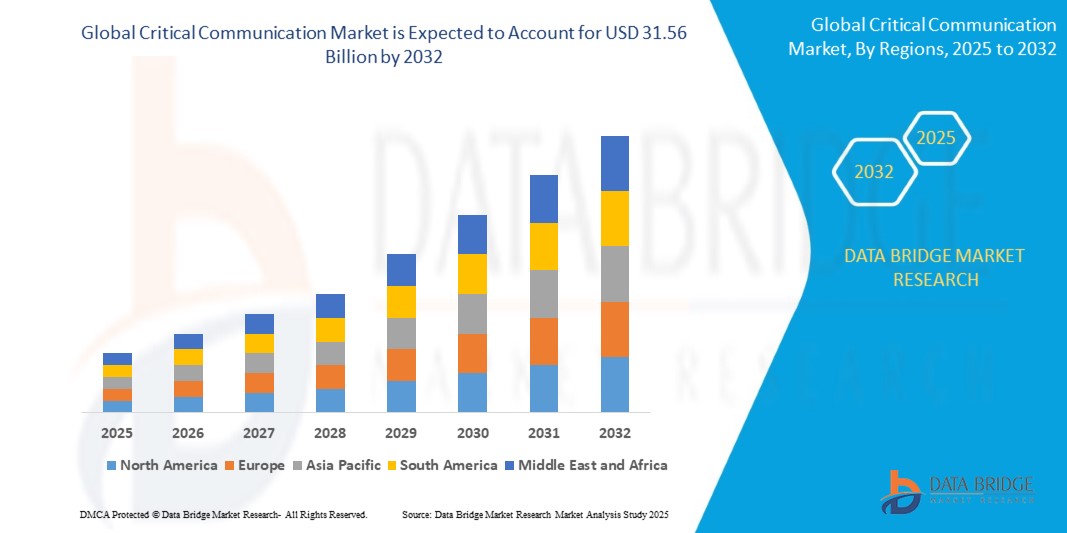
- The global critical communication market size was valued at USD 17.96 billion in 2024 and is expected to reach USD 31.56 billion by 2032, at a CAGR of 7.30% during the forecast period
- This growth is primarily driven by advancements in wireless communication technologies, rising adoption of mission-critical systems, and the need for real-time, secure communication across public safety, defense, and industrial sectors
- In addition, the growing emphasis on disaster response preparedness, coupled with government investments in next-generation communication infrastructure, is propelling the demand for critical communication solutions globally
What are the Major Takeaways of Critical Communication Market?
- Critical Communication systems are becoming indispensable for reliable, uninterrupted communication in emergency, defense, and industrial scenarios, offering resilient connectivity, low latency, and secure data transmission even in challenging environments
- The increasing adoption of LTE and 5G-based communication technologies, along with the transition from analog to digital networks, is accelerating the market’s evolution toward IP-based communication platforms
- The sector's growth is further supported by public-private partnerships, smart city developments, and modernized command-and-control operations, underscoring the strategic role of critical communication in national and enterprise security frameworks
- North America dominated the critical communication market with the largest revenue share of 42.21% in 2024, propelled by high adoption of mission-critical systems across public safety, defense, and industrial sectors
- Asia-Pacific critical communication market is forecast to grow at the fastest CAGR of 12.40% from 2025 to 2032, driven by rapid infrastructure expansion, urbanization, and rising safety concerns in countries such as China, Japan, and India
- The hardware segment dominated the market with the largest market revenue share of 67.9% in 2024, driven by the increasing deployment of physical communication devices such as transceivers, base stations, antennas, and control consoles
Report Scope and Critical Communication Market Segmentation
|
Attributes |
Critical Communication Key Market Insights |
|
Segments Covered |
|
|
Countries Covered |
North America
Europe
Asia-Pacific
Middle East and Africa
South America
|
|
Key Market Players |
|
|
Market Opportunities |
|
|
Value Added Data Infosets |
In addition to the insights on market scenarios such as market value, growth rate, segmentation, geographical coverage, and major players, the market reports curated by the Data Bridge Market Research also include in-depth expert analysis, pricing analysis, brand share analysis, consumer survey, demography analysis, supply chain analysis, value chain analysis, raw material/consumables overview, vendor selection criteria, PESTLE Analysis, Porter Analysis, and regulatory framework. |
What is the Key Trend in the Critical Communication Market?
“Rising Integration with 5G and Low-Latency Networks”
- The critical communication market is experiencing a significant shift with the integration of 5G technology and ultra-low-latency communication networks. This trend is enhancing the speed, reliability, and coverage of real-time communication for both commercial and emergency services
- 5G enables instantaneous data transmission for critical alerts, video surveillance feeds, and biometric authentication in high-risk or fast-moving environments such as public safety, industrial zones, and military operations
- The growing deployment of mission-critical broadband solutions leverages 5G’s bandwidth and low latency to support uninterrupted communication between command centers, field personnel, and connected devices
- In January 2024, Motorola Solutions announced enhancements to its LTE and 5G-powered mission-critical communication portfolio, including broadband push-to-talk (PTT) devices and video solutions aimed at improving operational responsiveness
- This trend is expected to transform emergency response systems, industrial automation, and critical infrastructure protection by ensuring faster, more secure, and highly responsive communication frameworks
What are the Key Drivers of Critical Communication Market?
- Government initiatives across the globe are fueling the deployment of next-gen communication systems for emergency responders, law enforcement, and disaster management teams
- Investments in digital transformation of public safety infrastructure, including smart city projects, are boosting demand for secure, real-time communication networks
- The need for interoperability across departments, such as police, fire, and EMS, is encouraging the integration of standardized critical communication platforms.
- In March 2024, the U.K. Home Office accelerated the rollout of the Emergency Services Network (ESN), replacing legacy TETRA systems with a 4G/5G-based communication network for better coordination and coverage
- As public safety takes center stage, the institutional support and funding for modern communication solutions will be a pivotal growth engine for the critical communication market
Which Factor is challenging the Growth of the Critical Communication Market?
- One of the major hurdles is the fragmentation of communication protocols and hardware standards, making it difficult for systems from different vendors to work seamlessly
- Many organizations struggle to upgrade legacy systems or integrate new technologies without disrupting operations or incurring high costs due to compatibility issues
- In sectors such as public safety or transportation, the need for real-time, multi-agency coordination is often impeded by disparate systems and software architectures
- A 2023 report by Public Safety Communications Europe (PSCE) highlighted that over 40% of emergency service providers in Europe faced cross-platform communication delays during collaborative operations due to incompatible systems
- To ensure smooth, scalable growth, the industry must prioritize standardization efforts, develop interoperable platforms, and promote vendor collaboration for unified communication solutions
How is the Critical Communication Market Segmented?
The market is segmented on the basis of offering, technology, enterprise size, and vertical.
• By Offering
On the basis of offering, the critical communication market is segmented into hardware and services. The hardware segment dominated the market with the largest market revenue share of 67.9% in 2024, driven by the increasing deployment of physical communication devices such as transceivers, base stations, antennas, and control consoles. The demand for robust and reliable hardware is especially high in sectors such as public safety and industrial operations, where dependable real-time communication is mission-critical.
The services segment is expected to witness the fastest growth rate from 2025 to 2032, propelled by the growing emphasis on maintenance, managed services, and system integration. As organizations seek to upgrade their legacy systems, there is a rising need for technical support, consulting, and lifecycle management to ensure optimal system performance.
• By Technology
On the basis of technology, the critical communication market is segmented into Land Mobile Radio (LMR) and Long-Term Evolution (LTE). The LMR segment held the largest market revenue share of 58.4% in 2024, owing to its proven reliability, resilience in harsh environments, and established use in public safety and mission-critical sectors. LMR technologies such as TETRA and P25 continue to dominate due to their high audio clarity, low latency, and dedicated spectrum usage.
The LTE segment is anticipated to witness the fastest CAGR from 2025 to 2032, driven by its capability to support high-speed data, video streaming, and broadband applications. LTE's scalability and compatibility with 5G standards make it attractive for evolving communication needs in utilities, logistics, and smart city applications.
• By Enterprise Size
On the basis of enterprise size, the critical communication market is segmented into large enterprises and small & medium enterprises (SMEs). The large enterprises segment dominated with the largest market revenue share of 61.5% in 2024, fueled by their greater financial resources, complex operational needs, and early adoption of advanced Critical Communication systems for centralized control and regulatory compliance.
The SMEs segment is expected to grow at the fastest CAGR from 2025 to 2032, driven by the increasing affordability of communication technologies and the growing awareness of the importance of secure, scalable communication infrastructure. Many SMEs are also adopting cloud-based or mobile-first solutions to maintain operational agility.
• By Vertical
On the basis of vertical, the critical communication market is segmented into public safety, utilities, transportation & logistics, mining, and others. The public safety segment held the largest market revenue share of 46.3% in 2024, owing to high demand from police, fire departments, emergency medical services, and disaster response units for mission-critical, real-time communication. Government funding and initiatives to modernize emergency communication systems further strengthen this segment’s dominance.
The transportation & logistics segment is projected to witness the fastest CAGR from 2025 to 2032, driven by the need for real-time fleet communication, tracking, and route optimization. As global supply chains become more digitized, reliable critical communication systems are becoming integral to operational efficiency and safety in transit environments.
Which Region Holds the Largest Share of the Critical Communication Market?
- North America dominated the critical communication market with the largest revenue share of 42.21% in 2024, propelled by high adoption of mission-critical systems across public safety, defense, and industrial sectors. The region benefits from strong infrastructure, significant government investments, and a mature user base focused on reliable and real-time communication capabilities
- Increasing demand for secure, uninterrupted communication during emergencies—especially in law enforcement, emergency response, and utilities is strengthening market growth
- In addition, the presence of major players such as Motorola Solutions, AT&T, and Harris Corporation, along with continuous advancements in LMR and LTE technologies, is sustaining regional leadership
U.S. Critical Communication Market Insight
The U.S. critical communication market dominated the North American revenue share in 2024, driven by large-scale public safety modernization projects and increased adoption across industrial and transportation sectors. The deployment of FirstNet (First Responder Network Authority), an initiative by the U.S. government, is a major growth catalyst. It enhances nationwide broadband access for first responders using LTE-based critical communication networks. The rise in critical infrastructure development and natural disaster preparedness is further boosting demand for robust and interoperable communication systems.
Europe Critical Communication Market Insight
The Europe critical communication market is projected to grow at a substantial CAGR during the forecast period, driven by heightened regulatory pressure for resilient emergency communication and smart city development. Adoption is increasing across transportation, energy, and public safety, with government initiatives promoting mission-critical broadband networks. Europe’s push for interoperability, spectrum harmonization, and private LTE networks is accelerating the transition from legacy LMR to hybrid communication systems.
U.K. Critical Communication Market Insight
The U.K. critical communication market is anticipated to grow significantly, fueled by the Emergency Services Network (ESN) project that aims to replace legacy TETRA systems with LTE-enabled solutions. The country’s focus on national security and smart infrastructure development is boosting investments in critical communication technology. Demand is also rising in commercial sectors, such as utilities and transport, where seamless communication is essential for operational efficiency and safety compliance.
Germany Critical Communication Market Insight
The Germany critical communication market is expanding steadily, backed by strong public safety funding, Industry 4.0 initiatives, and a growing emphasis on secure communications within smart industrial environments. Adoption is prevalent among police, emergency services, and transport authorities, while private LTE networks are gaining traction in manufacturing hubs. The integration of critical communication with automation and IoT platforms is fostering advanced use cases across both public and private sectors.
Which Region is the Fastest Growing in the Critical Communication Market?
Asia-Pacific critical communication market is forecast to grow at the fastest CAGR of 12.40% from 2025 to 2032, driven by rapid infrastructure expansion, urbanization, and rising safety concerns in countries such as China, Japan, and India. Governments in the region are heavily investing in smart cities and emergency communication networks, while industrial growth is creating demand for mission-critical wireless systems. A growing presence of domestic manufacturers and favorable regulatory environments is further broadening access and affordability for critical communication solutions.
Japan Critical Communication Market Insight
The Japan market is witnessing strong growth driven by its high-tech ecosystem and national emphasis on disaster resilience. With frequent natural disasters, the country has prioritized advanced emergency communication networks, making critical communication a vital part of its public safety infrastructure. Integration with IoT and AI technologies for predictive emergency response and real-time coordination is becoming more prevalent across cities and industrial zones.
China Critical Communication Market Insight
China held the largest market share in Asia-Pacific in 2024, attributed to massive investments in public safety and industrial communication systems. The government's focus on building smart cities, expanding its 5G infrastructure, and digitizing emergency services is rapidly scaling up market adoption. Local vendors such as Huawei and ZTE are playing a pivotal role by offering affordable, scalable critical communication systems tailored for large-scale deployment across sectors.
Which are the Top Companies in Critical Communication Market?
The critical communication industry is primarily led by well-established companies, including:
- AT&T Intellectual Property (U.S.)
- Leonardo S.p.A. (Italy)
- Telefonaktiebolaget LM Ericsson (Sweden)
- Motorola (U.S.)
- ZTE Corporation (China)
- Atos (France)
- Hytera Communications Corp (China)
- Nokia (Finland)
- Damm (Spain)
- Inmarsat Group (U.K.)
- Huawei Technologies Co., Ltd (China)
- Cobham Satcom (U.K.)
- Secure Land Communications (U.S.)
- Tait Communications (New Zealand)
- Ascom (Switzerland)
- Simoco Wireless Communications (U.K.)
- Zenitel (Norway)
- LS Spectrum Solutions (India)
- EFJohnson Technologies (U.S.)
- Mentura Group (Finland)
What are the Recent Developments in Global Critical Communication Market?
- In August 2024, AT&T Intellectual Property and Oracle announced a strategic collaboration to embed AT&T’s IoT connectivity into Oracle’s Enterprise Communications Platform (ECP), delivering secure, reliable connectivity and near real-time communication capabilities to Oracle's cloud application users. The integration supports diverse applications including public safety through FirstNet and AT&T’s network APIs, simplifying network operations and improving service reliability. This collaboration marks a significant step in enhancing critical communication through cloud-integrated IoT solutions
- In July 2024, Telefonaktiebolaget LM Ericsson was recognized as a Leader in the 2024 Gartner Magic Quadrant for CSP 5G RAN Infrastructure Solutions, earning the highest ranking for Ability to Execute. This acknowledgment highlights Ericsson’s excellence in delivering robust 5G RAN, Cloud RAN, and transport solutions that manage a substantial share of global mobile traffic while driving energy efficiency and network performance. This recognition reaffirms Ericsson's industry leadership and its commitment to innovation in 5G technology
- In January 2023, Airbus and M1 successfully conducted Singapore’s first standalone 5G aerial trial, showcasing the potential of 5G in supporting applications such as UAVs, aerial surveillance, and enhanced communication systems. This collaboration demonstrated how 5G can revolutionize airborne technologies and position Singapore as a pioneer in high-tech communication advancements. This trial set a new benchmark for integrating 5G capabilities into aerial and unmanned systems
- In February 2022, Radisys launched its 5G IoT Software Suite aimed at enabling telecom providers and enterprises to efficiently deploy and manage IoT applications over 5G networks. This suite leverages the ultra-fast speeds, low latency, and massive connectivity of 5G to support complex and high-demand IoT use cases. This release strengthened Radisys’ role in accelerating 5G-driven IoT transformation across industries

- Interactive Data Analysis Dashboard
- Company Analysis Dashboard for high growth potential opportunities
- Research Analyst Access for customization & queries
- Competitor Analysis with Interactive dashboard
- Latest News, Updates & Trend analysis
- Harness the Power of Benchmark Analysis for Comprehensive Competitor Tracking
Global Critical Communication Market, Supply Chain Analysis and Ecosystem Framework
To support market growth and help clients navigate the impact of geopolitical shifts, DBMR has integrated in-depth supply chain analysis into its Global Critical Communication Market research reports. This addition empowers clients to respond effectively to global changes affecting their industries. The supply chain analysis section includes detailed insights such as Global Critical Communication Market consumption and production by country, price trend analysis, the impact of tariffs and geopolitical developments, and import and export trends by country and HSN code. It also highlights major suppliers with data on production capacity and company profiles, as well as key importers and exporters. In addition to research, DBMR offers specialized supply chain consulting services backed by over a decade of experience, providing solutions like supplier discovery, supplier risk assessment, price trend analysis, impact evaluation of inflation and trade route changes, and comprehensive market trend analysis.
Data collection and base year analysis are done using data collection modules with large sample sizes. The stage includes obtaining market information or related data through various sources and strategies. It includes examining and planning all the data acquired from the past in advance. It likewise envelops the examination of information inconsistencies seen across different information sources. The market data is analysed and estimated using market statistical and coherent models. Also, market share analysis and key trend analysis are the major success factors in the market report. To know more, please request an analyst call or drop down your inquiry.
The key research methodology used by DBMR research team is data triangulation which involves data mining, analysis of the impact of data variables on the market and primary (industry expert) validation. Data models include Vendor Positioning Grid, Market Time Line Analysis, Market Overview and Guide, Company Positioning Grid, Patent Analysis, Pricing Analysis, Company Market Share Analysis, Standards of Measurement, Global versus Regional and Vendor Share Analysis. To know more about the research methodology, drop in an inquiry to speak to our industry experts.
Data Bridge Market Research is a leader in advanced formative research. We take pride in servicing our existing and new customers with data and analysis that match and suits their goal. The report can be customized to include price trend analysis of target brands understanding the market for additional countries (ask for the list of countries), clinical trial results data, literature review, refurbished market and product base analysis. Market analysis of target competitors can be analyzed from technology-based analysis to market portfolio strategies. We can add as many competitors that you require data about in the format and data style you are looking for. Our team of analysts can also provide you data in crude raw excel files pivot tables (Fact book) or can assist you in creating presentations from the data sets available in the report.













