




Global Critical Infrastructure Protection Market
Market Size in
CAGR :
% 
 161.70
294.89
2025
2033
161.70
294.89
2025
2033
 Forecast Period Forecast Period |
2026 –2033 |
 Market Size (Base Year) Market Size (Base Year) |
USD 161.70 |
 Market Size (Forecast Year) Market Size (Forecast Year) |
USD 294.89 |
 CAGR CAGR |
% |
| Major Markets Players |
|
What is the Global Critical Infrastructure Protection Market Size and Growth Rate?
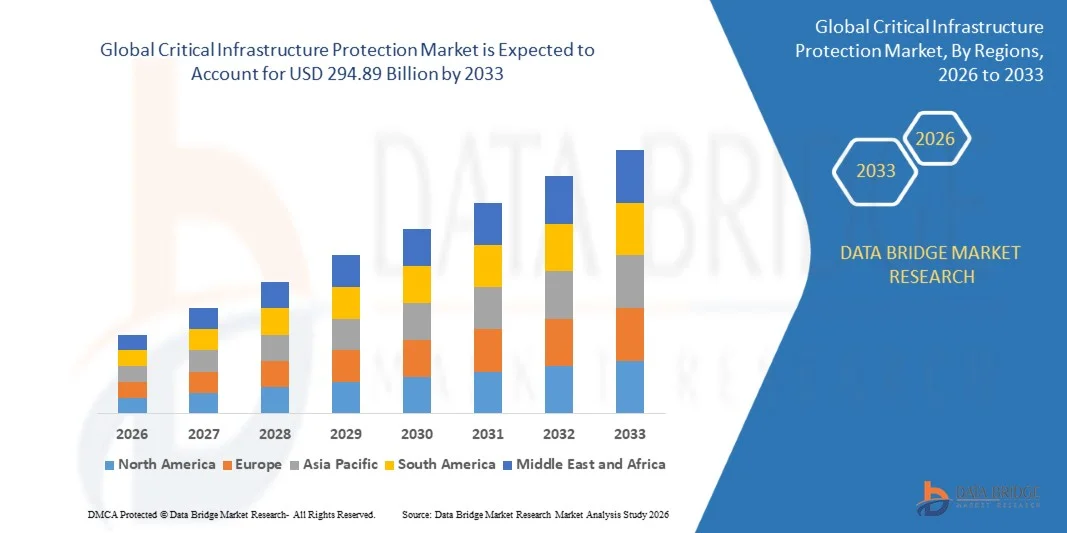
- The global critical infrastructure protection market size was valued at USD 161.70 billion in 2025 and is expected to reach USD 294.89 billion by 2033, at a CAGR of 7.8% during the forecast period
- The rise in the need to secure OT networks across the globe acts as one of the major factors driving the growth of critical infrastructure protection market
- The surge in the implementation of stringent government regulations to increase the adoption of CIP solutions, and high adoption of the technology to prevent the commission of high-impact terrorist attacks accelerate the market growth
What are the Major Takeaways of Critical Infrastructure Protection Market?
- The increase in the instances of security breaches and cyber-attacks that pose a threat to infrastructural development, and governments focusing on improving the infrastructure, such as transport, energy, and water, further influence the market
- In addition, rapid digitization, rise in trend of Bring-Your-Own-Devices (BYOD) across industries, and concerns for the security and safety of government information positively affect the critical infrastructure protection market. Furthermore, rise in the adoption of cloud technology and IoT devices and investments by governments and enterprises to develop robust CIP solutions extend profitable opportunities to the market players
- North America dominated the critical infrastructure protection market with a 38.6% revenue share in 2025, driven by strong adoption of advanced cybersecurity frameworks, surveillance systems, physical access control technologies, and large-scale investments in protecting critical assets across the U.S. and Canada
- Asia-Pacific is projected to register the fastest CAGR of 6.7% from 2025 to 2033, driven by rapid industrialization, expanding smart city initiatives, strong growth in manufacturing automation, and increasing investments in utility, telecom, and transport security infrastructure across China, Japan, India, South Korea, and Southeast Asia
- The Solutions segment dominated the market with a 66.4% share in 2025, as it remains the preferred choice for governments, utilities, and enterprises seeking integrated platforms for surveillance, access control, threat monitoring, and incident response
Report Scope and Critical Infrastructure Protection Market Segmentation
|
Attributes |
Critical Infrastructure Protection Key Market Insights |
|
Segments Covered |
|
|
Countries Covered |
North America
Europe
Asia-Pacific
Middle East and Africa
South America
|
|
Key Market Players |
|
|
Market Opportunities |
|
|
Value Added Data Infosets |
In addition to the insights on market scenarios such as market value, growth rate, segmentation, geographical coverage, and major players, the market reports curated by the Data Bridge Market Research also include in-depth expert analysis, pricing analysis, brand share analysis, consumer survey, demography analysis, supply chain analysis, value chain analysis, raw material/consumables overview, vendor selection criteria, PESTLE Analysis, Porter Analysis, and regulatory framework. |
What is the Key Trend in the Critical Infrastructure Protection Market?
“Increasing Shift Toward AI-Driven, Integrated, and Real-Time Infrastructure Security Solutions”
- The critical infrastructure protection market is witnessing strong adoption of AI-powered monitoring platforms, IoT-enabled surveillance systems, and integrated cybersecurity frameworks designed to protect critical assets across energy, transportation, telecom, defence, and public utilities
- Market players are introducing multi-layered security solutions that combine physical security, network protection, video analytics, access control, and threat intelligence for comprehensive risk mitigation
- Growing demand for cost-efficient, scalable, and real-time threat detection systems is driving deployment across smart cities, airports, oil & gas facilities, power grids, and government infrastructure
- For instance, companies such as BAE Systems, Honeywell, Thales, and Lockheed Martin are enhancing their infrastructure protection portfolios with AI-based analytics, sensor fusion, and advanced command-and-control systems
- Increasing need for rapid threat detection, predictive maintenance, and automated incident response is accelerating the shift toward cloud-integrated and AI-enabled protection platforms
- As infrastructure systems become more connected and digitally complex, critical infrastructure protection solutions will remain vital for resilience, operational continuity, and national security
What are the Key Drivers of Critical Infrastructure Protection Market?
- Rising demand for advanced security solutions to safeguard power plants, telecom networks, transportation systems, and water treatment facilities from physical and cyber threats
- For instance, in 2025, leading companies such as Raytheon, Honeywell, and Hexagon AB upgraded their portfolios with enhanced surveillance, threat detection, and risk intelligence capabilities
- Growing adoption of IoT devices, smart grid technologies, industrial automation, and digital control systems is boosting demand for critical infrastructure protection solutions across the U.S., Europe, and Asia-Pacific
- Advancements in AI-driven analytics, real-time monitoring, sensor technologies, and cloud-based security architectures have strengthened efficiency and response capabilities
- Rising geopolitical risks, cyberattacks on essential services, and increasing investment in homeland security are creating strong market demand
- Supported by steady investments in defence modernization, public safety, and smart infrastructure, the critical infrastructure protection market is expected to witness strong long-term growth
Which Factor is Challenging the Growth of the Critical Infrastructure Protection Market?
- High costs associated with advanced surveillance systems, cybersecurity infrastructure, and integrated threat management platforms restrict adoption among smaller public institutions and developing regions
- For instance, during 2024–2025, rising component costs, software licensing expenses, and integration complexities increased deployment costs for several global vendors
- Complexity in managing hybrid cyber-physical environments, legacy infrastructure systems, and real-time data streams increases the need for skilled professionals and specialized training
- Limited awareness and budget constraints in emerging economies regarding modern infrastructure security practices slow adoption
- Competition from fragmented standalone security solutions and interoperability challenges creates pricing pressure and reduces standardization
- To address these issues, companies are focusing on cost-optimized platforms, AI automation, training resources, and enhanced system integration to increase global adoption of critical infrastructure protection solutions
How is the Critical Infrastructure Protection Market Segmented?
The market is segmented on the basis of component, solution, and vertical.
• By Component
On the basis of component, the critical infrastructure protection market is segmented into Solutions and Services. The Solutions segment dominated the market with a 66.4% share in 2025, as it remains the preferred choice for governments, utilities, and enterprises seeking integrated platforms for surveillance, access control, threat monitoring, and incident response. These solutions provide centralized visibility, real-time analytics, and automated alerts, making them highly effective in protecting critical assets such as power grids, transportation systems, telecom networks, and industrial facilities. Their scalability, interoperability with legacy infrastructure, and ability to combine both physical and digital security functions continue to support strong market adoption across global markets.
The Services segment is expected to grow at the fastest CAGR from 2026 to 2033, driven by rising demand for consulting, risk assessment, managed security services, compliance support, system integration, and maintenance services. Increasing cyber threats and the need for specialized expertise are further accelerating demand for outsourced protection services.
• By Solution
On the basis of solution, the market is segmented into Physical Safety and Security and Cyber Security. The Cyber Security segment dominated the market with a 57.8% share in 2025, supported by the growing frequency of ransomware attacks, malware intrusions, SCADA vulnerabilities, and nation-state cyber threats targeting essential infrastructure. Increasing deployment of firewalls, intrusion detection systems, SIEM platforms, endpoint protection, and network monitoring tools continues to drive strong adoption across power plants, airports, data centers, and government institutions. The rise of smart grids, industrial IoT, and cloud-connected infrastructure further intensifies the need for advanced cyber resilience frameworks.
The Physical Safety and Security segment is projected to grow at the fastest CAGR from 2026 to 2033, driven by rising investments in video surveillance, biometric access systems, perimeter intrusion detection, and smart sensor technologies across public infrastructure and defense facilities.
• By Vertical
On the basis of vertical, the critical infrastructure protection market is segmented into Financial Institutions, Government, Defense, Transport and Logistics, Energy and Power, Commercial Sector, Telecom, Chemicals and Manufacturing, Oil and Gas, and Others. The Government segment dominated the market with a 24.9% share in 2025, driven by rising investments in homeland security, smart city infrastructure, public safety systems, and national cybersecurity frameworks. Governments continue to prioritize the protection of public assets, defense systems, and emergency response networks through advanced integrated security solutions.
The Energy and Power segment is expected to grow at the fastest CAGR from 2026 to 2033, propelled by increasing cyberattacks on smart grids, substations, renewable energy assets, and utility control systems. Growing modernization of power infrastructure and rising emphasis on operational continuity are driving robust demand for critical infrastructure protection solutions in this segment.
Which Region Holds the Largest Share of the Critical Infrastructure Protection Market?
- North America dominated the critical infrastructure protection market with a 38.6% revenue share in 2025, driven by strong adoption of advanced cybersecurity frameworks, surveillance systems, physical access control technologies, and large-scale investments in protecting critical assets across the U.S. and Canada. Rising cyber threats targeting energy grids, telecom networks, government infrastructure, and transport systems continue to fuel market demand across the region
- Leading companies in North America are introducing AI-enabled threat detection platforms, advanced video surveillance, perimeter intrusion detection, and OT security solutions, strengthening the region’s technological advantage. Continuous investment in homeland security, smart city infrastructure, and industrial cybersecurity drives long-term market expansion
- Strong regulatory frameworks, high defense budgets, and established public-private partnerships further reinforce regional market leadership
U.S. Critical Infrastructure Protection Market Insight
The U.S. is the largest contributor in North America, supported by strong investments in defense modernization, national cybersecurity initiatives, and critical infrastructure resilience programs across power, transport, oil & gas, and government sectors. Increasing cyberattacks on essential services, along with the deployment of advanced SIEM, IAM, and network security platforms, continues to intensify demand for critical infrastructure protection solutions. Presence of major defense contractors, technology vendors, and strong public-private collaboration frameworks further drives market growth.
Canada Critical Infrastructure Protection Market Insight
Canada contributes significantly to regional growth, driven by increasing investments in utility protection, telecom security, transportation monitoring, and public safety infrastructure. Rising focus on smart grid protection, cyber resilience, and government-backed security modernization programs continues to strengthen adoption across the country.
Asia-Pacific Critical Infrastructure Protection Market
Asia-Pacific is projected to register the fastest CAGR of 6.7% from 2025 to 2033, driven by rapid industrialization, expanding smart city initiatives, strong growth in manufacturing automation, and increasing investments in utility, telecom, and transport security infrastructure across China, Japan, India, South Korea, and Southeast Asia. Rising cyber risks and large-scale infrastructure projects continue to accelerate regional market expansion.
China Critical Infrastructure Protection Market Insight
China is the largest contributor to Asia-Pacific due to massive investments in industrial infrastructure, smart city development, power grid modernization, and public surveillance systems. Rising demand for AI-powered monitoring, industrial cybersecurity, and transport infrastructure protection solutions continues to drive strong market growth.
Japan Critical Infrastructure Protection Market Insight
Japan shows steady growth supported by advanced telecom infrastructure, disaster resilience planning, and continuous modernization of transportation and industrial control systems. Strong emphasis on high-reliability security systems and public safety solutions supports long-term market expansion.
India Critical Infrastructure Protection Market Insight
India is emerging as a major growth hub, driven by expanding smart city projects, rising digital infrastructure investments, and government-backed cybersecurity initiatives across transport, utilities, and telecom sectors. Increasing deployment of surveillance, access control, and OT security platforms is further accelerating market penetration.
South Korea Critical Infrastructure Protection Market Insight
South Korea contributes significantly due to strong demand for advanced telecom security, smart manufacturing protection, and critical utility monitoring systems. Rapid development of AI-driven surveillance, smart transport, and industrial automation ecosystems supports sustained market growth.
Which are the Top Companies in Critical Infrastructure Protection Market?
The critical infrastructure protection industry is primarily led by well-established companies, including:
- BAE Systems (U.K.)
- Lockheed Martin (U.S.)
- General Dynamics (U.S.)
- Honeywell (U.S.)
- Airbus (Netherlands)
- Raytheon Technologies (RTX) (U.S.)
- Thales (France)
- Hexagon AB (Sweden)
- Johnson Controls (Ireland)
- Huawei (China)
- Teltronic (Spain)
- Rolta (India)
- SCADAfence (Israel)
- Tyco International (Ireland)
- Optasense (U.K.)
- 3xLOGIC (U.S.)
What are the Recent Developments in Global Critical Infrastructure Protection Market?
- In June 2025, Lockheed Martin completed the acquisition of Amentum’s Rapid Solutions business for USD 360 million in cash, bringing advanced radar systems, payload technologies, and a highly skilled workforce of around 230 professionals into its Space division. This strategic move significantly strengthens the company’s capabilities in national security, surveillance, and mission-critical defense infrastructure, thereby reinforcing long-term growth prospects in the Critical Infrastructure Protection market
- In November 2024, BAE Systems partnered with National Highways under a three-year contract worth up to USD 25 million to deliver cybersecurity, threat intelligence, data protection, and information security services across major road infrastructure projects in the U.K., thereby highlighting the growing importance of cyber resilience in critical public infrastructure
- In October 2024, Northrop Grumman Corporation and Terma A/S entered into a strategic collaboration through a Memorandum of Understanding focused on advanced defense technologies such as F-35 systems, radar, electronic warfare, missile defense, and unmanned systems, thereby accelerating innovation and strengthening critical defense infrastructure capabilities
- In June 2024, General Dynamics, through its GDIT division, secured an Integrated Base Defense Sustainment Support task order from the U.S. Army to maintain global force protection systems including radars, cameras, and sensors while optimizing logistics through AI-enabled digital tools, thereby supporting sustained operational readiness and infrastructure security
- In April 2024, Axis Communications launched the AXIS Q9307-LV Dome Camera, equipped with advanced analytics, voice stress detection, two-way audio, and robust cybersecurity features for enhanced surveillance and incident response, thereby strengthening smart security infrastructure deployment across critical facilities
SKU-
Get online access to the report on the World's First Market Intelligence Cloud

- Interactive Data Analysis Dashboard
- Company Analysis Dashboard for high growth potential opportunities
- Research Analyst Access for customization & queries
- Competitor Analysis with Interactive dashboard
- Latest News, Updates & Trend analysis
- Harness the Power of Benchmark Analysis for Comprehensive Competitor Tracking
Research Methodology
Data collection and base year analysis are done using data collection modules with large sample sizes. The stage includes obtaining market information or related data through various sources and strategies. It includes examining and planning all the data acquired from the past in advance. It likewise envelops the examination of information inconsistencies seen across different information sources. The market data is analysed and estimated using market statistical and coherent models. Also, market share analysis and key trend analysis are the major success factors in the market report. To know more, please request an analyst call or drop down your inquiry.
The key research methodology used by DBMR research team is data triangulation which involves data mining, analysis of the impact of data variables on the market and primary (industry expert) validation. Data models include Vendor Positioning Grid, Market Time Line Analysis, Market Overview and Guide, Company Positioning Grid, Patent Analysis, Pricing Analysis, Company Market Share Analysis, Standards of Measurement, Global versus Regional and Vendor Share Analysis. To know more about the research methodology, drop in an inquiry to speak to our industry experts.
Customization Available
Data Bridge Market Research is a leader in advanced formative research. We take pride in servicing our existing and new customers with data and analysis that match and suits their goal. The report can be customized to include price trend analysis of target brands understanding the market for additional countries (ask for the list of countries), clinical trial results data, literature review, refurbished market and product base analysis. Market analysis of target competitors can be analyzed from technology-based analysis to market portfolio strategies. We can add as many competitors that you require data about in the format and data style you are looking for. Our team of analysts can also provide you data in crude raw excel files pivot tables (Fact book) or can assist you in creating presentations from the data sets available in the report.












