What is the Crop Residue Collection and Management Equipment Market Size and Growth Rate?
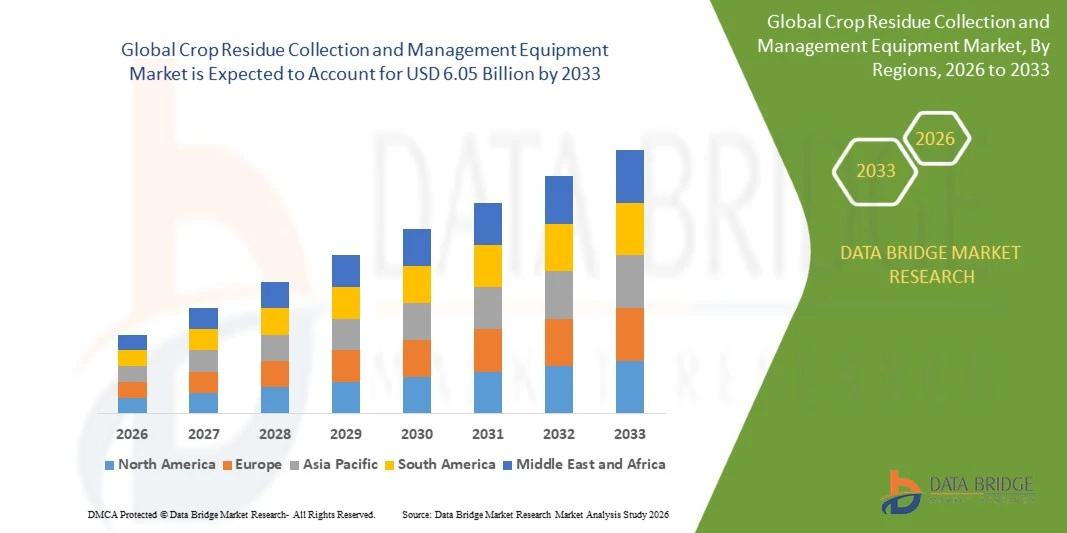
- As per Data Bridge Market Research analysis, the crop residue collection and management equipment market was valued at USD 3.60 billion in 2025 and is projected to reach USD 6.05 billion by 2033, growing at a CAGR of 6.70% from 2026 to 2033.
- The market is experiencing consistent growth driven by rising demand for mechanized agricultural residue collection, increasing adoption of sustainable farming practices, and expanding applications of crop residues in biomass and bioenergy production.
- The growing need to reduce open-field crop residue burning, combined with government subsidies for agricultural machinery and increasing emphasis on soil health, is encouraging farmers and agricultural contractors to adopt advanced residue management equipment. Balers, straw rakes, mulchers, and residue incorporation machines are supporting efficient post-harvest operations and enabling the conversion of agricultural waste into valuable resources for animal feed, composting, and renewable energy production.
Market Size & Forecast
- Global Market Value (2025): USD 3.60 Billion
- Expected Market Value (2033): USD 6.05 Billion
- Forecast CAGR (2026–2033): 6.70%
- Leading Region in 2025: North America
- Fastest Growing Region: Asia Pacific
What are the Major Takeaways of the Crop Residue Collection and Management Equipment Market?
- North America dominated the crop residue collection and management equipment market with the largest revenue share of 36.4% in 2025, supported by large-scale commercial farming, advanced agricultural mechanization, and established equipment distribution networks.
- Asia-Pacific is expected to be the fastest-growing region at a CAGR of 9.1% from 2026 to 2033, fueled by rapid agricultural mechanization, expanding bioenergy initiatives, government efforts to reduce crop residue burning, and rising demand for balers and shredders across India and China.
- The balers segment led the market with a 38.5% share in 2025, driven by its extensive use in collecting, compressing, and bundling agricultural residues after harvesting.
- Straw choppers and shredders are the fastest-growing equipment type, projected to register a CAGR of 8.5%, reflecting the surge in demand for efficient residue size reduction and field management.
- The cereal straw segment dominated the residue type category with a 38.0% revenue share in 2025, led by the large-scale cultivation of wheat, rice, barley, and other cereal crops worldwide
- Residue collection and baling accounted for 32% of the market share in 2025, preferred by the importance of gathering and compacting agricultural residues after harvesting.
- The chopping and shredding segment is the fastest-growing operation category, with a CAGR of 8.5%, driven by rising demand for alternatives to open-field residue burning.
Report Scope and Crop Residue Collection and Management Equipment Market Segmentation
|
Attributes |
Crop Residue Collection and Management Equipment Key Market Insights |
|
Segments Covered |
|
|
Countries Covered |
North America
Europe
Asia-Pacific
Middle East and Africa
South America
|
|
Key Market Players |
|
|
Market Opportunities |
|
|
Value Added Data Infosets |
In addition to the insights on market scenarios such as market value, growth rate, segmentation, geographical coverage, and major players, the market reports curated by the Data Bridge Market Research also include import export analysis, production capacity overview, production consumption analysis, price trend analysis, climate change scenario, supply chain analysis, value chain analysis, raw material/consumables overview, vendor selection criteria, PESTLE Analysis, Porter Analysis, and regulatory framework. |
What is the Key Trend in the Crop Residue Collection and Management Equipment Market?
- Farmers are increasingly adopting advanced crop residue management equipment to improve post-harvest field preparation, reduce residue burning, and convert agricultural waste into useful resources.
- For instance, in October 2024, Punjab Agricultural University (PAU) introduced its Mitter Seeder, a machine designed to incorporate paddy straw into the soil while sowing wheat in a single operation. It can operate with a 50 HP two-wheel-drive tractor and cover approximately 8–9 acres per day, offering an alternative to heavier, more expensive residue management equipment.
- Mechanized residue removal and processing help farmers manage agricultural waste more efficiently while supporting improved field preparation and residue utilization.
- Agricultural equipment developers are focusing on practical, cost-effective machinery that can improve residue handling and reduce dependence on manual field-clearing operations.
- For instance, in June 2023, CNH Industrial launched its Sustainable Environment Solution program in Chhattisgarh to promote alternatives to crop residue burning through improved stubble management and residue utilization. The three-year initiative initially covered two locations, with plans to expand to six additional locations across Uttar Pradesh, Madhya Pradesh, Haryana, and Bihar.
- Farmers and agricultural organizations prioritize sustainable farming and efficient residue utilization, demand for specialized collection and management equipment is expected to increase across major agricultural markets.
What are the Key Drivers of the Crop Residue Collection and Management Equipment Market?
- Increasing efforts to reduce open-field crop residue burning are driving demand for specialized equipment that supports in-situ management, collection, and productive reuse of agricultural residues.
- For instance, in March 2025, India's Ministry of Agriculture and Farmers Welfare confirmed financial assistance covering 50% of machinery costs for eligible farmers and 80% of project costs for eligible Custom Hiring Centers, encouraging wider access to crop residue management equipment.
- Farmers, cooperatives, and agricultural enterprises are adopting residue management machinery to improve field efficiency, support sustainable farming, and reduce the need for residue disposal through burning.
- For instance, in July 2023, India's Ministry of Environment, Forest and Climate Change announced guidelines for financial assistance to paddy-straw-based pelletisation and torrefaction plants, supporting the development of biomass utilization infrastructure and strengthening demand for crop residue collection and aggregation equipment.
- With government support and growing emphasis on sustainable agricultural practices, crop residue collection and management equipment is becoming increasingly important for efficient post-harvest operations.
What Factors are Challenging the Growth of the Crop Residue Collection and Management Equipment Market?
- Advanced crop residue management equipment can require substantial upfront investment, particularly for balers, high-horsepower tractor-compatible machines, and specialized residue collection systems.
- For instance, in October 2023, The Indian Express reported that farmers in Punjab were leaving previously purchased Happy Seeders and Super SMS attachments unused because newer machines offered improved functionality, while higher diesel consumption and operating costs reduced the attractiveness of some equipment.
- These costs limit adoption among small and marginal farmers, especially where machinery rental services, repair facilities, and equipment availability remain inadequate.
- High maintenance expenses, seasonal utilization, fuel costs, and shortages of trained operators can reduce equipment profitability and complicate timely residue management.
- For instance, in September 2025, the Council on Energy, Environment and Water reported that nearly 52% of surveyed Custom Hiring Centers identified maintenance expenses as a key challenge, while seven of eight surveyed baler operators experienced difficulty obtaining spare parts.
- These financial and operational barriers continue to constrain wider machinery adoption, particularly among smaller farms and service providers operating with limited capital and narrow post-harvest working windows.
How is the Crop Residue Collection and Management Equipment Market Segmented?
The crop residue collection and management equipment market is segmented on the basis of equipment type, residue type, operation, and distribution channel.
- By Equipment Type
On the basis of equipment type, the crop residue collection and management equipment market is segmented into balers, straw choppers and shredders, mulchers, rakes and tedders, residue collectors and pick-up machines, loaders and handling equipment, straw reapers, residue incorporation equipment, and others. The balers segment dominated the market with an estimated share of 38.5% in 2025, owing to its extensive use in collecting, compressing, and bundling agricultural residues after harvesting. Balers enable farmers to handle large volumes of straw efficiently and prepare residues for transportation and storage. These machines support the utilization of agricultural waste in animal feed, biomass energy, and industrial applications. Round and square balers provide flexibility for different farm sizes and residue handling requirements. Increasing demand for organized biomass supply chains is further supporting their adoption.
The straw choppers and shredders segment is projected to register the fastest growth at an estimated CAGR of 8.5% from 2026 to 2033, driven by increasing demand for efficient residue size reduction and field management. These machines cut crop stalks and straw into smaller pieces, facilitating uniform distribution and faster decomposition. They are increasingly used to manage rice straw, wheat stubble, corn stalks, and other agricultural residues. Growing efforts to reduce open-field burning are encouraging farmers to adopt mechanical alternatives. Compatibility with tractors and other agricultural machinery also supports wider application. Increasing adoption of conservation agriculture and in-situ residue management is expected to strengthen demand for these equipment types.
- By Residue Type
On the basis of residue type, the crop residue collection and management equipment market is segmented into cereal straw, corn stalks and maize residues, sugarcane trash, cotton stalks, oilseed crop residues, pulses and legume residues, and other crop residues. The cereal straw segment dominated the market with an estimated share of 38.0% in 2025, supported by the large-scale cultivation of wheat, rice, barley, and other cereal crops worldwide. Cereal harvesting generates substantial quantities of straw that require efficient collection, handling, and management. Balers, straw choppers, rakes, and residue incorporation machines are widely applicable to these materials. In regions where rice and wheat cultivation is extensive, mechanized residue management is particularly important for timely field preparation. Cereal straw is also used in livestock feed, bedding, composting, and biomass applications.
The sugarcane trash segment is projected to register the fastest growth at an estimated CAGR of 8.0% from 2026 to 2033, driven by increasing interest in recovering agricultural residues for biomass utilization and sustainable field management. Sugarcane cultivation generates substantial quantities of dry leaves, tops, and other residual material during harvesting. Specialized collection equipment can gather this material for use in bioenergy production, mulching, and other productive applications. Growing interest in reducing residue burning is encouraging the adoption of mechanical collection and management solutions. Sugar mills and biomass processing facilities can also benefit from more organized residue recovery systems. However, growth will depend on regional sugarcane production, collection economics, and the availability of suitable machinery.
- By Operation
On the basis of operation, the crop residue collection and management equipment market is segmented into residue collection and baling, chopping and shredding, mulching and surface spreading, residue incorporation into soil, loading, handling and transportation, residue compaction and packaging, and combined collection and management operations. The residue collection and baling segment dominated the market with an estimated share of 32.0% in 2025, owing to the importance of gathering and compacting agricultural residues after harvesting. These operations reduce the volume of loose straw and simplify storage, transportation, and subsequent processing. Baling equipment is widely used to prepare crop residues for livestock feed, biomass plants, and industrial applications. Efficient collection also helps farmers clear fields within short intervals between successive cropping seasons. Growing demand for agricultural biomass is strengthening the need for organized residue recovery.
The chopping and shredding segment is projected to register the fastest growth at an estimated CAGR of 8.5% from 2026 to 2033, supported by rising demand for alternatives to open-field residue burning. Chopping and shredding machinery reduces stalks and straw into smaller pieces that can be spread across fields or incorporated into soil. These operations can improve residue distribution and facilitate decomposition under appropriate soil and moisture conditions. Increasing adoption of conservation agriculture is encouraging the use of equipment that supports in-situ residue management. Tractor-mounted machines also offer practical solutions for farmers seeking to manage residues without collecting and transporting all the material. Government initiatives promoting sustainable crop residue practices are expected to further support demand for these operations.
- By Distribution Channel
On the basis of distribution channel, the crop residue collection and management equipment market is segmented into direct sales, agricultural equipment dealers and distributors, online sales channels, government-supported procurement programs, and cooperative and custom-hiring networks. The agricultural equipment dealers and distributors segment dominated the market with an estimated share of 44.0% in 2025, supported by established sales networks and the importance of local technical assistance in agricultural machinery purchasing. Dealers help farmers identify suitable equipment based on crop type, tractor capacity, field conditions, and operational requirements. They also provide demonstrations, installation support, maintenance, and access to spare parts. These services are particularly important for specialized machinery that requires appropriate setup and operation. Established relationships with farmers and agricultural contractors further strengthen dealer-led sales.
The cooperative and custom-hiring networks segment is projected to register the fastest growth at an estimated CAGR of 9.0% from 2026 to 2033, driven by the need to make specialized residue management machinery more affordable and accessible. Small and marginal farmers may find it difficult to justify purchasing expensive balers, shredders, and residue incorporation equipment for seasonal use. Custom Hiring Centers and farmer cooperatives allow multiple users to access machinery without bearing the full ownership cost. Government-supported programs in countries such as India are also encouraging the availability of agricultural equipment through shared-use models. These networks can improve machinery utilization and help farmers complete residue management operations within limited post-harvest windows. Their expansion is expected to support broader mechanization, particularly in regions dominated by small and medium-sized farms.
Which Region Holds the Largest Share of the Crop Residue Collection and Management Equipment Market?
- North America dominated the crop residue collection and management equipment market with the largest revenue share of 36.4% in 2025, supported by large-scale commercial farming, advanced agricultural mechanization, and established equipment distribution networks.
- The region also benefits from precision agriculture practices, growing interest in converting agricultural residues into biomass, and the use of residue management equipment to support soil conservation and reduce field waste. Continued investment in modern farm machinery and sustainable agricultural practices strengthens North America’s position in the global market.
U.S. Crop Residue Collection and Management Equipment Market Insight
The U.S. crop residue collection and management equipment market is witnessing strong growth due to rising adoption of advanced agricultural machinery, sustainable farming practices, and efficient post-harvest residue management technologies. The country’s large-scale commercial farming operations, established agricultural equipment industry, and increasing use of balers, shredders, and residue collectors are driving demand across crop production and biomass applications. In addition, growing emphasis on soil conservation, reducing field waste, and converting agricultural residues into valuable resources is accelerating equipment adoption among farmers and agricultural contractors.
Asia-Pacific Crop Residue Collection and Management Equipment Market Insight
The Asia-Pacific crop residue collection and management equipment market is expected to witness rapid growth, driven by extensive agricultural production, increasing farm mechanization, and rising efforts to reduce crop residue burning across countries such as China, India, and Japan. Growing government support for agricultural machinery, rising adoption of balers and shredders, and increasing demand for biomass utilization are supporting regional market expansion. In addition, growing awareness of sustainable farming practices and the need to improve residue collection efficiency are accelerating equipment adoption across commercial and small-scale farming operations.
Japan Crop Residue Collection and Management Equipment Market Insight
The Japan crop residue collection and management equipment market is witnessing consistent growth due to rising adoption of labor-saving agricultural technologies, advanced farm machinery, and sustainable residue management practices. Farmers and agricultural cooperatives are increasingly utilizing specialized equipment for collecting, chopping, and managing rice straw and other crop residues to improve field preparation and operational efficiency. Moreover, growing interest in biomass utilization, resource conservation, and efficient agricultural production is further contributing to market growth in Japan.
China Crop Residue Collection and Management Equipment Market Insight
The China crop residue collection and management equipment market is growing rapidly, driven by extensive crop production, expanding agricultural mechanization, and increasing government focus on sustainable residue management. Growing adoption of balers, straw choppers, shredders, and residue incorporation equipment across major farming regions is significantly boosting market demand. In addition, rising investments in biomass utilization, increasing awareness of soil conservation, and efforts to reduce open-field residue burning are positioning China as an important market for crop residue collection and management equipment.
U.K. Crop Residue Collection and Management Equipment Market Insight
The U.K. crop residue collection and management equipment market is experiencing steady growth, supported by increasing adoption of mechanized farming practices, demand for efficient straw collection, and growing emphasis on sustainable agricultural production. Farmers and agricultural contractors are increasingly using balers, rakes, shredders, and residue-handling machinery to improve post-harvest operations and manage crop residues effectively. Furthermore, rising interest in biomass applications, resource efficiency, and soil conservation is contributing to the adoption of modern crop residue management equipment across the U.K.
Germany Crop Residue Collection and Management Equipment Market Insight
The Germany crop residue collection and management equipment market is expanding steadily due to the country’s advanced agricultural machinery industry, established farming infrastructure, and increasing focus on sustainable crop production. Farmers and agricultural contractors are increasingly utilizing balers, shredders, and residue incorporation equipment to improve field management, reduce agricultural waste, and support efficient straw utilization. Continuous advancements in agricultural mechanization, growing interest in biomass applications, and stronger emphasis on resource-efficient farming practices are further driving market growth in Germany.
Which are the Top Companies in Crop Residue Collection and Management Equipment Market?
The crop residue collection and management equipment industry is primarily led by well-established companies, including:
- Deere & Company (U.S.)
- AGCO (U.S.)
- CNH Industrial N.V. (U.K.)
- CLAAS KGaA mbH (Germany)
- KUBOTA Corporation (Japan)
- Mahindra & Mahindra Ltd. (India)
- Escorts Kubota Limited (India)
- Tractors and Farm Equipment Limited (India)
- PREET Agro Industries Pvt. Ltd. (India)
- Panesar Agro Tech Pvt. Ltd. (India)
- KS Agrotech Pvt. Ltd. (India)
- BEW India - Malerkotla (India)
- Jagatjit Agri Engineering Limited (India)
- KUHN SAS (France)
- MASCHIO GASPARDO S.p.A. (Italy)
- Yanmar Holdings Co., Ltd. (Japan)
- Sonalika International Tractors Ltd. (India)
- Tirth Agro Technology Private Limited (India)
- Kartar Agro Industries Pvt. Ltd. (India)
- Dasmesh Mechanical Works (India)
What are Latest Developments in Crop Residue Collection and Management Equipment Market?
- In April 2025, iHub-AWaDH at IIT Ropar introduced an innovative Stubble Removing Machine designed to support sustainable crop residue management. Developed under the Department of Science and Technology’s National Mission on Interdisciplinary Cyber-Physical Systems, the machine was designed to remove crop stubble efficiently and reduce dependence on traditional residue-burning practices. The technology was reported as fully developed and tested, offering a practical solution for farmers seeking improved post-harvest field management. This development highlights ongoing innovation in affordable agricultural machinery for crop residue collection and removal.
- In April 2025, the Government of India reiterated financial assistance under its Crop Residue Management Scheme to encourage the adoption of residue management machinery. The scheme supports farmers purchasing equipment such as Super Seeders, Happy Seeders, balers, and straw rakes, while also supporting Custom Hiring Centres that make machinery accessible to farmers. The initiative promotes both in-situ residue management and the collection of straw for further utilization in biomass power generation and biofuel production.
- In September 2025, Escorts Kubota Limited launched its PRO588i-G combine harvester in Punjab and Haryana to support more effective crop residue management. The machine cuts crop stalks closer to ground level, enabling the collection of longer straw for use as cattle feed or as feedstock for biomass plants. Its harvesting technology is also designed to improve rice harvesting efficiency and reduce grain breakage. The launch reflects manufacturers’ efforts to develop agricultural machinery that helps farmers manage residue productively while reducing reliance on stubble burning.
- In May 2024, researchers from Swami Keshwanand Rajasthan Agricultural University in Bikaner secured a United Kingdom patent for an affordable stubble chopper-cum-spreader machine. The equipment was designed to chop and spread crop residue, offering farmers a lower-cost alternative for managing agricultural stubble. The innovation aimed to improve residue handling and provide a practical option for reducing crop residue burning. This development highlights the role of agricultural research in making crop residue management technologies more accessible to farmers.
- In November 2023, ICAR–Indian Institute of Wheat and Barley Research, Karnal, announced that its Rotary Disc Drill technology had been granted an Indian patent for in-situ crop residue management. The machine enables direct seeding of crops such as wheat, rice, soybean, and barley in fields containing anchored or loose crop residues, with minimal soil disturbance and lower power requirements. Designed for residue-intensive farming systems, the technology supports crop establishment without requiring complete residue removal. The development represents progress in machinery-based residue management and conservation agriculture.
- Interactive Data Analysis Dashboard
- Company Analysis Dashboard for high growth potential opportunities
- Research Analyst Access for customization & queries
- Competitor Analysis with Interactive dashboard
- Latest News, Updates & Trend analysis
- Harness the Power of Benchmark Analysis for Comprehensive Competitor Tracking
Data collection and base year analysis are done using data collection modules with large sample sizes. The stage includes obtaining market information or related data through various sources and strategies. It includes examining and planning all the data acquired from the past in advance. It likewise envelops the examination of information inconsistencies seen across different information sources. The market data is analysed and estimated using market statistical and coherent models. Also, market share analysis and key trend analysis are the major success factors in the market report. To know more, please request an analyst call or drop down your inquiry.
The key research methodology used by DBMR research team is data triangulation which involves data mining, analysis of the impact of data variables on the market and primary (industry expert) validation. Data models include Vendor Positioning Grid, Market Time Line Analysis, Market Overview and Guide, Company Positioning Grid, Patent Analysis, Pricing Analysis, Company Market Share Analysis, Standards of Measurement, Global versus Regional and Vendor Share Analysis. To know more about the research methodology, drop in an inquiry to speak to our industry experts.
Data Bridge Market Research is a leader in advanced formative research. We take pride in servicing our existing and new customers with data and analysis that match and suits their goal. The report can be customized to include price trend analysis of target brands understanding the market for additional countries (ask for the list of countries), clinical trial results data, literature review, refurbished market and product base analysis. Market analysis of target competitors can be analyzed from technology-based analysis to market portfolio strategies. We can add as many competitors that you require data about in the format and data style you are looking for. Our team of analysts can also provide you data in crude raw excel files pivot tables (Fact book) or can assist you in creating presentations from the data sets available in the report.