


Cryogenic Bulk Gas Market Overview
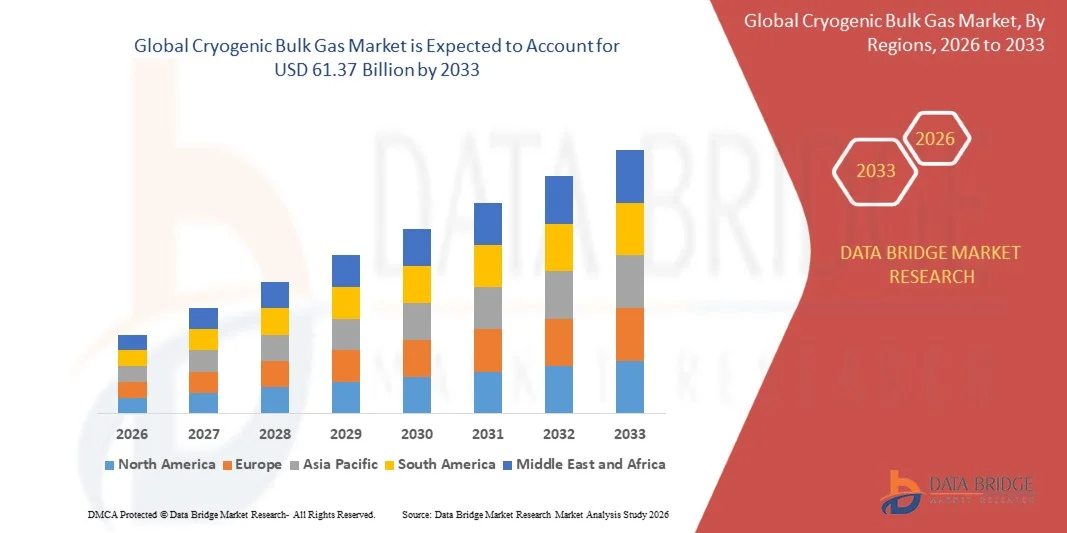
The Cryogenic Bulk Gas Market was valued at USD 38.42 billion in 2025 and is projected to reach USD 61.37 billion by 2033, growing at a CAGR of 6.03% from 2026 to 2033. The market is witnessing steady growth driven by increasing demand for industrial gases across healthcare, metallurgy, food processing, and electronics industries, along with rising adoption of cryogenic storage and transportation solutions. Expanding applications of liquid oxygen, nitrogen, argon, and carbon dioxide in manufacturing and medical sectors are further supporting market expansion.
The growing need for high-purity gases in semiconductor fabrication, increasing demand for oxygen in healthcare and hospitals, and rising use of cryogenic gases in food preservation and metal processing are significantly accelerating market adoption. In addition, technological advancements in storage tanks, logistics infrastructure, and on-site gas generation systems are improving supply efficiency and strengthening the global cryogenic bulk gas industry.
Key Market Trends & Insights
- North America dominated the cryogenic bulk gas market with the largest revenue share of 38.9% in 2025, supported by strong demand from healthcare, semiconductor manufacturing, metallurgy, and food processing industries. The region benefits from advanced industrial gas infrastructure, high adoption of oxygen and nitrogen in medical and industrial applications, and the presence of major industrial gas suppliers.
- Asia-Pacific cryogenic bulk gas market is expected to witness the fastest growth rate from 2026 to 2033, driven by rapid industrialization, expanding healthcare infrastructure, and rising semiconductor manufacturing activities. Countries such as China, India, Japan, and South Korea are significantly increasing demand for oxygen, nitrogen, and argon across multiple industries.
- The Liquid Oxygen segment held the largest market revenue share of approximately 32.6% in 2025, driven by strong demand from healthcare facilities, steel manufacturing, and emergency medical applications. Liquid oxygen is widely used in hospitals and ICUs for respiratory support and in industrial processes requiring high-temperature combustion efficiency. Expanding healthcare infrastructure and rising oxygen storage capacity investments are further strengthening segment dominance.
- The Liquid Nitrogen segment is projected to register the fastest growth at a CAGR of 6.9% from 2026 to 2033, driven by increasing usage in semiconductor manufacturing, food preservation, and cryogenic freezing applications. Its inert properties and ultra-low temperature capability make it highly suitable for precision electronics fabrication and rapid food freezing systems. Growing demand from AI chip production facilities and cold chain logistics networks is significantly accelerating adoption.
- The Cryogenic Tanks segment held the largest market revenue share of approximately 41.3% in 2025, driven by large-scale industrial gas storage and distribution requirements. These tanks are widely used in hospitals, manufacturing plants, and logistics hubs due to their high storage efficiency and safety standards. Increasing demand for continuous gas supply in industrial operations is supporting strong adoption.
- The ISO Containers segment is projected to register the fastest growth at a CAGR of 7.2% from 2026 to 2033, driven by rising global trade of liquefied gases and expansion of international supply chains. Their portability and compliance with global transportation standards make them highly suitable for cross-border industrial gas logistics.
- The Metal Fabrication and Processing segment held the largest market revenue share of approximately 28.1% in 2025, driven by extensive use of oxygen, argon, and nitrogen in welding, cutting, and heat treatment processes. Growth in automotive and heavy engineering industries is further boosting demand.
- The Electronics and Semiconductor Manufacturing segment is projected to register the fastest growth at a CAGR of 7.5% from 2026 to 2033, driven by rising demand for ultra-high-purity gases in chip fabrication and AI hardware production. Increasing semiconductor investments in Asia-Pacific are significantly strengthening segment growth.
- The Metallurgy and Metal Manufacturing segment held the largest market revenue share of approximately 30.2% in 2025, driven by strong demand for oxygen and argon in steel production, welding, and fabrication processes. Expansion of heavy industrial activities is further strengthening dominance.
- The Electronics and Semiconductors segment is projected to register the fastest growth at a CAGR of 7.6% from 2026 to 2033, driven by rapid expansion of chip manufacturing facilities and AI-driven computing infrastructure. Increasing demand for ultra-high-purity gases is significantly boosting adoption.
- The Merchant Liquid Delivery segment held the largest market revenue share of approximately 45.7% in 2025, driven by strong demand for flexible and scalable industrial gas supply solutions. It is widely used across hospitals, manufacturing plants, and food processing industries due to ease of transportation and availability.
- The Pipeline Supply Systems segment is projected to register the fastest growth at a CAGR of 6.8% from 2026 to 2033, driven by increasing adoption in large industrial clusters and continuous supply requirements in steel and chemical plants. Pipeline systems offer high efficiency and reduced logistics costs over long-term operations.
Market Size & Forecast
- Global Market Value (2025): USD 38.42 Billion
- Expected Market Value (2033): USD 61.37 Billion
- Forecast CAGR (2026–2033): 6.03%
- Leading Region in 2025: North America
- Fastest Growing Region: Asia-Pacific
Report Scope and Cryogenic Bulk Gas Market Segmentation
|
Attributes |
Cryogenic Bulk Gas Key Market Insights |
|
Segments Covered |
|
|
Countries Covered |
North America
Europe
Asia-Pacific
Middle East and Africa
South America
|
|
Key Market Players |
• Linde plc (Ireland) |
|
Market Opportunities |
|
|
Value Added Data Infosets |
In addition to the insights on market scenarios such as market value, growth rate, segmentation, geographical coverage, and major players, the market reports curated by the Data Bridge Market Research also include import export analysis, production capacity overview, production consumption analysis, price trend analysis, climate change scenario, supply chain analysis, value chain analysis, raw material/consumables overview, vendor selection criteria, PESTLE Analysis, Porter Analysis, and regulatory framework. |
Cryogenic Bulk Gas Market Trends
Trend: Rising Adoption Of High-Purity Cryogenic Gases In Advanced Industrial Applications
The global demand for cryogenic bulk gases is increasing due to rising consumption of high-purity oxygen, nitrogen, argon, and carbon dioxide across healthcare, metallurgy, electronics, and food processing industries. These gases play a critical role in ensuring controlled atmospheres, precision cooling, and contamination-free environments, especially in high-value manufacturing processes. Growing industrialization and expansion of heavy manufacturing sectors are further accelerating the need for reliable cryogenic gas supply systems.
In healthcare systems, liquid oxygen has become essential for respiratory care and emergency medical infrastructure, with hospitals and ICUs significantly increasing bulk oxygen storage capacity post-pandemic. For instance, India expanded its medical oxygen production capacity by more than 4,000 metric tonnes per day during 2021–2023 to strengthen healthcare resilience, driving sustained demand for cryogenic storage and distribution networks.
In the semiconductor and electronics industry, ultra-high-purity nitrogen and argon are widely used for wafer fabrication and inert atmospheric processing, where even minor contamination can impact chip yield. Countries such as Taiwan and South Korea, which together account for a significant share of global semiconductor production, are increasingly investing in advanced cryogenic gas infrastructure to support AI chip manufacturing and next-generation electronics fabrication.
In addition, the food and beverage sector is rapidly adopting liquid nitrogen for flash freezing and preservation, improving shelf life while maintaining product quality. In metallurgy and metal processing industries, cryogenic gases are being used for cutting, welding, and heat treatment processes, enhancing precision and reducing oxidation losses. The expansion of global cold chain logistics is further strengthening demand for cryogenic storage and transport solutions.
Cryogenic Bulk Gas Market Dynamics
Key Market Driver: Expanding Industrial Demand For High-Purity And Efficient Gas Supply Systems
Industries worldwide are increasingly relying on cryogenic gases to support precision manufacturing, healthcare operations, and advanced technological processes. Rising demand for oxygen in hospitals, nitrogen in electronics manufacturing, and argon in welding applications is driving large-scale investments in cryogenic air separation units and storage infrastructure.
Industrial gas companies are expanding production capacity and distribution networks to meet growing demand from steel manufacturing, chemical processing, and semiconductor fabrication industries. For instance, large-scale air separation units are being installed across Asia-Pacific industrial hubs to support continuous supply of oxygen and nitrogen for steel plants and electronics clusters.
Similarly, advancements in cryogenic storage technologies and pipeline distribution systems are improving efficiency and reducing gas losses during transportation. Real-world expansions in the U.S. and China during 2024–2025 have demonstrated significant improvements in supply chain reliability, particularly for medical oxygen and industrial nitrogen distribution networks.
Key Restraint/Challenge: High Infrastructure Costs And Complex Storage Requirements
Despite strong demand, the cryogenic bulk gas market faces challenges related to high capital investment requirements for production plants, storage tanks, and distribution systems. Cryogenic gases require extremely low-temperature conditions, increasing operational complexity and maintenance costs for end users.
In addition, transportation and storage of liquefied gases require specialized insulated tanks and safety systems, which increases logistics costs and limits accessibility in developing regions. Smaller industries often face barriers in adopting cryogenic systems due to high setup costs and technical expertise requirements.
Industry assessments indicate that cryogenic air separation units can require multi-million-dollar investments depending on capacity, making scalability a challenge for small and mid-sized enterprises. Moreover, strict safety regulations for handling liquefied gases further increase compliance costs and operational complexity.
Key Market Opportunity: Expansion Of Semiconductor, Healthcare, And Clean Energy Infrastructure
Rapid expansion of semiconductor manufacturing, healthcare infrastructure, and clean energy projects is creating significant opportunities for cryogenic bulk gas adoption globally. Increasing demand for ultra-high-purity gases in chip fabrication plants is driving investments in advanced air separation technologies.
Healthcare sector growth, particularly in developing economies, is also boosting demand for medical-grade oxygen storage and distribution systems. For instance, countries such as India and Brazil have significantly expanded hospital oxygen infrastructure to improve emergency response capabilities after COVID-19.
In addition, hydrogen energy projects and industrial decarbonization initiatives are expected to increase demand for cryogenic storage and transport systems. Liquid hydrogen and nitrogen are increasingly being explored for clean energy applications, with pilot hydrogen liquefaction plants in Europe and Japan demonstrating scalable cryogenic handling capabilities for future energy systems.
Cryogenic Bulk Gas Market Scope
The market is segmented on the basis of gas type, storage type, application, end-use industry, and distribution mode.
• By Gas Type
On the basis of gas type, the cryogenic bulk gas market is segmented into Liquid Oxygen, Liquid Nitrogen, Liquid Argon, Liquid Carbon Dioxide, and Others. The Liquid Oxygen segment held the largest market revenue share of approximately 32.6% in 2025, driven by strong demand from healthcare facilities, steel manufacturing, and emergency medical applications. Liquid oxygen is widely used in hospitals and ICUs for respiratory support and in industrial processes requiring high-temperature combustion efficiency. Expanding healthcare infrastructure and rising oxygen storage capacity investments are further strengthening segment dominance.
The Liquid Nitrogen segment is projected to register the fastest growth at a CAGR of 6.9% from 2026 to 2033, driven by increasing usage in semiconductor manufacturing, food preservation, and cryogenic freezing applications. Its inert properties and ultra-low temperature capability make it highly suitable for precision electronics fabrication and rapid food freezing systems. Growing demand from AI chip production facilities and cold chain logistics networks is significantly accelerating adoption.
• By Storage Type
On the basis of storage type, the market is segmented into Cryogenic Tanks, Dewars, ISO Containers, and Bulk Storage Systems. The Cryogenic Tanks segment held the largest market revenue share of approximately 41.3% in 2025, driven by large-scale industrial gas storage and distribution requirements. These tanks are widely used in hospitals, manufacturing plants, and logistics hubs due to their high storage efficiency and safety standards. Increasing demand for continuous gas supply in industrial operations is supporting strong adoption.
The ISO Containers segment is projected to register the fastest growth at a CAGR of 7.2% from 2026 to 2033, driven by rising global trade of liquefied gases and expansion of international supply chains. Their portability and compliance with global transportation standards make them highly suitable for cross-border industrial gas logistics.
• By Application
On the basis of application, the market is segmented into Freezing and Cooling, Metal Fabrication and Processing, Healthcare and Medical Applications, Food and Beverage Preservation, Electronics and Semiconductor Manufacturing, and Chemical Processing. The Metal Fabrication and Processing segment held the largest market revenue share of approximately 28.1% in 2025, driven by extensive use of oxygen, argon, and nitrogen in welding, cutting, and heat treatment processes. Growth in automotive and heavy engineering industries is further boosting demand.
The Electronics and Semiconductor Manufacturing segment is projected to register the fastest growth at a CAGR of 7.5% from 2026 to 2033, driven by rising demand for ultra-high-purity gases in chip fabrication and AI hardware production. Increasing semiconductor investments in Asia-Pacific are significantly strengthening segment growth.
• By End-Use Industry
On the basis of end-use industry, the market is segmented into Healthcare and Pharmaceuticals, Metallurgy and Metal Manufacturing, Food and Beverage Industry, Chemicals and Petrochemicals, Electronics and Semiconductors, and Energy and Power. The Metallurgy and Metal Manufacturing segment held the largest market revenue share of approximately 30.2% in 2025, driven by strong demand for oxygen and argon in steel production, welding, and fabrication processes. Expansion of heavy industrial activities is further strengthening dominance.
The Electronics and Semiconductors segment is projected to register the fastest growth at a CAGR of 7.6% from 2026 to 2033, driven by rapid expansion of chip manufacturing facilities and AI-driven computing infrastructure. Increasing demand for ultra-high-purity gases is significantly boosting adoption.
• By Distribution Mode
On the basis of distribution mode, the market is segmented into On-site Generation and Storage, Merchant Liquid Delivery, and Pipeline Supply Systems. The Merchant Liquid Delivery segment held the largest market revenue share of approximately 45.7% in 2025, driven by strong demand for flexible and scalable industrial gas supply solutions. It is widely used across hospitals, manufacturing plants, and food processing industries due to ease of transportation and availability.
The Pipeline Supply Systems segment is projected to register the fastest growth at a CAGR of 6.8% from 2026 to 2033, driven by increasing adoption in large industrial clusters and continuous supply requirements in steel and chemical plants. Pipeline systems offer high efficiency and reduced logistics costs over long-term operations.
Cryogenic Bulk Gas Market Regional Analysis
North America Cryogenic Bulk Gas Market Insight
North America dominated the cryogenic bulk gas market with the largest revenue share of 38.9% in 2025, supported by strong demand from healthcare, semiconductor manufacturing, metallurgy, and food processing industries. The region benefits from advanced industrial gas infrastructure, high adoption of oxygen and nitrogen in medical and industrial applications, and the presence of major industrial gas suppliers. Rising investments in clean energy, hydrogen projects, and large-scale air separation units are further strengthening market growth. In addition, increasing demand for high-purity gases in electronics and pharmaceuticals is reinforcing regional dominance.
U.S. Cryogenic Bulk Gas Market Insight
The U.S. cryogenic bulk gas market captured the largest revenue share in North America in 2025, driven by strong consumption of oxygen in healthcare facilities, nitrogen in electronics manufacturing, and argon in metal fabrication industries. The country has a well-established network of air separation plants and industrial gas distribution systems supporting large-scale supply. Growing demand from semiconductor fabrication plants and expanding data center infrastructure is further boosting nitrogen and argon consumption. In addition, rising investments in hydrogen energy and clean fuel technologies are supporting long-term market expansion.
Europe Cryogenic Bulk Gas Market Insight
The Europe cryogenic bulk gas market is expected to witness the fastest growth rate from 2026 to 2033, primarily driven by increasing demand for industrial decarbonization, stringent environmental regulations, and expansion of semiconductor and healthcare sectors. Countries across the region are investing heavily in low-carbon technologies and clean energy infrastructure, boosting demand for oxygen, nitrogen, and argon. The region also benefits from strong cold chain logistics and food processing industries adopting cryogenic storage solutions. In addition, hydrogen economy initiatives are significantly accelerating cryogenic gas infrastructure development.
U.K. Cryogenic Bulk Gas Market Insight
The U.K. cryogenic bulk gas market is expected to witness steady growth from 2026 to 2033, driven by increasing demand from healthcare, food processing, and industrial manufacturing sectors. Rising adoption of medical oxygen systems and expansion of hospital infrastructure are supporting market growth. In addition, the growing focus on clean energy transition and hydrogen projects is increasing demand for cryogenic storage and transport systems. Expansion of semiconductor-related research and advanced manufacturing is also contributing to market development across the country.
Germany Cryogenic Bulk Gas Market Insight
The Germany cryogenic bulk gas market is expected to witness strong growth from 2026 to 2033, supported by its advanced industrial base and strong demand from metallurgy, chemicals, and electronics industries. Germany’s leadership in engineering and manufacturing is driving large-scale use of oxygen and nitrogen in industrial applications. The country’s focus on energy efficiency and decarbonization is also promoting adoption of cryogenic technologies. In addition, expansion of semiconductor production facilities and green hydrogen projects is further strengthening market growth prospects.
Asia-Pacific Cryogenic Bulk Gas Market Insight
The Asia-Pacific cryogenic bulk gas market is expected to witness the fastest growth rate from 2026 to 2033, driven by rapid industrialization, expanding healthcare infrastructure, and rising semiconductor manufacturing activities. Countries such as China, India, Japan, and South Korea are significantly increasing demand for oxygen, nitrogen, and argon across multiple industries. Government initiatives supporting industrial expansion and clean energy development are further boosting market growth. In addition, strong growth in food processing, electronics manufacturing, and cold chain logistics is accelerating regional adoption of cryogenic bulk gas systems.
Japan Cryogenic Bulk Gas Market Insight
The Japan cryogenic bulk gas market is expected to witness steady growth from 2026 to 2033, driven by advanced electronics manufacturing, healthcare applications, and industrial processing requirements. The country has strong demand for high-purity nitrogen and argon in semiconductor fabrication and precision manufacturing. Japan’s aging population is also increasing demand for medical oxygen in healthcare facilities. In addition, ongoing investments in hydrogen energy infrastructure and clean industrial technologies are supporting long-term market expansion.
China Cryogenic Bulk Gas Market Insight
The China cryogenic bulk gas market accounted for the largest market revenue share in Asia-Pacific in 2025, driven by rapid industrialization, large-scale semiconductor production, and strong healthcare infrastructure expansion. China is one of the largest consumers of oxygen, nitrogen, and argon due to its extensive manufacturing base and steel production industry. The country’s push toward smart cities, clean energy development, and hydrogen economy initiatives is further boosting demand for cryogenic gases. In addition, expansion of cold chain logistics and electronics manufacturing is significantly supporting market growth.
Cryogenic Bulk Gas Market Share
The Cryogenic Bulk Gas industry is primarily led by well-established companies, including:
• Linde plc (Ireland)
• Air Liquide (France)
• Air Products and Chemicals, Inc. (U.S.)
• Messer Group GmbH (Germany)
• Nippon Sanso Holdings Corporation (Japan)
• Taiyo Nippon Sanso Corporation (Japan)
• Iwatani Corporation (Japan)
• Matheson Tri-Gas (U.S.)
• SOL Group (Italy)
• Air Water Inc. (Japan)
• Gulf Cryo (Kuwait)
• Chart Industries (U.S.)
• Cryostar (France)
• Yingde Gases Group Company Limited (China)
• INOX Air Products (India)

- Interactive Data Analysis Dashboard
- Company Analysis Dashboard for high growth potential opportunities
- Research Analyst Access for customization & queries
- Competitor Analysis with Interactive dashboard
- Latest News, Updates & Trend analysis
- Harness the Power of Benchmark Analysis for Comprehensive Competitor Tracking
Global Cryogenic Bulk Gas Market, Supply Chain Analysis and Ecosystem Framework
To support market growth and help clients navigate the impact of geopolitical shifts, DBMR has integrated in-depth supply chain analysis into its Global Cryogenic Bulk Gas Market research reports. This addition empowers clients to respond effectively to global changes affecting their industries. The supply chain analysis section includes detailed insights such as Global Cryogenic Bulk Gas Market consumption and production by country, price trend analysis, the impact of tariffs and geopolitical developments, and import and export trends by country and HSN code. It also highlights major suppliers with data on production capacity and company profiles, as well as key importers and exporters. In addition to research, DBMR offers specialized supply chain consulting services backed by over a decade of experience, providing solutions like supplier discovery, supplier risk assessment, price trend analysis, impact evaluation of inflation and trade route changes, and comprehensive market trend analysis.
Data collection and base year analysis are done using data collection modules with large sample sizes. The stage includes obtaining market information or related data through various sources and strategies. It includes examining and planning all the data acquired from the past in advance. It likewise envelops the examination of information inconsistencies seen across different information sources. The market data is analysed and estimated using market statistical and coherent models. Also, market share analysis and key trend analysis are the major success factors in the market report. To know more, please request an analyst call or drop down your inquiry.
The key research methodology used by DBMR research team is data triangulation which involves data mining, analysis of the impact of data variables on the market and primary (industry expert) validation. Data models include Vendor Positioning Grid, Market Time Line Analysis, Market Overview and Guide, Company Positioning Grid, Patent Analysis, Pricing Analysis, Company Market Share Analysis, Standards of Measurement, Global versus Regional and Vendor Share Analysis. To know more about the research methodology, drop in an inquiry to speak to our industry experts.
Data Bridge Market Research is a leader in advanced formative research. We take pride in servicing our existing and new customers with data and analysis that match and suits their goal. The report can be customized to include price trend analysis of target brands understanding the market for additional countries (ask for the list of countries), clinical trial results data, literature review, refurbished market and product base analysis. Market analysis of target competitors can be analyzed from technology-based analysis to market portfolio strategies. We can add as many competitors that you require data about in the format and data style you are looking for. Our team of analysts can also provide you data in crude raw excel files pivot tables (Fact book) or can assist you in creating presentations from the data sets available in the report.













