


Cryogenic Insulation Market Size
-
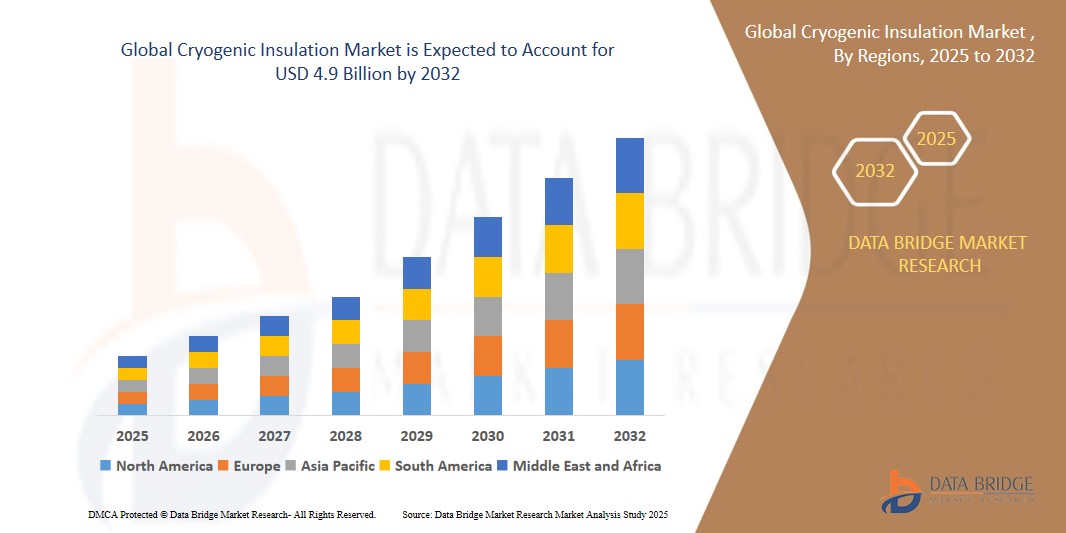
The global cryogenic insulation market size was valued at USD 2.8 billion in 2024 and is expected to reach USD 4.9 billion by 2032, at a CAGR of 7.05% during the forecast period
- This growth is driven by factors such as the expansion of LNG infrastructure, growing demand for cryogenic gases in medical and industrial applications, and technological advancements in insulation materials
Cryogenic Insulation Market Analysis
-
Cryogenic insulation plays a vital role in maintaining extremely low temperatures required for the storage and transportation of liquefied gases such as LNG, nitrogen, oxygen, and hydrogen. These materials are crucial in industries such as energy, healthcare, chemicals, and aerospace
- The demand for cryogenic insulation is significantly driven by the increasing adoption of liquefied natural gas (LNG) in power generation and transportation, as well as the growing demand for industrial and medical gases requiring cryogenic storage conditions
- North America is expected to dominate the cryogenic insulation market with a market share of approximately 34.8% in 2024, owing to established LNG infrastructure, technological advancements in insulation materials, and growing investments in clean energy and industrial gas sectors
- Asia-Pacific is expected to be the fastest-growing region during the forecast period, projected to register a CAGR of over 8.2%, driven by rapid industrialization, expansion of LNG terminals, and rising energy demand in countries like China, India, and South Korea
- The LNG storage and transportation segment is expected to dominate the market with a market share of around 61.5% in 2024. This dominance is fueled by the global transition toward cleaner energy sources. As major LNG infrastructure projects continue to be deployed globally, advanced cryogenic insulation becomes increasingly essential for operational efficiency and thermal protection
Report Scope and Cryogenic Insulation Market Segmentation
|
Attributes |
Cryogenic Insulation Key Market Insights |
|
Segments Covered |
|
|
Countries Covered |
North America
Europe
Asia-Pacific
Middle East and Africa
South America
|
|
Key Market Players |
|
|
Market Opportunities |
|
|
Value Added Data Infosets |
In addition to the insights on market scenarios such as market value, growth rate, segmentation, geographical coverage, and major players, the market reports curated by the Data Bridge Market Research also include import export analysis, production capacity overview, production consumption analysis, price trend analysis, climate change scenario, supply chain analysis, value chain analysis, raw material/consumables overview, vendor selection criteria, PESTLE Analysis, Porter Analysis, and regulatory framework |
Cryogenic Insulation Market Trends
“Technological Advancements and Material Innovation in Cryogenic Insulation Systems”
- A prominent trend in the cryogenic insulation market is the increasing adoption of advanced insulation materials and multi-layer insulation systems designed for superior thermal performance and energy efficiency in extreme low-temperature environments
- These innovations focus on reducing thermal conductivity, minimizing energy losses, and ensuring long-term performance stability in applications such as LNG storage, aerospace fuel systems, and medical gas handling
- For instance, In April 2023, Armacell introduced a new generation of flexible elastomeric foam insulation specifically engineered for cryogenic systems, offering improved thermal efficiency and mechanical strength for LNG and industrial gas sectors
- Material advancements such as aerogels, vacuum insulated panels (VIPs), and hybrid composite foams are transforming the cryogenic insulation landscape, enabling lighter, thinner, and more efficient insulation solutions. These trends are driving operational improvements and supporting the global shift toward clean energy and sustainable industrial practices
Cryogenic Insulation Market Dynamics
Driver
“Growing Demand from Expanding LNG Infrastructure”
- The global shift toward cleaner energy sources and the rising demand for liquefied natural gas (LNG) are significantly contributing to the increased use of cryogenic insulation across various sectors, particularly in energy and transportation
- As countries invest in LNG terminals, pipelines, storage tanks, and carriers, the need for reliable and high-performance cryogenic insulation to maintain ultra-low temperatures and prevent energy loss is becoming more critical
- The surge in LNG-related infrastructure projects ensures that cryogenic insulation systems are increasingly in demand to support efficient, safe, and sustainable energy transportation and storage
- For instance, In February 2024, the Indian Oil Corporation (IOC) commissioned a new LNG import terminal in Ennore, Tamil Nadu, to cater to India’s growing energy needs. This facility significantly increases the regional demand for cryogenic insulation materials used in LNG tanks and pipelines
- As global energy systems transition toward LNG and hydrogen-based fuels, cryogenic insulation becomes essential to ensuring safe storage and minimizing boil-off gas, thus driving market growth across industrial and energy sectors
Opportunity
“Emergence of Green Hydrogen and Cryogenic Energy Storage Applications”
- The rapid global shift toward decarbonization is accelerating the development of green hydrogen production, storage, and transportation infrastructure, creating new opportunities for the cryogenic insulation market
- Cryogenic insulation plays a crucial role in maintaining the extremely low temperatures required for storing liquefied hydrogen and other industrial gases, enabling the efficient functioning of green energy systems
- In addition, the growing adoption of cryogenic energy storage systems, which store energy in the form of liquefied air or gases, is expanding the scope for cryogenic insulation materials in grid-scale renewable energy projects
- For instance, In June 2023, the U.K.-based company Highview Power announced plans to build one of the world’s largest liquid air energy storage (LAES) plants in Greater Manchester. The facility, which relies on cryogenic technology to store and release energy, requires advanced cryogenic insulation to maintain optimal thermal conditions and prevent energy loss
- The integration of cryogenic insulation in hydrogen and cryogenic energy storage systems is expected to enhance energy efficiency, reduce emissions, and provide a reliable foundation for sustainable energy infrastructure globally
Restraint/Challenge
“High Material and Installation Costs Limiting Widespread Adoption”
- The high costs associated with the materials and installation of advanced cryogenic insulation systems pose a significant challenge for the market, particularly affecting the budgets of small-scale LNG operators and industrial facilities in emerging economies
- Cryogenic insulation materials, such as aerogels and vacuum insulated panels (VIPs), are often more expensive than traditional insulation solutions, which can result in substantial initial investment and installation costs
- This financial barrier can deter smaller companies and industrial players from adopting the latest insulation technologies, leading to reliance on less efficient and more costly traditional materials that do not meet the required performance standards
- For instance, In November 2023, a report published by Technip Energies highlighted that the rising cost of high-performance insulation materials, such as VIPs, adds to the overall capital expenditure of large-scale LNG infrastructure projects, thus delaying their implementation and restricting market penetration in certain regions
- As a result, these challenges limit the widespread adoption of cutting-edge cryogenic insulation solutions, especially in price-sensitive markets, and can lead to disparities in the quality and efficiency of energy storage and transportation infrastructure
Cryogenic Insulation Market Scope
The market is segmented on the basis of type, cryogenic equipment, form, and end- use industry.
|
Segmentation |
Sub-Segmentation |
|
By Type |
|
|
By Cryogenic Equipment |
|
|
By Form |
|
|
By End- Use Industry |
|
In 2025, the LNG storage and transportation is projected to dominate the market with a largest share in application segment
The LNG storage and transportation segment is projected to dominate the global cryogenic insulation market in 2025, capturing the largest share of approximately 61.5% due to the growing adoption of liquefied natural gas (LNG) as a cleaner energy source. As LNG infrastructure continues to expand globally, driven by investments in regions like North America, the Middle East, and Asia-Pacific, advanced cryogenic insulation solutions are essential to ensure safe, efficient storage and transportation of LNG, minimizing energy loss and ensuring safety. For example, Qatar Petroleum's LNG facility expansion in January 2024 highlights the increasing demand for these high-performance insulation materials in large-scale LNG projects. In addition the rise of sustainable energy projects and hydrogen storage further bolsters this segment’s market dominance
The PU (Polyurethane) and PIR (Polyisocyanurate) is expected to account for the largest share during the forecast period in technology market
The PU (Polyurethane) and PIR (Polyisocyanurate) insulation segment is expected to dominate the cryogenic insulation market, holding a significant market share of approximately 40-45%. This dominance is driven by their excellent thermal performance, cost-effectiveness, and widespread use in cryogenic applications such as LNG storage and transportation. PU and PIR materials play a crucial role in reducing heat transfer and maintaining ultra-low temperatures, essential for industries like energy and power, chemicals, and shipping. North America is expected to be the leading region, with the U.S. playing a central role, contributing to a dominant market share of approximately 30-35%
Cryogenic Insulation Market Regional Analysis
“North America Holds the Largest Share in the Cryogenic Insulation Market”
- North America is expected to dominate the cryogenic insulation market with a market share of approximately 34.8% in 2024, owing to established LNG infrastructure, technological advancements in insulation materials, and growing investments in clean energy and industrial gas sectors
- The U.S. holds a significant share of the market due to the growing demand for LNG storage and transportation, coupled with advancements in cryogenic insulation materials such as PU, PIR, and vacuum insulated panels (VIPs)
- The demand for cryogenic insulation is also fueled by the expansion of LNG terminals and the rise of sustainable energy projects across the region
- North America is expected to account for 35-40% of the global market share, with the U.S. leading this dominance, supported by strong investments in the energy sector and infrastructure development. The region's technological advancements and robust industry presence are key factors in maintaining its market leadership
“Asia-Pacific is Projected to Register the Highest CAGR in the Cryogenic Insulation Market”
- The Asia-Pacific region is projected to register the highest CAGR in the cryogenic insulation market, driven by rapid industrialization, expansion of LNG infrastructure, and increasing energy demands in emerging economies such as China, India, and South Korea
- China and India, with their large-scale LNG terminals, energy projects, and government-driven initiatives to reduce carbon emissions, are contributing to the demand for cryogenic insulation. These countries are also focusing on expanding their energy sectors, increasing the need for advanced insulation materials in LNG storage and transport
- South Korea is also emerging as a key player, with its growing role in energy infrastructure and shipping industries. Investments in clean energy projects and the need for high-performance cryogenic insulation materials are propelling the market in this region
- Asia-Pacific is expected to account for 25-30% of the global market share, with the highest growth rates driven by the increasing adoption of advanced insulation technologies and the expansion of LNG infrastructure
Cryogenic Insulation Market Share
The market competitive landscape provides details by competitor. Details included are company overview, company financials, revenue generated, market potential, investment in research and development, new market initiatives, global presence, production sites and facilities, production capacities, company strengths and weaknesses, product launch, product width and breadth, application dominance. The above data points provided are only related to the companies' focus related to market.
The Major Market Leaders Operating in the Market Are:
- Armacell (Germany)
- Lydall, Inc. (U.S.)
- BASF SE (Germany)
- Cabot Corporation (U.S.)
- Röchling (Germany)
- Johns Manville (U.S.)
- DUNMORE (U.S.)
- Pittsburgh Corning Corporation (U.S.)
- Imerys (France)
- Hertel (Netherlands)
- AMOL DICALITE LIMITED (India)
- G+H GROUP (Germany)
- ISOVER (France)
- Aspen Aerogels, Inc. (U.S.)
- Zircar Refractories (India)
- KAEFER (Germany)
- NICHIAS Corporation (Japan)
- Norplex Micarta (U.S.)
Latest Developments in Global Cryogenic Insulation Market
- In March 2024, Technip Energies was awarded a contract to provide cryogenic insulation solutions for a significant LNG project in Qatar. This development underscores the growing investments in large-scale cryogenic projects, reflecting the industry's focus on advanced technologies and sustainable energy solutions. The project aims to enhance Qatar's LNG production capacity while incorporating innovative measures to reduce greenhouse gas emissions. Technip Energies' expertise in engineering and technology for the energy sector continues to play a pivotal role in supporting global energy transition efforts
- In January 2024, BASF SE partnered with a European LNG infrastructure provider to test and validate innovative cryogenic insulation materials developed from aerogel composites. This collaboration aimed to enhance the efficiency and sustainability of LNG infrastructure by leveraging the unique properties of aerogel, such as its exceptional thermal insulation and lightweight characteristics. The initiative reflects BASF's commitment to advancing energy solutions and supporting the global transition to cleaner energy sources
- In February 2024, the Indian Oil Corporation (IOC) inaugurated a state-of-the-art LNG import terminal in Tamil Nadu, India. This facility is expected to significantly enhance the regional demand for cryogenic insulation, essential for efficient LNG storage and transportation. The terminal represents a strategic step in bolstering India's energy infrastructure, ensuring a reliable supply of natural gas to meet growing industrial and domestic needs. The project aligns with India's commitment to sustainable energy solutions and reducing carbon emissions
- In November 2023, Huntsman Corporation introduced an innovative cryogenic polyurethane foam insulation specifically designed for LNG carriers. This advanced insulation material enhances thermal efficiency and durability, addressing the critical demands of LNG transportation. By leveraging cutting-edge polyurethane technology, the solution aims to improve energy efficiency and operational reliability in the LNG sector. Huntsman's commitment to innovation and sustainability is evident in this development, which supports the global transition to cleaner energy solutions
- In March 2023, Linde plc announced a significant increase in investments in cryogenic gas technologies, focusing on the healthcare and semiconductor sectors. These industries rely heavily on advanced cryogenic insulation to ensure operational efficiency and maintain the integrity of sensitive processes. Linde's commitment to innovation in cryogenics highlights its role in supporting critical applications, such as medical gas supply and semiconductor manufacturing, which demand precision and reliability. This strategic move aligns with the company's vision to enhance technological capabilities and meet the evolving needs of these high-growth sectors

- Interactive Data Analysis Dashboard
- Company Analysis Dashboard for high growth potential opportunities
- Research Analyst Access for customization & queries
- Competitor Analysis with Interactive dashboard
- Latest News, Updates & Trend analysis
- Harness the Power of Benchmark Analysis for Comprehensive Competitor Tracking
Global Cryogenic Insulation Market, Supply Chain Analysis and Ecosystem Framework
To support market growth and help clients navigate the impact of geopolitical shifts, DBMR has integrated in-depth supply chain analysis into its Global Cryogenic Insulation Market research reports. This addition empowers clients to respond effectively to global changes affecting their industries. The supply chain analysis section includes detailed insights such as Global Cryogenic Insulation Market consumption and production by country, price trend analysis, the impact of tariffs and geopolitical developments, and import and export trends by country and HSN code. It also highlights major suppliers with data on production capacity and company profiles, as well as key importers and exporters. In addition to research, DBMR offers specialized supply chain consulting services backed by over a decade of experience, providing solutions like supplier discovery, supplier risk assessment, price trend analysis, impact evaluation of inflation and trade route changes, and comprehensive market trend analysis.
Data collection and base year analysis are done using data collection modules with large sample sizes. The stage includes obtaining market information or related data through various sources and strategies. It includes examining and planning all the data acquired from the past in advance. It likewise envelops the examination of information inconsistencies seen across different information sources. The market data is analysed and estimated using market statistical and coherent models. Also, market share analysis and key trend analysis are the major success factors in the market report. To know more, please request an analyst call or drop down your inquiry.
The key research methodology used by DBMR research team is data triangulation which involves data mining, analysis of the impact of data variables on the market and primary (industry expert) validation. Data models include Vendor Positioning Grid, Market Time Line Analysis, Market Overview and Guide, Company Positioning Grid, Patent Analysis, Pricing Analysis, Company Market Share Analysis, Standards of Measurement, Global versus Regional and Vendor Share Analysis. To know more about the research methodology, drop in an inquiry to speak to our industry experts.
Data Bridge Market Research is a leader in advanced formative research. We take pride in servicing our existing and new customers with data and analysis that match and suits their goal. The report can be customized to include price trend analysis of target brands understanding the market for additional countries (ask for the list of countries), clinical trial results data, literature review, refurbished market and product base analysis. Market analysis of target competitors can be analyzed from technology-based analysis to market portfolio strategies. We can add as many competitors that you require data about in the format and data style you are looking for. Our team of analysts can also provide you data in crude raw excel files pivot tables (Fact book) or can assist you in creating presentations from the data sets available in the report.













