


What is Cybersecurity in Critical Infrastructure Protection Market Size and Growth Rate ?
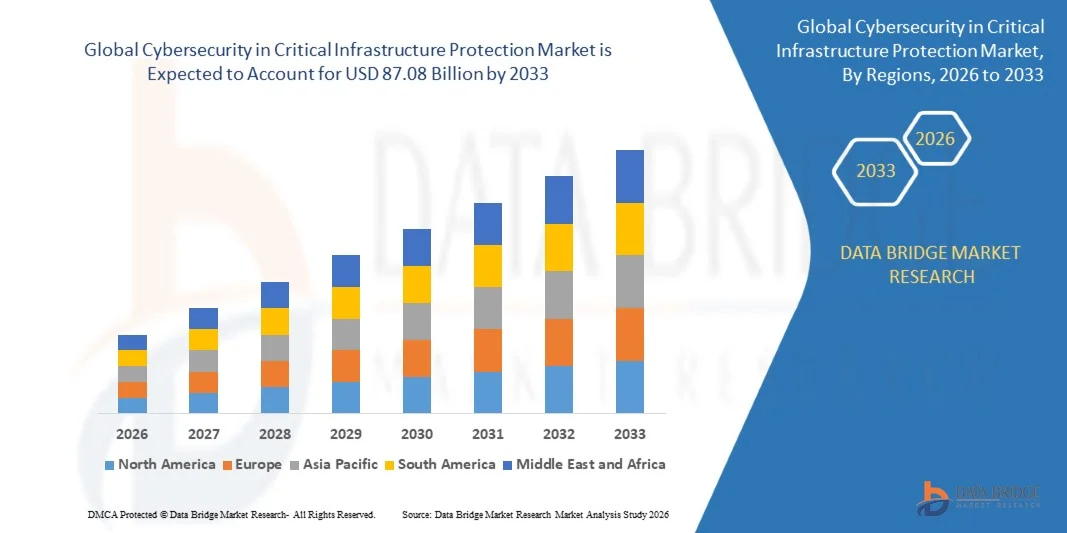
- As per Data Bridge Market Research Analysis the Global cybersecurity in critical infrastructure protection market size was valued at USD 55.89 billion in 2025 and is expected to reach USD 87.08 billion by 2033, at a CAGR of 5.70% during the forecast period
- The market growth is largely fueled by the rising frequency and sophistication of cyberattacks targeting critical infrastructure, leading to increased digitalization and security investments across sectors such as energy, transportation, and utilities
- Furthermore, growing demand for resilient, real-time, and integrated cybersecurity solutions across IT and operational technology environments is establishing advanced cybersecurity frameworks as essential for infrastructure protection. These converging factors are accelerating the adoption of cybersecurity solutions, thereby significantly boosting the market growth.
Market Size & Forecast
- Global Market Value (2025): USD 55.89 Billion
- Expected Market Value (2033): USD 87.89 Billion
- Forecast CAGR (2026–2033): 5.70%
What are the Major Takeaways of Cybersecurity in Critical Infrastructure Protection Market ?
- Cybersecurity in critical infrastructure protection involves safeguarding essential systems, networks, and assets from cyber threats through advanced technologies such as threat intelligence, network security, and incident response solutions. These systems ensure operational continuity, data protection, and resilience across sectors such as government, energy, healthcare, and transportation
- The escalating demand for these solutions is primarily driven by increasing digital transformation of infrastructure, growing regulatory requirements for data and system protection, and rising awareness regarding cyber risks, leading organizations to invest in comprehensive and proactive cybersecurity strategies
- North America dominated the cybersecurity in critical infrastructure protection market with a share of 39.2% in 2025, due to increasing cyber threats targeting critical sectors and strong government initiatives focused on infrastructure security
- Asia-Pacific is expected to be the fastest growing region in the cybersecurity in critical infrastructure protection market during the forecast period due to rapid digitalization, increasing cyberattack incidents, and expanding critical infrastructure projects across emerging economies
- Network security segment dominated the market with a market share of 29.1% in 2025, due to the growing need to safeguard critical infrastructure networks from increasingly sophisticated cyber threats and unauthorized intrusions. Critical sectors such as energy, utilities, and transport rely heavily on secure network architectures to ensure uninterrupted operations, leading to high investments in firewalls, intrusion detection systems, and secure communication protocols
Report Scope and Cybersecurity in Critical Infrastructure Protection Market Segmentation
|
Attributes |
Cybersecurity in Critical Infrastructure Protection Key Market Insights |
|
Segments Covered |
|
|
Countries Covered |
North America
Europe
Asia-Pacific
Middle East and Africa
South America
|
|
Key Market Players |
|
|
Market Opportunities |
|
|
Value Added Data Infosets |
In addition to the market insights such as market value, growth rate, market segments, geographical coverage, market players, and market scenario, the market report curated by the Data Bridge Market Research team includes in-depth expert analysis, import/export analysis, pricing analysis, production consumption analysis, and pestle analysis. |
What is the Key Trend in Cybersecurity in Critical Infrastructure Protection Market ?
“Rising Adoption of Zero Trust Security Frameworks”
- A significant trend in the cybersecurity in critical infrastructure protection market is the increasing adoption of Zero Trust security frameworks, driven by the growing complexity of cyber threats and the need to secure both IT and operational technology environments across critical sectors. This approach is redefining traditional perimeter-based security models by enforcing strict identity verification and continuous monitoring across all access points
- For instance, Illumio Inc. has implemented Zero Trust segmentation solutions for organizations to limit lateral movement of threats within critical infrastructure systems. Such implementations enhance breach containment and improve visibility across network dependencies in both IT and OT environments
- The integration of Zero Trust with industrial control systems is gaining traction as organizations seek to protect interconnected assets within energy grids, transportation systems, and manufacturing facilities. This is strengthening the ability to isolate compromised components and maintain operational continuity under cyberattack scenarios
- Critical infrastructure operators are increasingly leveraging identity-based access controls and micro-segmentation to ensure that only authorized users and devices can interact with sensitive systems. This is improving the overall resilience of infrastructure networks against unauthorized access and insider threats
- The adoption of Zero Trust is also being supported by regulatory frameworks and national cybersecurity strategies that emphasize proactive threat mitigation and continuous authentication. This is encouraging organizations to transition toward more adaptive and risk-based security architectures
- The market is witnessing a strong shift toward comprehensive Zero Trust implementations that integrate advanced analytics, automation, and real-time monitoring. This transition is reinforcing the importance of proactive cybersecurity strategies and positioning Zero Trust as a foundational element in protecting critical infrastructure systems
Cybersecurity in Critical Infrastructure Protection Market Dynamics
Driver
“Increasing Frequency of Cyberattacks on Critical Infrastructure”
- The rising frequency and sophistication of cyberattacks targeting critical infrastructure is a major driver for the market, as organizations face increasing risks to essential services such as power, transportation, and healthcare systems. These threats are compelling operators to invest in advanced cybersecurity solutions to safeguard operations and ensure service continuity
- For instance, the Colonial Pipeline Company ransomware attack in 2021 disrupted fuel supply across the U.S., highlighting vulnerabilities in critical infrastructure systems. This incident accelerated investments in cybersecurity technologies and prompted organizations to strengthen their defensive capabilities against similar threats
- The growing digitization of infrastructure systems, including the adoption of smart grids and connected industrial devices, is expanding the attack surface for cybercriminals. This is increasing the need for robust security frameworks that can detect and respond to threats in real time
- Governments and regulatory bodies are introducing stricter cybersecurity mandates to ensure the protection of national infrastructure, which is driving organizations to adopt compliant and advanced security solutions. These regulations are reinforcing the importance of continuous monitoring and incident response capabilities
- The continuous rise in cyber threats and their potential to disrupt essential services is strengthening the demand for comprehensive cybersecurity solutions. This driver is significantly influencing market growth by encouraging sustained investments in infrastructure protection technologies
Restraint/Challenge
“Shortage of Skilled Cybersecurity Professionals”
- The cybersecurity in critical infrastructure protection market faces a significant challenge due to the shortage of skilled professionals capable of managing complex security systems across IT and OT environments. This talent gap is limiting the ability of organizations to effectively implement and maintain advanced cybersecurity frameworks
- For instance, (ISC)² reported a global cybersecurity workforce gap exceeding millions of professionals, highlighting the scale of the talent shortage impacting infrastructure security. This shortage creates operational risks and delays in deploying critical security measures
- The increasing complexity of cyber threats requires specialized expertise in areas such as industrial control systems security, threat intelligence, and incident response. However, the availability of trained professionals with these niche skills remains limited, creating a barrier to effective cybersecurity implementation
- Organizations often face challenges in training and retaining skilled personnel due to high demand and competitive compensation requirements in the cybersecurity domain. This results in increased operational costs and resource constraints for infrastructure operators
- The ongoing shortage of cybersecurity talent is placing pressure on organizations to adopt automation and managed security services. However, this challenge continues to hinder the full-scale adoption of advanced cybersecurity solutions, thereby restraining overall market growth
Cybersecurity in Critical Infrastructure Protection Market Scope
The market is segmented on the basis of type, deployment type, and end-user.
• By Type
On the basis of type, the cybersecurity in critical infrastructure protection market is segmented into identity & access management (IAM), network security, risk & compliance management, application security, endpoint security, security information and event management (SIEM), cloud security, data loss prevention (DLP), web security, threat intelligence & incident response, encryption and tokenization, and others. The network security segment dominated the largest market revenue share of 29.1% in 2025, driven by the growing need to safeguard critical infrastructure networks from increasingly sophisticated cyber threats and unauthorized intrusions. Critical sectors such as energy, utilities, and transport rely heavily on secure network architectures to ensure uninterrupted operations, leading to high investments in firewalls, intrusion detection systems, and secure communication protocols. The segment continues to benefit from the expansion of interconnected industrial systems and the rising adoption of industrial IoT, which increases the attack surface and necessitates advanced network protection measures.
The cloud security segment is anticipated to witness the fastest growth rate from 2026 to 2033, fueled by the rapid migration of critical infrastructure systems to cloud-based platforms and hybrid environments. Organizations are increasingly adopting cloud solutions to enhance scalability and operational efficiency, which drives the need for robust cloud-native security frameworks. The rising adoption of remote monitoring and control systems further accelerates demand for cloud security solutions that ensure data integrity and system resilience. In addition, regulatory mandates for secure cloud adoption and the integration of advanced technologies such as AI-driven threat detection contribute to the rapid growth of this segment.
• By Deployment Type
On the basis of deployment type, the cybersecurity in critical infrastructure protection market is segmented into on-premise, cloud, and hybrid. The on-premise segment dominated the largest market revenue share in 2025, driven by the preference of critical infrastructure operators for maintaining full control over security systems and sensitive data. Sectors such as government & defense and energy often rely on on-premise deployments to meet strict regulatory and compliance requirements, ensuring minimal external exposure. The ability to customize security architectures and maintain direct oversight over infrastructure further supports the dominance of this segment.
The hybrid segment is anticipated to witness the fastest growth rate from 2026 to 2033, fueled by the increasing need for flexible and scalable security frameworks that combine the strengths of both on-premise and cloud deployments. Organizations are adopting hybrid models to balance data control with operational agility, particularly in environments where legacy systems coexist with modern digital platforms. The growing complexity of cyber threats and the need for real-time monitoring across distributed environments further accelerate hybrid adoption. This approach enables seamless integration of advanced analytics and cloud-based threat intelligence while retaining critical data within secure local environments.
• By End-User
On the basis of end-user, the cybersecurity in critical infrastructure protection market is segmented into BFSI, government & defense, transport & logistics, energy and utilities, IT & telecommunication, healthcare, oil & gas, and others. The government & defense segment dominated the largest market revenue share in 2025, driven by the high priority placed on national security and the protection of critical infrastructure assets from cyber warfare and espionage. Governments worldwide are significantly increasing investments in advanced cybersecurity frameworks to safeguard sensitive data, communication networks, and essential services. The rising frequency of state-sponsored cyberattacks and geopolitical tensions further strengthen the demand for robust cybersecurity solutions in this segment.
The energy and utilities segment is anticipated to witness the fastest growth rate from 2026 to 2033, fueled by the increasing digitalization of power grids and the integration of smart technologies within utility infrastructures. The transition toward smart grids and renewable energy systems introduces new vulnerabilities, driving the need for advanced cybersecurity solutions to ensure operational continuity. The growing adoption of remote monitoring systems and industrial control technologies further expands the attack surface, increasing the demand for comprehensive protection measures. In addition, stringent regulatory frameworks and the critical nature of uninterrupted energy supply contribute to the rapid growth of cybersecurity adoption in this segment.
Cybersecurity in Critical Infrastructure Protection Market Regional Analysis
- North America dominated the cybersecurity in critical infrastructure protection market with the largest revenue share of 39.2% in 2025, driven by increasing cyber threats targeting critical sectors and strong government initiatives focused on infrastructure security
- Organizations in the region emphasize advanced threat detection, real-time monitoring, and integration of cybersecurity frameworks across sectors such as energy, utilities, and defense
- This strong adoption is supported by high cybersecurity spending, presence of major technology providers, and continuous investments in safeguarding national infrastructure, establishing cybersecurity solutions as essential across both public and private sectors
U.S. Cybersecurity in Critical Infrastructure Protection Market Insight
The U.S. cybersecurity in critical infrastructure protection market captured the largest revenue share in 2025 within North America, fueled by rising incidents of cyberattacks on critical systems and strong federal investments in cybersecurity resilience. Organizations are increasingly focusing on securing industrial control systems and adopting advanced solutions for threat intelligence and incident response. The presence of leading cybersecurity firms, combined with strict regulatory frameworks and continuous innovation in security technologies, further accelerates market growth across sectors such as energy, transportation, and defense.
Europe Cybersecurity in Critical Infrastructure Protection Market Insight
The Europe cybersecurity in critical infrastructure protection market is projected to expand at a substantial CAGR throughout the forecast period, primarily driven by stringent regulatory policies and increasing focus on protecting essential services from cyber threats. Rising digital transformation across infrastructure sectors is encouraging organizations to adopt robust cybersecurity solutions. The region is witnessing increased deployment across energy, transport, and healthcare systems, with strong emphasis on compliance, data protection, and operational resilience.
U.K. Cybersecurity in Critical Infrastructure Protection Market Insight
The U.K. cybersecurity in critical infrastructure protection market is anticipated to grow at a noteworthy CAGR during the forecast period, driven by increasing cyber risk awareness and government-led initiatives to strengthen national infrastructure security. Organizations are prioritizing the protection of critical digital assets and adopting advanced monitoring systems. The country’s strong digital economy and regulatory support continue to drive investments in cybersecurity technologies across key sectors.
Germany Cybersecurity in Critical Infrastructure Protection Market Insight
The Germany cybersecurity in critical infrastructure protection market is expected to expand at a considerable CAGR during the forecast period, fueled by growing industrial digitalization and rising concerns over cyber threats targeting critical infrastructure. Germany’s focus on Industry 4.0 and secure industrial networks is promoting the adoption of advanced cybersecurity solutions. The integration of secure communication systems and emphasis on data protection further support market growth across manufacturing and energy sectors.
Asia-Pacific Cybersecurity in Critical Infrastructure Protection Market Insight
The Asia-Pacific cybersecurity in critical infrastructure protection market is poised to grow at the fastest CAGR during the forecast period of 2026 to 2033, driven by rapid digitalization, increasing cyberattack incidents, and expanding critical infrastructure projects across emerging economies. The region’s growing investments in smart grids, transportation systems, and digital public infrastructure are accelerating the demand for cybersecurity solutions. Rising government initiatives for national cybersecurity frameworks and increasing awareness among organizations are further supporting market expansion across diverse sectors.
Japan Cybersecurity in Critical Infrastructure Protection Market Insight
The Japan cybersecurity in critical infrastructure protection market is gaining momentum due to the country’s strong technological base, increasing cyber threat landscape, and focus on securing critical systems. Organizations are adopting advanced cybersecurity tools to protect industrial networks and essential services. The integration of cybersecurity with smart infrastructure and IoT ecosystems is driving growth, supported by government regulations and high awareness of digital security.
China Cybersecurity in Critical Infrastructure Protection Market Insight
The China cybersecurity in critical infrastructure protection market accounted for the largest market revenue share in Asia Pacific in 2025, attributed to rapid industrialization, large-scale infrastructure projects, and increasing cyber threats across critical sectors. China’s focus on strengthening national cybersecurity capabilities and protecting digital infrastructure is driving adoption. The presence of strong domestic technology providers and government-backed initiatives further accelerates market growth across energy, transport, and public infrastructure systems.
Cybersecurity in Critical Infrastructure Protection Market Share
The cybersecurity in critical infrastructure protection industry is primarily led by well-established companies, including:
- CyberArk Software Ltd. (Israel)
- AECOM (U.S.)
- Endian (Italy)
- Rockwell Automation, Inc. (U.S.)
- Cyberfort (U.K.)
- GE Vernova (U.S.)
- Plurilock Security Inc. (Canada)
- Airbus (Netherlands)
- Certcube Labs Private Limited (India)
- Johnson Controls (Ireland)
- Delta Risk (U.S.)
- BAE Systems (U.K.)
- NVIDIA Corporation (U.S.)
- OPSWAT Inc. (U.S.)
- CyberSecOp Consulting (U.S.)
Latest Developments in Global Cybersecurity in Critical Infrastructure Protection Market
- In August 2025, Fortinet announced the expansion of its critical infrastructure cybersecurity portfolio through enhanced OT security capabilities integrated into its Security Fabric platform, strengthening protection across energy, utilities, and industrial sectors. This development is significantly impacting the cybersecurity in critical infrastructure protection market by enabling unified visibility and control across IT and OT environments, reducing vulnerability gaps and improving response efficiency. The move reflects a growing industry shift toward integrated and platform-based security approaches, supporting organizations in managing complex infrastructure ecosystems and accelerating adoption of advanced cybersecurity frameworks
- In June 2025, Illumio Inc. entered into a strategic collaboration with NVIDIA to strengthen cybersecurity for critical infrastructure organizations while advancing Zero Trust strategies. This partnership integrates Illumio’s breach containment capabilities with NVIDIA’s BlueField platform, enabling enhanced visibility and enforcement across both IT and OT environments. The impact on the market is substantial as it promotes adoption of hardware-accelerated security solutions, improves operational efficiency, and supports organizations in achieving granular control over network segmentation and threat containment
- In May 2024, OPSWAT Inc. partnered with Hitachi Systems India to expand cybersecurity capabilities across multiple critical infrastructure sectors in India. This collaboration is influencing the market by strengthening regional cybersecurity ecosystems and addressing growing demand for localized security solutions across government, BFSI, IT, and healthcare sectors. The initiative supports increased adoption of advanced cybersecurity technologies while enhancing resilience against evolving cyber threats in emerging economies
- In April 2024, OPSWAT Inc. acquired CIP Cyber to enhance cybersecurity training and certification focused on critical infrastructure protection. This development is shaping the market by addressing the growing shortage of skilled cybersecurity professionals and improving workforce readiness in securing IT and OT environments. The integration into OPSWAT Academy expands global access to specialized training programs, thereby strengthening the overall cybersecurity ecosystem and supporting long-term market growth
- In February 2024, GE Vernova partnered with Dragos Inc. to deliver comprehensive cybersecurity solutions for grid automation and operational technology environments. This collaboration is impacting the market by enabling a more unified approach to protecting critical infrastructure through combined expertise in industrial systems and threat intelligence. It enhances the ability of organizations to detect, respond to, and mitigate cyber risks, reinforcing the importance of integrated cybersecurity solutions in safeguarding essential services

- Interactive Data Analysis Dashboard
- Company Analysis Dashboard for high growth potential opportunities
- Research Analyst Access for customization & queries
- Competitor Analysis with Interactive dashboard
- Latest News, Updates & Trend analysis
- Harness the Power of Benchmark Analysis for Comprehensive Competitor Tracking
Data collection and base year analysis are done using data collection modules with large sample sizes. The stage includes obtaining market information or related data through various sources and strategies. It includes examining and planning all the data acquired from the past in advance. It likewise envelops the examination of information inconsistencies seen across different information sources. The market data is analysed and estimated using market statistical and coherent models. Also, market share analysis and key trend analysis are the major success factors in the market report. To know more, please request an analyst call or drop down your inquiry.
The key research methodology used by DBMR research team is data triangulation which involves data mining, analysis of the impact of data variables on the market and primary (industry expert) validation. Data models include Vendor Positioning Grid, Market Time Line Analysis, Market Overview and Guide, Company Positioning Grid, Patent Analysis, Pricing Analysis, Company Market Share Analysis, Standards of Measurement, Global versus Regional and Vendor Share Analysis. To know more about the research methodology, drop in an inquiry to speak to our industry experts.
Data Bridge Market Research is a leader in advanced formative research. We take pride in servicing our existing and new customers with data and analysis that match and suits their goal. The report can be customized to include price trend analysis of target brands understanding the market for additional countries (ask for the list of countries), clinical trial results data, literature review, refurbished market and product base analysis. Market analysis of target competitors can be analyzed from technology-based analysis to market portfolio strategies. We can add as many competitors that you require data about in the format and data style you are looking for. Our team of analysts can also provide you data in crude raw excel files pivot tables (Fact book) or can assist you in creating presentations from the data sets available in the report.













