


Cylinder Deactivation System Market Overview
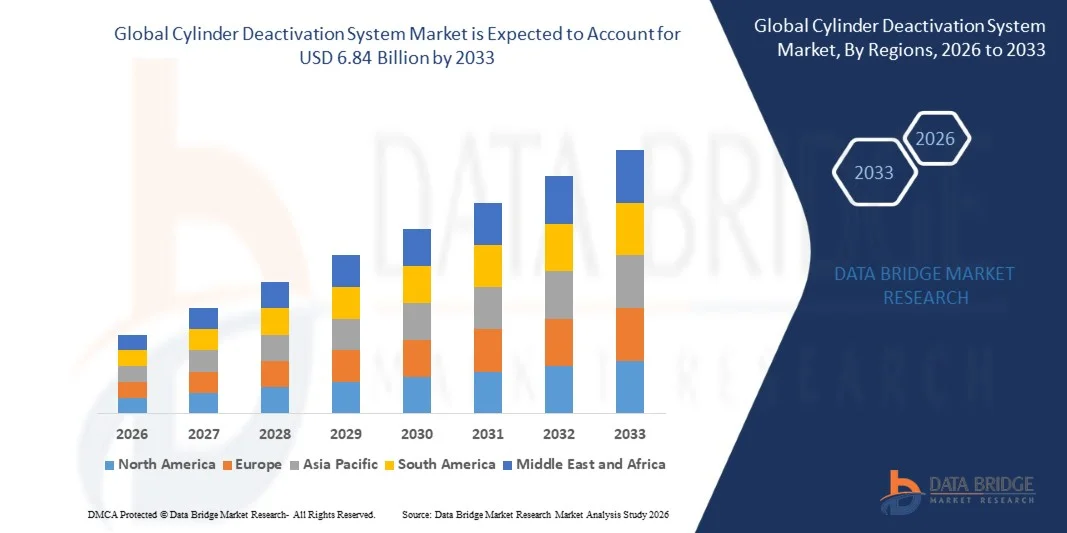
As per Data Bridge Market Research analysis, the cylinder deactivation system market was valued at USD 5.24 billion in 2025 and is projected to reach USD 6.84 billion by 2033, growing at a CAGR of 3.40% from 2026 to 2033. The market is experiencing consistent growth driven by increasing demand for fuel-efficient engine technologies, tightening global carbon dioxide emission and fuel economy regulations, and rising adoption of cost-effective solutions to improve internal combustion engine efficiency.
The growing implementation of stringent emission standards, including the European Union’s carbon dioxide fleet targets and United States Corporate Average Fuel Economy requirements, is encouraging automotive manufacturers to integrate cylinder deactivation systems as an efficient technology for reducing fuel consumption and emissions. The increasing adoption of 48 V mild-hybrid architectures, start-stop systems, and advanced engine control technologies is further supporting market expansion by enabling improved fuel savings, optimized engine performance, and enhanced thermal management in passenger and commercial vehicles
Market Size & Forecast
- Global Market Value (2025): USD 5.24 Billion
- Expected Market Value (2033): USD 6.84 Billion
- Forecast CAGR (2026–2033): 3.40%
- Leading Region in 2025: North America
- Fastest Growing Region: Asia-Pacific
Key Market Trends & Insights
- North America dominated the cylinder deactivation system market with the largest revenue share of 36.35% in 2025, supported by high adoption of pickup trucks and sport utility vehicles, along with stringent Corporate Average Fuel Economy (CAFE) regulations encouraging automotive manufacturers to improve fuel efficiency through advanced engine technologies
- The valve solenoid segment led the market with a 42.5% share in 2025, driven by its essential function in controlling oil flow and enabling precise cylinder activation and deactivation operations.
- Asia-Pacific is expected to be the fastest-growing region at a CAGR of 8.39% from 2026 to 2033, fueled by high vehicle production volumes, continued internal combustion engine demand, increasing adoption of emission-compliant technologies, and growing cylinder deactivation implementation in China and India.
- Engine control unit are the fastest-growing component type, projected to register a CAGR of 7.0%, reflecting the surge in integration of advanced electronic control systems in modern vehicles.
- The hydraulic segment dominated the actuation method category with a 53.1% revenue share in 2025, led by its extensive application in traditional internal combustion engines and established automotive manufacturing processes
- Gasoline accounted for 56.42% of the market, preferred by widespread adoption of cylinder deactivation technology in passenger vehicles equipped with gasoline engines.
- The idle-stop segment is the fastest-growing application category, with a CAGR of 8.0%, driven by increasing focus on reducing fuel consumption and emissions during urban driving conditions.
Report Scope and Cylinder Deactivation System Market Segmentation
|
Attributes |
Cylinder Deactivation System Key Market Insights |
|
Segments Covered |
|
|
Countries Covered |
North America
Europe
Asia-Pacific
Middle East and Africa
South America
|
|
Key Market Players |
|
|
Market Opportunities |
|
|
Value Added Data Infosets |
In addition to the market insights such as market value, growth rate, market segments, geographical coverage, market players, and market scenario, the market report curated by the Data Bridge Market Research team includes in-depth expert analysis, import/export analysis, pricing analysis, production consumption analysis, and pestle analysis. |
Cylinder Deactivation System Market Trends
Trend: Integration of Cylinder Deactivation with Hybrid Powertrain Technologies
Automotive manufacturers are increasingly integrating cylinder deactivation systems with mild-hybrid and advanced powertrain architectures to improve fuel efficiency and reduce carbon dioxide emissions while maintaining engine performance. The combination of cylinder deactivation with 48 V electrical systems, start-stop technologies, and advanced engine management enables optimized operation by dynamically controlling cylinder activation based on driving conditions. Vehicle manufacturers are similarly adopting these technologies to comply with tightening global emission regulations and enhance the efficiency of internal combustion engines during the transition toward electrified mobility. For instance, in October 2022, Mazda announced that the first-ever CX-60 would feature hybrid-only powertrains, including newly developed 48V M Hybrid Boost systems paired with advanced inline-six gasoline and diesel engines, demonstrating the integration of advanced engine efficiency technologies with hybrid powertrain systems.
The integration of cylinder deactivation with hybrid and advanced engine technologies is expected to remain a key market trend as manufacturers focus on improving fuel efficiency and extending the competitiveness of internal combustion engine platforms.
Cylinder Deactivation System Market Dynamics
Key Market Driver: Increasing Stringency of Global Emission Regulations
The implementation of increasingly stringent fuel economy standards and carbon dioxide emission regulations is creating significant demand for cylinder deactivation systems across passenger and commercial vehicles. Automotive manufacturers are adopting cylinder deactivation technologies as an effective solution to optimize internal combustion engine efficiency, reduce fuel consumption, and comply with regulatory requirements without major engine redesigns. The adoption of advanced engine control systems and variable displacement technologies is further supporting market growth by enabling precise cylinder activation and improved vehicle performance. For instance, in March 2024, the U.S. Environmental Protection Agency (EPA) finalized new Multi-Pollutant Emissions Standards for Model Years 2027 and Later Light-Duty and Medium-Duty Vehicles, establishing stricter greenhouse gas and air pollutant emission requirements and encouraging automotive manufacturers to adopt advanced fuel-efficiency and powertrain technologies to meet future emission targets.
Increasing regulatory pressure on vehicle emissions is expected to accelerate the adoption of cylinder deactivation systems as automakers seek efficient solutions to meet fuel economy and emission compliance targets
Key Restraint/Challenge: Limited Adoption Due to High System Complexity and Cost
A significant challenge in the cylinder deactivation system market is the complexity involved in integrating advanced components, including electronic control units, solenoid valves, hydraulic systems, and software algorithms. The requirement for precise calibration and additional manufacturing costs can limit adoption, particularly in cost-sensitive vehicle segments. Furthermore, compatibility issues with smaller engines and concerns regarding noise, vibration, and harshness during cylinder switching create additional barriers for wider implementation across automotive platforms. For instance, in April 2021, research published by the Society of Automotive Engineers highlights that cylinder deactivation systems require advanced control strategies to manage combustion transitions, vibration characteristics, and drivability concerns during cylinder activation and deactivation events.
The complexity and additional cost associated with cylinder deactivation technology remain key challenges, requiring manufacturers to develop simplified and cost-effective solutions for broader market penetration.
Key Market Opportunity: Development of Advanced Dynamic Cylinder Deactivation Technologies
The development of advanced dynamic cylinder deactivation technologies presents a significant market opportunity by enabling real-time cylinder management, improved fuel economy, and enhanced engine efficiency across varying driving conditions. Next-generation systems using advanced electronic controls, artificial intelligence-based algorithms, and predictive engine management can optimize cylinder operation while supporting hybrid powertrain integration. The increasing focus on reducing emissions from existing internal combustion engines is further creating opportunities for technology providers to expand cylinder deactivation applications in global automotive markets. For instance, in September 2021, Tula Technology expanded the application of its Dynamic Skip Fire (DSF) technology, which uses advanced control algorithms to dynamically manage cylinder activation and deactivation events, improving fuel efficiency and reducing emissions in internal combustion engines.
Advancements in intelligent cylinder control technologies are expected to create significant growth opportunities by improving system efficiency, expanding applications, and supporting emission reduction objectives across automotive markets.
Cylinder Deactivation System Market Scope
The cylinder deactivation system market is segmented on the basis of component, actuation method, fuel type, cylinders deactivated, and application.
- By Component
On the basis of component, the cylinder deactivation system market is segmented into valve solenoid, engine control unit, and others. The valve solenoid segment dominated the market with an estimated share of 42.5% in 2025, owing to its essential function in controlling oil flow and enabling precise cylinder activation and deactivation operations. Valve solenoids are widely adopted across hydraulic cylinder deactivation systems due to their reliability, fast response, and compatibility with existing internal combustion engine architectures. These components play a critical role in maintaining engine efficiency by accurately regulating cylinder operation according to driving conditions. Increasing demand for fuel-efficient vehicles and advanced engine management technologies is supporting continued adoption of valve solenoid-based systems. However, the segment faces challenges from the increasing transition toward electric actuation technologies. The widespread use of hydraulic cylinder deactivation systems in passenger vehicles continues to maintain the dominance of valve solenoids globally.
The engine control unit segment is projected to register the fastest growth at a CAGR of 7% from 2026 to 2033, driven by increasing integration of advanced electronic control systems in modern vehicles. Engine control units enable real-time monitoring and management of cylinder activation patterns, improving fuel economy and reducing emissions. Growing adoption of software-controlled powertrain technologies and artificial intelligence-based engine optimization is strengthening demand for advanced ECUs. The increasing complexity of hybrid powertrains and connected vehicles is further accelerating ECU development. Automotive manufacturers are focusing on improving control accuracy, response time, and engine performance through advanced computing capabilities. Rising vehicle electrification trends are also creating opportunities for more sophisticated engine management solutions.
- By Actuation Method
On the basis of actuation method, the cylinder deactivation system market is segmented into hydraulic, electric, and mechanical systems. The hydraulic segment dominated the market with an estimated share of 53.1% in 2025, supported by its extensive application in traditional internal combustion engines and established automotive manufacturing processes. Hydraulic actuation systems provide reliable cylinder switching performance by controlling oil pressure to activate or deactivate engine components. These systems are widely used in large-displacement engines, including pickup trucks, sport utility vehicles, and commercial vehicles. The mature supply chain and proven operational reliability of hydraulic systems continue to support market penetration. However, hydraulic systems require additional mechanical complexity and may have slower response compared with advanced electric alternatives. The segment remains dominant due to its long-standing adoption by major automotive manufacturers.
The electric actuation segment is expected to witness the fastest growth at a CAGR of 8% from 2026 to 2033, driven by increasing demand for faster, more precise, and electronically controlled cylinder deactivation solutions. Electric actuation provides improved response time and better compatibility with advanced engine management systems. The growing adoption of 48 V mild-hybrid architectures is supporting the integration of electrically controlled powertrain components. Automotive manufacturers are increasingly focusing on reducing mechanical complexity and improving energy efficiency through electronic systems. Advancements in sensors, controllers, and vehicle software platforms are further enhancing electric actuation capabilities. The segment is expected to gain momentum as next-generation vehicles require more intelligent engine control solutions.
- By Fuel Type
On the basis of fuel type, the cylinder deactivation system market is segmented into gasoline, diesel, and LPG/CNG. The gasoline segment dominated the market with an estimated share of 56.42% in 2025, driven by widespread adoption of cylinder deactivation technology in passenger vehicles equipped with gasoline engines. Gasoline engines, particularly larger displacement engines used in pickup trucks and sport utility vehicles, extensively utilize cylinder deactivation to improve fuel efficiency during low-load driving conditions. Increasing regulatory pressure to reduce carbon dioxide emissions is encouraging gasoline engine manufacturers to implement efficiency-enhancing technologies. The segment benefits from strong production volumes of gasoline-powered vehicles globally. However, growing electrification trends may limit long-term expansion. Despite this, gasoline applications continue to represent the largest opportunity for cylinder deactivation system adoption.
The diesel segment is projected to grow at the fastest rate with a CAGR of 7% from 2026 to 2033, supported by increasing demand for fuel-efficient commercial vehicles and emission management solutions. Diesel cylinder deactivation technology is gaining attention for improving thermal efficiency and supporting exhaust after-treatment system performance. Heavy-duty vehicle manufacturers are exploring advanced cylinder management solutions to comply with stricter emission standards. Increasing adoption of diesel engines in commercial transportation markets is creating new growth opportunities. Technological improvements are helping overcome challenges related to vibration and combustion stability. The segment is expected to expand as manufacturers seek efficient solutions for reducing emissions from existing diesel platforms.
- By Cylinders Deactivated
On the basis of cylinders deactivated, the market is segmented into 2 cylinders, 3 cylinders, 4 cylinders, and others. The 4 cylinders segment dominated the market with an estimated share of 42.6% in 2025, owing to increasing adoption in mainstream passenger vehicles and medium-sized engine platforms. Four-cylinder configurations provide an effective balance between fuel efficiency improvement and engine performance optimization. Automotive manufacturers widely implement cylinder deactivation in these engines to improve fuel economy during cruising and low-load conditions. Growing demand for efficient passenger vehicles is supporting segment expansion. The segment benefits from high global production volumes of four-cylinder engines. However, increasing adoption of hybrid and electric powertrains may influence future demand.
The 6 cylinder and above segment is expected to register the fastest growth at a CAGR of 7.8% from 2026 to 2033, driven by increasing application in premium vehicles, pickup trucks, and performance-oriented automobiles. Larger engines provide significant fuel-saving potential through cylinder deactivation because they operate more frequently under partial-load conditions. Manufacturers are increasingly integrating advanced cylinder management technologies into high-performance engines to meet emission regulations without compromising power output. Growing demand for luxury vehicles and large sport utility vehicles is supporting adoption. Advanced control systems are improving drivability and reducing vibration concerns. The segment represents a strong opportunity for technology providers targeting high-value automotive applications.
- By Application
On the basis of application, the cylinder deactivation system market is segmented into start-stop systems, idle-stop systems, and others. The start-stop system segment dominated the market with an estimated share of 52.22% in 2025, driven by increasing adoption of fuel-saving technologies in passenger vehicles. Cylinder deactivation systems integrated with start-stop technologies help improve fuel efficiency by reducing unnecessary engine operation during low-demand conditions. Automotive manufacturers are implementing these systems to comply with global fuel economy regulations. The segment benefits from widespread adoption in conventional internal combustion vehicles. Increasing consumer demand for improved fuel economy is supporting market growth. However, system complexity and calibration requirements remain challenges for manufacturers.
The idle-stop segment is expected to witness the fastest growth at a CAGR of 8% from 2026 to 2033, supported by increasing focus on reducing fuel consumption and emissions during urban driving conditions. These systems optimize engine operation by reducing unnecessary fuel usage during idling and low-load conditions. Growing adoption of advanced powertrain control technologies is accelerating integration opportunities. Regulatory pressure on urban emissions is encouraging manufacturers to adopt improved engine efficiency solutions. Development of intelligent vehicle control systems is further supporting segment expansion. The segment is expected to gain importance as automotive manufacturers continue improving conventional engine efficiency.
Cylinder Deactivation System Market Regional Analysis
North America dominated the cylinder deactivation system market with the largest revenue share of 36.35% in 2025, supported by high adoption of pickup trucks and sport utility vehicles, along with stringent Corporate Average Fuel Economy (CAFE) regulations encouraging automotive manufacturers to improve fuel efficiency through advanced engine technologies. The region also benefits from stringent fuel economy regulations, including Corporate Average Fuel Economy (CAFE) standards, and the strong presence of leading automotive manufacturers implementing cylinder deactivation solutions. Growing integration of advanced engine management systems, dynamic fuel management technologies, and hybrid powertrain components is accelerating market development. Increasing focus on improving fuel efficiency, reducing carbon dioxide emissions, and optimizing internal combustion engine performance continues to strengthen North America's leadership position in the global market.
U.S. Cylinder Deactivation System Market Insight
The U.S. cylinder deactivation system market is witnessing strong growth due to increasing demand for fuel-efficient internal combustion engines, stringent fuel economy regulations, and high adoption of pickup trucks and sport utility vehicles equipped with advanced engine management technologies. The country’s strong automotive manufacturing ecosystem, along with the presence of major vehicle manufacturers implementing cylinder deactivation solutions, is driving demand across passenger and commercial vehicle applications. In addition, increasing focus on reducing carbon dioxide emissions and improving fleet fuel efficiency is accelerating adoption of cylinder deactivation technologies across the automotive sector. The U.S. Environmental Protection Agency and National Highway Traffic Safety Administration’s Corporate Average Fuel Economy (CAFE) standards require automakers to improve vehicle fuel efficiency, supporting the adoption of technologies such as cylinder deactivation for emission reduction.
Europe Cylinder Deactivation System Market Insight
The Europe cylinder deactivation system market remains a major contributor to global revenue, driven by strict carbon dioxide emission regulations, automotive technology innovation, and increasing demand for fuel-saving engine solutions. The widespread implementation of advanced engine management technologies by European automotive manufacturers is supporting market expansion across the region. Increasing investments in low-emission mobility solutions, coupled with regulatory pressure to reduce vehicle emissions and improve fleet efficiency, continue to enhance adoption of cylinder deactivation systems throughout Europe. The European Union’s Regulation (EU) 2019/631 establishes carbon dioxide emission performance standards for new passenger cars and vans, encouraging manufacturers to adopt fuel-efficiency technologies to meet fleet emission targets.
U.K. Cylinder Deactivation System Market Insight
The U.K. cylinder deactivation system market is experiencing steady growth, supported by increasing adoption of fuel-efficient vehicle technologies, automotive engineering capabilities, and government initiatives focused on reducing transportation emissions. Increasing investments in advanced powertrain technologies and growing demand for solutions that improve internal combustion engine efficiency are contributing to market growth. Furthermore, integration of advanced electronic engine management systems and emission-control technologies is improving cylinder deactivation performance, positioning the U.K. as an important automotive technology market in Europe. The U.K. Government’s Transport Decarbonisation Plan outlines measures to reduce transport emissions and accelerate the adoption of cleaner and more efficient vehicle technologies, supporting demand for advanced automotive efficiency solutions.
Germany Cylinder Deactivation System Market Insight
The Germany cylinder deactivation system market is expanding steadily due to the country’s strong automotive manufacturing base, advanced powertrain engineering capabilities, and increasing adoption of fuel-efficiency technologies. Automotive manufacturers and suppliers are increasingly developing advanced engine management systems to improve vehicle efficiency and comply with European emission requirements. Continuous advancements in intelligent engine controls, variable displacement technologies, and hybrid-compatible powertrain solutions, along with strong automotive research activities, are further driving market growth in Germany. German automotive manufacturers such as Volkswagen Group have implemented cylinder deactivation technology in selected TSI engines to improve fuel efficiency during partial-load operation, demonstrating regional adoption of cylinder management solutions.
Asia-Pacific Cylinder Deactivation System Market Insight
The Asia-Pacific cylinder deactivation system market is expected to witness rapid growth, driven by increasing vehicle production, expanding automotive manufacturing capabilities, and rising adoption of fuel-efficient technologies across countries such as China, India, and Japan. Growing regulatory focus on reducing vehicle emissions, increasing demand for passenger vehicles, and rising investments in advanced automotive technologies are supporting regional market expansion. In addition, the growing presence of automotive manufacturing facilities and research centers is accelerating adoption of cylinder deactivation systems across passenger and commercial vehicle segments. China VI emission standards introduced stricter pollutant emission limits for vehicles, encouraging automotive manufacturers to adopt advanced engine management and emission-control technologies to improve efficiency and comply with regulatory requirements.
Japan Cylinder Deactivation System Market Insight
The Japan cylinder deactivation system market is witnessing consistent growth due to rising investments in automotive innovation, advanced engine technologies, and fuel-efficiency improvement solutions. Automotive manufacturers and research organizations are increasingly focusing on optimizing internal combustion engines through advanced control systems and hybrid-compatible technologies. Moreover, Japan’s strong automotive engineering ecosystem and focus on reducing vehicle emissions are further contributing to cylinder deactivation system adoption. For instance, Honda introduced Variable Cylinder Management (VCM) technology in selected V6 engines, enabling cylinder deactivation during cruising and low-load conditions to improve fuel economy while maintaining performance during high-power operation
China Cylinder Deactivation System Market Insight
The China cylinder deactivation system market is growing rapidly, driven by increasing vehicle production, tightening emission regulations, and rising demand for technologies that improve fuel efficiency in internal combustion engines. Growing adoption of advanced engine control systems across passenger vehicles and commercial vehicles is significantly boosting market demand. In addition, increasing investments in automotive innovation, government emission-control initiatives, and the expansion of domestic vehicle manufacturing are positioning China as one of the fastest-growing markets for cylinder deactivation technologies globally. China’s New Energy Vehicle Industry Development Plan (2021–2035) promotes automotive technology innovation and energy-efficient vehicle development, supporting demand for advanced powertrain technologies as manufacturers improve vehicle efficiency alongside electrification efforts.
Cylinder Deactivation System Market Share
The cylinder deactivation system industry is primarily led by well-established companies, including:
- General Motors (U.S.)
- Ford Motor Company (U.S.)
- Stellantis N.V. (Netherlands)
- TOYOTA MOTOR CORPORATION (Japan)
- Honda Motor Co., Ltd. (Japan)
- Mazda Motor Corporation (Japan)
- Volkswagen AG (Germany)
- Mercedes-Benz AG (Germany)
- BMW AG (Germany)
- Hyundai Motor Company (South Korea)
- Kia Corporation (South Korea)
- Nissan Motor Co., Ltd. (Japan)
- Subaru Corporation (Japan)
- Renault Group (France)
- Volvo Car Corporation (Sweden)
- Cummins Inc. (U.S.)
- Tula Technology, Inc. (U.S.)
- Jacobs Vehicle Systems, LLC (U.S.)
- Eaton Corporation plc (Ireland)
- Schaeffler AG (Germany)
Latest Developments in Cylinder Deactivation System Market
- In September 2025, Tula Technology announced new global automotive development agreements with a Tier-1 supplier and a Chinese original equipment manufacturer (OEM), expanding its propulsion efficiency technology programs. The company highlighted continued advancement of its intelligent powertrain technologies, including software-based solutions designed to improve vehicle efficiency and support next-generation automotive platforms. This development reflects increasing industry focus on advanced control technologies that optimize engine and powertrain efficiency.
- In July 2024, Hyundai Motor India launched the Exter Hy-CNG Duo with dual-cylinder technology, introducing a packaging-focused cylinder solution designed to improve space utilization while maintaining CNG vehicle practicality. The launch demonstrated continued innovation in cylinder-based vehicle technologies and highlighted manufacturers’ efforts to improve efficiency and optimize vehicle design for alternative fuel applications
- In March 2023, researchers published a study on feedforward cylinder deactivation control for Formula 1 hybrid power units, demonstrating the application of advanced cylinder deactivation control strategies in high-performance automotive systems. The research showed that optimized cylinder deactivation control could improve energy management and enhance powertrain efficiency under racing conditions
- In November 2022, Jacobs Vehicle Systems introduced its cylinder deactivation (CDA) technology for heavy-duty diesel engines, targeting improved emissions performance and fuel efficiency in commercial vehicles. The technology was developed to help engine manufacturers address tightening global carbon dioxide and nitrogen oxide regulations by enabling controlled cylinder shutdown during low-load operating conditions
- In September 2021, Jacobs Vehicle Systems and Tula Technology announced a cooperation agreement to accelerate the development of Jacobs’ Cylinder Deactivation (CDA) valve actuation technology combined with Tula’s Dynamic Skip Fire (DSF) control algorithms for medium- and heavy-duty vehicles. The collaboration focused on reducing nitrogen oxide and carbon dioxide emissions by improving cylinder deactivation control, enabling more efficient engine operation under low-load condition

- Interactive Data Analysis Dashboard
- Company Analysis Dashboard for high growth potential opportunities
- Research Analyst Access for customization & queries
- Competitor Analysis with Interactive dashboard
- Latest News, Updates & Trend analysis
- Harness the Power of Benchmark Analysis for Comprehensive Competitor Tracking
Data collection and base year analysis are done using data collection modules with large sample sizes. The stage includes obtaining market information or related data through various sources and strategies. It includes examining and planning all the data acquired from the past in advance. It likewise envelops the examination of information inconsistencies seen across different information sources. The market data is analysed and estimated using market statistical and coherent models. Also, market share analysis and key trend analysis are the major success factors in the market report. To know more, please request an analyst call or drop down your inquiry.
The key research methodology used by DBMR research team is data triangulation which involves data mining, analysis of the impact of data variables on the market and primary (industry expert) validation. Data models include Vendor Positioning Grid, Market Time Line Analysis, Market Overview and Guide, Company Positioning Grid, Patent Analysis, Pricing Analysis, Company Market Share Analysis, Standards of Measurement, Global versus Regional and Vendor Share Analysis. To know more about the research methodology, drop in an inquiry to speak to our industry experts.
Data Bridge Market Research is a leader in advanced formative research. We take pride in servicing our existing and new customers with data and analysis that match and suits their goal. The report can be customized to include price trend analysis of target brands understanding the market for additional countries (ask for the list of countries), clinical trial results data, literature review, refurbished market and product base analysis. Market analysis of target competitors can be analyzed from technology-based analysis to market portfolio strategies. We can add as many competitors that you require data about in the format and data style you are looking for. Our team of analysts can also provide you data in crude raw excel files pivot tables (Fact book) or can assist you in creating presentations from the data sets available in the report.













