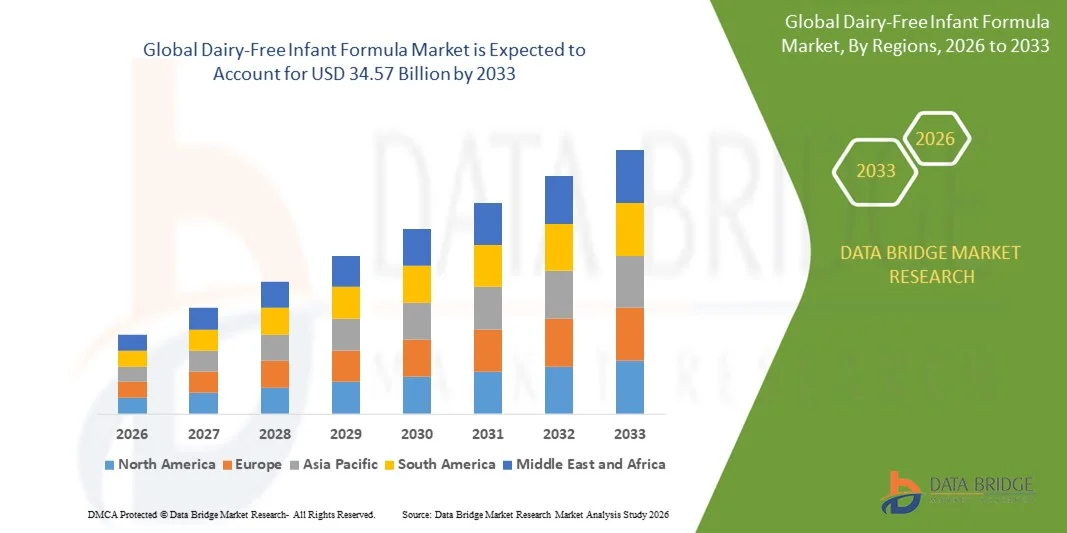
Dairy-Free Infant Formula Market Size
- The global dairy-free infant formula market size was valued at USD 16.60 billion in 2025 and is expected to reach USD 34.57 billion by 2033, at a CAGR of 9.60% during the forecast period
- The market growth is largely fuelled by the rising prevalence of lactose intolerance and cow-milk protein allergies, which is driving parents to opt for safer, easily digestible dairy-free alternatives for infants
- Increasing parental preference for plant-based, clean-label, and hypoallergenic formulations is supporting sustained demand, as consumers prioritise formulas without common allergens or synthetic additives
Dairy-Free Infant Formula Market Analysis
- The market is witnessing strong momentum as parents become more conscious of the long-term health and digestive comfort of infants, leading to increased adoption of dairy-free products that offer gentler formulations and comprehensive nutrient profiles
- Continuous advancements in plant-based protein processing and fortification technologies are enhancing the texture, taste, and nutritional balance of dairy-free formulas, making them more competitive with conventional dairy-based products and supporting broader market acceptance
- North America dominated the dairy-free infant formula market in 2025 with the largest revenue share, driven by the rising prevalence of lactose intolerance among infants and the growing preference for plant-based nutrition. Increasing awareness of digestive health, along with strong consumer trust in hypoallergenic and clean-label products, continues to support market expansion
- Asia-Pacific region is expected to witness the highest growth rate in the global dairy-free infant formula market, driven by expanding retail penetration, increasing disposable incomes, and growing acceptance of dairy-free and allergen-friendly infant formulas
- The organic segment held the largest market revenue share in 2025 due to rising parental preference for clean-label, chemical-free, and naturally sourced infant nutrition. Organic dairy-free formulas are increasingly chosen for infants with heightened sensitivity, as they avoid synthetic additives and offer enhanced nutritional purity aligned with health-conscious parenting trends
Report Scope and Dairy-Free Infant Formula Market Segmentation
|
Attributes |
Dairy-Free Infant Formula Key Market Insights |
|
Segments Covered |
|
|
Countries Covered |
North America
Europe
Asia-Pacific
Middle East and Africa
South America
|
|
Key Market Players |
|
|
Market Opportunities |
|
|
Value Added Data Infosets |
In addition to the insights on market scenarios such as market value, growth rate, segmentation, geographical coverage, and major players, the market reports curated by the Data Bridge Market Research also include in-depth expert analysis, pricing analysis, brand share analysis, consumer survey, demography analysis, supply chain analysis, value chain analysis, raw material/consumables overview, vendor selection criteria, PESTLE Analysis, Porter Analysis, and regulatory framework. |
Dairy-Free Infant Formula Market Trends
Rise of Plant-Based and Hypoallergenic Infant Nutrition
- The growing shift toward plant-based infant nutrition is transforming the dairy-free formula landscape by offering gentler, allergen-friendly alternatives for infants with lactose intolerance or cow-milk protein allergies. Improved digestibility and nutrient fortification support healthier feeding outcomes and reduce discomfort-related issues in infants
- The rising demand for clean-label products in both developed and emerging regions is driving adoption of formulas made from soy, almond, coconut, and hydrolysed rice proteins. These options appeal to parents seeking natural, minimally processed ingredients, supported by rising awareness of early-life dietary sensitivity
- The convenience and enhanced formulation quality of modern dairy-free infant formulas are making them suitable for routine feeding, supporting improved nutritional intake. Parents benefit from a broader selection of fortified, easy-to-digest options without compromising on essential nutrients required for early development
- For instance, in 2024, several Asia-Pacific manufacturers launched rice-protein-based infant formulas that recorded strong sales due to their hypoallergenic nature and high digestibility. These products gained rapid acceptance among infants with recurring milk intolerance issues, reducing feeding complications and improving overall comfort
- While plant-based formulas are improving early-life nutrition and expanding consumer choice, long-term impact depends on continued R&D, regulatory support, and cost-effective production. Manufacturers must strengthen labelling transparency and product accessibility to capitalize on rising global demand
Dairy-Free Infant Formula Market Dynamics
Driver
Rising Lactose Intolerance and Growing Consumer Preference for Plant-Based Nutrition
- The increasing prevalence of lactose intolerance and dairy allergies among infants is prompting parents and healthcare professionals to prioritise dairy-free formulas for safer feeding. These concerns have accelerated the shift toward plant-based alternatives designed to minimise digestive discomfort and allergic reactions
- Parents are becoming more aware of the nutritional and functional benefits of hypoallergenic and plant-derived formulas, including ease of digestion and reduced inflammatory responses. This awareness aligns with evolving consumer demand for allergen-free, naturally sourced infant nutrition
- Governments, paediatric associations, and health agencies are increasingly promoting awareness programs on milk allergies and digestive issues in infants. Supportive guidelines and safety standards are encouraging more families to adopt dairy-free nutritional solutions for sensitive infants
- For instance, in 2023, European health authorities expanded recommendations for hypoallergenic formulas for infants showing recurrent intolerance symptoms, boosting demand for fortified dairy-free solutions across major markets
- While rising awareness and supportive policy measures are fuelling adoption, efforts are needed to enhance affordability, ensure widespread availability, and strengthen clinical validation of plant-based formulations for long-term nutritional confidence
Restraint/Challenge
High Cost of Dairy-Free Formulations and Limited Accessibility in Price-Sensitive Markets
- The high production cost of dairy-free infant formulas, especially those derived from advanced plant-protein processing, makes them unaffordable for many families in low- and middle-income markets. This limits widespread adoption and concentrates usage primarily in premium and urban consumer segments
- Many regions lack proper awareness and retail availability of high-quality dairy-free infant formula options. Limited distribution channels, combined with insufficient paediatric guidance, restrict access to reliable alternatives for families with infants experiencing dairy intolerance
- Supply chain inconsistencies, especially in developing countries, often affect the availability of specialised dairy-free formulas. This results in delayed access and reliance on less suitable substitutes, increasing the risk of nutritional imbalances for infants with severe intolerance
- For instance, in 2023, health agencies across parts of Africa and Southeast Asia reported shortages of fortified plant-based infant formulas due to import dependency and price fluctuations, affecting care for infants with acute milk allergies
- While technological advancements are boosting production capabilities, overcoming cost barriers, improving retail penetration, and ensuring regulatory harmonisation remain essential for unlocking long-term growth potential in the dairy-free infant formula market
Dairy-Free Infant Formula Market Scope
The market is segmented on the basis of type and distribution channel.
- By Type
On the basis of type, the dairy-free infant formula market is segmented into organic and conventional. The organic segment held the largest market revenue share in 2025 due to rising parental preference for clean-label, chemical-free, and naturally sourced infant nutrition. Organic dairy-free formulas are increasingly chosen for infants with heightened sensitivity, as they avoid synthetic additives and offer enhanced nutritional purity aligned with health-conscious parenting trends.
The conventional segment is expected to witness the fastest growth rate from 2026 to 2033, driven by its wider affordability, strong retail presence, and improved formulation quality. Advancements in plant-based protein processing are enabling manufacturers to enhance taste, digestibility, and nutrient balance in conventional dairy-free formulas, expanding their acceptance among cost-sensitive consumers.
- By Distribution Channel
On the basis of distribution channel, the dairy-free infant formula market is segmented into supermarkets and hypermarkets, convenience stores, and online. The supermarkets and hypermarkets segment held the largest market share in 2025 owing to the broad product assortment, strong brand visibility, and consumer preference for in-store comparison before purchasing infant nutrition products.
The online segment is expected to exhibit the fastest growth rate from 2026 to 2033, supported by the expansion of e-commerce platforms, subscription-based delivery models, and growing demand for doorstep availability of specialized formulas. Online channels also provide access to a wider variety of dairy-free formulations, particularly benefiting parents in regions with limited retail availability.
Dairy-Free Infant Formula Market Regional Analysis
- North America dominated the dairy-free infant formula market in 2025 with the largest revenue share, driven by the rising prevalence of lactose intolerance among infants and the growing preference for plant-based nutrition. Increasing awareness of digestive health, along with strong consumer trust in hypoallergenic and clean-label products, continues to support market expansion
- Parents in the region highly value the nutritional safety, allergen-free composition, and enhanced digestibility offered by dairy-free formulas made from soy, almond, and rice proteins. The increasing emphasis on infant wellness and proactive allergy management further strengthens product demand
- This widespread adoption is also supported by high spending capacity, well-established retail infrastructure, and strong acceptance of premium infant nutrition products. The growing preference for sustainable and plant-based alternatives has positioned dairy-free infant formulas as a favored choice for health-conscious families
U.S. Dairy-Free Infant Formula Market Insight
The U.S. dairy-free infant formula market captured the largest revenue share in 2025 within North America, driven by rising awareness of cow-milk protein allergies and the shift toward plant-based nutrition. Parents are prioritizing safer, easily digestible alternatives that reduce gastrointestinal discomfort and allergic reactions. The growing popularity of organic and clean-label formulas, along with strong retail penetration across pharmacies, supermarkets, and online platforms, is accelerating market growth. Moreover, increased pediatric recommendations and expanding product innovation are contributing significantly to the market’s expansion.
Europe Dairy-Free Infant Formula Market Insight
The Europe dairy-free infant formula market is expected to witness the fastest growth rate from 2026 to 2033, driven by stringent infant nutrition regulations and the rising adoption of hypoallergenic feeding options. Growing concerns about food sensitivities, combined with the region’s strong preference for sustainable, plant-based ingredients, are boosting market appeal. Europe is witnessing strong uptake across residential consumers and childcare institutions, supported by expanding product availability in both offline and online channels.
U.K. Dairy-Free Infant Formula Market Insight
The U.K. dairy-free infant formula market is expected to witness the fastest growth rate from 2026 to 2033, propelled by increasing cases of lactose intolerance and rising demand for clean-label, allergen-free nutrition. Concerns regarding infant digestive health are encouraging parents to choose plant-based formulas as safer alternatives. The U.K.’s rapid adoption of premium infant nutrition products, along with strong e-commerce expansion, is expected to further stimulate market growth.
Germany Dairy-Free Infant Formula Market Insight
The Germany dairy-free infant formula market is expected to witness the fastest growth rate from 2026 to 2033, driven by growing awareness of allergy management and strong demand for scientifically formulated, eco-conscious nutrition solutions. Germany’s advanced healthcare system and preference for high-quality, regulated infant food products support strong adoption. The increasing integration of sustainable plant-based formulations, aligned with local consumer expectations for safety and purity, continues to propel market growth.
Asia-Pacific Dairy-Free Infant Formula Market Insight
The Asia-Pacific dairy-free infant formula market is expected to witness the fastest growth rate from 2026 to 2033, supported by rising infant allergies, increasing disposable incomes, and rapid urbanization in countries such as China, Japan, and India. Growing interest in specialized infant nutrition, supported by government-led health awareness initiatives, is driving adoption. As APAC strengthens its manufacturing capabilities for plant-based ingredients, product affordability and availability are expanding across both urban and semi-urban regions.
Japan Dairy-Free Infant Formula Market Insight
The Japan dairy-free infant formula market is expected to witness the fastest growth rate from 2026 to 2033, fueled by the nation’s strong emphasis on high-quality nutrition, rapid urbanization, and rising interest in allergen-free products. Japanese consumers prioritize safety, convenience, and advanced formulation technologies, driving strong uptake of plant-based infant formulas. In addition, the country’s aging caregiver population is likely to support demand for easy-to-prepare, digestible feeding solutions.
China Dairy-Free Infant Formula Market Insight
The China dairy-free infant formula market accounted for the largest revenue share in Asia-Pacific in 2025, supported by a rapidly growing middle class, increased focus on infant health, and strong acceptance of plant-based nutrition. China remains one of the largest markets for infant formula, with rising demand across residential households, childcare centers, and health institutions. Government support for improved infant nutrition, combined with strong domestic manufacturing capabilities and availability of affordable products, continues to propel market growth.
Dairy-Free Infant Formula Market Share
The Dairy-Free Infant Formula industry is primarily led by well-established companies, including:
- Nestlé (Switzerland)
- Nutricia (Netherlands)
- Valio Ltd (Finland)
- Abbott (U.S.)
- GIMME THE GOOD STUFF (U.S.)
- Silverson (U.K.)
- Apta-Advice (Netherlands)
- Danone (France)
- Nurture, Inc. (U.S.)
- Hero MotoCorp Ltd (India)
- Reckitt Benckiser Group plc (U.K.)
- DANA DAIRY GROUP (Jordan)
- Mead Johnson & Company, LLC (U.S.)
- HiPP (Germany)
- Vermont Organics (U.S.)
- Perrigo Company plc (Ireland)
- The Hain Celestial Group, Inc. (U.S.)
- Bristol-Myers Squibb Company (U.S.)

- Interactive Data Analysis Dashboard
- Company Analysis Dashboard for high growth potential opportunities
- Research Analyst Access for customization & queries
- Competitor Analysis with Interactive dashboard
- Latest News, Updates & Trend analysis
- Harness the Power of Benchmark Analysis for Comprehensive Competitor Tracking
Global Dairy Free Infant Formula Market, Supply Chain Analysis and Ecosystem Framework
To support market growth and help clients navigate the impact of geopolitical shifts, DBMR has integrated in-depth supply chain analysis into its Global Dairy Free Infant Formula Market research reports. This addition empowers clients to respond effectively to global changes affecting their industries. The supply chain analysis section includes detailed insights such as Global Dairy Free Infant Formula Market consumption and production by country, price trend analysis, the impact of tariffs and geopolitical developments, and import and export trends by country and HSN code. It also highlights major suppliers with data on production capacity and company profiles, as well as key importers and exporters. In addition to research, DBMR offers specialized supply chain consulting services backed by over a decade of experience, providing solutions like supplier discovery, supplier risk assessment, price trend analysis, impact evaluation of inflation and trade route changes, and comprehensive market trend analysis.
Data collection and base year analysis are done using data collection modules with large sample sizes. The stage includes obtaining market information or related data through various sources and strategies. It includes examining and planning all the data acquired from the past in advance. It likewise envelops the examination of information inconsistencies seen across different information sources. The market data is analysed and estimated using market statistical and coherent models. Also, market share analysis and key trend analysis are the major success factors in the market report. To know more, please request an analyst call or drop down your inquiry.
The key research methodology used by DBMR research team is data triangulation which involves data mining, analysis of the impact of data variables on the market and primary (industry expert) validation. Data models include Vendor Positioning Grid, Market Time Line Analysis, Market Overview and Guide, Company Positioning Grid, Patent Analysis, Pricing Analysis, Company Market Share Analysis, Standards of Measurement, Global versus Regional and Vendor Share Analysis. To know more about the research methodology, drop in an inquiry to speak to our industry experts.
Data Bridge Market Research is a leader in advanced formative research. We take pride in servicing our existing and new customers with data and analysis that match and suits their goal. The report can be customized to include price trend analysis of target brands understanding the market for additional countries (ask for the list of countries), clinical trial results data, literature review, refurbished market and product base analysis. Market analysis of target competitors can be analyzed from technology-based analysis to market portfolio strategies. We can add as many competitors that you require data about in the format and data style you are looking for. Our team of analysts can also provide you data in crude raw excel files pivot tables (Fact book) or can assist you in creating presentations from the data sets available in the report.