


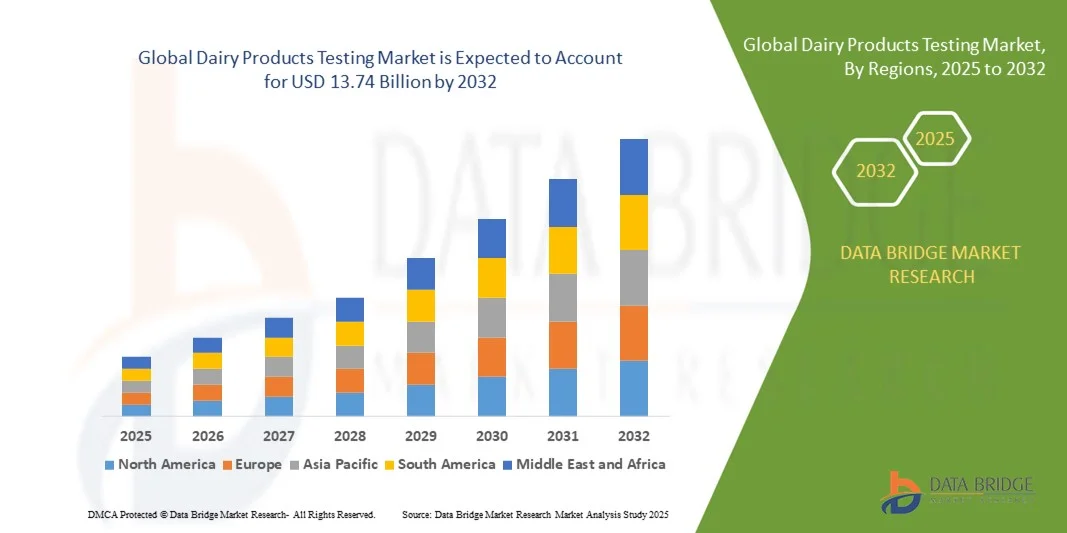
Dairy Products Testing Market Size
- The global dairy products testing market size was valued at USD 8.00 billion in 2024 and is expected to reach USD 13.74 billion by 2032, at a CAGR of 7.00% during the forecast period
- The market growth is largely fueled by the increasing emphasis on food safety, stringent regulatory standards, and the growing need for quality assurance in the global dairy industry. Rising cases of food contamination and adulteration are driving dairy manufacturers to adopt advanced testing methods to ensure compliance and maintain consumer trust. The expansion of international dairy trade further strengthens the demand for standardized testing procedures across regions
- Furthermore, rising consumer awareness regarding nutritional labeling, product authenticity, and allergen detection is propelling the adoption of reliable dairy testing solutions. These factors, combined with the growing focus on sustainability and traceability within the dairy supply chain, are enhancing the need for consistent safety and quality verification, thereby significantly boosting the market’s growth
Dairy Products Testing Market Analysis
- Dairy products testing, involving microbiological, chemical, and nutritional assessment, plays a vital role in ensuring the safety, purity, and consistency of milk and milk-derived products. The increasing consumption of processed and packaged dairy items has made testing an essential step in safeguarding public health and maintaining brand reputation across the global dairy value chain
- The growing demand for dairy testing is driven by the expansion of dairy exports, technological advancements in rapid testing methods, and stringent international food quality standards. As consumers prioritize safe, high-quality, and transparent dairy products, the market continues to evolve with the integration of automation, digital data management, and precision-based analytical systems
- North America dominated the dairy products testing market with a share of 43% in 2024, due to strict food safety regulations and an advanced dairy processing industry
- Asia-Pacific is expected to be the fastest growing region in the dairy products testing market during the forecast period due to the rapid expansion of dairy consumption and increasing awareness of food safety
- Traditional technology segment dominated the market with a market share of 61.7% in 2024, due to its established reliability and cost-effectiveness for large-scale dairy testing. Methods such as titration, culture-based assays, and spectrophotometry remain prevalent across small and medium dairy processing facilities. Many laboratories continue to depend on these conventional techniques due to their high accuracy and regulatory acceptance for routine quality checks. Despite slower throughput, their widespread accessibility and familiarity among technicians maintain their strong market position
Report Scope and Dairy Products Testing Market Segmentation
|
Attributes |
Dairy Products Testing Key Market Insights |
|
Segments Covered |
|
|
Countries Covered |
North America
Europe
Asia-Pacific
Middle East and Africa
South America
|
|
Key Market Players |
|
|
Market Opportunities |
|
|
Value Added Data Infosets |
In addition to the insights on market scenarios such as market value, growth rate, segmentation, geographical coverage, and major players, the market reports curated by the Data Bridge Market Research also include in-depth expert analysis, pricing analysis, brand share analysis, consumer survey, demography analysis, supply chain analysis, value chain analysis, raw material/consumables overview, vendor selection criteria, PESTLE Analysis, Porter Analysis, and regulatory framework. |
Dairy Products Testing Market Trends
Adoption of Rapid and Automated Testing Technologies
- The dairy products testing market is witnessing accelerated transformation with the increasing adoption of rapid and automated testing technologies aimed at improving food safety, operational efficiency, and regulatory compliance. These advanced testing solutions allow quicker detection of contaminants, pathogens, antibiotics, and adulterants while reducing manual intervention and human error in laboratory processes
- For instance, Eurofins Scientific has integrated fully automated microbial and chemical testing systems across its dairy testing facilities, enabling faster turnaround times and improved accuracy in product quality assessments. The deployment of automation and digital data management platforms is significantly streamlining dairy testing workflows across the supply chain
- Technological advancements such as polymerase chain reaction (PCR), liquid chromatography–mass spectrometry (LC–MS), and near-infrared spectroscopy (NIRS) are being widely adopted for multi-parameter analysis. These rapid methods allow comprehensive detection of residues and spoilage indicators in milk, cheese, yogurt, and other dairy derivatives with minimal sample preparation
- Automation in sample handling, coupled with the use of cloud-based laboratory information management systems (LIMS), is improving real-time data tracking and regulatory reporting. This technological shift is helping dairy processors maintain audit readiness and ensure product traceability from farm to distribution channels
- Leading market players are investing in research to develop portable and cost-efficient on-site testing kits designed for small-scale producers and dairy cooperatives. For instance, Neogen Corporation has introduced rapid test kits for aflatoxin M1 and antibiotic detection compatible with high-throughput dairy testing environments
- The adoption of rapid and automated technologies marks a critical step toward ensuring safety and consistency across global dairy supply chains. As efficiency, accuracy, and compliance become integral to food testing operations, automation will continue to power the modernization and competitiveness of the dairy products testing industry
Dairy Products Testing Market Dynamics
Driver
Rising Regulatory Emphasis on Food Safety and Quality Compliance
- Stringent regulations and heightened emphasis on food safety standards across global markets are major factors driving the growth of the dairy products testing market. Authorities are enforcing comprehensive quality monitoring frameworks to ensure consumer safety and maintain confidence in dairy supply chains
- For instance, the European Food Safety Authority (EFSA) and the U.S. Food and Drug Administration (FDA) have mandated frequent residue and contaminant testing in dairy products to meet the Hazard Analysis and Critical Control Points (HACCP) and ISO 17025 quality standards. Such policies have increased the demand for validated testing solutions among dairy processors and exporters
- With the rising complexity of international trade, food safety certification and compliance verification have become essential for global dairy exporters. Inspections for melamine, antibiotic residues, and microbial contamination are now part of routine quality assurance, especially in high-consumption regions such as Europe, North America, and Asia-Pacific
- Growing consumer awareness regarding nutritional quality, labeling accuracy, and traceability is prompting dairy brands to strengthen their in-house testing capabilities. The heightened focus on purity, allergen control, and product standardization is reinforcing the role of testing laboratories as strategic partners for dairy manufacturers
- As governments continue to tighten safety regulations and promote harmonized international standards, the demand for advanced, accredited dairy testing infrastructure will continue to rise. This regulatory-driven growth ensures consistent product quality, enhances brand integrity, and protects public health across the global dairy sector
Restraint/Challenge
High Cost of Advanced Testing Equipment and Infrastructure
- High capital investment required for advanced testing infrastructure poses a major challenge to the dairy products testing market. The implementation of automated and high-throughput analytical systems demands significant spending on equipment, software integration, maintenance, and personnel training
- For instance, installing advanced chromatographic instruments such as LC–MS and gas chromatography–mass spectrometry (GC–MS) systems can cost hundreds of thousands of dollars, limiting affordability for small and mid-sized laboratories. Companies such as SGS SA and Bureau Veritas face high operational costs associated with continuous technology upgrades to maintain testing efficiency and precision
- The ongoing cost of calibrating sensitive equipment, purchasing certified reagents, and ensuring compliance with international standards such as ISO and Codex Alimentarius further increases financial pressure on testing facilities. Smaller dairy producers and cooperatives, particularly in developing countries, often lack access to such high-end infrastructure
- In addition to equipment expenses, advanced testing requires skilled analytical personnel to manage complex instrumentation and interpret multivariate data. Recruitment and training costs represent another barrier for new market entrants or expanding quality assurance divisions
- To address cost challenges, industry participants are focusing on modular instrument designs, automation-as-a-service models, and regional testing networks to share infrastructure expenses. Continued efforts toward cost-efficient equipment design and strategic collaborations will be critical to expanding accessibility and affordability of testing technologies in the dairy products sector
Dairy Products Testing Market Scope
The market is segmented on the basis of product type, type, and technology.
- By Product Type
On the basis of product type, the dairy products testing market is segmented into milk and milk powder, cheese, butter and spreads, infant food, ice cream and desserts, yogurt, and others. The milk and milk powder segment dominated the market with the largest revenue share in 2024 due to the widespread consumption and trade of milk-based products globally. The segment’s growth is supported by stringent safety standards imposed by regulatory bodies to detect adulteration, microbial contamination, and antibiotic residues. The increasing demand for protein-rich and fortified milk products has prompted manufacturers to invest in advanced testing technologies to ensure compliance and maintain consumer trust. The continuous monitoring of milk quality from collection to packaging has reinforced the dominance of this segment in the global market.
The infant food segment is expected to witness the fastest growth rate from 2025 to 2032, driven by the heightened focus on product safety and nutritional integrity for newborns and infants. The rising incidences of product recalls and contamination concerns have increased the adoption of rigorous testing protocols in this category. Manufacturers are implementing advanced microbiological and chemical analyses to ensure compliance with stringent global regulations. The growing demand for organic and fortified infant formula products also necessitates precise quality verification, propelling the expansion of this segment.
- By Type
On the basis of type, the market is divided into safety testing and quality analysis. The safety testing segment held the largest revenue share in 2024, primarily driven by increasing concerns over contamination and adulteration in dairy supply chains. Governments and food safety authorities have enforced strict regulations to identify and eliminate harmful pathogens, toxins, and antibiotic residues. The growing awareness of foodborne illnesses and consumer preference for certified safe products have further enhanced the need for extensive safety testing. The segment’s expansion is also supported by advancements in analytical methods such as ELISA and chromatography for precise contaminant detection.
The quality analysis segment is projected to record the fastest growth during 2025–2032, fueled by rising emphasis on maintaining consistent flavor, texture, and nutritional value in dairy products. Manufacturers are increasingly adopting comprehensive quality checks to meet evolving consumer expectations and premiumization trends in dairy. Advanced analytical technologies are being integrated to ensure optimal freshness and standardization of product batches. This trend is reinforced by the rising global export of dairy products, where quality certification plays a vital role in brand credibility and market acceptance.
- By Technology
On the basis of technology, the dairy products testing market is bifurcated into traditional technology and rapid technology. The traditional technology segment dominated the market with a share of 61.7% in 2024 owing to its established reliability and cost-effectiveness for large-scale dairy testing. Methods such as titration, culture-based assays, and spectrophotometry remain prevalent across small and medium dairy processing facilities. Many laboratories continue to depend on these conventional techniques due to their high accuracy and regulatory acceptance for routine quality checks. Despite slower throughput, their widespread accessibility and familiarity among technicians maintain their strong market position.
The rapid technology segment is anticipated to grow at the fastest CAGR from 2025 to 2032, supported by the growing need for high-speed testing and real-time data accuracy. Technologies such as biosensors, PCR-based assays, and immunoassays are increasingly being adopted to enable immediate detection of contaminants and quality deviations. Rapid testing facilitates on-site analysis, reducing downtime and improving production efficiency for dairy processors. The growing integration of automation and digital data management in quality control workflows has further accelerated the demand for rapid technologies in modern dairy testing operations.
Dairy Products Testing Market Regional Analysis
- North America dominated the dairy products testing market with the largest revenue share of 43% in 2024, driven by strict food safety regulations and an advanced dairy processing industry
- The region’s strong focus on ensuring product purity, nutritional value, and compliance with FDA and USDA standards supports widespread testing adoption across all dairy categories
- The growing consumption of fortified and organic dairy products further accelerates the need for comprehensive quality analysis and contamination detection. High consumer awareness regarding foodborne diseases and sustainability in dairy sourcing continues to strengthen the market position of North America
U.S. Dairy Products Testing Market Insight
The U.S. dairy products testing market accounted for the largest revenue share in 2024 within North America, supported by the country’s expansive dairy production and export base. The implementation of the Food Safety Modernization Act (FSMA) and stringent microbial testing requirements have increased the use of advanced analytical methods. Rising consumer demand for traceability and transparency in dairy sourcing also fuels the integration of automated and rapid testing systems. The market benefits from the presence of leading testing laboratories and advanced technology providers ensuring compliance and quality assurance in the dairy value chain.
Europe Dairy Products Testing Market Insight
The Europe dairy products testing market is projected to expand at a substantial CAGR during the forecast period, driven by strict European Food Safety Authority (EFSA) standards and the region’s emphasis on maintaining product integrity. Growing health awareness and the rising preference for clean-label dairy products encourage producers to invest in high-precision testing. The increasing production of artisanal and organic dairy items, combined with stringent export quality norms, supports the demand for both microbiological and chemical analyses. The strong dairy heritage of countries such as France, Germany, and the Netherlands continues to underpin regional testing growth.
U.K. Dairy Products Testing Market Insight
The U.K. dairy products testing market is anticipated to grow at a noteworthy CAGR, driven by rising concerns over contamination, authenticity, and nutritional accuracy. The country’s growing preference for sustainable and locally sourced dairy items has prompted stricter monitoring across production and supply chains. Regulatory alignment with international safety standards post-Brexit has increased investments in advanced testing technologies. Moreover, the strong presence of private-label dairy brands and rising consumer awareness regarding allergen and additive testing are accelerating market development in the U.K.
Germany Dairy Products Testing Market Insight
The Germany dairy products testing market is expected to expand at a considerable CAGR, supported by its advanced dairy processing infrastructure and strong focus on food quality. German producers prioritize purity verification, antibiotic residue detection, and traceability to meet both domestic and EU regulations. The growing trend of plant-based and lactose-free alternatives has also boosted testing requirements for nutritional labeling and cross-contamination control. Continuous R&D investments and the presence of leading analytical laboratories further enhance the reliability and efficiency of testing operations across the German dairy sector.
Asia-Pacific Dairy Products Testing Market Insight
The Asia-Pacific dairy products testing market is poised to grow at the fastest CAGR from 2025 to 2032, fueled by the rapid expansion of dairy consumption and increasing awareness of food safety. Rising disposable incomes, urbanization, and government-led quality monitoring initiatives in countries such as China, India, and Japan are major growth enablers. The market is also supported by the expansion of domestic dairy brands and export-oriented quality certification programs. The integration of rapid testing and digital traceability solutions is strengthening the reliability and scalability of dairy safety standards across the region.
China Dairy Products Testing Market Insight
The China dairy products testing market captured the largest revenue share in Asia-Pacific in 2024, driven by the nation’s extensive dairy production base and strong government oversight on food quality. The aftermath of past contamination incidents has led to a significant rise in testing adoption throughout the supply chain. Chinese dairy producers are heavily investing in modern laboratories and international standard certifications to improve consumer confidence. Increasing exports of milk powder and infant formula further necessitate rigorous testing compliance, establishing China as a key contributor to the regional market.
India Dairy Products Testing Market Insight
The India dairy products testing market is projected to register the fastest growth rate within Asia-Pacific, propelled by the country’s status as the world’s largest milk producer and expanding organized dairy sector. Growing regulatory enforcement by the Food Safety and Standards Authority of India (FSSAI) and awareness about adulteration risks are driving increased testing adoption. The surge in packaged dairy products, along with technological advancements in rapid testing and cold chain logistics, enhances market opportunities. The transition toward certified and traceable dairy production is further shaping India’s testing landscape.
Dairy Products Testing Market Share
The dairy products testing industry is primarily led by well-established companies, including:
- SGS SA (Switzerland)
- Bureau Veritas (France)
- Eurofins Scientific (Luxembourg)
- Intertek Group plc (U.K.)
- IDEXX Laboratories, Inc. (U.S.)
- TÜV SÜD (Germany)
- ALS Limited (Australia)
- NEOGEN Corporation (U.S.)
- PerkinElmer, Inc. (U.S.)
- GEA Group Aktiengesellschaft (Germany)
- APX Laboratories (U.S.)
- J K Analytical Laboratory & Research Centre (India)
- TÜV NORD GROUP (Germany)
- VWR International, LLC (U.S.)
- CIS Laboratory (A Unit of CRS Inc.) (U.S.)
- AMETEK Inc. (U.S.)
- Mérieux NutriSciences (France)
- AsureQuality (New Zealand)
- Microbac Laboratories, Inc. (U.S.)
- Romer Labs Division Holding GmbH (Austria)
Latest Developments in Global Dairy Products Testing Market
- In June 2025, SGS entered into a strategic partnership with The PLEDGE on Food Waste, a globally recognized third-party audited certification program dedicated to minimizing food waste and promoting sustainable practices within food service operations. This collaboration reflects SGS’s growing commitment to sustainability and operational efficiency in food safety management. By integrating waste reduction practices with testing and certification services, SGS is strengthening its influence in the dairy products testing market. The initiative allows the company to deliver more comprehensive solutions that ensure product quality and safety and also align with global sustainability goals, reinforcing SGS’s leadership position in responsible dairy production and processing systems
- In October 2024, Mérieux NutriSciences finalized the acquisition of the worldwide food testing business of Bureau Veritas at an enterprise value of EUR 360 million, marking a major milestone in the consolidation of the global food testing industry. This acquisition expands Mérieux NutriSciences’ service network across multiple regions and enhances its expertise in dairy quality and safety testing. The move strengthens the company’s technical capabilities in microbiological and chemical analyses while improving its access to multinational clients. By integrating Bureau Veritas’s strong testing infrastructure, Mérieux NutriSciences aims to accelerate innovation in dairy testing and offer end-to-end safety assurance solutions, further solidifying its dominance in the international dairy products testing market
- In April 2023, Symbio inaugurated its fifth diagnostic research laboratory in suburban Melbourne, covering an expansive area of 8,600 square meters, making it the largest testing facility in the Southern Hemisphere. This development represents a significant capacity expansion for Symbio, enabling it to handle a broader range of analytical testing, including advanced dairy safety and quality assessments. The new facility is designed with cutting-edge diagnostic technologies to support rapid, high-volume sample processing while maintaining exceptional accuracy. By establishing a strong regional hub, Symbio enhances its ability to serve major dairy producers across Asia-Pacific, responding to the region’s growing demand for high-standard testing and regulatory compliance services
- In 2023, Bio-Rad Laboratories launched the EVOLIS Pathogen Detection System, a next-generation testing platform designed to provide rapid, multiplex detection of pathogens in dairy products. This system represents a leap forward in dairy safety monitoring, offering simultaneous identification of multiple contaminants with improved sensitivity and reduced turnaround times. The technology helps processors and testing labs detect bacterial and viral threats early in the supply chain, thereby minimizing the risk of foodborne outbreaks. The EVOLIS system’s automation and high-throughput capabilities make it ideal for large-scale dairy operations, empowering manufacturers to maintain stringent quality control standards while enhancing overall productivity and consumer confidence in dairy safety

- Interactive Data Analysis Dashboard
- Company Analysis Dashboard for high growth potential opportunities
- Research Analyst Access for customization & queries
- Competitor Analysis with Interactive dashboard
- Latest News, Updates & Trend analysis
- Harness the Power of Benchmark Analysis for Comprehensive Competitor Tracking
Global Dairy Products Testing Market, Supply Chain Analysis and Ecosystem Framework
To support market growth and help clients navigate the impact of geopolitical shifts, DBMR has integrated in-depth supply chain analysis into its Global Dairy Products Testing Market research reports. This addition empowers clients to respond effectively to global changes affecting their industries. The supply chain analysis section includes detailed insights such as Global Dairy Products Testing Market consumption and production by country, price trend analysis, the impact of tariffs and geopolitical developments, and import and export trends by country and HSN code. It also highlights major suppliers with data on production capacity and company profiles, as well as key importers and exporters. In addition to research, DBMR offers specialized supply chain consulting services backed by over a decade of experience, providing solutions like supplier discovery, supplier risk assessment, price trend analysis, impact evaluation of inflation and trade route changes, and comprehensive market trend analysis.
Data collection and base year analysis are done using data collection modules with large sample sizes. The stage includes obtaining market information or related data through various sources and strategies. It includes examining and planning all the data acquired from the past in advance. It likewise envelops the examination of information inconsistencies seen across different information sources. The market data is analysed and estimated using market statistical and coherent models. Also, market share analysis and key trend analysis are the major success factors in the market report. To know more, please request an analyst call or drop down your inquiry.
The key research methodology used by DBMR research team is data triangulation which involves data mining, analysis of the impact of data variables on the market and primary (industry expert) validation. Data models include Vendor Positioning Grid, Market Time Line Analysis, Market Overview and Guide, Company Positioning Grid, Patent Analysis, Pricing Analysis, Company Market Share Analysis, Standards of Measurement, Global versus Regional and Vendor Share Analysis. To know more about the research methodology, drop in an inquiry to speak to our industry experts.
Data Bridge Market Research is a leader in advanced formative research. We take pride in servicing our existing and new customers with data and analysis that match and suits their goal. The report can be customized to include price trend analysis of target brands understanding the market for additional countries (ask for the list of countries), clinical trial results data, literature review, refurbished market and product base analysis. Market analysis of target competitors can be analyzed from technology-based analysis to market portfolio strategies. We can add as many competitors that you require data about in the format and data style you are looking for. Our team of analysts can also provide you data in crude raw excel files pivot tables (Fact book) or can assist you in creating presentations from the data sets available in the report.













