


What is the Data Center Robotics Market Size and Growth Rate?
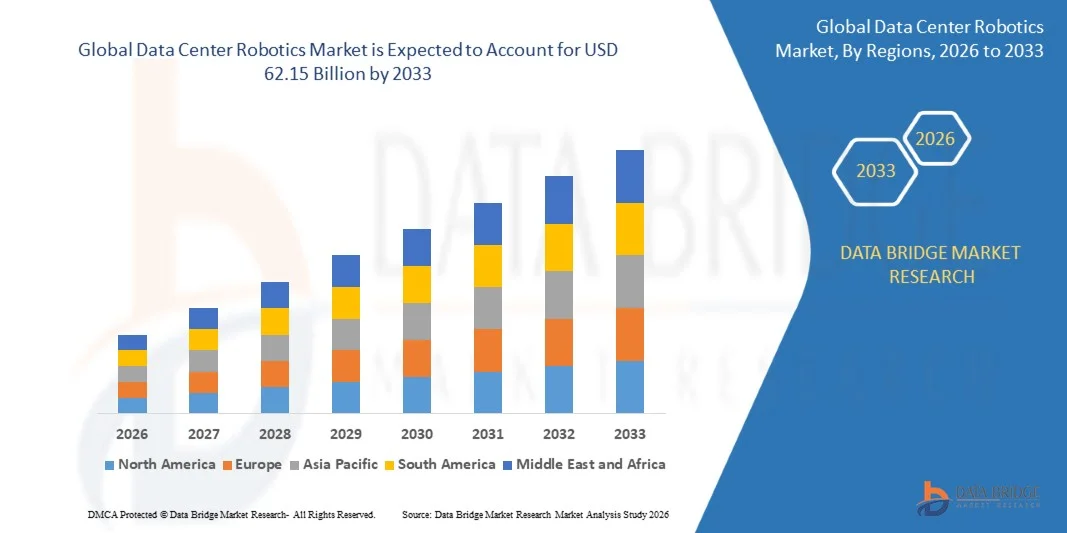
- As per Data Bridge Market Research analysis, the data center robotics market was valued at USD 13.50 billion in 2025 and is projected to reach USD 62.15 billion by 2033, growing at a CAGR of 21.03% from 2026 to 2033.
- The market is experiencing rapid growth driven by the increasing need for automation in data centers, expanding data center infrastructure, and the demand for improved productivity, reduced human labor, and enhanced operational efficiency. Robotics are increasingly being used for server maintenance, cable management, and environmental monitoring, helping reduce downtime and operational costs.
- The increasing complexity and scale of data center operations, combined with the rapid adoption of artificial intelligence (AI), machine learning, and Internet of Things (IoT) technologies, is accelerating the deployment of robotics for hardware management, real-time monitoring, predictive maintenance, cooling optimization, security surveillance, and asset management. The expansion of cloud computing, edge data centers, and 5G rollouts is further supporting the adoption of autonomous robotic solutions across data center environments.
Market Size & Forecast
- Global Market Value (2025): USD 13.50 Billion
- Expected Market Value (2033): USD 62.15 Billion
- Forecast CAGR (2026–2033): 21.03%
- Leading Region in 2025: North America
- Fastest Growing Region: Asia Pacific
What are the Major Takeaways of the Data Center Robotics Market?
- North America dominated the data center robotics market with the largest revenue share of 42.4% in 2025, supported by the presence of major data center operators, increasing investment in automation, and growing demand for reliable and efficient data center operations.
- Asia-Pacific is expected to be the fastest-growing region at a CAGR of 24.7% from 2026 to 2033, fueled by rapid digital transformation, rising adoption of cloud, artificial intelligence and Internet of Things technologies, and increasing demand for scalable and efficient data center operations.
- The hardware segment led the market with a 48% share in 2025, driven by increasing deployment of autonomous mobile robots, robotic arms, sensors, cameras, navigation systems, and inspection equipment across data center facilities
- Software is the fastest-growing component type, projected to register a CAGR of 32%, reflecting the surge in demand for AI-powered robotic control, autonomous navigation, predictive analytics, remote monitoring, and centralized fleet management strengthens software adoption.
- The on-premises segment dominated the deployment category with a 55% revenue share in 2025, led by the need for direct control over robotic systems, operational data, security, and critical infrastructure.
- Autonomous mobile robots accounted for 30% of the market share in 2025, preferred by their ability to navigate data center environments autonomously and perform inspection, monitoring, equipment transportation, inventory management, and security activities
- The maintenance and repair segment is the fastest-growing application category, with a CAGR of 27.5%, driven by increasing automation requirements in modern data centers, where server racks are becoming heavier, denser, and more complex.
Report Scope and Data Center Robotics Market Segmentation
|
Attributes |
Data Center Robotics Key Market Insights |
|
Segments Covered |
|
|
Countries Covered |
North America
Europe
Asia-Pacific
Middle East and Africa
South America
|
|
Key Market Players |
|
|
Market Opportunities |
|
|
Value Added Data Infosets |
In addition to the market insights such as market value, growth rate, market segments, geographical coverage, market players, and market scenario, the market report curated by the Data Bridge Market Research team includes in-depth expert analysis, import/export analysis, pricing analysis, production consumption analysis, and pestle analysis. |
What is the Key Trend in the Data Center Robotics Market?
- AI-powered and autonomous robotics are increasingly being integrated into data center operations to automate inspection, maintenance, security surveillance, asset tracking, and environmental monitoring while reducing human intervention and improving operational efficiency.
- For instance, in May 2025, ASUS highlighted Foxlink’s AI-powered intelligent surveillance robot, developed using the NVIDIA Jetson AGX Orin platform, for 24/7 monitoring, safety inspections, and real-time detection of unauthorized access and operational anomalies at data center facilities.
- Robotic systems increasingly combine artificial intelligence, machine learning, sensors, computer vision, and autonomous navigation to provide continuous monitoring and enable predictive identification of equipment and facility-related issues.
- Cloud-based robotic management and remote operations are gaining importance as data center operators seek centralized monitoring, predictive maintenance, performance optimization, and robotic control across distributed facilities.
- For instance, in June 2025, Boost Robotics introduced autonomous mobile manipulation robots designed specifically for data centers, enabling remote inspection, physical interaction with infrastructure, 24/7 security monitoring, inventory management, and remote resolution of operational issues.
- As hyperscale, edge, and AI-driven data centers continue expanding, the integration of autonomous robotics with AI and cloud-based management platforms is expected to accelerate, making robotic automation an increasingly important component of modern data center operations.
What are the Key Drivers of the Data Center Robotics Market?
- The rapid expansion of hyperscale, cloud, and AI data centers has significantly increased demand for robotics capable of automating server maintenance, cable management, environmental monitoring, inspection, and physical security across increasingly complex facilities.
- For instance, in November 2024, Microsoft Research published an article, demonstrating robots capable of performing network maintenance tasks such as reseating and cleaning optical transceivers and replacing optical fiber cables, with the objective of reducing service windows, costs, and downtime as data center infrastructure expands
- Data center operators, cloud providers, and technology companies are increasingly deploying robotic systems to improve productivity, reduce human labor, minimize errors, and enhance operational reliability across mission-critical facilities.
- For instance, in February 2025, Submer announced the development of its ADA autonomous robot to automate the installation and removal of servers from immersion-cooling tanks, addressing the operational complexity of vertically handling servers and reducing dependence on cranes and manual intervention.
- With data centers becoming larger, more distributed, and increasingly critical to AI and cloud infrastructure, robotics will remain essential for improving uptime, automating repetitive operations, and addressing labor and operational efficiency requirements.
Which Factors are Challenging the Growth of the Data Center Robotics Market?
- High initial capital investment and implementation complexity remain major barriers to data center robotics adoption, particularly for smaller operators and facilities with limited capital budgets.
- For instance, in September 2025, Forrester highlighted that data center robotics must be thoroughly tested and highly reliable before integration because robots need to operate alongside existing infrastructure and systems; the article noted that seamless interoperability remains critical, creating challenges for widespread deployment
- The costs of robotic hardware, sensors, artificial intelligence integration, system integration, staff training, and facility modifications can substantially increase the overall deployment expenditure.
- Legacy data centers create an additional challenge because many brownfield facilities were not designed for robotic navigation and require specialized modifications to accommodate autonomous systems.
- For instance, in January 2026, Data Center Frontier reported that robotics deployment requires data centers to become more standardized and robot-ready, with existing environments presenting challenges related to complex infrastructure, integration, and operational reliability; the article emphasized that robotic systems are increasingly being introduced through phased deployments rather than immediate full automation.
- The combination of high upfront expenditure, integration complexity, infrastructure modification, training requirements, and potential operational downtime continues to limit robotics adoption among smaller and legacy data center operators despite growing automation demand.
How is the Data Center Robotics Market Segmented?
The data center robotics market is segmented on the basis of component, deployment, robot type, application, and end user.
- By Component
On the basis of component, the data center robotics market is segmented into hardware, software, and services. The hardware segment dominated the market with 48% share in 2025, owing to increasing deployment of autonomous mobile robots, robotic arms, sensors, cameras, navigation systems, and inspection equipment across data center facilities. Hardware forms the foundation for inspection, material handling, equipment management, and security operations. Increasing investments in hyperscale and large-scale data centers are supporting demand for advanced robotic hardware. Integration of artificial intelligence, computer vision, sensors, and autonomous navigation is further improving robotic capabilities. However, high hardware costs and infrastructure requirements can limit adoption among smaller operators. The growing need to automate physical data center operations continues to support the dominance of hardware.
The software segment is projected to witness the fastest growth at a CAGR of 32% during forecast period, as increasing demand for AI-powered robotic control, autonomous navigation, predictive analytics, remote monitoring, and centralized fleet management strengthens software adoption. Software enables robots to interpret sensor information and respond to changing operating conditions. Artificial intelligence and machine learning capabilities allow robotic systems to identify anomalies and support predictive maintenance. Cloud-based platforms can also enable centralized management of robotic fleets across multiple facilities. Increasing integration between robotics, data center infrastructure management, and analytics platforms is strengthening software demand. As data centers move toward greater automation and autonomous operations, software is becoming increasingly important to overall robotic performance.
- By Deployment
On the basis of deployment, the data center robotics market is segmented into cloud-based and on-premises. The on-premises segment dominated the market with 55% share in 2025, supported by the need for direct control over robotic systems, operational data, security, and critical infrastructure. On-premises deployment enables organizations to maintain robotic management systems within their own facilities and integrate them with existing operational technology. This model is particularly relevant for mission-critical data centers where data security, low latency, and operational control are important considerations. It also enables organizations to customize robotic systems according to facility-specific requirements. However, on-premises deployment requires greater investment in infrastructure, maintenance, and technical resources. The need for secure and controlled management of critical data center operations continues to support this deployment model.
The cloud-based segment is projected to register the fastest growth at a CAGR of 35% during forecast period, driven by increasing demand for remote monitoring, centralized fleet management, analytics, and scalable robotic operations. Cloud platforms enable operators to monitor robotic systems across geographically distributed data centers from centralized locations. They can facilitate software updates, performance analysis, predictive maintenance, and integration with artificial intelligence systems. Cloud connectivity also allows organizations to expand robotic deployments without establishing separate management infrastructure at every facility. The expansion of edge and distributed data centers is further increasing the importance of centralized robotic management. Growing adoption of remote and autonomous data center operations is expected to accelerate cloud-based deployment.
- By Robot Type
On the basis of robot type, the data center robotics market is segmented into collaborative robots, industrial robots, service robots, autonomous mobile robots, automated guided vehicles, robotic arms, and drones. The autonomous mobile robots segment dominated the market with a 30% share in 2025, supported by their ability to navigate data center environments autonomously and perform inspection, monitoring, equipment transportation, inventory management, and security activities. AMRs can move between racks, equipment areas, and operational zones without requiring fixed tracks. Integration of cameras, thermal sensors, computer vision, and artificial intelligence is expanding their capabilities. These robots can operate continuously and reduce the need for personnel to perform repetitive monitoring activities. Their flexibility and autonomous navigation capabilities make them highly suitable for large and complex data center environments.
The service robots segment is projected to register the fastest growth at a CAGR of 28.5% during forecast period, driven by increasing demand for automated inspection, maintenance, security, monitoring, and other operational services within data center facilities. Service robots can perform repetitive and routine activities while reducing the need for continuous human intervention. Integration of artificial intelligence, sensors, cameras, and autonomous navigation is improving their ability to operate in complex data center environments. These robots can support equipment inspection, environmental monitoring, security surveillance, and maintenance-related activities. The growing complexity and scale of modern data centers is increasing the need for continuous and automated operational support. As operators focus on improving uptime, safety, and workforce efficiency, demand for service robots is expected to accelerate.
- By Application
On the basis of application, the data center robotics market is segmented into inspection & monitoring, material handling, inventory management, monitoring and surveillance, maintenance and repair, equipment handling, cable management, temperature monitoring, and physical security. The inspection & monitoring segment dominated the market with a 28% share in 2025, owing to the increasing requirement for continuous monitoring of servers, racks, cables, cooling systems, and other critical infrastructure. Robotic systems can conduct routine inspections while collecting information through cameras, sensors, and thermal imaging technologies. Automated inspection reduces the need for personnel to repeatedly access difficult-to-reach areas. Robots can also identify abnormal temperatures, equipment conditions, water leaks, and other potential operational issues. Integration of inspection robotics with predictive maintenance platforms can support early detection of failures. The increasing emphasis on uptime, reliability, and operational efficiency continues to support demand for robotic inspection and monitoring.
The maintenance and repair application is projected to experience the fastest growth at 27.5% CAGR from 2026 to 2033. Growth is being driven by increasing automation requirements in modern data centers, where server racks are becoming heavier, denser, and more complex. High-power AI accelerators are increasing the physical handling requirements associated with modern computing infrastructure. Robotics can assist with equipment handling, server replacement, component movement, and infrastructure deployment. Automated handling can also reduce manual handling risks while improving precision and operational speed. Increasing deployment of AI-ready infrastructure is therefore creating stronger demand for robotic handling and maintenance solutions.
- By End User
On the basis of end user, the data center robotics market is segmented into IT & telecom, BFSI, healthcare, education, government, retail & e-commerce, and others. The IT & telecom segment dominated the market with a 45% share in 2025, supported by the extensive data center infrastructure operated by cloud service providers and technology organizations. These facilities require continuous equipment monitoring, maintenance, security, and asset management to maintain high availability. Robotics can automate repetitive physical activities and improve operational visibility across large facilities. The continued expansion of cloud computing and AI infrastructure is increasing the scale and complexity of IT infrastructure. Hyperscale operators are increasingly looking for automated solutions to manage large physical data center environments. The need for high availability, operational efficiency, and reduced dependence on manual labor continues to strengthen robotics adoption across IT and cloud facilities.
The retail & e-commerce segment is projected to register the fastest growth at a CAGR of 27.5% during forecast period, driven by the rapid expansion of e-commerce platforms, digital retail infrastructure, online transactions, and cloud-based applications. Retail and e-commerce companies increasingly depend on data centers to support websites, payment processing, customer databases, inventory platforms, and real-time order management. Robotics can support automated monitoring, equipment inspection, inventory-related data center operations, and physical security. The increasing volume of digital transactions is generating greater requirements for reliable and continuously available computing infrastructure. Expansion of online retail and omnichannel commerce is further increasing investment in digital infrastructure. Consequently, growing dependence on data-intensive retail platforms is expected to accelerate adoption of robotics within retail and e-commerce data center environments.
Which Region Holds the Largest Share of the Data Center Robotics Market?
- North America dominated the data center robotics market with the largest revenue share of 42.4% in 2025, supported by the presence of major data center operators, increasing investment in automation, and growing demand for reliable and efficient data center operations.
- The region also benefits from rapid adoption of artificial intelligence, cloud computing, and autonomous robotics, along with strong investments in data center expansion and advanced infrastructure. The growing requirement for automated inspection, monitoring, maintenance, security, and equipment handling is encouraging operators to integrate robotics into data center operations. Increasing deployment of hyperscale and AI-focused facilities across the U.S. is expected to further strengthen North America's leadership in the global data center robotics market
U.S. Data Center Robotics Market Insight
The U.S. data center robotics market is witnessing strong growth due to rapid expansion of hyperscale, cloud, and AI-focused data center infrastructure, increasing demand for automation, and the need to improve operational efficiency. The country’s mature data center ecosystem and concentration of major technology companies are creating strong demand for robotic inspection, monitoring, maintenance, security, and equipment handling. Increasing AI workloads are also raising infrastructure density and operational complexity, strengthening the requirement for automated solutions. In addition, extremely low vacancy and strong preleasing activity are encouraging operators to maximize the efficiency of existing and newly developed facilities. The continued expansion of large-scale data center capacity is therefore supporting the adoption of autonomous robotic technologies. Northern Virginia recorded 1,102 MW of net data center absorption, a 144% increase from 2024, while total inventory expanded to 4,039.6 MW, demonstrating the scale and rapid expansion of U.S. data center infrastructure.
Asia-Pacific Data Center Robotics Market Insight
The Asia-Pacific data center robotics market is expected to witness rapid growth, driven by expanding hyperscale infrastructure, increasing cloud adoption, AI workloads, and strong demand for new data center capacity across major Asian economies. The region is experiencing increasing investment in digital infrastructure as organizations require greater computing capacity and reliable data processing services. Growing deployment of AI infrastructure is also increasing power density and operational complexity within data centers. These developments are creating opportunities for robotic solutions supporting inspection, monitoring, equipment handling, maintenance, and security. Increasing hyperscaler commitments are further strengthening the regional data center development pipeline. The combination of rapid infrastructure expansion and increasing operational requirements is expected to accelerate robotics adoption across Asia-Pacific. JLL reported in March 2026 that Asia Pacific is expected to deliver 4.8 GW of new data center supply by 2027, with 78% of this capacity already preleased, demonstrating strong underlying demand for regional data center infrastructure.
Japan Data Center Robotics Market Insight
The Japan data center robotics market is witnessing consistent growth due to increasing AI utilization, expanding digital infrastructure, and continued investment in advanced data center facilities. Japan has a mature data center ecosystem supported by strong connectivity, technological capabilities, and demand from cloud and digital service providers. Increasing AI workloads are creating requirements for higher-capacity facilities and more sophisticated infrastructure management. Robotics can support automated inspection, equipment monitoring, security surveillance, and maintenance activities across these increasingly complex environments. Development beyond the established Tokyo and Osaka markets is also creating new opportunities for automation technologies. Increasing power and capacity requirements are expected to strengthen demand for efficient robotic operations.
China Data Center Robotics Market Insight
The China data center robotics market is growing rapidly, driven by accelerating digital infrastructure development, increasing AI adoption, and government-supported expansion of computing capacity. The country is investing heavily in data infrastructure to support cloud computing, artificial intelligence, digital services, and data-intensive applications. Increasing data center capacity is creating greater requirements for automated inspection, environmental monitoring, equipment management, and physical security. The expansion of computing infrastructure across different regions is also increasing the need for scalable and remotely managed operational technologies. Government initiatives supporting national computing infrastructure are further encouraging data center development. These trends are creating a favorable environment for the deployment of robotic solutions across Chinese data center facilities. Chinese government reported that by the end of the third quarter of 2024, the total number of data center racks in use exceeded 2.11 million, representing year-on-year growth of more than 100%, demonstrating the rapid expansion of the country's data infrastructure.
U.K. Data Center Robotics Market Insight
The U.K. data center robotics market is experiencing steady growth, supported by increasing hyperscaler demand, AI workloads, cloud adoption, and continued expansion of London’s data center ecosystem. The country’s established digital infrastructure and concentration of major data center operators are supporting investment in automated facility management technologies. Increasing computing density is creating greater requirements for continuous monitoring, maintenance, security, and equipment handling. Robotics can help operators automate repetitive physical activities while improving operational visibility and facility efficiency. The growing importance of AI infrastructure is further increasing demand for reliable and scalable data center capacity. Continued expansion of hyperscale and AI-related infrastructure is therefore expected to support robotics adoption across the U.K. The CBRE projected London data center take-up to reach a record 183 MW in 2025, representing a 58% increase from 2024, with hyperscalers and AI providers driving a significant portion of demand.
Germany Data Center Robotics Market Insight
The Germany data center robotics market is expanding steadily due to increasing data center capacity, strong cloud demand, and growing requirements from AI and digital services. Frankfurt is one of Europe’s major data center hubs and provides a substantial installed infrastructure base for automation and robotics technologies. Increasing computing density is creating greater requirements for equipment monitoring, preventive maintenance, energy management, and physical security. Robotic systems can support continuous inspection and repetitive operational activities while reducing dependence on manual intervention. Continued investment by data center operators is also expanding the availability of modern facilities suitable for advanced automation. Growing AI and cloud workloads are expected to further strengthen demand for robotic solutions in German data centers. In March 2025, Digital Realty opened its FRA18 data center in Frankfurt with 16 MW of power, demonstrating continued investment in new German data center capacity and creating additional infrastructure where automated monitoring and operational technologies can be deployed.
Which are the Top Companies in Data Center Robotics Market?
The data center robotics industry is primarily led by well-established companies, including:
- Microsoft Corporation (U.S.)
- NTT DATA Group Corporation (Japan)
- ABB (Switzerland)
- Siemens (Germany)
- Rockwell Automation, Inc. (U.S.)
- Honeywell International Inc. (U.S.)
- Cisco Systems, Inc. (U.S.)
- Hewlett Packard Enterprise Development LP (U.S.)
- Huawei Technologies Co., Ltd. (China)
- Amazon.com, Inc. (U.S.)
- NVIDIA Corporation (U.S.)
- OMRON Corporation (Japan)
- Schneider Electric (France)
- FANUC America Corporation (U.S.)
- Equinix, Inc. (U.S.)
- Digital Realty Trust (U.S.)
- Grenzebach Data Center Solutions (U.S.)
- Datum Robotics (U.S.)
- FiberSmart Robotics (U.S.)
- Powerman (U.S.)
What are Latest Developments in Data Center Robotics Market?
- In June 2025, Boost Robotics launched its autonomous mobile manipulation robots specifically for data center inspection and maintenance. The robots are designed to inspect and physically interact with data center infrastructure, enabling operators to automate tasks that traditionally require technicians to be physically present. The product combines autonomous mobility with robotic manipulation for applications including inspection and maintenance of data center equipment.
- In February 2025, Submer announced its ADA autonomous robot for immersion-cooled data centers, designed to automate the installation and removal of servers from immersion-cooling tanks. The robot addresses the physical challenges of vertically handling servers and is intended to reduce manual intervention in high-density data center environments. The development represents a product-focused application of robotics for automated server handling and immersion-cooling operations.
- In November 2024, Digital Edge highlighted the deployment and development of robotics for data center operations, including autonomous security, maintenance, cleaning, and drone-based inspection applications. The company described robotics as an emerging technology area capable of supporting physical security, equipment monitoring, and facility operations across its data center portfolio.
- In November 2024, Microsoft Research demonstrated its self-maintaining data center robotics technology, featuring dexterous modular robots capable of autonomously manipulating optical transceivers and cables and performing optical-fiber cleaning and installation. Microsoft Research is developing the technology with the broader objective of enabling self-maintaining data centers through robotics, artificial intelligence, and automation
- In December 2022, NTT DATA announced the introduction of a customized data center inspection robot following a successful trial at its Shinagawa Data Center in Tokyo. The robot was equipped with a 4K camera, thermal camera, microphone, and sensors for detecting humidity, temperature, and substances in the air. NTT DATA planned to introduce the robotic system across 15 data centers in Japan beginning in April 2023, demonstrating the transition from testing to planned commercial-scale deployment.

- Interactive Data Analysis Dashboard
- Company Analysis Dashboard for high growth potential opportunities
- Research Analyst Access for customization & queries
- Competitor Analysis with Interactive dashboard
- Latest News, Updates & Trend analysis
- Harness the Power of Benchmark Analysis for Comprehensive Competitor Tracking
Data collection and base year analysis are done using data collection modules with large sample sizes. The stage includes obtaining market information or related data through various sources and strategies. It includes examining and planning all the data acquired from the past in advance. It likewise envelops the examination of information inconsistencies seen across different information sources. The market data is analysed and estimated using market statistical and coherent models. Also, market share analysis and key trend analysis are the major success factors in the market report. To know more, please request an analyst call or drop down your inquiry.
The key research methodology used by DBMR research team is data triangulation which involves data mining, analysis of the impact of data variables on the market and primary (industry expert) validation. Data models include Vendor Positioning Grid, Market Time Line Analysis, Market Overview and Guide, Company Positioning Grid, Patent Analysis, Pricing Analysis, Company Market Share Analysis, Standards of Measurement, Global versus Regional and Vendor Share Analysis. To know more about the research methodology, drop in an inquiry to speak to our industry experts.
Data Bridge Market Research is a leader in advanced formative research. We take pride in servicing our existing and new customers with data and analysis that match and suits their goal. The report can be customized to include price trend analysis of target brands understanding the market for additional countries (ask for the list of countries), clinical trial results data, literature review, refurbished market and product base analysis. Market analysis of target competitors can be analyzed from technology-based analysis to market portfolio strategies. We can add as many competitors that you require data about in the format and data style you are looking for. Our team of analysts can also provide you data in crude raw excel files pivot tables (Fact book) or can assist you in creating presentations from the data sets available in the report.













