


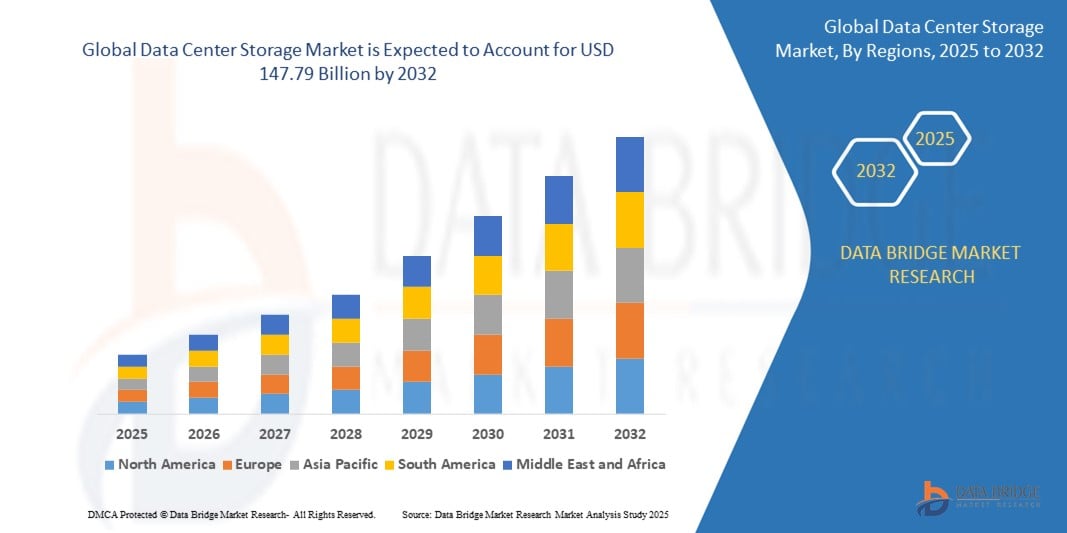
Data Center Storage Market Size
- The global data center storage market was valued at USD 61.61 billion in 2024 and is expected to reach USD 147.79 billion by 2032, at a CAGR of 11.49% during the forecast period
- This growth is fueled by factors such as the rising volume of data generated by businesses, advancements in storage technologies, and the increasing adoption of digital transformation across industries
Data Center Storage Market Analysis
- Data center storage solutions are vital for managing and storing large volumes of data in modern data centers, providing high-capacity, high-speed storage systems that support the demands of cloud computing, big data analytics, and enterprise applications
- The demand for data center storage is primarily driven by the growing volume of data generated by businesses, the rapid adoption of cloud services, and advancements in storage technologies such as solid-state drives (SSDs) and software-defined storage (SDS). Over half of the global demand for data center storage is driven by the growing need for cloud-based storage services, with the highest demand in regions undergoing digital transformation
- North America is expected to dominate the data center storage market with the largest market share of 40.1% due to high adoption of cloud services
- Asia-Pacific is expected to be the fastest growing region in the data center storage market during the forecast period due to rising awareness about eye health
- IT & Telecommunications segment is expected to dominate the market with a market share of 23.9% due to the swift growth of cloud computing, 5G networks, and AI-powered applications
Report Scope and Data Center Storage Market Segmentation
|
Attributes |
Data Center Storage Key Market Insights |
|
Segments Covered |
|
|
Countries Covered |
North America
Europe
Asia-Pacific
Middle East and Africa
South America
|
|
Key Market Players |
|
|
Market Opportunities |
|
|
Value Added Data Infosets |
In addition to the market insights such as market value, growth rate, market segments, geographical coverage, market players, and market scenario, the market report curated by the Data Bridge Market Research team includes in-depth expert analysis, import/export analysis, pricing analysis, production consumption analysis, and pestle analysis. |
Data Center Storage Market Trends
"Increasing Adoption of Software-Defined Storage (SDS) and Cloud Integration"
- One prominent trend in the global data center storage market is the growing adoption of software-defined storage (SDS) and cloud integration
- These advanced solutions offer greater scalability, flexibility, and cost-efficiency by decoupling storage management from hardware, enabling businesses to manage vast amounts of data with increased agility
- For instance, SDS allows organizations to easily scale their storage infrastructure to meet growing data demands, while cloud integration enables seamless access to off-site storage, facilitating data backup, disaster recovery, and global accessibility
- Cloud integration also enhances collaboration and data sharing across geographies, driving the adoption of hybrid and multi-cloud environments, which is becoming increasingly common in modern data centers
- This trend is transforming the way data is stored and managed, supporting the rapid growth of cloud services, big data analytics, and digital transformation across industries
Data Center Storage Market Dynamics
Driver
"Growing Need Due to the Surge in Data Generation"
- The increasing volume of data generated by businesses, cloud services, and emerging technologies such as IoT, AI, and big data analytics is significantly driving the demand for data center storage solutions
- As industries across the globe undergo digital transformation, the need for high-capacity, scalable, and high-performance storage systems to manage this massive data influx continues to grow
- Cloud computing, in particular, is one of the largest contributors to this data explosion, as more businesses move to cloud environments to store, manage, and analyze their data
- The ongoing advancements in storage technologies, such as the development of software-defined storage (SDS) and NVMe-based solutions, further highlight the need for cutting-edge storage infrastructure to support complex workloads and ensure efficient data management
- As businesses, governments, and individuals create more data, the demand for reliable and scalable storage solutions increases, ensuring data availability, security, and faster access to critical information
For instance,
- In April 2022, according to a report by Statista, the global data volume is expected to reach 175 zettabytes by 2025, further fueling the demand for advanced data center storage technologies to manage and store these massive datasets
- In August 2021, a study by IDC projected that by 2025, the total amount of data stored in the global data centers will grow significantly, further driving the need for efficient, scalable storage solutions to accommodate this expanding data landscape
- As a result of the surge in data generation, driven by digital transformation and the increasing reliance on cloud-based services, there is a significant rise in demand for data center storage solutions
Opportunity
"Advancing Data Management with Artificial Intelligence Integration"
- AI-powered data center storage solutions are enhancing data management capabilities by automating storage allocation, optimizing data retrieval, and improving predictive maintenance. These AI-driven technologies enable data centers to handle massive amounts of data more efficiently and cost-effectively
- AI algorithms can analyze usage patterns, predict storage requirements, and provide real-time insights, helping organizations optimize storage resources and ensure that critical data is always available when needed
- Additionally, AI can assist in anomaly detection, enabling data centers to identify potential security threats or hardware failures before they disrupt operations, thereby improving system reliability and reducing downtime
- The integration of AI in data center storage solutions also leads to enhanced operational efficiency, improved data security, and lower overall infrastructure costs. By leveraging AI-driven technologies, data centers can better manage storage assets, reduce risks, and ensure continuous, high-performance data access
Restraint/Challenge
"High Equipment and Infrastructure Costs Hindering Market Penetration"
- The high cost of data center storage solutions remains a significant challenge, especially for small and mid-sized businesses (SMBs) or organizations in developing regions with limited budgets
- Advanced storage technologies, including high-performance SSDs, software-defined storage (SDS), and hybrid storage solutions, often come with substantial upfront investment costs that can deter organizations from upgrading their infrastructure or adopting newer technologies
- This financial barrier can lead to a reliance on older, less efficient storage systems, limiting access to the latest innovations in data management and hindering overall growth in the market
For instance,
- In June 2024, according to a report published by Data Center Knowledge, one of the primary concerns surrounding the high cost of data center infrastructure is its potential impact on business scalability and long-term operational efficiency. The initial investment in high-performance storage systems can often exceed the budgets of smaller businesses, preventing them from adopting cutting-edge technologies
- Consequently, such limitations may result in disparities in data management capabilities between large enterprises and SMBs, ultimately hindering broader adoption and growth in the global data center storage market
Data Center Storage Market Scope
The market is segmented on the basis of deployment, application, and storage type
|
Segmentation |
Sub-Segmentation |
|
By Deployment |
|
|
By Application |
|
|
By Storage Type |
|
In 2025, the IT and telecommunications is projected to dominate the market with a largest share in application segment
The IT and telecommunications segment is expected to dominate the data center storage market with the largest share of 23.9% in 2025. This dominance is attributed to the segment’s heavy reliance on large-scale data processing, storage, and management solutions. The rapid expansion of cloud computing, 5G infrastructure, and AI-driven applications has significantly increased the demand for high-capacity, efficient, and scalable storage systems. Additionally, the growing need for real-time data access, network optimization, and enhanced customer experiences further accelerates storage adoption within this sector.
The Storage Area Network (SAN) System is expected to account for the largest share during the forecast period in deployment segment
In 2025, the Storage Area Network (SAN) System segment is expected to dominate the data center storage market with the largest market share of 17.8%. This dominance is driven by SAN systems' ability to deliver high-speed, reliable, and scalable data storage solutions, which are critical for supporting enterprise workloads and mission-critical applications. The increasing adoption of virtualization, cloud services, and big data analytics across industries is fueling the demand for SAN systems, as they offer enhanced data management, centralized storage, and improved network performance. Additionally, advancements in storage technologies and the need for efficient disaster recovery solutions further bolster the growth of the SAN system segment.
Data Center Storage Market Regional Analysis
“North America is the Dominant Region in the Data Center Storage Market”
- North America dominates the global data center storage market with the largest market share of 40.1%, driven by advanced IT infrastructure, high adoption of cloud services, and a strong presence of leading market players
- The U.S. holds a significant share of 30.5% due to the growing demand for high-performance storage solutions, the expansion of data centers, and continuous advancements in storage technologies such as NVMe and software-defined storage (SDS)
- The availability of robust data security regulations, established cloud service providers, and substantial investments in technology by major companies further strengthen the market
- Additionally, the increasing adoption of big data analytics, artificial intelligence, and IoT is fueling the demand for scalable and efficient storage systems across the region
“Asia-Pacific is Projected to Register the Highest Growth Rate”
- The Asia-Pacific region is expected to witness the highest growth rate in the data center storage market, driven by rapid expansion in digital infrastructure, increasing data generation, and rising cloud adoption
- Countries such as China, India, and Japan are emerging as key markets due to rapid urbanization, increasing internet penetration, and significant investments in data center infrastructure
- Japan, with its advanced technology infrastructure and high demand for reliable storage solutions, remains a crucial market for data center storage providers. The country continues to lead in the adoption of high-capacity and high-performance storage systems to support its digital transformation
- China and India, with their large and growing populations, are seeing increased government investments and private sector growth in data storage and cloud services. The expanding presence of global IT giants and the need for data localization are further contributing to market growth across the region
Data Center Storage Market Share
The market competitive landscape provides details by competitor. Details included are company overview, company financials, revenue generated, market potential, investment in research and development, new market initiatives, global presence, production sites and facilities, production capacities, company strengths and weaknesses, product launch, product width and breadth, application dominance. The above data points provided are only related to the companies' focus related to market.
The Major Market Leaders Operating in the Market Are:
- Dell Technologies (U.S.)
- Hewlett Packard Enterprise (U.S.)
- IBM Corporation (U.S.)
- NetApp (U.S.)
- Hitachi Vantara (Japan)
- Huawei Technologies (China)
- Western Digital Corporation (U.S.)
- Seagate Technology (U.S.)
- Pure Storage (U.S.)
- Cisco Systems (U.S.)
Latest Developments in Global Data Center Storage Market
- In May 2023, Pure Storage Inc. broadened its flash-based storage portfolio with the introduction of FlashBlade//E, designed to address the approximately 80% of data stored on disk-based systems that is classified as non-primary or "cold." This innovative solution aims to improve both efficiency and cost-effectiveness within data center storage environments
- In April 2023, Microsoft furthered its global expansion by launching its first trusted cloud space in Poland, marking a pivotal milestone as the inaugural facility in Central and Eastern Europe. This strategic initiative is designed to enhance cloud accessibility and improve data services within the region
- In June 2022, Pure Storage Inc. established a research and development center in Bengaluru, with a strategic focus on advancing storage and data management solutions, including FlashArray, FlashBlade, FlashStack, and Pure as-a-Service
- In September 2020, INVITE Systems, an innovation-focused technology platform, partnered with Huawei to develop a highly reliable data center designed to meet the diverse requirements of enterprises. This collaboration underscores a unified effort to deliver robust and dependable infrastructure solutions for businesses within the technology sector
- In December 2022, Samsung Electronics announced the development of its 16-gigabit (Gb) DDR5 DRAM built with the industry's first 12-nanometer (nm)-class process technology and the completion of product compatibility testing with AMD

- Interactive Data Analysis Dashboard
- Company Analysis Dashboard for high growth potential opportunities
- Research Analyst Access for customization & queries
- Competitor Analysis with Interactive dashboard
- Latest News, Updates & Trend analysis
- Harness the Power of Benchmark Analysis for Comprehensive Competitor Tracking
Table of Content
1 INTRODUCTION
1.1 OBJECTIVES OF THE STUDY
1.2 MARKET DEFINITION
1.3 OVERVIEW OF GLOBAL DATA CENTER STORAGE MARKET
1.4 CURRENCY AND PRICING
1.5 LIMITATION
1.6 MARKETS COVERED
2 MARKET SEGMENTATION
2.1 KEY TAKEAWAYS
2.2 ARRIVING AT THE GLOBAL DATA CENTER STORAGE MARKET
2.2.1 VENDOR POSITIONING GRID
2.2.2 TECHNOLOGY LIFE LINE CURVE
2.2.3 MARKET GUIDE
2.2.4 COMAPANY MARKET SHARE ANALYSIS
2.2.5 MULTIVARIATE MODELLING
2.2.6 TOP TO BOTTOM ANALYSIS
2.2.7 STANDARDS OF MEASUREMENT
2.2.8 VENDOR SHARE ANALYSIS
2.2.9 DATA POINTS FROM KEY PRIMARY INTERVIEWS
2.2.10 DATA POINTS FROM KEY SECONDARY DATABASES
2.3 GLOBAL DATA CENTER STORAGE MARKET: RESEARCH SNAPSHOT
2.4 ASSUMPTIONS
3 MARKET OVERVIEW
3.1 DRIVERS
3.2 RESTRAINTS
3.3 OPPORTUNITIES
3.4 CHALLENGES
4 EXECUTIVE SUMMARY
5 PREMIUM INSIGHT
5.1 PORTERS FIVE FORCES
5.2 REGULATORY STANDARDS
5.3 TECHNOLOGICAL TRENDS
5.4 PATENT ANALYSIS
5.5 CASE STUDY
5.6 VALUE CHAIN ANALYSIS
5.7 COMPANY COMPARITIVE ANALYSIS
6 GLOBAL DATA CENTER STORAGE MARKET, BY STORAGE SYSTEM TYPE
6.1 OVERVIEW
6.2 DIRECT ATTACHED STORAGE (DAS)
6.3 NETWORK ATTACHED STORAGE (NAS)
6.3.1 BY PROTOCOLS
6.3.1.1. NETWORK FILE SYSTEM (NFS)
6.3.1.2. COMMON INTERNET FILE SYSTEM (CIFS)
6.3.1.3. FILE TRANSFER PROTOCOL (FTP)
6.3.1.4. HYPER TEXT TRANSFER PROTOCOL (HTTP)
6.3.1.5. OTHERS
6.4 STORAGE AREA NETWORK (SAN)
6.4.1 BY TYPE
6.4.1.1. FC-SAN
6.4.1.2. IP-SAN
7 GLOBAL DATA CENTER STORAGE MARKET, BY COMPONENT
7.1 OVERVIEW
7.2 HARDWARE
7.2.1 ROUTERS
7.2.2 SWITCHES
7.2.3 FIREWALLS
7.2.4 OTHERS
7.3 SOFTWARE
7.3.1 STORAGE MANAGEMENT SOFTWARE
7.3.2 BACKUP MANAGEMENT SOFTWARE
7.3.3 OTHERS
7.4 SERVICES
7.4.1 PROFESSIONAL SERVICES
7.4.1.1. CONSULTING
7.4.1.2. INTEGRATION
7.4.1.3. SUPPORT & MAINTENANCE
7.4.2 MANAGED SERVICES
8 GLOBAL DATA CENTER STORAGE MARKET, BY SYSTEM ARCHITECTURE
8.1 OVERVIEW
8.2 BLOCK STORAGE DEVICES
8.3 FILE STORAGE DEVICES
9 GLOBAL DATA CENTER STORAGE MARKET, BY STORAGE TECHNOLOGY
9.1 OVERVIEW
9.2 HARD DISK DRIVE (HDD)
9.3 SOLID STATE DRIVE (SSD)
9.4 HYBRID STORAGE
10 GLOBAL DATA CENTER STORAGE MARKET, BY DEPLOYMENT MODE
10.1 OVERVIEW
10.2 ON-PREMISES
10.3 CLOUD
11 GLOBAL DATA CENTER STORAGE MARKET, BY TYPE OF DATA CENTER
11.1 OVERVIEW
11.2 ENTERPRISE DATA CENTERS
11.3 MANAGED SERVICES DATA CENTERS
11.4 COLOCATION DATA CENTERS
11.5 CLOUD DATA CENTERS
11.6 EDGE DATA CENTERS
11.7 OTHERS
12 GLOBAL DATA CENTER STORAGE MARKET, BY TIER TYPE
12.1 OVERVIEW
12.2 TIER I
12.3 TIER II
12.4 TIER III
12.5 TIER IV
13 GLOBAL DATA CENTER STORAGE MARKET, BY DATA CENTER SIZE
13.1 OVERVIEW
13.2 MICRO DATA CENTER
13.3 SMALL DATA CENTERS
13.4 MID-SIZED DATA CENTERS
13.5 LARGE DATA CENTERS
14 GLOBAL DATA CENTER STORAGE MARKET, BY STORAGE TYPE
14.1 OVERVIEW
14.2 TRADITIONAL STORAGE
14.3 ALL-FLASH STORAGE
14.4 HYBRID STORAGE
15 GLOBAL DATA CENTER STORAGE MARKET, BY END USER
15.1 OVERVIEW
15.2 ENTERPRISE
15.2.1 BY SIZE,
15.2.1.1. SMALL & MEDIUM SIZE ENTERPRISE
15.2.1.2. LARGE SIZE ENTERPRISE
15.3 COLOCATION PROVIDERS
15.4 CLOUD PROVIDERS
16 GLOBAL DATA CENTER STORAGE MARKET, BY INDUSTRY
16.1 OVERVIEW
16.2 BANKING, FINANCIAL SERVICES AND INSURANCE (BFSI)
16.2.1 BY STORAGE SYSTEM TYPE
16.2.1.1. DIRECT ATTACHED STORAGE (DAS)
16.2.1.2. NETWORK ATTACHED STORAGE (NAS)
16.2.1.2.1. BY PROTOCOLS
16.2.1.2.1.1 NETWORK FILE SYSTEM (NFS)
16.2.1.2.1.2 COMMON INTERNET FILE SYSTEM (CIFS)
16.2.1.2.1.3 FILE TRANSFER PROTOCOL (FTP)
16.2.1.2.1.4 HYPER TEXT TRANSFER PROTOCOL (HTTP)
16.2.1.2.1.5 OTHERS
16.2.1.3. STORAGE AREA NETWORK (SAN)
16.2.1.3.1. BY TYPE
16.2.1.3.1.1 FC-SAN
16.2.1.3.1.2 IP-SAN
16.3 GOVERNMENT & DEFENSE
16.3.1 BY STORAGE SYSTEM TYPE
16.3.1.1. DIRECT ATTACHED STORAGE (DAS)
16.3.1.2. NETWORK ATTACHED STORAGE (NAS)
16.3.1.2.1. BY PROTOCOLS
16.3.1.2.1.1 NETWORK FILE SYSTEM (NFS)
16.3.1.2.1.2 COMMON INTERNET FILE SYSTEM (CIFS)
16.3.1.2.1.3 FILE TRANSFER PROTOCOL (FTP)
16.3.1.2.1.4 HYPER TEXT TRANSFER PROTOCOL (HTTP)
16.3.1.2.1.5 OTHERS
16.3.1.3. STORAGE AREA NETWORK (SAN)
16.3.1.3.1. BY TYPE
16.3.1.3.1.1 FC-SAN
16.3.1.3.1.2 IP-SAN
16.4 HEALTHCARE
16.4.1 BY STORAGE SYSTEM TYPE
16.4.1.1. DIRECT ATTACHED STORAGE (DAS)
16.4.1.2. NETWORK ATTACHED STORAGE (NAS)
16.4.1.2.1. BY PROTOCOLS
16.4.1.2.1.1 NETWORK FILE SYSTEM (NFS)
16.4.1.2.1.2 COMMON INTERNET FILE SYSTEM (CIFS)
16.4.1.2.1.3 FILE TRANSFER PROTOCOL (FTP)
16.4.1.2.1.4 HYPER TEXT TRANSFER PROTOCOL (HTTP)
16.4.1.2.1.5 OTHERS
16.4.1.3. STORAGE AREA NETWORK (SAN)
16.4.1.3.1. BY TYPE
16.4.1.3.1.1 FC-SAN
16.4.1.3.1.2 IP-SAN
16.5 MANUFACTURING
16.5.1 BY STORAGE SYSTEM TYPE
16.5.1.1. DIRECT ATTACHED STORAGE (DAS)
16.5.1.2. NETWORK ATTACHED STORAGE (NAS)
16.5.1.2.1. BY PROTOCOLS
16.5.1.2.1.1 NETWORK FILE SYSTEM (NFS)
16.5.1.2.1.2 COMMON INTERNET FILE SYSTEM (CIFS)
16.5.1.2.1.3 FILE TRANSFER PROTOCOL (FTP)
16.5.1.2.1.4 HYPER TEXT TRANSFER PROTOCOL (HTTP)
16.5.1.2.1.5 OTHERS
16.5.1.3. STORAGE AREA NETWORK (SAN)
16.5.1.3.1. BY TYPE
16.5.1.3.1.1 FC-SAN
16.5.1.3.1.2 IP-SAN
16.6 RETAIL
16.6.1 BY STORAGE SYSTEM TYPE
16.6.1.1. DIRECT ATTACHED STORAGE (DAS)
16.6.1.2. NETWORK ATTACHED STORAGE (NAS)
16.6.1.2.1. BY PROTOCOLS
16.6.1.2.1.1 NETWORK FILE SYSTEM (NFS)
16.6.1.2.1.2 COMMON INTERNET FILE SYSTEM (CIFS)
16.6.1.2.1.3 FILE TRANSFER PROTOCOL (FTP)
16.6.1.2.1.4 HYPER TEXT TRANSFER PROTOCOL (HTTP)
16.6.1.2.1.5 OTHERS
16.6.1.3. STORAGE AREA NETWORK (SAN)
16.6.1.3.1. BY TYPE
16.6.1.3.1.1 FC-SAN
16.6.1.3.1.2 IP-SAN
16.7 IT & TELECOM
16.7.1 BY STORAGE SYSTEM TYPE
16.7.1.1. DIRECT ATTACHED STORAGE (DAS)
16.7.1.2. NETWORK ATTACHED STORAGE (NAS)
16.7.1.2.1. BY PROTOCOLS
16.7.1.2.1.1 NETWORK FILE SYSTEM (NFS)
16.7.1.2.1.2 COMMON INTERNET FILE SYSTEM (CIFS)
16.7.1.2.1.3 FILE TRANSFER PROTOCOL (FTP)
16.7.1.2.1.4 HYPER TEXT TRANSFER PROTOCOL (HTTP)
16.7.1.2.1.5 OTHERS
16.7.1.3. STORAGE AREA NETWORK (SAN)
16.7.1.3.1. BY TYPE
16.7.1.3.1.1 FC-SAN
16.7.1.3.1.2 IP-SAN
16.8 MEDIA & ENTERTAINMENT
16.8.1 BY STORAGE SYSTEM TYPE
16.8.1.1. DIRECT ATTACHED STORAGE (DAS)
16.8.1.2. NETWORK ATTACHED STORAGE (NAS)
16.8.1.2.1. BY PROTOCOLS
16.8.1.2.1.1 NETWORK FILE SYSTEM (NFS)
16.8.1.2.1.2 COMMON INTERNET FILE SYSTEM (CIFS)
16.8.1.2.1.3 FILE TRANSFER PROTOCOL (FTP)
16.8.1.2.1.4 HYPER TEXT TRANSFER PROTOCOL (HTTP)
16.8.1.2.1.5 OTHERS
16.8.1.3. STORAGE AREA NETWORK (SAN)
16.8.1.3.1. BY TYPE
16.8.1.3.1.1 FC-SAN
16.8.1.3.1.2 IP-SAN
16.9 TRANSPORTATION & LOGISTICS
16.9.1 BY STORAGE SYSTEM TYPE
16.9.1.1. DIRECT ATTACHED STORAGE (DAS)
16.9.1.2. NETWORK ATTACHED STORAGE (NAS)
16.9.1.2.1. BY PROTOCOLS
16.9.1.2.1.1 NETWORK FILE SYSTEM (NFS)
16.9.1.2.1.2 COMMON INTERNET FILE SYSTEM (CIFS)
16.9.1.2.1.3 FILE TRANSFER PROTOCOL (FTP)
16.9.1.2.1.4 HYPER TEXT TRANSFER PROTOCOL (HTTP)
16.9.1.2.1.5 OTHERS
16.9.1.3. STORAGE AREA NETWORK (SAN)
16.9.1.3.1. BY TYPE
16.9.1.3.1.1 FC-SAN
16.9.1.3.1.2 IP-SAN
16.1 EDUCATION
16.10.1 BY STORAGE SYSTEM TYPE
16.10.1.1. DIRECT ATTACHED STORAGE (DAS)
16.10.1.2. NETWORK ATTACHED STORAGE (NAS)
16.10.1.2.1. BY PROTOCOLS
16.10.1.2.1.1 NETWORK FILE SYSTEM (NFS)
16.10.1.2.1.2 COMMON INTERNET FILE SYSTEM (CIFS)
16.10.1.2.1.3 FILE TRANSFER PROTOCOL (FTP)
16.10.1.2.1.4 HYPER TEXT TRANSFER PROTOCOL (HTTP)
16.10.1.2.1.5 OTHERS
16.10.1.3. STORAGE AREA NETWORK (SAN)
16.10.1.3.1. BY TYPE
16.10.1.3.1.1 FC-SAN
16.10.1.3.1.2 IP-SAN
16.11 OTHERS
17 GLOBAL DATA CENTER STORAGE MARKET, BY GEOGRAPHY
GLOBAL DATA CENTER STORAGE MARKET, (ALL SEGMENTATION PROVIDED ABOVE IS REPRESENTED IN THIS CHAPTER BY COUNTRY)
17.1 NORTH AMERICA
17.1.1 U.S.
17.1.2 CANADA
17.1.3 MEXICO
17.2 EUROPE
17.2.1 GERMANY
17.2.2 FRANCE
17.2.3 U.K.
17.2.4 ITALY
17.2.5 SPAIN
17.2.6 RUSSIA
17.2.7 TURKEY
17.2.8 BELGIUM
17.2.9 NETHERLANDS
17.2.10 NORWAY
17.2.11 FINLAND
17.2.12 SWITZERLAND
17.2.13 DENMARK
17.2.14 SWEDEN
17.2.15 POLAND
17.2.16 REST OF EUROPE
17.3 ASIA PACIFIC
17.3.1 JAPAN
17.3.2 CHINA
17.3.3 SOUTH KOREA
17.3.4 INDIA
17.3.5 AUSTRALIA
17.3.6 NEW ZEALAND
17.3.7 SINGAPORE
17.3.8 THAILAND
17.3.9 MALAYSIA
17.3.10 INDONESIA
17.3.11 PHILIPPINES
17.3.12 TAIWAN
17.3.13 VIETNAM
17.3.14 REST OF ASIA PACIFIC
17.4 SOUTH AMERICA
17.4.1 BRAZIL
17.4.2 ARGENTINA
17.4.3 REST OF SOUTH AMERICA
17.5 MIDDLE EAST AND AFRICA
17.5.1 SOUTH AFRICA
17.5.2 EGYPT
17.5.3 SAUDI ARABIA
17.5.4 U.A.E
17.5.5 OMAN
17.5.6 BAHRAIN
17.5.7 ISRAEL
17.5.8 KUWAIT
17.5.9 QATAR
17.5.10 REST OF MIDDLE EAST AND AFRICA
17.6 KEY PRIMARY INSIGHTS: BY MAJOR COUNTRIES
18 GLOBAL DATA CENTER STORAGE MARKET,COMPANY LANDSCAPE
18.1 COMPANY SHARE ANALYSIS: GLOBAL
18.2 COMPANY SHARE ANALYSIS: NORTH AMERICA
18.3 COMPANY SHARE ANALYSIS: EUROPE
18.4 COMPANY SHARE ANALYSIS: ASIA PACIFIC
18.5 MERGERS & ACQUISITIONS
18.6 NEW PRODUCT DEVELOPMENT AND APPROVALS
18.7 EXPANSIONS
18.8 REGULATORY CHANGES
18.9 PARTNERSHIP AND OTHER STRATEGIC DEVELOPMENTS
19 GLOBAL DATA CENTER STORAGE MARKET, SWOT & DBMR ANALYSIS
20 GLOBAL DATA CENTER STORAGE MARKET, COMPANY PROFILE
20.1 T-SYSTEMS INTERNATIONAL GMBH(A PART OF DEUTSCHE TELEKOM)
20.1.1 COMPANY SNAPSHOT
20.1.2 REVENUE ANALYSIS
20.1.3 PRODUCT PORTFOLIO
20.1.4 RECENT DEVELOPMENT
20.2 CISCO SYSTEMS, INC.
20.2.1 COMPANY SNAPSHOT
20.2.2 REVENUE ANALYSIS
20.2.3 PRODUCT PORTFOLIO
20.2.4 RECENT DEVELOPMENT
20.3 HYPERTEC GROUP INC
20.3.1 COMPANY SNAPSHOT
20.3.2 REVENUE ANALYSIS
20.3.3 PRODUCT PORTFOLIO
20.3.4 RECENT DEVELOPMENT
20.4 WESTERN DIGITAL CORPORATION
20.4.1 COMPANY SNAPSHOT
20.4.2 REVENUE ANALYSIS
20.4.3 PRODUCT PORTFOLIO
20.4.4 RECENT DEVELOPMENT
20.5 MICRON TECHNOLOGY, INC
20.5.1 COMPANY SNAPSHOT
20.5.2 REVENUE ANALYSIS
20.5.3 PRODUCT PORTFOLIO
20.5.4 RECENT DEVELOPMENT
20.6 DELL INC.
20.6.1 COMPANY SNAPSHOT
20.6.2 REVENUE ANALYSIS
20.6.3 PRODUCT PORTFOLIO
20.6.4 RECENT DEVELOPMENT
20.7 HEWLETT PACKARD ENTERPRISE DEVELOPMENT LP
20.7.1 COMPANY SNAPSHOT
20.7.2 REVENUE ANALYSIS
20.7.3 PRODUCT PORTFOLIO
20.7.4 RECENT DEVELOPMENT
20.8 NETAPP
20.8.1 COMPANY SNAPSHOT
20.8.2 REVENUE ANALYSIS
20.8.3 PRODUCT PORTFOLIO
20.8.4 RECENT DEVELOPMENT
20.9 HITACHI VANTARA LLC
20.9.1 COMPANY SNAPSHOT
20.9.2 REVENUE ANALYSIS
20.9.3 PRODUCT PORTFOLIO
20.9.4 RECENT DEVELOPMENT
20.1 PURE STORAGE, INC
20.10.1 COMPANY SNAPSHOT
20.10.2 REVENUE ANALYSIS
20.10.3 PRODUCT PORTFOLIO
20.10.4 RECENT DEVELOPMENT
20.11 LENOVO
20.11.1 COMPANY SNAPSHOT
20.11.2 REVENUE ANALYSIS
20.11.3 PRODUCT PORTFOLIO
20.11.4 RECENT DEVELOPMENT
20.12 FUJITSU
20.12.1 COMPANY SNAPSHOT
20.12.2 REVENUE ANALYSIS
20.12.3 PRODUCT PORTFOLIO
20.12.4 RECENT DEVELOPMENT
20.13 SEAGATE TECHNOLOGY LLC
20.13.1 COMPANY SNAPSHOT
20.13.2 REVENUE ANALYSIS
20.13.3 PRODUCT PORTFOLIO
20.13.4 RECENT DEVELOPMENT
20.14 AMAZON WEB SERVICES, INC.
20.14.1 COMPANY SNAPSHOT
20.14.2 REVENUE ANALYSIS
20.14.3 PRODUCT PORTFOLIO
20.14.4 RECENT DEVELOPMENT
20.15 CLOUDIAN INC
20.15.1 COMPANY SNAPSHOT
20.15.2 REVENUE ANALYSIS
20.15.3 PRODUCT PORTFOLIO
20.15.4 RECENT DEVELOPMENT
20.16 EQUINIX, INC.
20.16.1 COMPANY SNAPSHOT
20.16.2 REVENUE ANALYSIS
20.16.3 PRODUCT PORTFOLIO
20.16.4 RECENT DEVELOPMENT
20.17 HUAWEI TECHNOLOGIES CO., LTD
20.17.1 COMPANY SNAPSHOT
20.17.2 REVENUE ANALYSIS
20.17.3 PRODUCT PORTFOLIO
20.17.4 RECENT DEVELOPMENT
20.18 ORACLE
20.18.1 COMPANY SNAPSHOT
20.18.2 REVENUE ANALYSIS
20.18.3 PRODUCT PORTFOLIO
20.18.4 RECENT DEVELOPMENT
20.19 NUTANIX
20.19.1 COMPANY SNAPSHOT
20.19.2 REVENUE ANALYSIS
20.19.3 PRODUCT PORTFOLIO
20.19.4 RECENT DEVELOPMENT
20.2 DATADIRECT NETWORKS
20.20.1 COMPANY SNAPSHOT
20.20.2 REVENUE ANALYSIS
20.20.3 PRODUCT PORTFOLIO
20.20.4 RECENT DEVELOPMENT
20.21 NFINA TECHNOLOGIES, INC
20.21.1 COMPANY SNAPSHOT
20.21.2 REVENUE ANALYSIS
20.21.3 PRODUCT PORTFOLIO
20.21.4 RECENT DEVELOPMENT
NOTE: THE COMPANIES PROFILED IS NOT EXHAUSTIVE LIST AND IS AS PER OUR PREVIOUS CLIENT REQUIREMENT. WE PROFILE MORE THAN 100 COMPANIES IN OUR STUDY AND HENCE THE LIST OF COMPANIES CAN BE MODIFIED OR REPLACED ON REQUEST
21 CONCLUSION
22 QUESTIONNAIRE
23 RELATED REPORTS
24 ABOUT DATA BRIDGE MARKET RESEARCH

Data collection and base year analysis are done using data collection modules with large sample sizes. The stage includes obtaining market information or related data through various sources and strategies. It includes examining and planning all the data acquired from the past in advance. It likewise envelops the examination of information inconsistencies seen across different information sources. The market data is analysed and estimated using market statistical and coherent models. Also, market share analysis and key trend analysis are the major success factors in the market report. To know more, please request an analyst call or drop down your inquiry.
The key research methodology used by DBMR research team is data triangulation which involves data mining, analysis of the impact of data variables on the market and primary (industry expert) validation. Data models include Vendor Positioning Grid, Market Time Line Analysis, Market Overview and Guide, Company Positioning Grid, Patent Analysis, Pricing Analysis, Company Market Share Analysis, Standards of Measurement, Global versus Regional and Vendor Share Analysis. To know more about the research methodology, drop in an inquiry to speak to our industry experts.
Data Bridge Market Research is a leader in advanced formative research. We take pride in servicing our existing and new customers with data and analysis that match and suits their goal. The report can be customized to include price trend analysis of target brands understanding the market for additional countries (ask for the list of countries), clinical trial results data, literature review, refurbished market and product base analysis. Market analysis of target competitors can be analyzed from technology-based analysis to market portfolio strategies. We can add as many competitors that you require data about in the format and data style you are looking for. Our team of analysts can also provide you data in crude raw excel files pivot tables (Fact book) or can assist you in creating presentations from the data sets available in the report.













